Sofrito.
The slow-cooked tomato-onion-garlic base under Spanish rice and half the stews here. One hour, four ingredients, four jars — your start-of-everything paste.
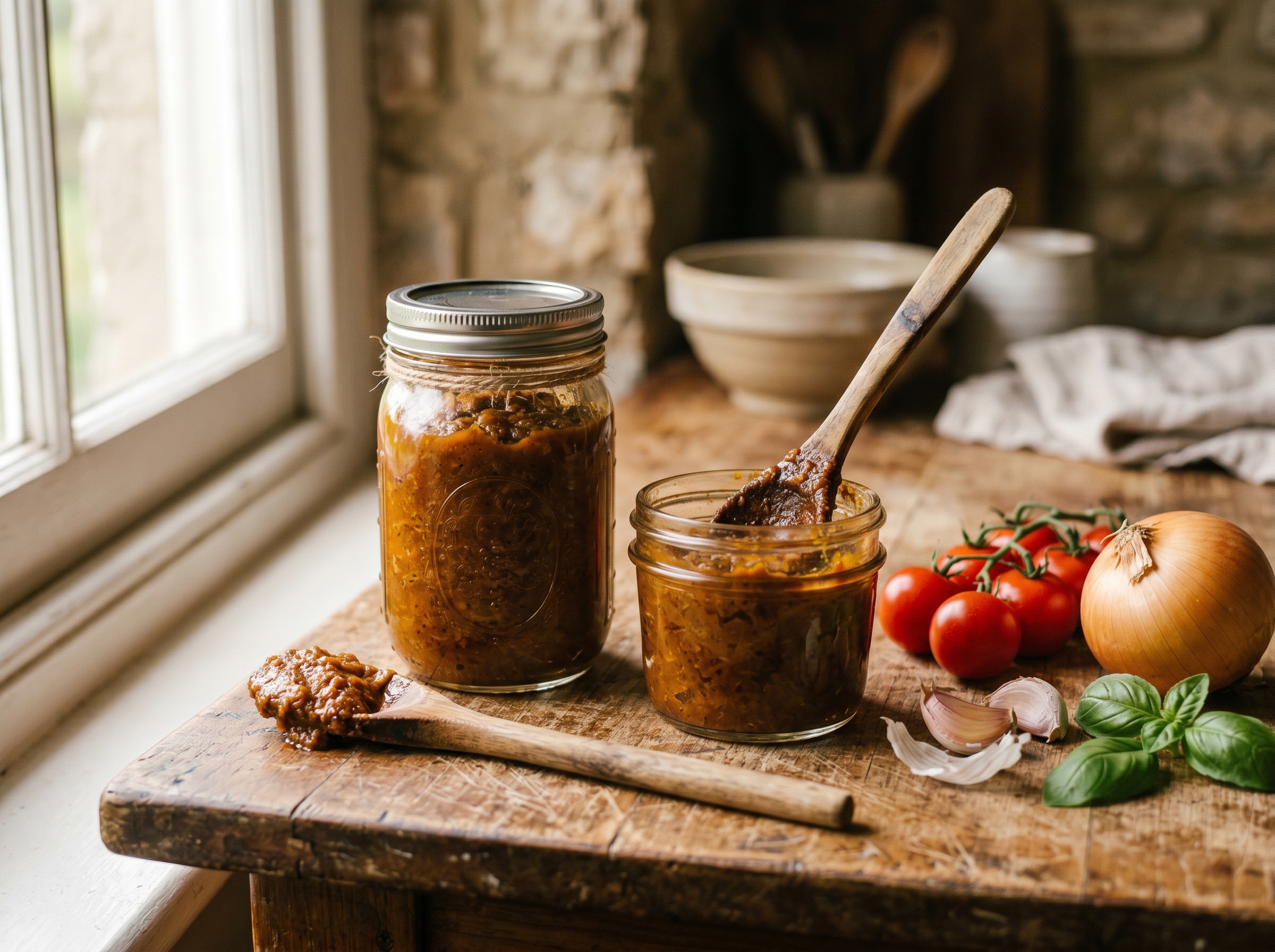
Getting ready…
Sofrito is the start-of-everything paste. The base under paella, the foundation of a Cuban black bean stew, the depth-charge in an arroz al horno, the sweetness in a vegetable stock that needed more body. Forty-five minutes of unattended cooking yields four jars. One jar starts four dinners.
I learned to make it properly in Valencia in 2018 at La Riuà, the arrocería off Plaza de la Reina where Joan — the cook who taught me paella — had a 12-quart pot of sofrito simmering at all times. He would pull a ladle of it into every pan as the socarrat base. He said: “sin sofrito, no hay arroz” — without sofrito, there is no rice.
This is true, and it’s also a slightly broader lesson: sofrito is what makes vegetable cooking taste like something. The slow oil-onion-tomato reduction is the trick that builds depth into a dish without animal stock or roasting bones for hours.
The line I draw
I will not chop the onion big. I have seen sofrito recipes online that call for “1/4-inch dice” or “rough chop.” Both are wrong. The onion must be the size of a pea — small enough to dissolve into the paste over the hour. A larger dice keeps its texture and you end up with a chunky sauce that tastes of sweet onion rather than the smooth marmalade you actually want. Take the thirty minutes. Run a fan if it makes you cry.
When this can fail
- The onion browned. You cooked at medium-high instead of medium-low. The sofrito is faintly bitter and the color is wrong (mottled brown instead of clean deep brick). Fix: there is no fix — the brown bitterness will dominate. Start over and watch the heat. Better to undercook than to brown.
- The reduction stopped at “saucy.” You pulled it off the heat at 20 minutes because it looked done. The sofrito is too watery — it didn’t reduce far enough. Fix: put it back on, uncovered, medium heat, another 10 to 15 minutes. The wooden spoon line should hold 2 seconds.
- The tomato skins ended up in the sofrito. You chopped the tomato instead of grating it. The cooked sofrito has tiny rolled-up skin curls in it that feel like plastic in the mouth. Fix: pass the cooked sofrito through a coarse strainer with the back of a spoon to remove the skin shreds.
Cook fast on a Tuesday because you did this on a Sunday.
You'll need
Ingredients
For 1 servings · 7 items
The sofrito
The method
Method
6 steps · check as you go
What this enables
Questions, honestly answered
FAQ
QHow is sofrito different from a tomato sauce?
Sofrito is the *base* of a dish — the start, not the finish. It's denser, more concentrated, smaller-yielding than a tomato sauce. You don't pour sofrito over pasta; you start a paella, a stew, a soup, a rice dish, an arroz al horno with a few tablespoons of sofrito as the foundation flavor layer. Tomato sauce is a finishing sauce; sofrito is a building block. Both have tomato and onion and garlic and oil; the proportions and the reduction times produce two different things.
QWhat's the difference between Spanish sofrito and Italian soffritto?
Spanish sofrito (this recipe) is tomato + onion + garlic + olive oil + smoked paprika, cooked down to a jammy base. Italian *soffritto* is finely-diced onion + carrot + celery (mirepoix-equivalent) sweated in olive oil — no tomato, no paprika. The Italian version is the base of bolognese and most ragù. They share the name and the technique (slow sweat) but the ingredients are different. If you want the Italian version, omit the tomato and paprika and add 2 diced carrots and 2 diced celery stalks; the method is identical.
QCan I use canned tomatoes instead of fresh?
Yes, with one adjustment. Use 1 × 28-oz can of whole peeled San Marzano DOP, drained and hand-crushed (don't blend). The texture won't be exactly the same as grated fresh tomato — slightly coarser — but the flavor is comparable for stews and braises where the sofrito will be cooked further. For paella and the *socarrat* dishes, fresh-grated is meaningfully better.
QCan I make it in larger batches?
Yes — double the recipe and use a 7-quart pot. The active time is the same. Eight jars instead of four lasts roughly two months of regular cooking. The only constraint is the size of your pot and the surface area for reduction — a 5-quart pot reduces 2x faster than a 7-quart at the same heat because of the larger evaporative surface, so adjust simmer time by 15 minutes.