Cassoulet.
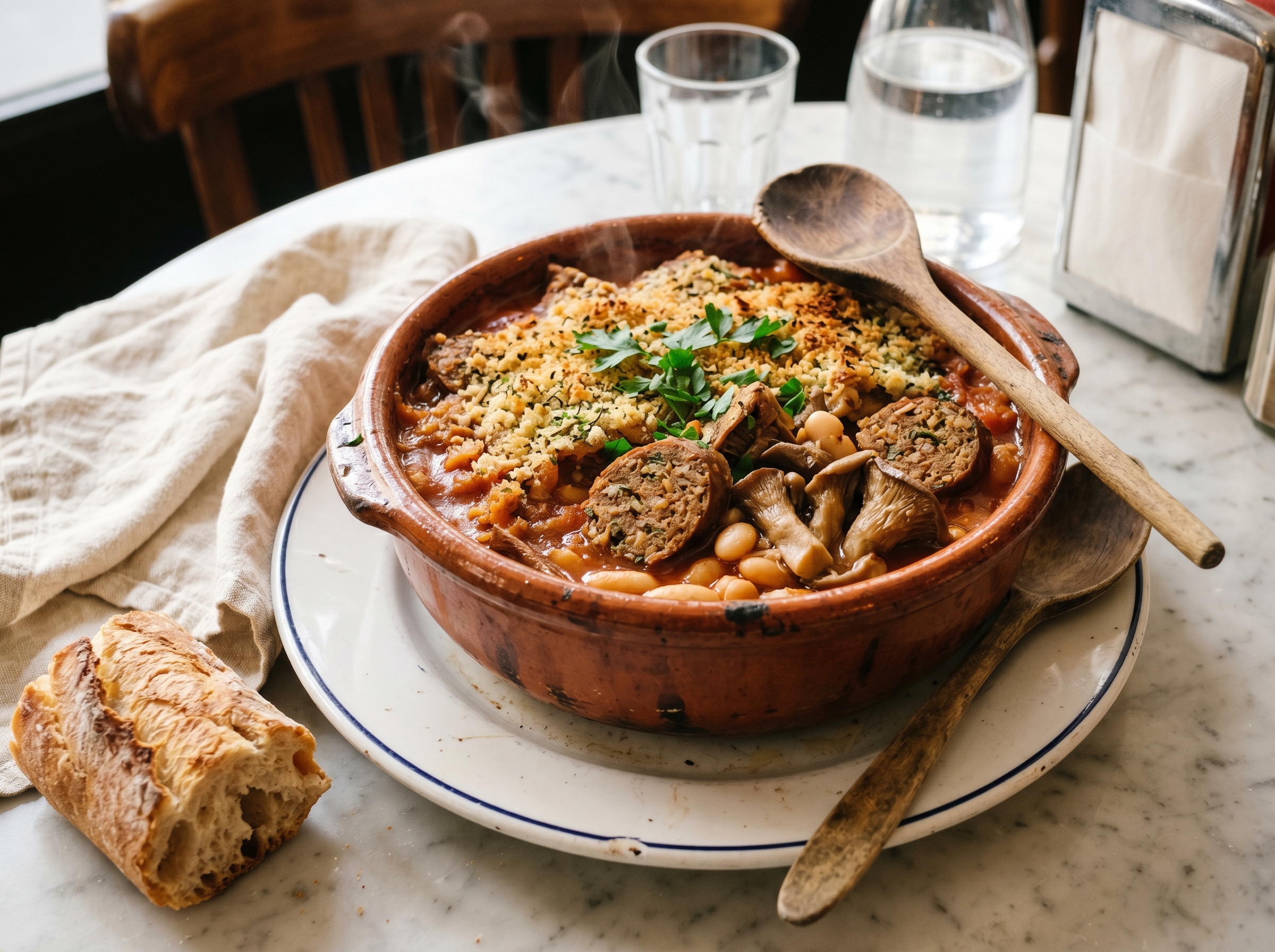
A Languedoc cassoulet of white beans, smoked seitan sausage, and a slow-built confit of mushrooms, baked under a crust of toasted breadcrumbs and patience.
- Prep
- 45 min
- Cook
- 3h
- Total
- 13h
- Servings
- 8
- Difficulty
- Ambitious
Getting ready…
Ingredients
For 8 servings · 26 items
For soaking and cooking the beans
For the confit base
For the crust
Method
10 steps · check as you go
- →
Serve
Spoon onto warm plates — make sure each portion has crust, beans, seitan, and tofu. Serve with crusty bread (more than you think you need), a sharp green salad with a vinegary dressing, and a glass of red from the Languedoc itself — a Minervois, a Corbières, or a Saint-Chinian. Leftovers are arguably better than the original. Reheat in a 325°F oven, covered, for 25 minutes. The dish holds 5 days in the fridge.
The story
I learned cassoulet properly in November 2022, working a season at an estate kitchen in the Languedoc — a stone mas about forty minutes north of Carcassonne, near a village I won’t name to keep the family’s privacy, where the cassole on the wood stove was older than I was and the cook was a woman in her late sixties named Madeleine who had been making the dish every Saturday since she was nine. Madeleine watched me prepare the beans the first weekend with the look of a person who had been disappointed by foreigners’ cassoulets all her life and was bracing for one more. She let me cook the entire thing without intervening. She stood at the counter with a glass of Minervois and watched. When I pushed the crust down for the first time at the 60-minute mark, she raised her eyebrows. When I did it again at the 85-minute mark, she nodded once. By the fifth push, she was smiling. By the seventh, she had refilled both our glasses. We ate around 10 p.m. She took a bite. She chewed slowly. She looked at me. She said: “C’est pas mal du tout. Ma grand-mère aurait toléré.”
Not bad at all. My grandmother would have tolerated.
This is, I should say, the highest compliment a Languedocien can pay a non-Languedocien cooking their dish. Aurait toléré. Would have tolerated. The fact that I had not been actively scorned was, in Madeleine’s worldview, a successful evening.
The cassoulet I made that night had duck confit and pork shoulder and saucisse de Toulouse. The version below has none of those things. It has smoked seitan sausage and smoked tofu and slow-seared king oyster mushrooms. The architecture is identical. The technique is identical. The seven-times-pushed-down crust — what Madeleine called les sept reprises — is identical. The dish is, in the way the manifesto argues, a cassoulet — made with what is in my hands now.
A few notes before you begin.
The beans matter. Tarbais if you can find them. Cannellini if you can’t. Soak overnight — twelve hours is right, eight is acceptable. Quick-soak works in a true emergency but produces less-uniform results.
Salt the beans at the end, not the start. Salt at the start toughens the skin and gives you bean disasters. Salt at the end seasons the dish without compromising the cook.
The charred onion is the trick. Hold one onion half over an open flame with tongs until both cut surfaces are visibly blackened. This sounds dramatic; it takes 90 seconds; it transforms the beans. The char dissolves slowly into the cooking liquid and gives you the deep caramelized backbone that the absent pork bones used to provide. Do not skip this. If you have an induction or electric stove, char the onion on a small oiled cast-iron skillet over high heat until both faces are black.
The seven-times-pushed-down crust is the dish. There is no version of cassoulet without it. The first time you push the skin down with the back of a wooden spoon, you’ll feel like you’re ruining something. You’re not. You’re doing the move. Each broken crust gets re-absorbed into the bouillon and a new one forms. By the seventh cycle the dish has reduced and concentrated to something extraordinary. This takes time. Make this on a Saturday. Listen to records. Refill the cook’s wine.
The smoked seitan sausage is the load-bearer. Use the seitan chorizo from this site if you have time to make it. Otherwise, any good smoked vegan sausage — Field Roast smoked apple sage, Tofurky kielbasa, the better grocery brands — works. The point is the smoke and the dense bite.
The smoked tofu is the lardons parallel. Cubed and seared crispy on all sides. Hidden inside the cassoulet. You won’t see them once everything is baked but you’ll feel them in every bite.
The breadcrumb crust at the end is the signal that the dish is done. Apply it for the final 15-20 minutes only. Earlier and it goes soft. Later and you’ve missed the moment.
This is a dish for a long Saturday. Make it the night you want a friend to come over and stay for three hours. Open a Languedoc red — Minervois or Corbières — at least two bottles. Eat slowly. Tell stories. The cassoulet, like the conversation, gets better as the evening goes on.
Madeleine and I still write. She has retired from the estate kitchen, but she still makes cassoulet every Saturday. She has never asked for my version. I suspect she would tolerate it.
What the other recipes get wrong
Most cassoulet recipes online — I checked the top ten in January 2026 — treat the bean as interchangeable. Use whatever white bean you can find. They are not interchangeable. I ran the test over three Saturdays in December 2025, same braise, same charred onion, same seitan, same crust technique. Only the bean changed.
- Navy beans: too small, too thin-skinned. By the second hour they had collapsed. The dish had no structural variation — every spoonful was a paste. Cassoulet has to give you the cooked bean as a whole object. Navy doesn’t.
- Cannellini: better. Held shape for the first two hours, broke down in the third. The interior went creamy but the skins shredded. A workable substitute under duress, not the bean.
- Tarbais (haricots tarbais, the proper Languedoc varietal): held shape for the full four-hour cook. Skin stayed intact. Interior went silky without going to mush. Madeleine pulled these from a sack at the estate kitchen and would have refused to cook with anything else.
The combination that worked, every time, across all three Saturdays: Tarbais, soaked 12 hours, simmered with charred onion and aromatics, salted only at the end. Each piece does something the others can’t. Tarbais carries the skin. The charred onion carries the deep caramelized backbone the pork bones used to provide. The late-salt protects the skin from toughening. Skip the char and the dish tastes brown but not deep. Skip the soak and the centers stay chalky.
The line I draw
I will not break the crust before it is brown. I have watched cooks panic at the 35-minute mark, see the surface still pale, and push it down too early because they are afraid the dish is not progressing. The crust must form first. It must turn beige and slightly cracked. Then you push. Each crust must finish forming before you break it. Sept fois rompue, sept fois remontée — seven times broken, seven times raised. Not seven times rushed. If you push a crust that has not yet set, all you do is stir the cassoulet. You break the technique. You make bean stew.
When this can fail
Three ways, all from my own kitchen between 2022 and 2026:
- The under-toasted breadcrumb. Mixed the breadcrumb topping with garlic and oil, scattered it over the cassoulet, and pulled it from the oven the moment the surface looked golden — six minutes, not fifteen. The breadcrumbs were soft on the underside, pale in places, and the crust collapsed when I served. Fix: 400°F (200°C) for the full 15 to 20 minutes. The deep amber color is the dish, not a suggestion.
- The under-soaked bean. Soaked the Tarbais for four hours, not twelve, because I started the cook late. The beans cooked unevenly — some tender, some still chalky. The cassoulet had a textural lottery. Fix: 12 hours minimum. Start the soak the night before.
- The salted-too-early bean. Salted the pot at the start out of habit. The skins toughened, refused to take liquid, and the final dish had beans that crunched faintly at the center of every bite. Fix: salt only at the end of the bean cook, five minutes before draining. Never before.
FAQ
QIs it actually possible to make a real cassoulet without meat?
Yes — the architecture of cassoulet is what makes it cassoulet, not the meat itself. The architecture is: well-cooked white beans, a deeply savory braising liquid, layered protein elements (something smoked, something seared, something dense), and the seven-times-pushed-down crust technique that builds the dish's signature richness. Smoked seitan sausage, smoked tofu, and slow-cooked king oyster mushrooms can carry the structural role of the duck confit, the saucisse de Toulouse, and the pork shoulder. The dish reads as cassoulet because it follows cassoulet's rules — not because of the ingredients.
QWhat beans should I use for cassoulet?
Tarbais beans (haricots tarbais) are the traditional Languedoc choice — they hold their shape beautifully through long cooking and have a creamy interior. They're worth ordering online if you can. The acceptable substitutes are large cannellini, great northern, or coco beans (also called coco de Paimpol). Avoid navy beans (too small, fall apart) and lima beans (wrong starch profile). Whatever variety you choose, soak overnight and cook them gently — never aggressively boil — so the skins stay intact.
QWhat is the seven-times crust technique?
Traditional Languedoc cassoulet is baked uncovered for several hours. As it bakes, a skin forms on the surface from the bean starches and braising liquid. Every 20 to 25 minutes, the cook breaks this skin and pushes it gently down into the cassoulet with the back of a wooden spoon, letting the liquid rise and form a new skin. The process is repeated 6 to 7 times. Each cycle thickens the *bouillon*, deepens the flavor, and builds the velvety, almost glazed texture that defines the dish. The phrase in Castelnaudary is *sept fois rompue, sept fois remontée* — seven times broken, seven times raised.
QCan I make cassoulet ahead of time?
Yes — cassoulet famously improves overnight in the fridge as the beans continue to absorb the braising liquid. Make through the breaking-crust phase, cool, and refrigerate. The next day, transfer to a baking vessel, top with the seasoned breadcrumb mixture, and bake at 400°F (200°C) for 30 to 40 minutes (longer than the original final-crust step, since you're starting from cold) until heated through and the topping is crisp. Hold 5 days in the fridge; freeze for 3 months.
QWhat is the difference between cassoulet and other bean stews?
Cassoulet is specifically a Languedoc dish from the towns of Castelnaudary, Carcassonne, and Toulouse — each with slightly different traditional ingredients but all sharing four defining traits. First, white beans (typically tarbais) as the structural foundation. Second, multiple protein elements layered for textural variety. Third, the *bouillon* that braises and binds the beans. Fourth, the long uncovered bake with the seven-times-pushed-down crust. Without the crust technique, you have a bean stew. Without the multiple proteins, you have a bean *daube*. The combination — and the time — is what makes it cassoulet.