Aubergine dream machine.
Moussaka.
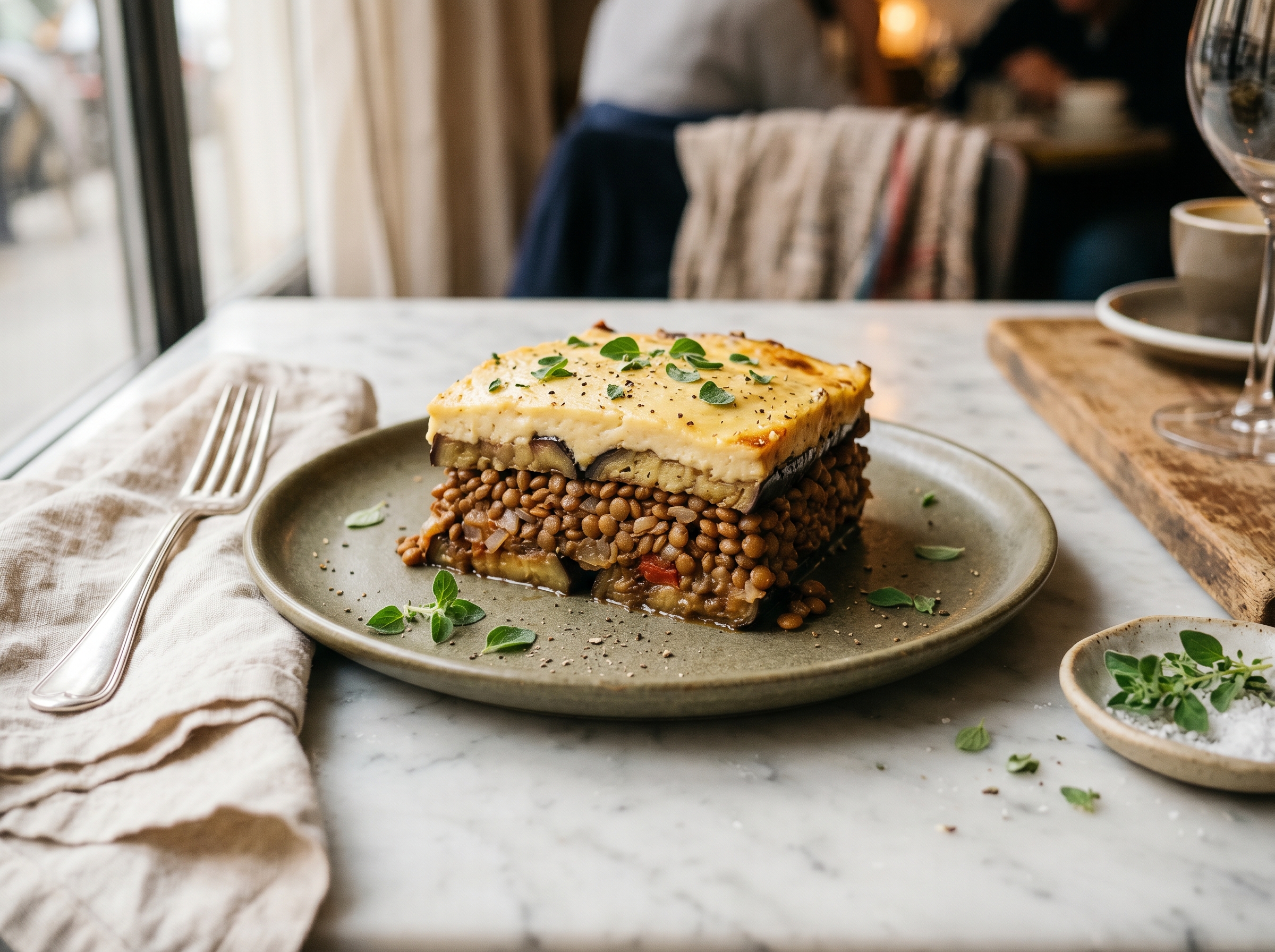
A Greek moussaka of eggplant, lentils, and cinnamon, with a béchamel that knows it doesn't need cheese. Built the way Athens built it.
- Prep
- 45 min
- Cook
- 1h 30min
- Total
- 2h 15min
- Servings
- 6
- Difficulty
- Ambitious
Getting ready…
Ingredients
For 6 servings · 25 items
For the eggplant
For the lentil filling
For the béchamel
To serve
Method
8 steps · check as you go
- →
Serve
Cut into squares. Scatter parsley over each portion. Serve with a sharp green salad and a glass of the same red wine you used in the filling. Greek tradition leans on a crusty bread and a small bowl of olives on the side — both welcome.
The story
I learned moussaka in April 2017, in a taverna in Plaka, the old quarter under the Acropolis, where I spent six months cooking next to a woman named Eleni. The taverna had eight tables, a charcoal grill in the back, and a ceramic baking dish older than I was. Eleni made the moussaka every Saturday for the Sunday lunch service. She started at 9 a.m. with the eggplants and finished at 6 p.m. with the rest. The kitchen smelled of cinnamon and burnt béchamel by 4 p.m. — a smell I now associate with weekends the way other people associate weekends with coffee.
The first plate I ate, on a Sunday in May 2017, arrived in a hot ceramic dish with the corners still hissing. Eleni set it down at the staff table and stood beside the chair to make sure I cut into it the right way. I held the fork the wrong way. She corrected me. She waited until I lifted the first bite. She nodded once when I closed my eyes. Then she went back to the grill.
That moussaka had cinnamon in the lentils, allspice in the tomato, and a béchamel top the color of a wheat field at dusk. I have been chasing that dish in my own kitchen for nine years. The version below is the closest I have gotten. The lentils replace the lamb without apologizing — they hold the same spice profile, they give the same dense, layered structure, they take the same béchamel without flinching. The dish is a moussaka. Eleni would still correct my fork. She would not correct the recipe.
What the other recipes get wrong
Most lentil-moussaka recipes online — I checked the top ten in March 2026 — call for “lentils” without specifying which kind. I tested three varieties side by side in March 2026, three identical dishes built on the same Saturday, sharing the same eggplant and the same béchamel. The only variable was the lentil:
- Red lentils: collapsed into a purée within fifteen minutes of simmering. The filling read as dal under béchamel — not a moussaka.
- Brown lentils (standard supermarket): held shape through twenty minutes of simmer, gave the layered structure a real bite, took the cinnamon and allspice without muddying.
- French Le Puy lentils (green, from Auvergne): held shape even more firmly, kept a slight peppery note that fought the warm spice. Beautiful in a salad. Wrong in a moussaka.
The variety that worked, every time, across all three batches: brown lentils, simmered 18 to 22 minutes, drained before they go into the tomato. The Le Puy were technically more elegant but the moussaka wants a lentil that bends slightly to the spice — not one with its own agenda. The brown ones bend. Eleni used the cheapest lentil on the shelf at the Plaka grocery. She was right.
The line I draw
I will not use shredded eggplant skin or skin-on shredded eggplant in a moussaka. The architecture of the dish is layered planks — half-inch slices, salted, roasted, overlapping in the pan. The moment you shred or cube the eggplant, the layers collapse, the béchamel sinks instead of capping, and you have a casserole. Casserole is a fine word and a worse dish. Moussaka is a structural dish. The slices are the structure. Cut them clean, salt them honest, roast them dark.
When this can fail
Three ways, all from my own kitchen between 2022 and 2026:
- The wet eggplant. Rinsed the salt off but skipped the towel-dry on a hot July night. The slices steamed in the oven, never browned, went limp under the béchamel. The whole bake collapsed into a beige stew when I tried to lift a square. Fix: pat each slice on both sides with a clean kitchen towel until the surface is matte, not shiny.
- The split béchamel. Poured oat milk straight from the carton into the hot roux without warming it. The sauce broke into curds in ninety seconds. Fix: warm the milk to a gentle simmer in a separate pan first, or use full-fat soy milk which holds against heat shock. Add in three additions, whisking through each.
- The under-rested bake. Cut into it five minutes out of the oven for a photo. The squares slid into a hot, beautiful, irrecoverable mess. Fix: twenty minutes of rest, minimum. The béchamel sets as it cools. The layers consolidate. The corners stop bubbling. Then you cut.
A few notes before you start.
The eggplant must be salted. This is not optional. Forty-five minutes minimum, sixty better. The eggplant on the other side of that wait is silky, sweet, and willing to layer; un-salted eggplant is wet, squeaky, and tastes like nothing. The trade you make is forty-five minutes of patience for an actual moussaka instead of a pile.
The béchamel needs a real roux. Cook the flour into the butter for 90 seconds before any liquid goes in. The roux is what gives the sauce its body and its faint nutty character. The milk goes in slowly, in three additions, with whisking between each — this is how you avoid lumps. Soy milk holds its structure under heat better than oat or almond, both of which can split when they meet the hot roux.
The spice is the signature. Cinnamon, oregano, allspice. Three-quarters of a teaspoon of cinnamon in the lentils is the line between bolognese and moussaka. Don’t reduce it. The cinnamon doesn’t read as sweet — it reads as warm. Without it, you have a perfectly fine lentil bake. With it, you have a Greek dish.
The rest at the end is the third non-negotiable. Twenty minutes, minimum. The béchamel sets as it cools; the layers consolidate; the corners stop bubbling. A piece lifted from the dish after the rest holds its shape on the spatula. A piece lifted before the rest tastes the same but looks like an accident.
This is a dish to make on a Sunday afternoon, eat on Sunday night, and finish the leftovers on Monday — when, if the kitchen gods are kind, it tastes even better than the night before.
FAQ
QIs moussaka traditionally vegetarian or vegan?
Traditional Greek moussaka uses ground lamb or beef and a béchamel made with eggs and cheese. The lentil-and-béchamel version is a modern adaptation that retains the spice profile (cinnamon, allspice, oregano) and the layered architecture (salted eggplant, spiced filling, béchamel topping) — but uses lentils for the filling and a dairy-free béchamel for the top. The structure and seasoning are what make a moussaka recognizable as moussaka; the protein source is incidental.
QWhat is the best plant-based substitute for the béchamel in moussaka?
A roux-based béchamel made with vegan butter, all-purpose flour, and unsweetened soy milk is the closest to traditional in both texture and browning behavior. Soy milk holds its structure under high heat better than oat or almond, which can split. Adding nutritional yeast and dijon mustard supplies the umami and slight sharpness that aged cheese normally contributes.
QWhy do you salt the eggplant before roasting?
Salting draws out excess water and slightly bitter compounds from the eggplant. The result is a roasted slice with tender, silky texture instead of the squeaky, watery interior that raw eggplant produces. 45 minutes is the minimum; an hour is better if you have it. Rinse thoroughly afterward and pat very dry — surface water prevents browning in the oven.
QCan you make moussaka ahead of time?
Yes — moussaka actually improves overnight. Assemble the layers fully, cover, and refrigerate for up to 24 hours before the final bake. Add 10 minutes to the baking time if going from cold. Fully baked moussaka also reheats well: cover with foil and warm at 350°F (175°C) for 25 minutes. The flavors deepen and the layers consolidate further on day two.
QWhat kind of lentils should I use for vegan moussaka?
Brown or green lentils. Both hold their shape during the long simmer and provide the meaty bite that traditional moussaka relies on. Red lentils break down into a purée — useful in dal, wrong here. French Le Puy lentils are excellent but expensive; standard brown lentils from the supermarket are entirely sufficient.