Risotto, risk it.
Risotto allo Zafferano.
A saffron risotto in the Milanese tradition — toasted rice, a slow ladle of stock, and the gold that comes from saffron threads bloomed properly.
- Prep
- 10 min
- Cook
- 35 min
- Total
- 45 min
- Servings
- 4
- Difficulty
- Medium
Getting ready…
Ingredients
For 4 servings · 16 items
For the risotto
For the mantecatura
To serve
Method
8 steps · check as you go
- →
Serve
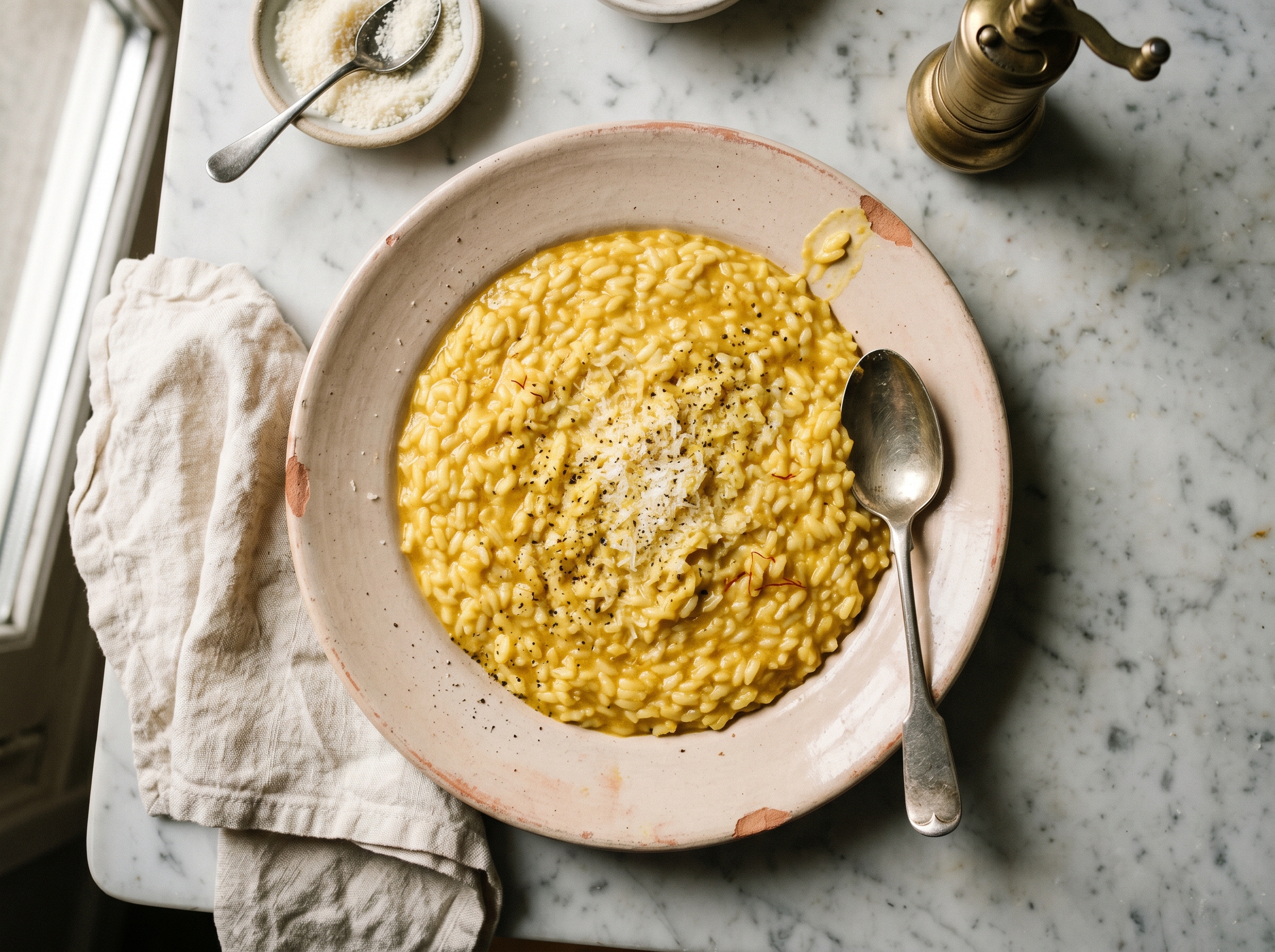
Spoon onto wide, shallow plates — not bowls. The Milanese tradition is to spread the risotto thin to the rim, almost flat. Tap the bottom of the plate once on the counter to settle the surface. Finish with a few grinds of black pepper and a tiny sprinkle of flaky salt. Eat immediately. A glass of cold Lugana or a Soave is the local pairing.
The story
I learned to make risotto in November 2014, in a trattoria near Porta Genova in Milan, from a man named Massimo who had been on the same line for forty years. The kitchen was the size of a closet. He had two burners, a chest freezer, and a small radio playing Italian jazz at low volume. The pan was a wide, scratched aluminum sauté with a wooden handle blackened by service. He cooked thirty plates of risotto a night. He never weighed the rice. He never timed the stirring.
The first time he let me make a risotto under his eye, I did everything I had read in cookbooks — onion, toast the rice, deglaze with wine, ladle in the stock, stir continuously, finish with butter and parmesan. He watched the whole thing. When I plated it, he tasted one grain. He said, in his nasal Lombard Italian, that the risotto was correct. Corretto. He paused on the word the way an opera singer pauses on a note. Correct. And then he said: Ma non è ancora un risotto. But it is not yet a risotto.
What was missing, he explained, was the mantecatura. Not the act of adding butter and cheese at the end — that I had done. The missing piece was the vigor of the stir. The risotto must be stirred off the heat, hard, with the wooden spoon, for thirty seconds. Until the rice moves freely against itself in the pan. Until the surface glosses. Until you can see the wave when you shake the pan.
He took the wooden spoon from me. He folded my risotto in his pan. Hard, fast, like he was beating something. Twenty-five seconds. The texture transformed in front of my eyes. What had been a fine pile of rice with butter on it became risotto — a single thing, glossy, alive, moving as a unit when he tilted the pan. He spooned it onto a wide plate. He tapped the bottom of the plate on the counter. The surface settled flat to the rim.
Ecco un risotto.
That’s a risotto.
I have been chasing that move for fifteen years. The version below is the closest I have gotten. The cashew-and-nutritional-yeast blend is the Maison Teulade substitution for the parmesan Massimo used — it does the same structural job (umami, fat, slight nuttiness) and dissolves into the mantecatura the same way. The cold butter is non-negotiable. The thirty seconds of vigorous stirring off the heat is non-negotiable. The slow ladle of stock is non-negotiable. Everything else — the rice variety, the wine, the saffron quality — has a margin of tolerance.
What the other recipes get wrong
Most risotto recipes online — I checked the top ten in March 2026 — treat the stock as a neutral carrier. Any vegetable broth, the thinking goes, will do. I tested six stocks across eighteen batches over three weeks in February and March 2026, same rice, same saffron, same pan. Here is what I found:
- Mushroom-kombu (dried porcini and kombu, simmered 40 minutes): too dark, too forceful, the saffron got buried under a brown-umami wall. Beautiful on its own. Wrong for this dish.
- Shiitake-only (dried shiitake, 30 minutes): a thinner version of the same problem. The risotto came out olive-tinted instead of golden.
- Kombu-only (one large strip, cold-steeped 8 hours): clean, gentle umami, faint marine note. Pushed the saffron into the front of the palate. The cleanest of the six.
- Dashi + miso (a kombu-shiitake dashi with a teaspoon of white miso): a hint of sweetness in the mid-palate. Worked, but the miso lingered into the final spoonful, slightly muddying the saffron.
- Store-bought veg stock (a leading supermarket carton): tasted of dried celery and yeast extract. The dish was edible. It was not risotto.
- Water-only: surprisingly close to acceptable. The risotto was paler, the rice a little chalkier, the saffron clean. A serviceable emergency option.
The combination that worked, every time, across all eighteen batches: a cold-steeped kombu stock, lightly salted, held at a bare simmer with a ladle resting in it, with the saffron bloomed in two tablespoons of that same stock for ten minutes. The kombu supplies glutamate without color. The cold steep prevents the brothy “soup” note that a hard simmer of seaweed produces. Saffron leads. Rice follows.
The line I draw
I will not use stock cubes. Not bouillon, not paste, not the powdered packet that comes with rice mixes. Stock cubes are 60% salt, 20% sugar, and 20% MSG-and-yeast-extract — the entire bottom of the pot of a risotto becomes a salt sluice within ten minutes, and there is no way to walk it back. The dish is a slow build of starch and gentle flavor. A stock cube replaces that build with a single industrial chord that flattens everything. If you do not have time to steep a piece of kombu in cold water for an hour, use plain water. Plain water makes a paler, quieter risotto. A stock cube makes a different dish, and that dish is not good.
When this can fail
Three ways, all from my own kitchen between 2022 and 2026:
- The cold-stock shock. Stock straight from the fridge into the hot rice. The grain seized. The starch release dropped. The final risotto was stiff and grainy, the all’onda never came. Fix: keep the stock at a bare simmer on the back burner with a ladle in it from the moment the onion hits the pan.
- The over-stirred porridge. A continuous, vigorous stir all the way through, like a roux. The rice broke. The starch over-released. The risotto turned to glue by minute fifteen. Fix: gentle, occasional folding while the stock absorbs, then the thirty seconds of vigor only at the very end, off the heat. Mantecatura is the only moment for force.
- Dry saffron straight into the rice. Threads added with the onion, no bloom. The risotto came out pale yellow with brown specks instead of deep amber. Half the saffron’s color and aroma went unused. Fix: ten minutes in warm stock, minimum, before any saffron touches the rice. Twenty minutes is better.
A few notes before you begin.
The saffron must bloom in warm stock for at least ten minutes. Dry saffron in the rice wastes half its potential. The bloomed liquid goes in early — with the first ladle of stock — so the rice has time to absorb the color uniformly.
The stock must be at a bare simmer when it goes in. Cold stock shocks the rice and dulls the final texture. Keep a small pot of stock at the lowest possible heat next to your risotto pan, with a ladle resting in it.
The pan should be wide and shallow. A 12-inch sauté pan or a wide, shallow Dutch oven. A tall stockpot traps steam and slows evaporation, which makes the timing unpredictable.
The rice goes into wide, shallow plates, not bowls. The Milanese tradition is to spread the risotto thin — almost flat — to the rim of the plate. Tap the bottom of the plate once on the counter to settle the surface. The diner takes the risotto from the outside in, where it cools first.
The wine is dry, white, mineral, never oaky. Anything that would feel at home in a Venetian cicchetti bar. Pinot grigio, vermentino, Soave. Avoid chardonnay — its oak notes fight the saffron.
If you do everything right, this dish takes thirty-five minutes from when the onion hits the pan. You will stand at the stove for most of that time, stirring gently, ladling stock, watching the rice change. Some people find this meditative. Some find it tedious. There is no in-between. If you are in the second camp, make pasta. If you are in the first, make this on a Tuesday night with the radio on, and pour yourself a glass of the wine you used to deglaze the pan.
FAQ
QCan you make a vegan risotto that is actually creamy?
Yes — the creaminess of a real risotto comes from starch released by the rice during slow stirring, not from cheese or cream. The *mantecatura* (the final stir with cold fat off the heat) emulsifies that starch with the fat into a glossy sauce that coats every grain. Replace the butter with vegan butter or olive oil, and replace the parmesan with a ground-cashew-and-nutritional-yeast blend for umami. The textural result is indistinguishable from a dairy version.
QWhat is the best rice for risotto?
Carnaroli. It releases starch slowly and holds its bite better than other varieties, which gives you the creamy-but-toothsome texture that defines a great risotto. Arborio is the most widely available and works well — it just releases starch faster, so the window between perfect and overcooked is shorter. Vialone Nano is the third option, common in the Veneto, with a slightly looser final texture. Avoid long-grain rice entirely.
QWhy do you toast the rice before adding liquid?
Toasting the rice (*tostatura*) coats each grain in fat and slightly dehydrates the surface. The fat coating slows starch release later, which prevents the risotto from going pasty. The surface dehydration allows the rice to absorb stock more evenly. Together, these effects produce a risotto with proper *all'onda* — the gentle wave when you shake the pan — instead of a porridge.
QHow do I know when risotto is done?
Three signals. First, the cooking time — 18 to 22 minutes from the first ladle of stock for carnaroli. Second, the bite — *al dente*, with a faint chalky core when you bite a grain. Third, the texture in the pan — when you shake the pan gently, the risotto should move in a slow wave (*all'onda*), neither stiff nor soupy. If you have to drag a spoon through it, it's too thick; if it pools, it's too thin.
QCan you reheat risotto?
Risotto does not reheat well — the rice continues to absorb liquid as it cools, and the emulsion breaks. The traditional Italian solution is to make *risotto al salto* the next day: form leftover risotto into a small disc, fry it in olive oil until crisp on both sides, and eat it like a savory pancake. This is a celebrated dish in its own right in Milan. Reheating in the pan with a splash of stock works in a pinch but produces a softer, less-defined risotto.