Paella.
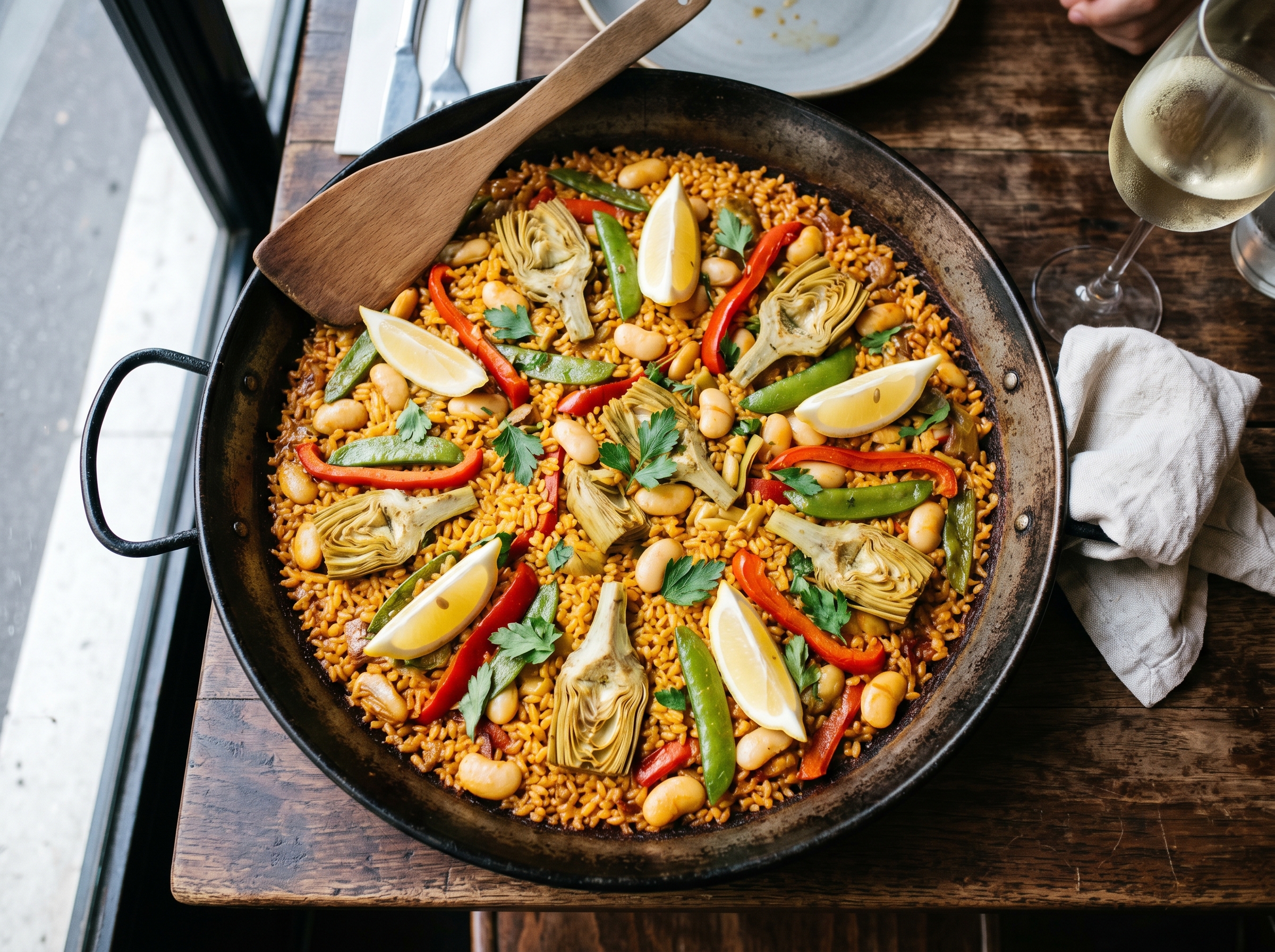
A Valencian paella built on what matters — short-grain rice, real saffron, the socarrat at the bottom — with artichokes and white beans instead of seafood.
- Prep
- 25 min
- Cook
- 40 min
- Total
- 1h 5min
- Servings
- 6
- Difficulty
- Ambitious
Getting ready…
Ingredients
For 6 servings · 17 items
For the sofrito
For the paella
To serve
Method
7 steps · check as you go
- →
Serve
Bring the pan to the table. Set it on a trivet. Scatter lemon wedges around the edge. Each diner takes a section from the rim toward the center using a wooden spoon — and crucially, scrapes the bottom with the edge of the spoon to lift a piece of the *socarrat* onto their plate. The *socarrat* is the prize. The lemon is squeezed over the rice the moment before the first bite. A glass of cold *fino* sherry or a young Albariño is the local pairing.
The story
The first thing you have to know about paella is that it was never meant to have seafood in it.
The dish is Valencian. It comes from the rice fields and orchards inland from the city of Valencia, not the coast. The original ingredients — paella valenciana — are chicken, rabbit, green beans, garrofón (a large white bean), tomato, paprika, saffron, and rice. The seafood paella you see in tourist menus on the Costa Brava is a coastal adaptation that took over the international image of the dish sometime in the 1960s. The Valencians, who are not subtle about this, have a phrase for it: eso no es paella. That is not paella.
What I am about to show you is closer to the original than to the seafood version. We drop the chicken and the rabbit. We keep everything else. The white beans, the green beans, the artichokes (which appear in some traditional versions), the tomato, the saffron, the pimentón, the rice. The structural principles — slow sofrito, no stirring, the socarrat at the end — are the principles that define any real paella. The protein is not the principle.
I learned to make this version in the summer of 2018, in a Valencian arrocería called La Riuà in the old quarter near the Plaza de la Reina, where I spent three months cooking arroces on the line. The owner — a man named Joan — refused to make a seafood paella for tourists and refused to put a paella on his lunch menu before noon because, in his view, you need to be hungry for two hours before you sit down to one. He cooked it on a real paellera over wood — a fire of orange-tree prunings, which gives the dish a perfume that no gas burner can replicate. The kitchen smelled of citrus smoke and toasted rice every afternoon from July to September. I have not been able to recreate the fire at home. The rest of it, I can.
What the other recipes get wrong
Most paella recipes online — I checked the top ten in March 2026 — say you can use “any short-grain rice” or, worse, “Arborio is an acceptable substitute.” I tested three rice varieties side by side in April 2026, three identical pans built within an hour, same sofrito, same saffron, same stock. The only variable was the rice:
- Arborio: released too much starch, the grains went creamy in the first five minutes, the socarrat tried to form but the texture was wrong — risotto with a crust, not paella.
- Calasparra (Spanish short-grain from Murcia): absorbed three times its volume, kept distinct grains, gave a clean socarrat. Slightly less forgiving on liquid ratio than bomba — you must measure.
- Bomba (Spanish short-grain from Valencia and the Ebro Delta): absorbed three times its volume too, but with a wider margin of error, the grains stayed separate even when I deliberately added an extra quarter cup of stock. The socarrat set deep amber and held.
The variety that worked, every time, across all three pans: bomba. Calasparra is a close second and a perfectly honorable choice. Arborio is a different dish — call it something else. Joan kept a single sack of bomba from a farmer near Sueca in the corner of the kitchen and would not let me touch any other rice for the first month I worked there.
The line I draw
I will not stir the rice once it is in the pan. Not to “check it,” not to “redistribute,” not because the heat looks uneven on one side. The no-stir rule is the dividing line between paella and rice pilaf. Stirring releases starch. Starch makes the rice creamy. Creamy is risotto. Paella has separate grains and a caramelized bottom. The moment a wooden spoon enters the pan after the stock goes in, you are making something else. If the heat is uneven, rotate the whole pan a quarter-turn — never the rice.
When this can fail
Three ways, all from my own kitchen between 2022 and 2026:
- The rushed sofrito. Pulled the tomato base off the heat at twelve minutes because dinner guests were already at the table. The paella tasted thin and slightly raw — the tomato never gave up its water, the paprika sat on top of the dish instead of underneath. Fix: start the sofrito before the guests arrive. Twenty minutes is the floor. The signal is oil pooling around the edges of the mass — no oil, no done.
- The cold stock. Poured room-temperature stock into the hot pan to save the trouble of a second pot. The pan temperature crashed, the rice stopped cooking for three minutes, the timing of the socarrat was off by the same three minutes — and I burned the bottom trying to catch up. Fix: hold the stock at a bare simmer in a separate pot, ladle it in hot.
- The missed socarrat. Walked away during the final two minutes to plate the lemon wedges. Came back to a pan that was past the caramel and into bitter char. Fix: stand at the pan for the last three minutes. Listen. The sizzle deepens, then sharpens — pull the pan the moment the sound shifts. Burnt rice tastes of nothing but regret.
A few notes before you begin.
You need a wide pan. A 14-inch paella pan is ideal. A 12 to 14-inch shallow skillet is the acceptable substitute. Anything taller than 2 inches steams the rice instead of letting it crisp. If you do not have either, this is the dish to invest in a proper paellera for — they cost about $40 online and last forever.
The sofrito is twenty minutes of patience. Most paella failures happen in the sofrito. The signal of doneness is the oil separating from the tomato mass — you’ll see clear oil pooling around the edges. That separation tells you the water has cooked off and the sugars are caramelizing into the fat. Pull the sofrito too early and the paella tastes thin.
The no-stir rule starts the moment liquid hits the pan. From minute one of the simmer, you do not touch the rice with a spoon. The wide pan does the work — every grain is in contact with the liquid. Stirring releases starch, which is what you want in risotto but not in paella.
The socarrat is the prize and the trap. Two minutes of high heat at the end is the right move. Three is the upper limit. Four and you have burned the bottom. The signal is sound — a steady sizzle, like distant popcorn, deepens to a more emphatic crackling. Pull the pan the moment it deepens. If you cannot hear it over your range hood, turn the fan off.
The lemon at the end is not a garnish. The squeeze of lemon over the rice at the moment of eating cuts the richness and lifts the saffron. Skip the lemon and you are eating half the dish.
This is a Sunday dish. Or a long-table dinner-for-six dish. It is not a Tuesday-night dish. The reward for the effort is a pan you bring to the table and watch six friends fight politely over the socarrat, which is exactly the right number of friends, and the right amount of fighting.
FAQ
QWhat is the best plant-based paella recipe?
A Valencian-style vegetable paella built on three principles: a slow-cooked *sofrito* (tomato, onion, pepper, garlic, *pimentón*), real saffron bloomed in warm stock, and Spanish short-grain rice (bomba or calasparra) cooked unstirred in a wide shallow pan until a *socarrat* forms at the bottom. The vegetables — artichokes, white beans, green beans — are the original Valencian *paella valenciana* additions, long before the seafood version became internationally famous.
QWhat kind of rice should you use for paella?
Spanish short-grain rice — specifically bomba or calasparra. These varieties absorb 3 times their volume in liquid without breaking down, which is essential for paella's distinct-grain texture. Arborio (risotto rice) releases too much starch and gives you a creamy result, which is wrong for paella. Long-grain rice doesn't absorb enough flavor and ends up dry. Bomba is widely available online and in Spanish markets; it is worth the extra cost.
QWhat is the socarrat in paella?
The *socarrat* is the dark caramelized layer of rice that forms at the bottom of the paella pan in the final 2 to 3 minutes of cooking, when all the liquid has been absorbed and the rice in direct contact with the pan begins to toast. It is considered the most prized part of the dish in Valencia. A real paella is judged in part by whether the cook achieved a proper *socarrat* — a steady sizzle at the end of cooking, but no burn.
QWhy should you not stir paella?
Stirring rice during cooking releases starch from the grains, which produces the creamy texture of risotto. Paella is supposed to have distinct, separate grains — not creaminess. The wide, shallow paella pan exposes the entire rice surface to the cooking liquid, which is how the rice cooks evenly without needing to be stirred. Stir paella and you get a sticky rice pilaf; leave it alone and you get paella.
QCan you make paella without a paella pan?
Yes — a wide, shallow skillet works. The critical dimension is *width* relative to *depth*. A 12 to 14-inch skillet about 2 inches deep gives you the same surface-to-volume ratio as a traditional paella pan. The result will be slightly less of a *socarrat* (because the heat distribution isn't quite as even), but the dish itself will be authentic. Avoid Dutch ovens, deep braisers, and any pan over 3 inches deep — they steam the rice instead of letting it crisp.