The spinning top, reimagined.
Tacos al Pastor.
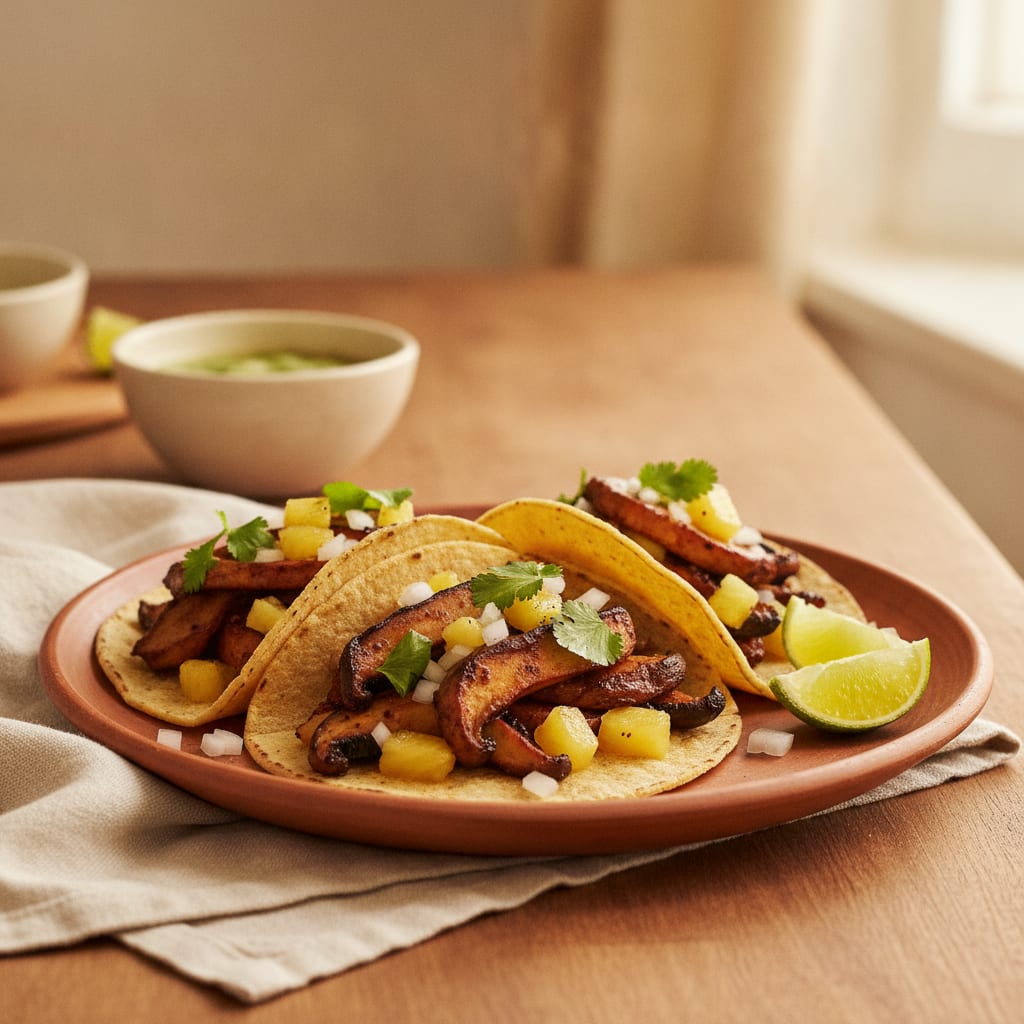
King oyster al pastor: chiles guajillo and achiote adobo, charred trompo-style edges, pineapple, warm corn tortillas, onion, cilantro, lime.
- Prep
- 30 min
- Cook
- 30 min
- Total
- 1h 30min
- Servings
- 4
- Difficulty
- Medium
Getting ready…
Ingredients
For 4 servings · 20 items
For the adobo
For the al pastor
To serve
Method
7 steps · check as you go
- →
Serve
Serve on doubled small corn tortillas, taquero-style, with white onion, cilantro, lime, and salsa verde at the table. A little extra charred pineapple in a bowl alongside is right. Cold Mexican lager or a tamarind agua fresca. Eat standing up if you can.
The story
I learned to respect al pastor at a taquería on a corner of Mount Pleasant, in Washington D.C., in the spring of 2025 — one of those storefronts where the trompo turns in the window all afternoon and the line out the door is half-Salvadoran, half-Mexican, all hungry. The taquero, whose name I never got because the place ran on a kind of urgent silence, carved the charred outer edge of the cone with one hand and caught it on a doubled tortilla with the other, flicked a knife at the pineapple riding the top of the spit, and had the taco built — onion, cilantro, lime — before I’d finished saying al pastor, por favor. The first bite was sweet, sour, smoky, and sharp all at once. I went back four times that week.
What struck me, reading later, was how migrant this taco is all the way down. The spit-roast came to Puebla with Lebanese immigrants in the early twentieth century — their shawarma became tacos árabes on flatbread, and Mexican cooks turned the lamb to pork, the seasoning to a chile-and-achiote adobo, the bread to a corn tortilla, and the spit into the trompo, the spinning top. By the 1950s and 60s it had crossed to Mexico City and become an icon. A dish that is itself a layering of arrivals.
This al pastor has no pork in it. It has a guajillo-and-achiote adobo, king oyster mushrooms scored and seared to a charred trompo edge, charred pineapple, and warm corn tortillas with onion, cilantro, and lime. The adobo is unchanged. The char is unchanged. The way it is chopped and built and eaten at once is unchanged. It is not a “version” of al pastor. It is al pastor, made with what is in my hands now.
À la maison
The weeknight reading is the recipe above, and it asks two things of you: toast the chiles without scorching them, and get the pan genuinely hot. Everything else is assembly. The adobo blends in two minutes and keeps a week in the fridge, so you can make it Sunday and have tacos Tuesday in the time it takes to warm tortillas. The one move people skip is the crosshatch scoring on the mushroom — do it, because that is how the adobo gets inside the dense flesh instead of just painting the outside. And warm the tortillas over a flame, not a microwave. That char-smell on the corn is not optional.
Au bistrot
The bistronomique reading keeps the chopped al pastor exactly as it is and builds a single, composed taco-as-course around it.
Push the adobo one step further into a glossy salsa de adobo: take half the blended adobo, loosen it with a little vegetable stock, and reduce it in a pan with a teaspoon of agave until it coats a spoon and turns lacquer-dark — a sauce, not a marinade. Make a quick pineapple escabeche by tossing the diced pineapple with lime, a pinch of salt, and a few rings of raw red onion, so it reads bright and almost pickled against the char. Char a separate batch of king oyster on the plancha until the edges are nearly black, chop it fine, and bind it with a spoonful of the reduced adobo so each piece glistens. Press one small nixtamal tortilla until it just puffs, lay it slightly off-centre on a dark plate, and build low: the glazed al pastor, a line of the pineapple escabeche, a few leaves of micro-cilantro, a thread of charred-onion crema, and a brushstroke of the lacquer adobo dragged across the plate. One taco, plated like a course, with a lime cut into a clean half resting at the edge.
Le dressage — Overhead, tight. Dark matte plate, one small tortilla off-centre, the al pastor built low and glistening, a single brushstroke of lacquer-red adobo. Micro-cilantro, a half lime, raw onion ring. Warm directional light catching the char. The plate should say one perfect street taco, slowed down — sharp, sweet, smoky, deliberate.
What the other recipes get wrong
Most plant-based al pastor recipes online — I read the top ten in February 2026 — reach straight for liquid smoke and a bottle of chipotle and call the result al pastor. It is not the smoke that makes al pastor; it is the adobo and the char. I ran the test over four nights in February 2026, same mushroom, same pan, same tortillas, only the seasoning base changed:
- Chipotle-in-adobo from the can: smoky and loud, but one-dimensional — it tasted of canned chipotle, not of al pastor. The fruit was missing entirely.
- Guajillo only: bright, fruity, correctly red, but thin and a little flat. Pleasant; not deep.
- Store-bought al pastor paste: closer, but sweet and sour in a flat, vinegary way, with that processed-paste tang sitting on top of everything.
- Toasted guajillo + ancho + achiote + clove + pineapple juice: layered — fruit from the guajillo, dark depth from the ancho, earth and stain from the achiote, warmth from the clove, sweetness and acid from the pineapple. This was not close. It was a different category of taco.
The reason is structural, not opinion. Guajillo and ancho carry distinct flavour compounds — guajillo its fruity, berry-bright notes, ancho its raisin-and-cocoa depth — and achiote (annatto) brings both the earthy carotenoid that stains the meat orange and a faint peppery edge. Toasting the dried chiles first matters: brief dry heat volatilises and blooms the aromatic oils locked in the skins, which is why a soaked-but-untoasted chile tastes muted. Layer the three, toast them, and you rebuild the depth that slow-rendered pork fat used to provide. Reach for one shortcut chile and you get colour without complexity.
The line I draw
I will not steam the mushroom in its adobo and call it al pastor. I have seen recipes that braise the marinated mushroom soft in a covered pan to “save time,” and what comes out is a wet, red, savory mushroom stew — fine on rice, not al pastor. The entire identity of the dish is the char: the crisp, blackened outer edge that on a trompo comes from the carved face of the turning cone. That edge only forms in a dry, screaming-hot pan with the mushroom pressed flat and left alone. The moment you trap steam under a lid, you have killed the char, and without the char you are no longer making al pastor — you are making a mushroom braise that happens to be orange.
When this can fail
Three ways, all from my own kitchen between 2022 and 2026:
- The scorched chiles. Got distracted toasting the guajillos, let one blacken at the edge, blended it anyway. The whole adobo carried a bitter, ashy back-note I couldn’t season out. Fix: toast 15–20 seconds per side, pull them the second they turn glossy and smell nutty, and discard any that actually char.
- The steamed, pale mushroom. Crowded the pan, the planks stewed in their own moisture, and the adobo went dull-red and soft instead of charring. Fix: sear in a single uncrowded layer, in batches if you must, in a pan hot enough that the adobo sizzles on contact.
- The cracking tortilla. Warmed the tortillas too early, let them sit and dry out, and they split when I folded them. Fix: warm them last, over a live flame until freckled, and keep them stacked in a cloth so they steam themselves soft right up to serving.
FAQ
QCan you make real tacos al pastor without meat?
Yes, because al pastor is defined by its adobo and its method, not by the pork. The identity is the chile-and-achiote adobo, the char of the trompo, the pineapple, and the corn tortilla with onion, cilantro and lime. King oyster mushroom, scored and seared hard, carries the dense chew and crisp edge that carved spit-roasted pork gives. The dish reads as al pastor because it follows al pastor's rules.
QWhat is the origin of tacos al pastor?
Al pastor descends from the shawarma brought by Lebanese immigrants who settled in Puebla in the early 20th century, who cooked stacked, spit-roasted meat — the dish that became tacos árabes, served on a flatbread. From the 1930s onward Mexican cooks adapted it: the vertical spit was christened the trompo (spinning top), the lamb became pork, the seasoning became a red adobo of dried chiles and achiote, and the bread became the small corn tortilla. The transformation crossed from Puebla to Mexico City through the 1950s and 60s, where it became the street-food icon it is today.
QWhy pineapple on al pastor?
On a classic trompo a pineapple sits on top of the spit, dripping its juice down the cooking cone, so the meat catches sweetness and the fruit roasts at the edges. Pineapple also contains bromelain, an enzyme that tenderises. Here, the pineapple juice goes into the adobo for sweetness and acidity, and diced pineapple is charred in the pan to give that caramelised, slightly smoky bite against the savory mushroom.
QWhich chiles make the al pastor adobo?
The backbone is guajillo — fruity, brick-red, mild — supported by ancho for raisin-dark depth, and achiote (annatto) paste for its earthy note and the signature orange-red stain. Toast the dried chiles briefly in a dry pan before soaking to bloom their oils, then blend with garlic, onion, vinegar, cumin, oregano, clove and pineapple juice into a thick paste that clings to the mushroom.
QDo the corn tortillas matter?
They are half the taco. Look for tortillas made from nixtamalized corn — maize cooked in an alkaline lime solution, a Mesoamerican process roughly 3,500 years old that loosens the hull, deepens the corn aroma, and unlocks the grain's bound niacin. Warm them directly over a flame until soft and freckled, then keep them stacked in a cloth so they stay pliable. A cold, cracking tortilla undoes everything you built in the pan.