Thirty ingredients, one sauce.
Mole Poblano.
Puebla's great mole: ancho, mulato, pasilla and chipotle toasted and ground with seeds, nuts, spice, fruit and a backbone of dark chocolate, over roasted mushrooms.
- Prep
- 45 min
- Cook
- 1h 30min
- Total
- 2h 15min
- Servings
- 6
- Difficulty
- Ambitious
Getting ready…
Ingredients
For 6 servings · 26 items
For the chiles
For the seeds, nuts and spice
For the fruit, body and finish
To serve
Method
7 steps · check as you go
- →
Serve
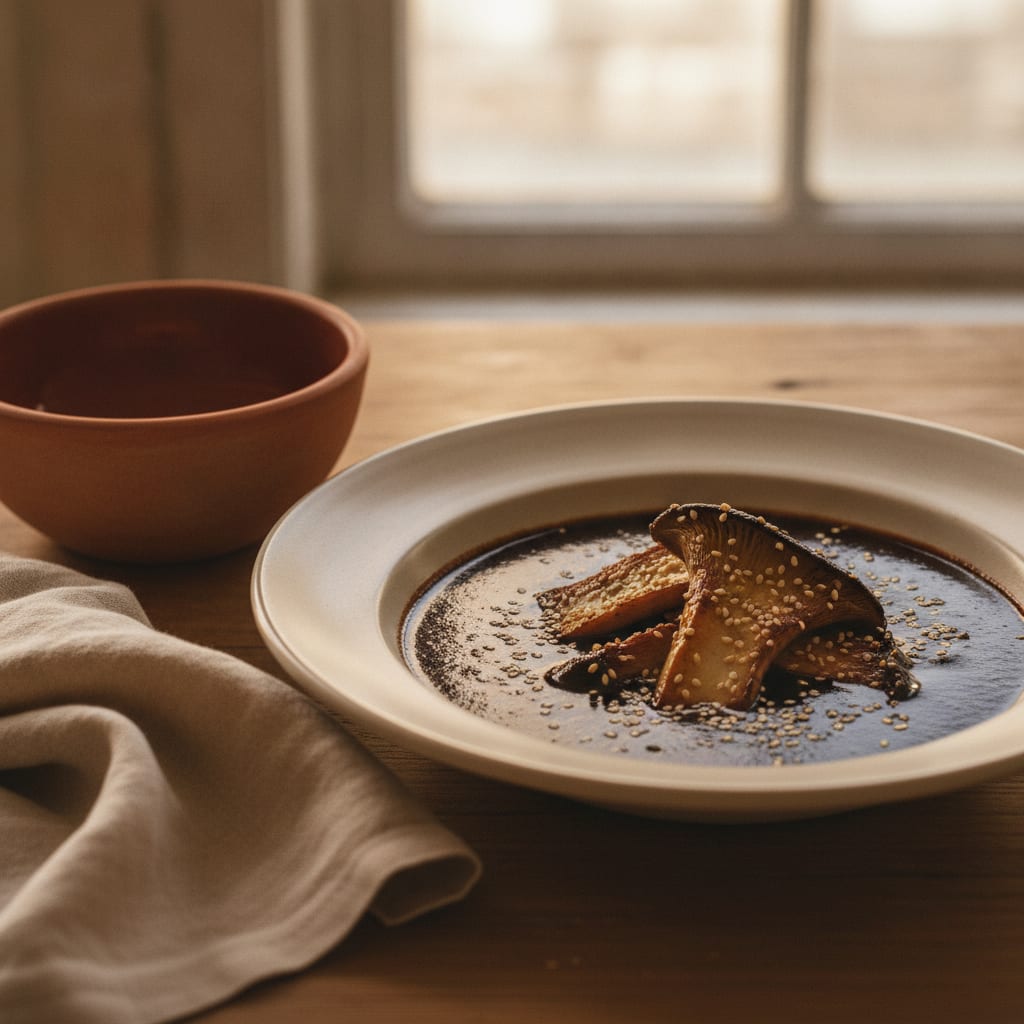
Pool the mole generously on warm plates — mole is the dish, the protein is the canvas. Lay the roasted king oyster mushrooms over, scatter with toasted sesame seeds, and serve with warm corn tortillas and white rice to carry the sauce. A glass of something dark and low-tannin, or a cold horchata. Leftover mole freezes beautifully and is, like all good moles, better the next day.
The story
I cooked my first proper mole in a rented kitchen in Columbia Heights, in Washington D.C., over a long Sunday in the autumn of 2025, because a neighbour from Puebla — a woman named Reyna who ran a stall at a weekend market two blocks away — had told me, kindly but firmly, that the jarred mole I’d been buying was an insult. She wrote me a list on the back of a receipt: the four chiles, the seeds, the fruit, the bread, the chocolate “poquito, no es postre” — a little, it’s not dessert. It took me most of the day. The kitchen filled with the smell of toasting chiles and burnt sugar and clove, and when I finally fried the paste and it spat and darkened in the pot, I understood why she’d been firm. There is no shortcut to that smell.
Mole carries one of the most beloved origin stories in Mexican food: the nuns of the Convent of Santa Rosa in Puebla, and Sister Andrea de la Asunción, said to have improvised the sauce around 1680 for a viceroy’s surprise visit, grinding together whatever the pantry held. I love the story and I’ll repeat it, but honestly — the precise date and the named nun are legend, not documented record. What is solid is older and bigger: Indigenous cooks made complex chile-and-seed sauces, mōlli, long before the convents existed, and mole poblano is that base fused with Old World cinnamon, almonds, and sugar.
This mole has no meat anywhere in it — it never needed any. It has the four chiles, the toasted seeds and nuts, the charred vegetables and fruit, the toasted tortilla, and a little dark chocolate for the backbone, over roasted king oyster mushrooms. The toasting is unchanged. The grinding is unchanged. The frying of the paste is unchanged. It is not a “version” of mole. It is mole, made with what is in my hands now.
À la maison
The weeknight reading is the recipe above — though “weeknight” is generous; this is a Sunday sauce. What makes it honest is restraint at two points. First, toast everything to fragrant, never to black; a single scorched chile poisons the whole pot with bitterness, and there is no fixing it afterward. Second, do not skip frying the paste before you add stock — that splattering, darkening few minutes is what turns a raw purée into mole. Make a double batch; it freezes for months and is better the second day. And keep the chocolate small. It is a backbone, not a dessert.
Au bistrot
The bistronomique reading keeps the mole exactly as it is — you do not improve mole, you only frame it — and composes the plate around it with two bright counterpoints and one textural one.
Reduce a ladleful of the finished mole further, with a splash of stock and a thread of agave, into a darker, glossier mole concentrado for painting the plate. Roast a single thick king oyster medallion hard until its edges crisp, then glaze it in a spoonful of the mole so it lacquers. Make a sharp green note to cut the sauce’s depth: a quick salsa verde cruda of charred tomatillo, raw onion, and cilantro, blended loose and bright. For texture and the traditional crown, toast pepitas and sesame in a dry pan until they pop and turn nutty. Spoon a wide pool of mole onto a warm pale plate and swirl it flat. Set the glazed medallion off-centre, drag a brushstroke of the mole concentrado out across the plate, spoon three small drops of the green salsa around it, and finish with the toasted seeds and a few micro-cilantro leaves. A warm tortilla, folded into a quarter, leans at the rim.
Le dressage — Overhead, tight, intimate. Pale plate flooded with near-black mole, a single lacquered medallion off-centre, a dark brushstroke dragged out, three bright-green drops of salsa, toasted seeds scattered. Warm directional light raking the glossy surface so it gleams. The plate should say one of the most complex sauces on earth, given room to be seen.
What the other recipes get wrong
Most mole recipes online — I read the top ten in March 2026 — either dump everything raw into a blender and simmer, or lean so hard on the chocolate that the sauce tastes like a savory brownie. Both miss the two moves that make mole. I ran the test over three Sundays in March 2026, same chiles, same ingredient list, only the technique changed:
- Everything blended raw, then simmered (no separate toasting, no paste-fry): harsh, flat, with a raw-chile rasp at the back that two hours of simmering never resolved. The flavours sat side by side instead of marrying.
- Toasted, blended, but stock added straight to the purée (no sofreír): better, but thin and a little sour — the colour stayed dull-red instead of going deep brown, and the chile read raw.
- Toasted separately, blended, then the paste fried hard in oil before stock: this was the mole. It darkened, thickened, lost all rawness, and the flavour concentrated into something glossy and resolved. Not close — a different sauce entirely.
The reason is real cooking chemistry, not folklore. Toasting the chiles and seeds drives Maillard and the volatilisation of aromatic oils, building roasted, nutty, complex notes that raw ingredients simply do not have. Then frying the blended paste — the sofreír — does two things at once: it cooks off the raw, green chile compounds, and it pushes the sauce further through caramelisation and Maillard, deepening colour and flavour while concentrating it as water boils off. The chocolate, kept small, adds bitterness and emulsifying cocoa-butter body underneath. Tip too much chocolate in and you don’t deepen the mole, you bury it. Across all three Sundays, the toast-and-fry mole won, every time, by a distance.
The line I draw
I will not let a single chile scorch. Not “just the one that got away,” not the edge of one I’ll blend in anyway and hope it disappears. It does not disappear. Burnt chile releases bitter, acrid compounds that thread through the entire pot and cannot be seasoned, sweetened, or simmered out — I have tried, and thrown out whole batches of mole that took me four hours to build. Toast each chile to fragrant and pliable, watch it like it owes you money, and the moment one blackens, discard it and start that chile again. A mole is only as clean as its most-burnt chile.
When this can fail
Three ways, all from my own kitchen between 2022 and 2026:
- The bitter, burnt-chile mole. Toasted the chiles over too high a heat while I dealt with the seeds, blackened two, blended them in. The whole sauce carried an ashy bitterness no amount of agave could balance. Fix: low-medium heat, 15–20 seconds a side, full attention, and discard any chile that chars.
- The flat, raw-tasting mole. Rushed the paste straight into stock without frying it first, because the kitchen was hot and I was impatient. The sauce stayed thin, dull-red, and raw-edged all through the simmer. Fix: fry the blended paste in hot oil 8–10 minutes until it darkens and thickens, every time, before any liquid goes in.
- The dessert mole. Eyeballed the chocolate generously one night, “for richness.” It came out tasting of cocoa, sweet and one-noted, the chiles buried. Fix: weigh the chocolate, keep it to about 40 g for this batch, and add it at the end so you can taste and stop. Poquito.
FAQ
QIs mole poblano really a chocolate sauce?
No — this is the most common misunderstanding of the dish. Mole poblano contains only a small amount of dark chocolate, and it functions as a backbone: a layer of bitterness and body underneath the chiles, seeds, nuts, dried fruit, and spice. The dominant flavours are the toasted ancho, mulato, and pasilla chiles. The chocolate rounds and deepens; it does not lead. A mole that tastes of chocolate has too much chocolate.
QWhere does mole poblano come from?
Mole has deep pre-Hispanic roots — Indigenous cooks made complex chile-and-seed sauces called mōlli long before contact. The famous convent legend credits Sister Andrea de la Asunción at the Convent of Santa Rosa in Puebla, said to have improvised the sauce around 1680 for a surprise visit by a viceroy or archbishop, grinding together chiles, spices, day-old bread, nuts and a little chocolate. Food historians treat the precise date and authorship as legend rather than documented fact; what is clear is that mole poblano fuses an Indigenous chile base with Old World additions like cinnamon, almonds, and sugar.
QWhy so many ingredients in mole?
Mole's character comes from layering many small things that resolve into one smooth, unified sauce — no single element legible on its own. Each plays a role: ancho, mulato, and pasilla build the chile backbone, sesame and nuts add richness and body, dried fruit and plantain bring sweetness, charred tomato and tomatillo add brightness, a toasted tortilla thickens, whole spices add warmth, and a little chocolate deepens the base. The craft is in the disciplined toasting and grinding of each component.
QWhat is the most important technique in making mole?
Two things. First, the staggered toasting: chiles, seeds, nuts, and spices each reach their peak at a different moment, so they are toasted separately, and a chile taken even slightly too far turns the whole sauce bitter. Second, frying the blended paste — the sofreír — for several minutes in hot oil before adding stock. Frying the paste cooks out the raw chile, darkens the colour, and concentrates the flavour. Skip it and the mole tastes flat no matter how long it simmers.
QCan I make mole poblano ahead?
Yes, and you should — mole improves over a day or two as its flavours marry, and it freezes well for months. Make the sauce ahead, cool, and refrigerate or freeze. Reheat gently with a splash of stock to loosen it back to a thick-cream consistency, stirring often so it doesn't catch, then roast the mushrooms fresh on the day you serve.