The corn that flowers.
Pozole Rojo.
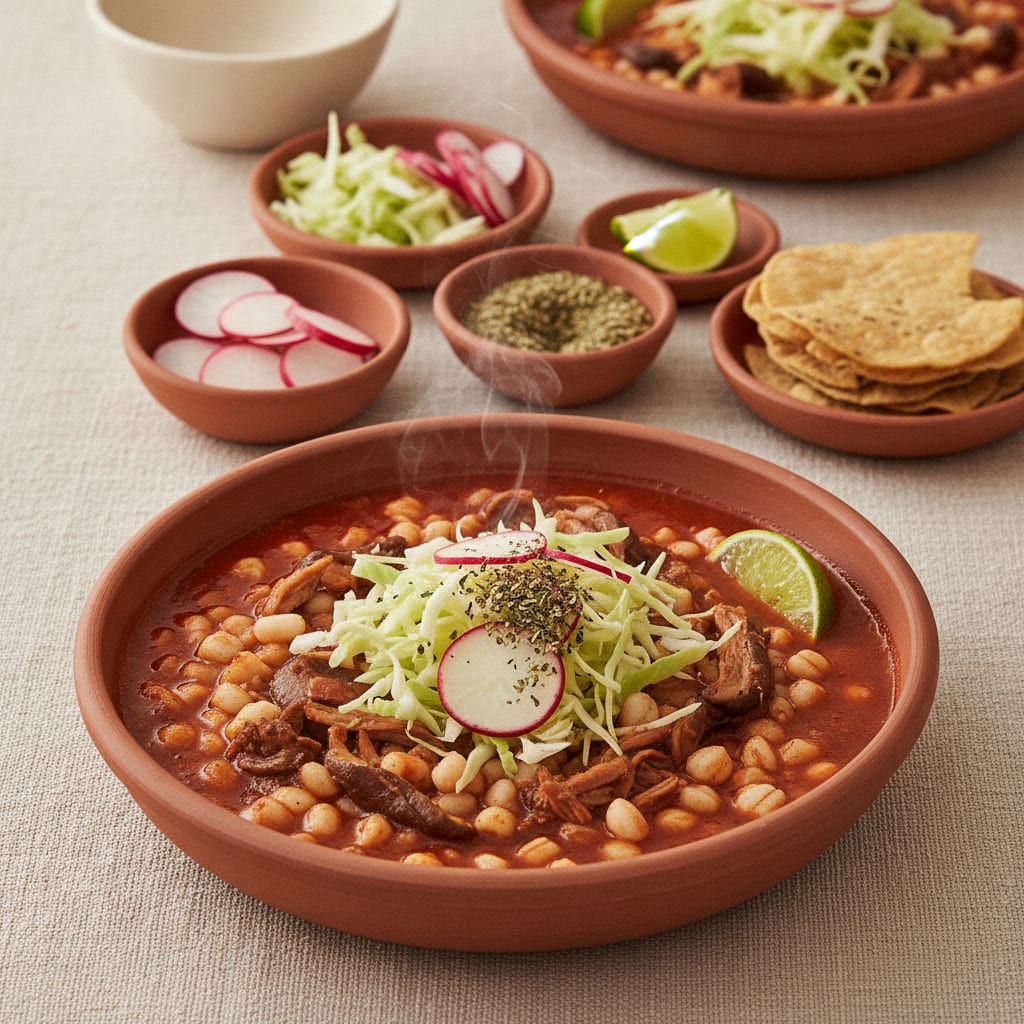
Pozole rojo: nixtamalized hominy simmered until it flowers, in a guajillo-ancho broth with mushrooms, finished at a radish, cabbage and lime garnish bar.
- Prep
- 30 min
- Cook
- 1h 15min
- Total
- 1h 45min
- Servings
- 6
- Difficulty
- Medium
Getting ready…
Ingredients
For 6 servings · 21 items
For the broth base
For the pozole
For the garnish bar
Method
7 steps · check as you go
- →
Serve
Serve in wide bowls with the garnish bar alongside: sliced radish, finely shredded cabbage or lettuce, diced white onion, lime wedges, dried oregano, ground chile, and crisp tostadas. Let each person dress their own bowl heavily — the cold crunch and sharp lime against the hot broth is the whole point. A cold beer or a hibiscus agua fresca. Pozole is a dish for a crowd and a long table.
The story
The first bowl of pozole that taught me anything was at a long folding table in a church basement in Mount Pleasant, Washington D.C., in the winter of 2025, at a fundraiser run by a Guerrero family I’d met through the weekend market. There was a vat of brick-red broth at one end and, beside it, the thing I came to understand was the real dish: the garnish bar. Shredded cabbage, a mountain of sliced radishes, oregano in a chipped cup, lime wedges, ground chile, stacks of tostadas. The grandmother working the ladle — I never learned her name, only that everyone called her señora with real deference — watched me hesitate, then loaded my bowl and pointed firmly at the cabbage and the limes. Más. More. The hot broth, the cold crunch, the sour lime: it landed all at once.
What I didn’t know then is how old and how heavy that bowl of corn is. Pozole is pre-Columbian, ritual food of the Mexica and their neighbours, and the maize at its centre — cacahuazintle, big-kernelled and nixtamalized — was sacred, the very substance humans were made from in their cosmology. I’ll be honest about the rest: the earliest Spanish accounts tie the original ceremonial pozole to human sacrifice, and that grim history is better told straight than romanticised away. What survived, and what we eat now, is the corn, the chile, and the communal table.
This pozole has no pork in it. It has flowered cacahuazintle hominy, a fried and strained guajillo-ancho broth, pulled king oyster mushroom and jackfruit, and the same garnish bar. The nixtamal corn is unchanged. The red broth is unchanged. The ritual of dressing your own bowl is unchanged. It is not a “version” of pozole. It is pozole, made with what is in my hands now.
À la maison
The weeknight reading is the recipe above, and canned hominy is what makes it weeknight — it skips the hours of simmering dried maize without giving up the flowered kernel. The two moves that matter: toast and strain the chile base so the broth is silky and not gritty, and fry that base in the pot before the stock goes in, the same way you would for mole. Season the pot harder than feels right; the lime and cabbage at the table will pull it back. And do not skip the garnish bar. A bowl of red broth without the cold, sharp, raw toppings is just soup. Pozole is finished at the table, by the person eating it.
Au bistrot
The bistronomique reading keeps the broth and the flowered hominy exactly as they are, and turns the garnish bar — the soul of the dish — into a composed plate.
Clarify a portion of the strained chile broth into a brighter caldo: simmer it with a little extra stock and a charred tomato, then pass it again through a fine cloth so it pours brilliant and clear-red. Treat the hominy as the hero: warm the flowered kernels in a spoonful of the broth so they gloss. Build a small, deliberate garnish set instead of a pile — a single watermelon-radish slice shaved paper-thin, a tight quenelle of finely shredded cabbage dressed with lime and salt, a few leaves of oregano, a thin shard of tostada stood upright for height. Sear a small cap of king oyster until its edges crisp. In a wide shallow bowl, mound the glossed hominy and the seared mushroom off-centre, lean the tostada shard against it, set the radish and the cabbage quenelle alongside, scatter oregano and a dusting of ground árbol — then pour the clear red caldo at the table, in front of the guest, so the steam rises as the bowl fills.
Le dressage — Overhead, then a second frame at the pour. Wide pale bowl, flowered hominy and seared mushroom mounded off-centre, one paper-thin radish, a cabbage quenelle, a tostada shard standing up, clear red caldo poured tableside. Negative space and steam. The plate should say the garnish bar, composed — bright, sharp, and precise against the deep red.
What the other recipes get wrong
Most vegan pozole recipes online — I read the top ten in April 2026 — treat the broth like a tomato soup: blend the chiles, dump them straight into stock, simmer. They never fry the chile base, and they rarely strain it. I ran the test over four nights in April 2026, same hominy, same garnishes, only the broth technique changed:
- Chiles blended raw into the stock, unstrained: gritty from the guajillo skins, dull orange-pink rather than deep red, with a raw, vegetal chile edge that the simmer never cooked out.
- Chiles toasted and blended, but added straight to stock (no fry, no strain): better colour and aroma, but still slightly gritty and thinner than it should be — the chile read fresh, not deep.
- Chiles toasted, blended, strained, then fried in the pot before the stock: silky, glossy, deep brick-red, with a roasted depth and no rawness at all. Not close — this was the broth.
The reason is two pieces of real technique. Frying the strained chile purée before adding liquid — the same sofreír that builds mole and adobo — cooks off the raw chile compounds and pushes the base further through caramelisation, concentrating colour and flavour as moisture boils away. And straining removes the tough guajillo skins, which a home blender cannot fully break, so the broth pours silky instead of sandy. The hominy does the rest: as nixtamalized cacahuazintle simmers it keeps releasing starch and that distinctive alkaline corn flavour into the broth, giving it body no stock cube provides. Toast, strain, fry — every night, the broth came out a different category.
The line I draw
I will not serve pozole without the garnish bar. Not “I’ll just put cabbage on top in the kitchen,” not “lime on request.” The cold, crisp, raw, sour toppings dressed by the eater at the table are not garnish — they are half the dish, and they are the ritual that makes a bowl of red corn broth into pozole. The shredded cabbage gives crunch, the radish gives pepper and water, the lime cuts the richness, the oregano and ground chile lift the aroma, the tostada gives the snap. Take them away and you have a competent soup. Put them on for people, in the kitchen, and you have robbed them of the part where the dish becomes theirs. Set the bowls out. Point at the cabbage. Say más.
When this can fail
Three ways, all from my own kitchen between 2022 and 2026:
- The gritty broth. Blended the guajillos and poured them straight into the pot without straining, in a hurry. The pozole was sandy on the tongue all night and never lost it. Fix: always pass the blended chile base through a sieve before it goes near the stock.
- The flat, raw-chile broth. Skipped frying the chile base and just simmered it in the stock. The broth stayed thin, pinkish, and tasted of raw chile under everything. Fix: fry the strained purée in the pot for five minutes until it darkens and thickens before adding liquid.
- The under-seasoned bowl. Salted the pot to taste in the kitchen, then watched it go thin and dull the moment the lime and cabbage hit it at the table. Fix: season pozole harder than feels right in the pot — the bright, acidic garnishes need a broth seasoned to stand up to them.
FAQ
QCan you make real pozole without meat?
Yes, because pozole is built on its nixtamalized hominy, its chile broth, and its garnish-bar ritual — not on the pork. The flowered cacahuazintle corn is the soul of the dish and the broth is a fried, strained guajillo-ancho base. Pulled king oyster mushroom and shredded jackfruit carry the soft, stringy, meaty texture, and a stock built for savory depth replaces the pork broth. Dressed at the table with cabbage, radish, oregano and lime, it reads unmistakably as pozole.
QWhat is the hominy in pozole, and why does it 'flower'?
Pozole is built on cacahuazintle, a large-kernelled heirloom maize, that has been nixtamalized — cooked and steeped in an alkaline lime (calcium hydroxide) solution. This roughly 3,500-year-old Mesoamerican process loosens the hull and transforms the corn. As the nixtamalized kernels simmer for hours, they burst open and splay at the tip — cooks call this 'flowering,' and it is the texture pozole is named for. Nixtamalization also unlocks the corn's bound niacin, which is why maize-based cultures that nixtamalized never suffered the pellagra that struck those who ate corn untreated.
QWhat is the history of pozole?
Pozole is a pre-Columbian dish with deep ritual roots among the Mexica (Aztecs) and other Mesoamerican peoples, tied to maize as the sacred origin of humanity in their cosmology and reserved for ceremonial occasions. Spanish accounts describe a far grimmer original version tied to ritual sacrifice — a history worth being honest about rather than romanticising. After the conquest the dish continued in a form built on hominy, chiles and pork, and today it is a festive communal food, especially red pozole (pozole rojo) made with guajillo and ancho.
QWhat is the difference between pozole rojo, verde and blanco?
All three share the flowered hominy and the garnish bar; the difference is the broth. Pozole rojo is coloured and flavoured with dried red chiles — guajillo and ancho here. Pozole verde is built on a green base of tomatillo, pepitas, and fresh herbs and chiles. Pozole blanco is the plain, uncoloured broth, dressed almost entirely by the garnishes. This recipe is rojo, the most widespread version.
QDo I have to use dried hominy?
No — good canned or pre-cooked hominy works well and saves hours. If you start from dried nixtamalized maize (cacahuazintle), it needs several hours of simmering until the kernels flower, and the result is more deeply corn-flavoured and more dramatically open. Either way, the kernel should splay at the tip; that flowering is the texture the dish is named for. Cook canned hominy in the broth for 30–40 minutes so it drinks the chile.