Fifteen minutes, not hours.
Ceviche.
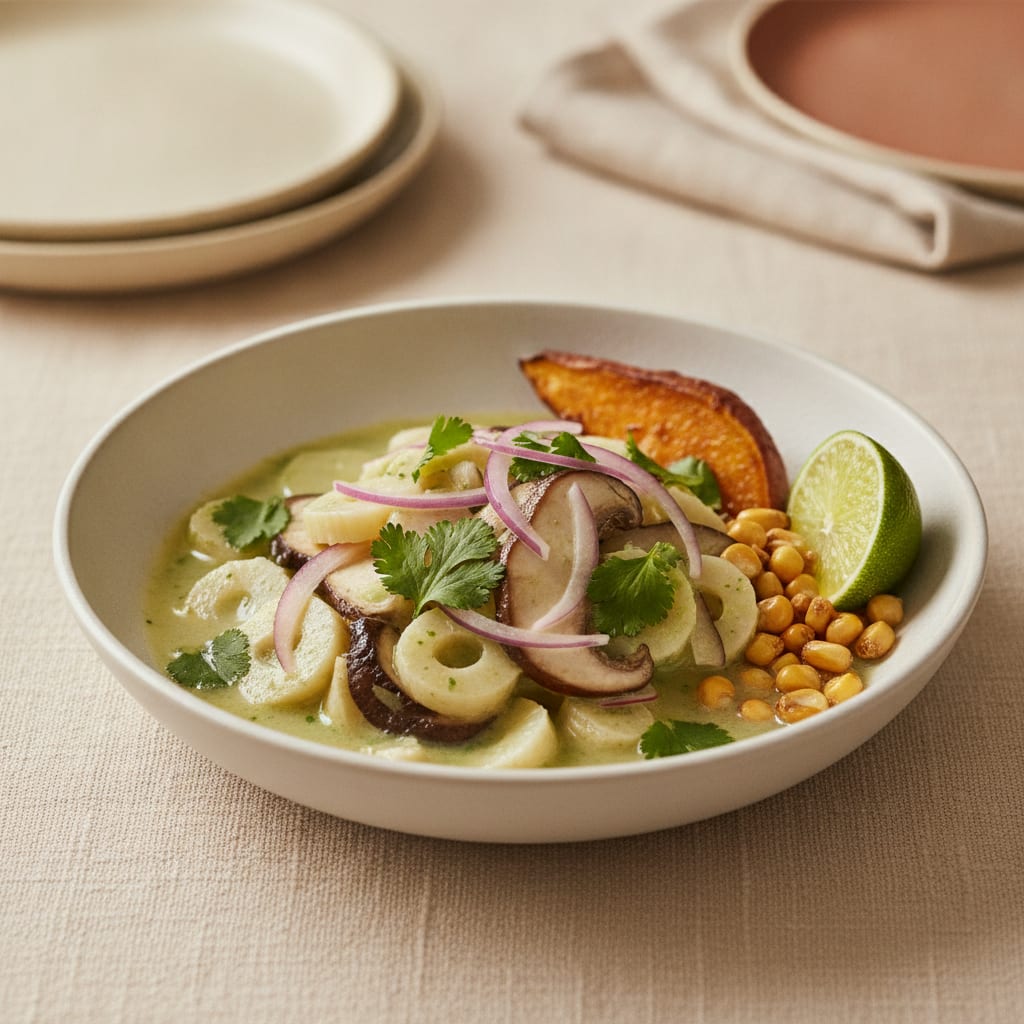
Hearts-of-palm and king oyster ceviche in a sharp leche de tigre of lime, ají, ginger and garlic, with red onion, cilantro, sweet potato and toasted corn.
- Prep
- 25 min
- Cook
- 15 min
- Total
- 40 min
- Servings
- 4
- Difficulty
- Easy
Getting ready…
Ingredients
For 4 servings · 15 items
For the leche de tigre
For the ceviche
To serve
Method
5 steps · check as you go
- →
Serve
Serve cold, immediately, in shallow bowls with plenty of leche de tigre pooled underneath — it is meant to be spooned or drunk. Rounds of boiled sweet potato and a scatter of toasted corn (cancha) on the side, red onion and cilantro on top, lime wedges alongside. A cold beer or a pisco-based drink is the Peruvian pour. Never let it sit; make it the moment guests are seated.
The story
I got the leche de tigre right for the first time on a hot afternoon in Columbia Heights, in Washington D.C., in the summer of 2025, in a friend’s kitchen with the windows open and a blender full of lime and ají. My friend Lucía, who grew up in Lima, stood over my shoulder and made me taste it before I poured it on anything. “Más sal. Más limón.” More salt, more lime. Then she dropped two ice cubes into the blender and told me that was the secret nobody writes down — cold keeps it pale, and the chill knocks the raw edge off the garlic. She was right. The next pour tasted like the sea and a slap at once, savory and screaming-sharp, and I understood that the marinade was the dish.
The history under that pour is older than the limes in it. Ceviche is Peru’s national dish, and its roots run back nearly two thousand years to the Moche on the northern coast, whose fishermen are thought to have marinated raw fish in the fermented juice of tumbo — a banana passionfruit — with chili and salt, “cooking” with native fruit acid long before any Spaniard arrived. The limes and onions came later, with the colonists. The genius — the acid bath — was already Indigenous.
This ceviche has no fish in it. It has a leche de tigre of lime, ají amarillo, garlic, ginger, and cilantro; hearts of palm and king oyster for the body; red onion, sweet potato, and toasted corn. And here I’ll be honest about the science, because it matters: lime “cooks” fish by denaturing its proteins, and a plant ceviche skips that step entirely — hearts of palm don’t denature. So this version doesn’t win by imitating that chemistry. It wins where ceviche actually lives: in the leche de tigre. It is not a “version” of ceviche. It is ceviche, made with what is in my hands now.
À la maison
The weeknight reading is the recipe above, and it is genuinely easy — the only skill is balance. Build the leche de tigre cold, with ice, and taste it until it’s bracingly sharp and properly salty before it touches anything; that one bowl decides the dish. Then dress at the last minute and respect the fifteen-minute rule: a short bath keeps the hearts of palm crisp and the lime bright, while a long soak turns everything soggy and the acid bitter. And don’t skip the sweet potato and toasted corn. They aren’t garnish — they’re the cooling, sweet, starchy counterweight that the searing acid needs to land right.
Au bistrot
The bistronomique reading keeps the leche de tigre as the star and turns the bowl into a precise, cold, composed course.
Split the leche de tigre in two. Keep half sharp and clear for spooning. Enrich the other half into a pale leche de tigre cremosa: blend it with a spoonful of soaked cashews or a little coconut cream until it turns silky and opaque, the milky body the name always promised. Cut the hearts of palm into clean, even cylinders and the king oyster into thin scallop-like coins, lightly blanched and chilled. Make a cancha crocante — toast the corn in a dry pan with a little oil and salt until it pops and turns golden and crunchy. Dice the sweet potato small and dress it with a thread of lime. In a wide, shallow, chilled bowl, lay a base of the creamy leche de tigre, arrange the hearts-of-palm cylinders and mushroom coins off-centre, tuck in the sweet potato dice, sliver over rinsed red onion and micro-cilantro, scatter the toasted corn for crunch and height — then pour the clear, sharp leche de tigre around it at the table, cold, so it pools bright at the bottom of the bowl.
Le dressage — Overhead, tight, cool daylight. Wide chilled bowl, a pale pool of creamy leche de tigre, hearts-of-palm cylinders and mushroom coins arranged off-centre, toasted corn for height, slivered red onion and micro-cilantro. The clear leche de tigre poured around at the table. Condensation on the bowl. The plate should say cold, sharp, alive — the sea in a glass, plated.
What the other recipes get wrong
Most plant ceviche recipes online — I read the top ten in May 2026 — make one of two mistakes: they treat lime as a thing that “cooks” the hearts of palm and marinate it for an hour like fish, or they underbuild the leche de tigre into plain lime-and-salt. I ran the test over four batches in May 2026, same hearts of palm, same garnishes, only the acid handling changed:
- Hearts of palm marinated 1 hour in plain lime juice: limp, waterlogged, and aggressively sour — the lime had pulled the body soft and gone harsh and bitter. Nothing was “cooked”; everything was drowned.
- Plain lime, salt, onion, dressed 10 minutes: bright but thin and one-dimensional — sharp without depth, missing the savory, almost creamy backbone ceviche needs.
- Full blended-and-strained leche de tigre, dressed 10 minutes: bracing, savory, layered, with the hearts of palm still crisp and the onion still snappy. Not close — this was ceviche.
The reason runs through both history and chemistry. With fish, lime denatures the actin and myosin — at a pH around 2 to 2.5 the protein unfolds and re-links, turning the flesh opaque and firm, a real chemical “cook.” Hearts of palm and mushroom have no such proteins to denature, so acid doesn’t transform them; it only softens and waterlogs them over time, which is exactly why the hour-long marinade fails. That frees a plant ceviche to do what modern Peruvian ceviche already does: dress à la minute. Peruvian chefs from the 1970s onward cut the old hours-long bath to minutes precisely to stop the fish going rubbery — and a plant ceviche should lean into that even harder, building all its depth into the leche de tigre and giving the vegetables only a brief, bright bath. Blend the aromatics into the lime, strain for that milky body, keep it cold with ice, and the marinade carries the whole dish.
The line I draw
I will not marinate a plant ceviche for an hour. Not “to let the flavours develop,” not “to cook it like the fish.” There is no protein here to cook, so a long bath does nothing but soften the hearts of palm to mush, waterlog the onion, and turn the lime from bright to bitter as it oxidises and concentrates. The whole modern art of ceviche — the thing Peruvian chefs fought for from the 1970s on — is the short bath: dress it minutes before it’s eaten, while the acid is fresh and the vegetables are crisp. The moment you let a plant ceviche sit and soak, you have made a sad, sour salad. Build the leche de tigre to carry the depth, and dress at the last possible minute.
When this can fail
Three ways, all from my own kitchen between 2022 and 2026:
- The soggy, sour bowl. Dressed the ceviche half an hour before guests arrived “to get ahead.” By the time we ate, the hearts of palm were limp, the onion was waterlogged, and the lime had gone bitter. Fix: build everything ahead, but dress only 5–15 minutes before serving — never sooner.
- The flat leche de tigre. Made the marinade as just lime, salt, and onion one night and wondered why it tasted thin. It had no savory backbone. Fix: blend the lime with ají, garlic, ginger, celery, and cilantro stems and strain — that’s what gives it the depth and the milky body it’s named for.
- The harsh, garlicky tiger’s milk. Blended the leche de tigre warm, without ice, and the raw garlic turned aggressive and the colour went dull. Fix: blend cold with a couple of ice cubes, briefly, and strain — cold keeps it pale and tames the garlic’s raw edge.
FAQ
QCan you make real ceviche without fish?
Yes, because ceviche is defined by its leche de tigre and its service — the sharp lime-ají-garlic marinade, the cold raw vegetables, the red onion and cilantro, the sweet potato and toasted corn, eaten cold and fresh. Hearts of palm give the tender, faintly oceanic body and king oyster a scallop-like bite. What changes is the chemistry: the acid is no longer 'cooking' a protein. But because the leche de tigre is the soul of the dish, a plant ceviche can be every bit as bright and complete — and it never risks the rubberiness of over-marinated fish.
QDoes lime juice actually 'cook' the fish in ceviche?
Not with heat, but it does denature the protein. Fish muscle is built largely from folded proteins like actin and myosin held together by weak bonds. Lime juice has a pH around 2 to 2.5, and that acidity disrupts those bonds so the protein chains unravel and re-link into a new network that traps water — turning the flesh opaque and firm, the same outcome heat produces. A plant ceviche skips this step entirely: hearts of palm and mushroom don't denature, so they stay tender and the dish wins instead on the brightness and depth of the leche de tigre.
QHow long should ceviche marinate?
Minutes, not hours. Traditional Peruvian ceviche once bathed the fish in lime for a long time, but from around the 1970s Peruvian chefs cut the marinade to just a few minutes, finding that a short bath kept the fish firm outside and tender inside. For this plant ceviche, dress it 5 to 15 minutes before serving — long enough to take on the leche de tigre, short enough that the hearts of palm and onion stay crisp and the lime stays bright rather than turning harsh and bitter.
QWhere does ceviche come from?
Ceviche is Peru's national dish, with roots reaching back nearly 2,000 years to the Moche civilisation on Peru's northern coast, whose fishermen are believed to have marinated raw fish in the fermented juice of tumbo, a banana passionfruit, along with chili and salt — 'cooking' fish with native fruit acids long before contact. Spanish colonists later brought citrus — sour oranges and limes — and onions and cilantro, which became the lime-based ceviche recognised today.
QWhat is leche de tigre?
Leche de tigre — tiger's milk — is the marinade and sauce of ceviche in one: a sharp, savory, slightly spicy blend of fresh lime juice, ají chile, garlic, ginger, and aromatics, traditionally enriched with fish essence. Here it is built on lime, ají amarillo, garlic, ginger, celery, and cilantro stems, blended cold with ice and strained until pale and almost milky. It is poured over the ceviche, pooled at the bottom of the bowl, and meant to be drunk — it is the soul of the dish.