Tabbouleh.
The Levantine herb-and-bulgur salad — fine bulgur, mountains of parsley and mint, almost no grain. The proportion is the point.
- Prep
- 35 min
- Cook
- 0 min
- Total
- 35 min
- Servings
- 6
- Difficulty
- Easy
Getting ready…
Ingredients
For 6 servings · 15 items
The base
The herbs
The vegetables
The dressing
To serve
Method
7 steps · check as you go
- →
Serve
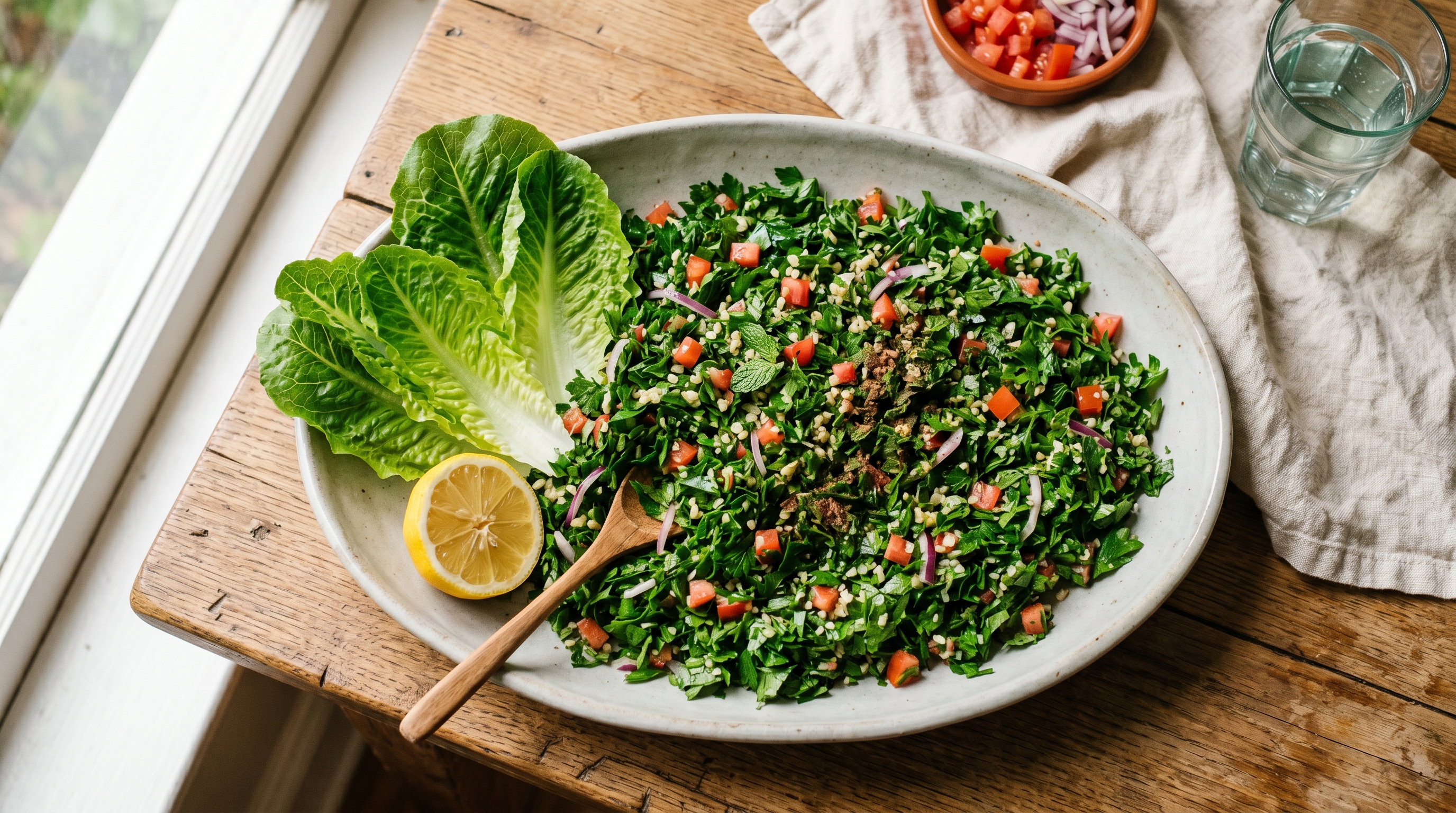
Wide shallow bowl, romaine leaves on the side. Eat by hand with the leaves as scoops. Serve as part of a mezze table: hummus, baba ganoush, falafel, olives, warm pita. Drink chilled white wine, beer, or arak (the Lebanese anise spirit) cut with cold water and ice.
The story
The parsley is the salad. The bulgur is the seasoning of the parsley. The tomato is a brightener. The mint is a top note. The dressing is the cohesion. The lettuce is the spoon. In that order, in those proportions, in that ritual — that is tabbouleh.
This is the dish that American kitchens have inverted more thoroughly than almost any other Levantine import. The version you find at most American supermarkets, delis, and “Mediterranean” restaurants is roughly 60-70% bulgur with parsley sprinkled on top — a grain salad with herbs as garnish. The Lebanese original, the dish that the Levantine kitchen has cooked for centuries, is the opposite: mountains of parsley with bulgur as accent. The proportion is not a detail; it is the entire identity of the dish.
I learned this distinction the slow way — first making the deli version for years, thinking I was making tabbouleh, never tasting anything that approached what I had eaten at a Lebanese family table in Paris in 2024. (A colleague at Le 110 had me to her parents’ apartment in the 11th arrondissement for an early summer dinner; her mother — Lebanese, from a Beirut family that had relocated to France in the 1970s — served a tabbouleh that was almost luminous green, with the bulgur visible only as small specks. The flavor was a clear, sharp, green thing — herbal and lemony, with a soft warm allspice base. It was so different from what I had been making that for a moment I wasn’t sure we were eating the same dish.)
I asked her, after dinner, what was different. She showed me. The proportion. The drained tomato. The mint cut at the last moment. The lemon juice in the bulgur soak. The dressing at the table. None of these are secrets in Lebanese kitchens — they are simply the way the dish is made there. None of them appeared in any of the American recipes I had cooked from for the previous decade.
The dish, made the proper Lebanese way, is faster than the deli version. There is no cooking. The bulgur soaks. The herbs are chopped. Everything is combined and dressed. Twenty minutes of active work, plus 10 minutes of soaking. The labor is in the parsley — 5 to 8 minutes of careful knife work to chop 4 cups of leaves. That labor is the whole game. If you skip it (with a food processor), the dish breaks. If you do it (by hand, with a sharp knife), the salad holds for 2 hours and tastes the way Beirut wants it to taste.
What the other recipes get wrong
Most tabbouleh recipes online — I checked the top ten in May 2026 — get the proportion exactly backwards. The ratios I measured by visual volume across the top ten:
- Average American recipe: 60% bulgur, 25% tomato, 10% parsley, 5% mint
- Lebanese standard: 65% parsley, 10% mint, 15% tomato + onion, 10% bulgur
The visual difference between the two finished salads is unmissable. The American one is tan with green specks. The Lebanese one is bright green with tan specks. They are different foods.
I tested three other variables over April 2026, with batches of 200g each:
- Knife vs food processor for the parsley: food processor batch went limp within 8 minutes of dressing, knife-cut held its structure for 2 hours. Visible side-by-side.
- Coarse bulgur (#3) vs fine bulgur (#1): coarse bulgur required cooking, the cooked grain was chewy and dominated the salad. Fine bulgur stayed in the background where it belongs.
- Tomato drained 5 min vs not drained: undrained-tomato batch had visible pooling liquid at the bottom of the bowl after 30 minutes; drained batch was dry, clean, photographic.
The combination that worked, every time: fine bulgur (#1 or #2), cold-soaked with lemon juice for 15 minutes; tomato diced fine and drained 5 minutes; parsley chopped by hand with a sharp knife; mint chiffonaded at the last moment; allspice in the dressing; dressing whisked separately and added at the table. Each piece is small. Skip any one and the salad degrades visibly.
I have the photos from the test batches. The proportion difference shows up clearly even from above, on the same plate, with the same lighting. The American version looks like a grain side dish. The Lebanese version looks like a bowl of fresh green herbs with grain as accent. Same name. Different food.
The line I draw
I will not put couscous in tabbouleh. This is the most common American substitution and it genuinely makes a different dish. Couscous is not bulgur. They are made from different processes, taste different, eat different. A tabbouleh-with-couscous is a fine Mediterranean grain salad; it is not tabbouleh. If you cannot find fine bulgur, do not substitute couscous — wait a day and order bulgur from a Middle Eastern grocery, or use farro cracked into smaller pieces. But not couscous.
I will also not chop the parsley with a food processor. The mechanical bruising of the leaves changes the dish from a fresh green salad into a wet green sludge within 10 minutes. The 5 to 8 minutes of knife work is the entire texture of the salad. A sharp knife. A cutting board. A pile of leaves. That is the labor that the dish requires.
When this can fail
Three ways, all from my own kitchen between 2020 and 2026:
- The parsley wasn’t dried. Washed the parsley, didn’t spin-dry it, started chopping. The wet leaves clumped under the knife and the resulting chop was bruised and slimy. The salad went watery within 20 minutes. Fix: wash the parsley first, then spin-dry thoroughly in a salad spinner (or pat aggressively with clean towels). The leaves must be dry before they hit the knife.
- The mint was cut too early. Chopped the mint while still doing the parsley — by the time I assembled the salad 15 minutes later, the cut edges of the mint had turned black and the flavor was muddy and bitter. Fix: mint is the last thing you cut. Sliced and added in the same 60-second window as the dressing.
- The salad was dressed in advance. Combined everything 45 minutes before service to “let the flavors meld.” The acid in the lemon juice wilted the parsley into a sad limp green by service time. Fix: combine the salad with NO dressing. Whisk the dressing separately. Pour the dressing the moment you bring the bowl to the table, not before.
The dinner
Tabbouleh is mezze. It belongs on a table with hummus, baba ganoush, falafel, olives, fresh tomato, sliced cucumber, warm pita, and a glass of something cool. A chilled Lebanese white wine (a Musar Blanc if you can find it, or a Greek Assyrtiko). Or arak — the anise spirit — cut with cold water until milky, served over ice. Or just cold beer.
Eat with the romaine leaves as scoops. Pinch a leaf, fold it gently, scoop a forkful of the salad onto it, lift to the mouth. The leaf crunches against the soft salad. The lemon hits first, then the parsley, then the mint, then the warm allspice in the back. Then the bulgur — the smallest amount, the seasoning of the herbs, the way it has been in Beirut for as long as anyone has been writing recipes down.
The technique never moved. The dish never moved. The proportion is the point. Cook the bulgur cold. Chop by hand. Dress at the table.
The salad is the salad.
FAQ
QWhy is tabbouleh almost all parsley?
Because that's the dish. The Lebanese name — *tabbouleh* — comes from the Arabic root *tabbal*, meaning 'to season' — and the bulgur is the seasoning of the herbs, not the other way around. The traditional ratio in Lebanese kitchens is roughly 70% herbs (parsley dominant, mint supporting) and 30% everything else. American versions inverted this in the 1970s and 1980s, treating tabbouleh as a grain salad and reducing the herbs to a garnish. Both versions are real foods, but only the herb-dominant one is what Lebanon eats and what the Levantine kitchen has always cooked. If your salad is more bulgur than parsley by volume, you have a different dish.
QCan I use couscous instead of bulgur in tabbouleh?
No, and this is one of the most common American substitutions that genuinely breaks the dish. Couscous and bulgur are different ingredients. Couscous is rolled-and-dried semolina paste — small bead-like pellets. Bulgur is whole cracked wheat — parboiled and dried, then milled to varying coarseness. They cook differently, taste differently, and eat differently. Couscous tabbouleh is denser, starchier, and lacks the slight nuttiness of bulgur. It's a fine Mediterranean grain salad — call it 'couscous salad' and serve it proudly — but it is not tabbouleh. The dish is defined in part by the grain.
QWhat's the difference between fine and coarse bulgur?
Bulgur is sold in four grades: #1 (extra fine), #2 (fine), #3 (medium/coarse), and #4 (coarse). For tabbouleh you want #1 or #2 — the fine grades. Fine bulgur rehydrates with a cold soak in lemon juice and water in 10-15 minutes, with no cooking required. It produces small, tender grains that distribute through the herbs without dominating. Coarse bulgur (#3 or #4) is meant for pilaf-style dishes — kibbeh, mujadara — and requires boiling like rice. If you use coarse bulgur in tabbouleh, you'll need to cook it first AND the texture will be chewy and heavy, throwing off the herb-to-grain balance. Look for bulgur clearly labeled 'fine' or '#1'/'#2' at a Middle Eastern grocery.
QWhy does my tabbouleh go limp and watery?
Almost always one of three things. (1) You didn't drain the tomato — the tomato's cellular water is bleeding into the salad. Drain diced tomato for at least 5 minutes in a fine-mesh strainer before adding. (2) You used a food processor instead of a knife on the parsley — the processor crushes the cell walls and releases chlorophyll-bound moisture, turning the parsley into wet sludge within 10 minutes. Chop by hand with a sharp knife. (3) You dressed the salad too early — the lemon juice in the dressing wilts the parsley if it sits for more than 30 minutes. Dress at the moment you serve, not before. Fix all three and your tabbouleh will hold its texture for 2-3 hours after assembly.
QHow long does tabbouleh keep?
Tabbouleh is best within 2-3 hours of dressing — that's the window where the texture is at peak: parsley crisp, bulgur tender, tomato bright. After that, the lemon and salt start to wilt the parsley and the texture deteriorates. You can prep all the components in advance — chop the parsley and mint, soak the bulgur, drain the tomato — and hold them separately in the fridge for up to 24 hours. Combine and dress at the moment of service. Once dressed, tabbouleh holds at room temperature for 2-3 hours, refrigerated for up to a day (with declining texture). It does not freeze, does not improve overnight, does not 'meal-prep' well. This is a same-day salad.