Baba Ganoush.
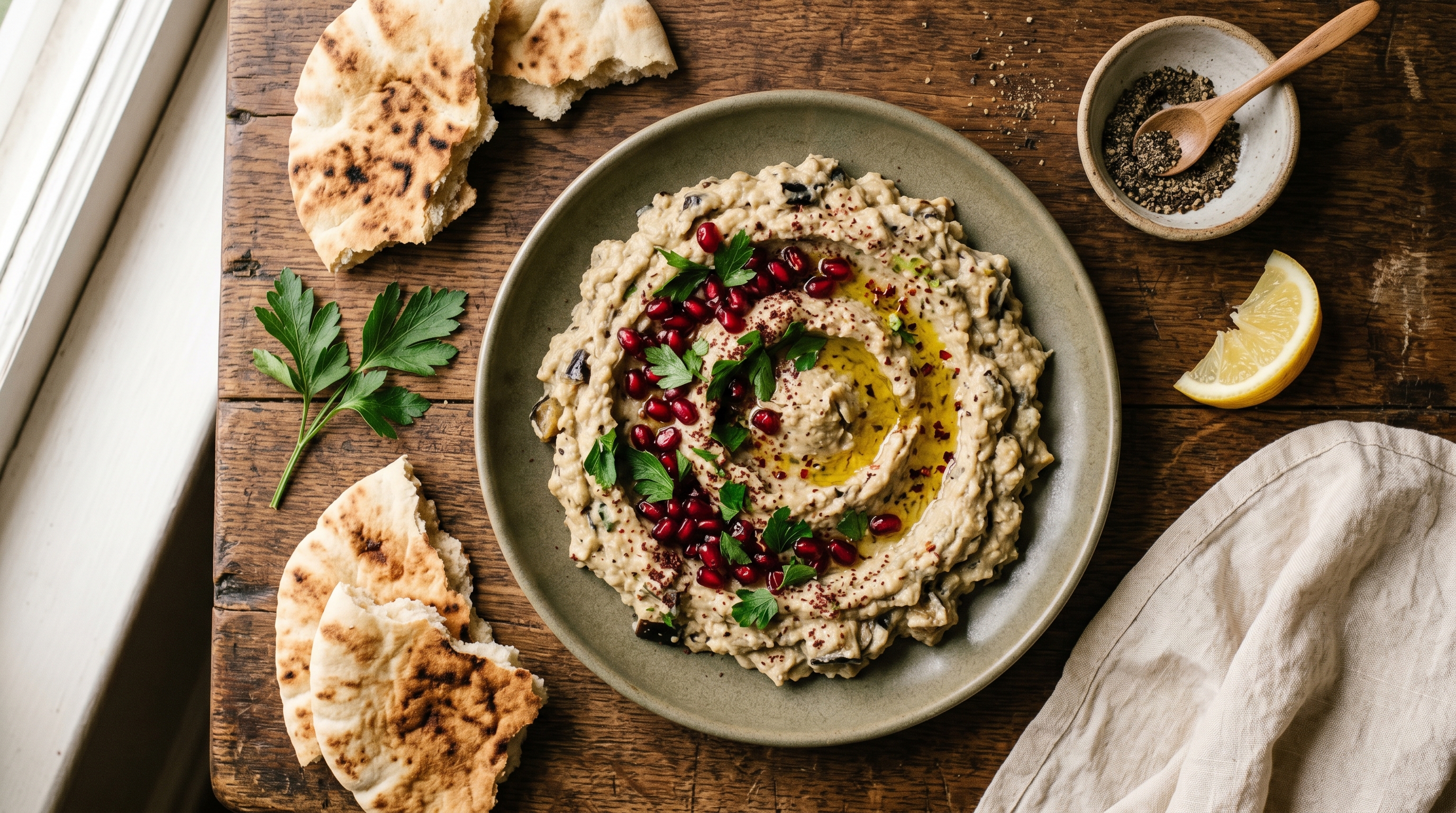
Charred eggplant, tahini, garlic, lemon. The smoke is the whole dish — char the eggplants over open flame, not in the oven.
- Prep
- 15 min
- Cook
- 25 min
- Total
- 55 min
- Servings
- 6
- Difficulty
- Medium
Getting ready…
Ingredients
For 6 servings · 12 items
The eggplants
The dip
Garnish
Method
7 steps · check as you go
- →
Serve
Warm pita, eaten by hand. Scoop from the edge toward the center where the oil pools. Drink something cool — chilled wine, beer, mint tea. Baba ganoush is a mezze, not a meal by itself; serve alongside hummus, olives, pickled vegetables, sliced tomato, fresh herbs. The whole table is the dinner.
The story
The eggplant goes on the flame, not in the oven. That is the rule, and every recipe I have written in this file rests on that one sentence. Baba ganoush is a smoke dish — the entire architecture of the recipe is built to capture the specific flavor compounds that develop when eggplant skin is charred in direct contact with an open flame. Take the flame away, you don’t have a baba ganoush. You have an eggplant dip with tahini in it. Which is fine. Which is also not the dish.
The first proper baba ganoush I ate was in the spring of 2017, in La Marsa, the seaside suburb of Tunis. I was there for a long weekend with a colleague named Sami, for a wedding I have written about elsewhere in this kitchen. (Khadija, who made the brik on the sidewalk at 2 a.m., is the same Khadija who, the next morning, set out the mezze table that included this dip among about fourteen others.) The baba ganoush in her version was the Maghrebi style — a touch of cumin, a hit of smoked paprika, slightly more lemon than the standard Levantine — and it was charred eggplant in a way I had not seen done in a Western kitchen. She did it on a small portable propane burner on the side patio, two eggplants directly on the metal grate, while the rest of us drank coffee and watched. The smell was the smell of a bonfire in a tomato field — earthy, sulfurous, faintly sweet, completely intoxicating.
She did not write down a recipe. She did not, as far as I can tell, ever cook the same thing twice the same way. But the technique was clear: flame, char, rest, drain, crush. Tahini and lemon and salt and a touch of cumin. The dip is itself simple — five ingredients, six counting the cumin, plus garnish. The whole game is in the smoke.
I cook her version now in Washington, on a four-burner gas range with cast-iron grates that have been seasoned to the color of charcoal from a year of doing exactly this. I do not own a grill. I have never used the broiler for baba ganoush. The propane burner on the side patio in La Marsa and the gas burner in my D.C. kitchen are functionally identical for this purpose, and that is the only equipment that matters.
What the other recipes get wrong
Most baba ganoush recipes online — I checked the top ten in May 2026 — solve the charring problem by roasting the eggplants in the oven. Some at 400°F, some at 425°F, some under the broiler. I tested every variant over four weekends in April and May 2026, holding all other variables constant (same eggplants from the same vendor, same tahini, same lemons), comparing the smokiness of the final dip on a 1-10 scale:
- Oven at 400°F, 50 minutes: smoke score 2/10. Eggplant cooked through, no char on the skin, dip tasted of eggplant and tahini. Not baba ganoush.
- Oven at 450°F, 40 minutes: smoke score 3/10. Some dark spots on the skin, slight smoky note. Closer, still not the dish.
- Broiler on high, 20 minutes per side: smoke score 5/10. The skin charred unevenly — the side facing the element burnt, the sides did not. About 50% smoke.
- Gas grill set to high, lid closed, 25 minutes: smoke score 8/10. The skin charred all around, but the dip lacked the deepest layer of smoke that the burner gives.
- Open gas burner, rotated every 2 minutes, 25 minutes total: smoke score 10/10. The dish. Skin completely blackened, the dip carrying the full smoke profile.
The combination that worked, every time: gas burner, directly on the grate, full char (skin completely blackened, not just darkened), 10-minute paper-towel rest, 15-minute strainer drain, hand crush with fork, tahini before lemon, real Lebanese tahini, fresh lemons, and rest the dip 30 minutes before serving. Each piece does something. Skip the flame and you don’t have baba ganoush. Skip the double-drain and the dip is watery. Skip the hand crush and the texture is wrong. Skip the rest and the flavors haven’t integrated.
I have the photos from the test batches lined up — five bowls of dip, all pale gray-beige and visually nearly identical from above, but the smell of each one is a completely different dish. The burner one smells of bonfire. The oven one smells of cooked vegetable. Same ingredients minus the heat source, different food.
The line I draw
I will not make baba ganoush without an open flame. If you don’t have a gas burner, a propane camp stove, a charcoal grill, or some equivalent source of direct flame, do not make this recipe. Make an oven-roasted eggplant dip instead — it’s a perfectly fine dip and I will not pretend otherwise. But call it what it is. The smoke IS the dish, and you cannot get the smoke from an oven. The chemistry doesn’t allow it.
I will also not use a food processor on the cooked eggplant. The texture of hand-crushed flesh is part of the dish’s identity. A food processor turns baba ganoush into hummus-with-eggplant, which is a different and lesser thing. Five extra minutes with a fork over a bowl. Do it.
When this can fail
Three ways, all from my own kitchen between 2022 and 2026:
- The eggplant was overcooked AND under-charred. Left on the burner too long with low heat, trying to be patient. The flesh went mushy and watery while the skin barely browned. The dip turned out wet, vegetal, with almost no smoke. Fix: medium-HIGH heat, full flame contact, 5-7 minutes per side. Move it. Rotate it. Don’t be afraid of the blackness — the eggplant is fine.
- I skipped the paper-towel rest. Took the charred eggplants straight from the burner into a bowl. The bitter cellular liquid pooled at the bottom of the bowl and reabsorbed into the flesh. The final dip had an unpleasant vegetal-bitter undertone. Fix: paper-towel rest for 10 minutes, then strainer for 15. The drains are mandatory.
- I used Japanese eggplants. Long, thin, more like cucumbers than globes. The skin charred fine but the flesh-to-skin ratio was wrong — too much skin contact for the flesh inside, so the dip ended up with a slightly bitter, charred-paper taste. Fix: globe or Italian eggplants only. Plump, heavy, glossy, no soft spots.
The dinner
A Levantine mezze table is not a starter — it IS the meal, with maybe a piece of grilled fish or a small portion of lamb on the side. Set out the baba ganoush, the hummus (the dip’s sibling on this site), some good olives, sliced tomato, pickled vegetables, sliced cucumber, fresh mint, fresh parsley. Warm pita. A glass of chilled white wine — a Greek Assyrtiko or a Lebanese Musar Blanc if you can find one.
Eat with your hands. The pita is the plate. The smoke from the eggplant should still be detectable in the dip 30 minutes into the meal, and that is the point. The bonfire stays on the table.
Cook this on a Saturday afternoon. The eggplants take 25 minutes on the burner, the rest is mostly waiting. Make hummus while the eggplants char. Make a salad. Set the table. Take your time.
The dish is the dish, and the smoke is the dish.
FAQ
QCan I make baba ganoush in the oven instead of over flame?
You can, but you lose roughly 60-70% of what makes the dish itself. Baba ganoush is defined by the smoke that comes from skin-on-direct-flame charring — the high-temperature breakdown of the eggplant skin releases the specific aroma compounds (phenolic, sulfurous, slightly bonfire-like) that give the dish its character. An oven, even at 450°F, never gets the skin to the same level of char, so you end up with what's essentially eggplant dip — fine, but not baba ganoush. If you must use the oven, set it to broil on HIGH, place the eggplants directly under the broiler element, and turn them every 5 minutes for 20-25 minutes total. That gets you the closest oven approximation — maybe 60% of the proper smoke. A gas grill set to high gets you 90%. An open gas burner gets you 100%. If you have only an electric stove and no broiler, find a friend with a gas burner before making this.
QIs the dip supposed to be gray instead of white?
Yes. Proper baba ganoush is a pale gray-beige color — sometimes described as 'oyster' or 'stone.' The gray comes from the eggplant flesh, which oxidizes slightly when exposed to air, and from the trace amounts of char that get scraped in with the flesh. A pure-white baba ganoush usually means either (a) too much tahini relative to eggplant, or (b) under-charred eggplant. The proper proportion is about 4 parts crushed eggplant to 1 part tahini by weight, and the eggplant should be heavily smoke-flavored. If your dip is white and creamy, taste it — it's probably more tahini-forward than smoky.
QWhy is my baba ganoush bitter?
Three possible causes. (1) You skipped the paper-towel rest and the strainer drain — the bitter cellular water didn't leach out, and now it's in the dip. The fix is to scoop the dip back into a strainer for 30 minutes and let some of the water drain off. (2) Your eggplants were old or had soft spots — older eggplants have higher concentrations of bitter alkaloids. Use eggplants that are firm and glossy with no soft spots. (3) You used too much raw garlic — more than one small clove pushes the dip into bitter territory, especially as the dip sits and the garlic continues to develop. Make a fresh batch and tone the garlic down.
QShould I crush by hand or use a food processor?
Hand crush. Every time. A food processor will turn baba ganoush into a uniform smooth puree that misses the visible eggplant strands and irregular texture that the dish should have. Hand-crushed dip has small chunks, fibers, and irregular consistency — you scoop it with pita and feel the eggplant in the bite, which is exactly what the Levantine version should be. A blender or stick blender does the same thing — turns the dish into a smoothie. Use a fork in a bowl, or a wooden spoon and pressure. It takes 60 to 90 seconds; not long.
QHow long does baba ganoush keep?
Refrigerated, 3 to 4 days in a sealed container. Like hummus, the texture is at peak in the first 24 hours; by day 3 it's denser and slightly drier. The smoke flavor actually deepens for the first 24 hours then plateaus. Bring back to room temperature before serving — 30 minutes on the counter is enough. A cold dip eats heavy and the flavors are muted. Do not freeze; the eggplant texture breaks down completely on thaw and you end up with an unpleasant watery paste.