Hummus.
The Levantine standard — dried chickpeas slow-cooked with baking soda, ice cubes in the blender, fresh-pressed lemon, real tahini. The texture is the dish.
- Prep
- 15 min
- Cook
- 1h 30min
- Total
- 13h 45min
- Servings
- 6
- Difficulty
- Medium
Getting ready…
Ingredients
For 6 servings · 17 items
The chickpeas
The hummus
Garnish
Method
8 steps · check as you go
- →
Serve
Warm pita, eaten by hand, scooping toward the center. Eat hummus the day it's made — the texture is at peak in the first 24 hours. If you must store, refrigerate up to 4 days, but bring to room temperature and stir before serving. A cold hummus eats like wallpaper paste.
The story
This is the recipe that finally gave me proper hummus, in my Washington kitchen, in the spring of 2024. For something like fifteen years before that, my hummus was wrong. Not bad — palatable, edible, recognizable — but wrong in the same way a dish from a restaurant chain is wrong: heavier than it should be, slightly grainy, the wrong color, a profile that tasted of chickpeas and tahini in series instead of chickpeas-and-tahini integrated. I made it for years with canned chickpeas, a normal food processor, room-temperature ingredients, and none of the right tricks. I thought hummus was just supposed to be like that.
The year I finally fixed it was 2024. I was reading a piece on the Lebanese hummusiya tradition — the all-day hummus restaurants in Beirut where the line is out the door from 8 a.m. — and the technique laid out was nothing like what I had been doing. Dried chickpeas, soaked overnight with baking soda. Cooked another 90 minutes with more baking soda. Blended hot with ice cubes. Whipped tahini first, before anything else went in. Each one of these was a move I had never made, never seen in an American recipe.
I cooked it that night. The hummus that came out of my food processor that night was not what I had been making for fifteen years. It was paler, lighter, silkier, more integrated. The kind of hummus you eat with bread and forget you’re eating because it tastes like one continuous thing instead of an assembly. I have been making it this way ever since.
The whole architecture of proper Levantine hummus rests on the chickpea texture. If the chickpea is not soft enough — and I mean crushes instantly between your fingers with zero resistance soft — no amount of blending or trick technique can save you. The bean is the body. The tahini is the soul. The lemon and garlic are the punctuation. The ice cubes are the magic, and the brand of tahini you buy matters more than the brand of olive oil you finish with. That’s the whole dish.
What the other recipes get wrong
Most American hummus recipes — I checked the top ten in April 2024 — make some combination of these mistakes:
- Use canned chickpeas (8 out of 10)
- Skip the baking soda (6 out of 10)
- Don’t whip the tahini first (9 out of 10)
- Skip the ice cubes (10 out of 10 — I have not seen a single American recipe that includes them)
- Under-blend by a factor of 3 (most call for 30 seconds; the dish needs 4 minutes)
- Use bad tahini (Joyva, Krinos, store-brand)
I tested each variable in isolation over six weekends in spring 2024, holding all other variables constant and changing one at a time, with 200g batches each. The results, ranked by impact on the final hummus:
- Tahini brand: the single biggest variable. Switching from store-brand to Soom or Al Wadi changes the dish more than any other single change.
- Chickpea source (dried vs canned): second biggest. Dried chickpeas cooked to the crush-test softness give a fundamentally different texture.
- The ice cubes: third biggest. Adding 4-5 cubes during the blend changes the color from tan to pale-cream and lightens the texture noticeably. Visible in any side-by-side.
- Whipping the tahini first: noticeable improvement, especially in mouthfeel.
- Baking soda in the cook: matters mostly for cook time and skin removal — the texture is slightly creamier but the difference is smaller than the other variables.
- Blending time: the difference between 30 seconds and 4 minutes is real but plateaus at 4 minutes.
The combination that worked, every time: dried chickpeas, baking soda in both the soak and the cook, cooked to fingertip-crush softness, blended hot, tahini whipped first with lemon and garlic, ice cubes added mid-blend, full 4-minute blend, real Lebanese or Palestinian tahini, fresh lemon juice never bottled. Skip any of these and the hummus degrades in a measurable way.
I have the photos of these test batches in a folder. The side-by-side of canned-no-ice versus dried-with-ice is genuinely striking — the colors are different, the textures are different, the way the hummus pours from the spoon is different. The dish is not the same dish.
The line I draw
I will not use bottled lemon juice. Ever. The chemistry difference between fresh-pressed and bottled is large and obvious — bottled lemon juice contains preservatives that taste vaguely metallic and lack the fresh top-note that the hummus needs. Buy two lemons. Squeeze them. The 20 seconds is the difference between hummus that tastes of itself and hummus that tastes of a delicatessen.
I also will not use Joyva tahini. I know it’s cheap and it’s at every grocery store. It is not real tahini in the Lebanese sense — it’s sweet, gritty, and made from inferior seed. If your only choice is Joyva, buy a small jar of Soom online instead, or wait until you can get to a Middle Eastern grocery. The tahini is the dish.
When this can fail
Three ways, all from my own kitchen between 2020 and 2026:
- The chickpeas were undercooked. Tested at 45 minutes of cooking instead of the full 90. The chickpeas crushed with some resistance, not instantly. The final hummus was grainy no matter how long I blended — 4 minutes, 6 minutes, even 8 minutes couldn’t make it smooth. Fix: cook the chickpeas longer than you think you need to. Crush-test before draining. If there’s any resistance, give them another 15 minutes.
- The tahini broke the emulsion. Blended the hummus warm AND added cold ice all at once instead of one cube at a time. The temperature shock split the emulsion and the hummus went grainy and oily. Fix: drop the cubes in one at a time, with the blender running, so each one melts and integrates before the next.
- The garlic was too much. Three cloves instead of one. By the time the blender finished, the hummus was sharp-bitter in a way that nothing could fix. Garlic in a blender continues to develop allyl-sulfide compounds for 5 minutes after pulverization. Fix: one clove for a standard hummus, two for assertive, never more. Slightly under-garlic and add a tiny grated extra at the end if needed.
The dinner
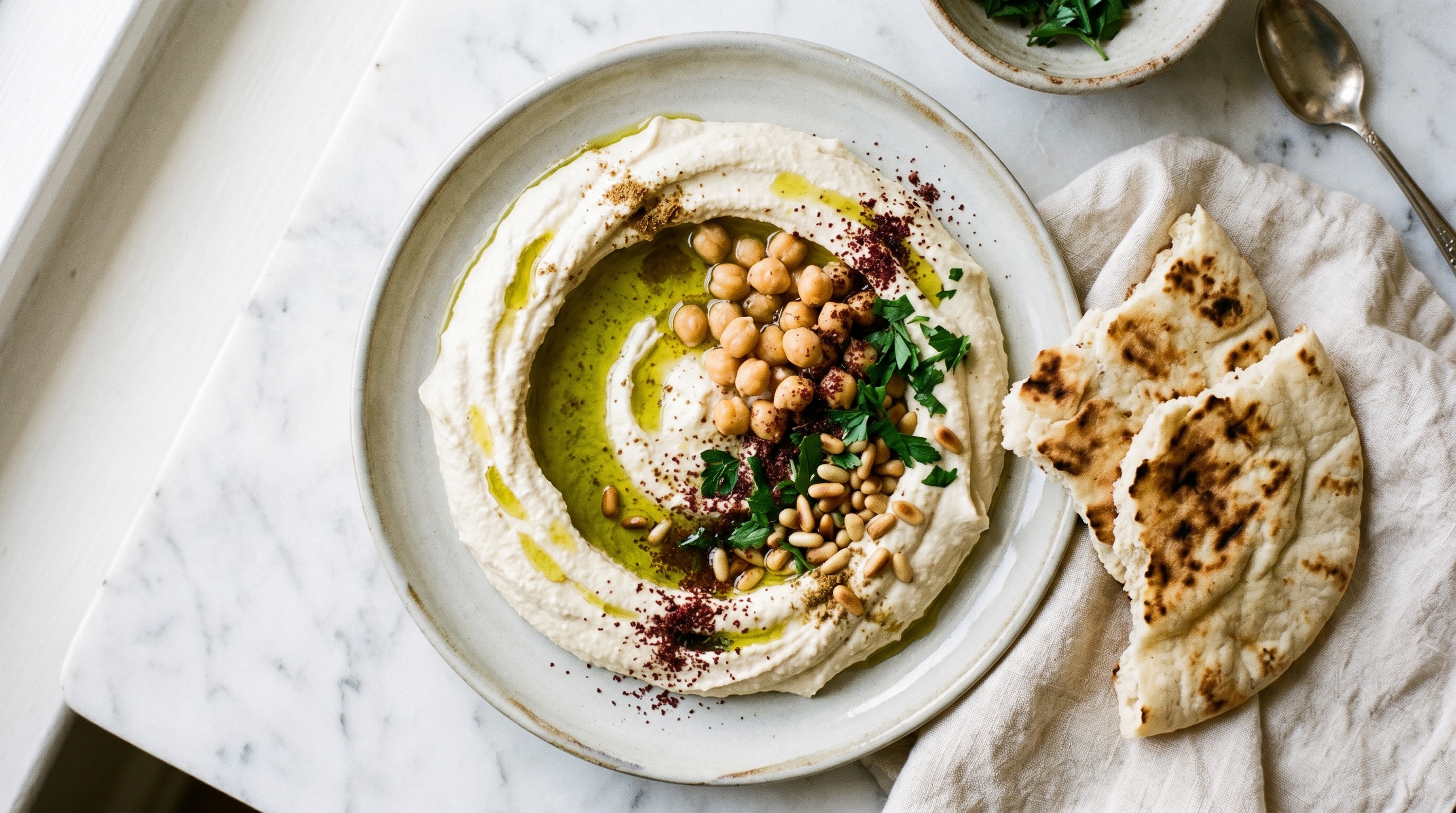
Warm pita on a dry skillet — 30 seconds a side, the surface should puff and brown slightly. Set out small dishes of olives, pickled vegetables, fresh tomatoes, sliced cucumber. Pour the hummus into a shallow bowl with the proper swoop. Drizzle the oil. Sumac, paprika, parsley.
Eat with your hands, scooping from the edge toward the center where the oil pools. Drink something cool — chilled white wine, beer, mint tea over ice. This is the Levantine table set: mezze, hummus, warm bread, the small dishes. The whole dish is the dish, and the hummus is the center.
The technique never moved. The dish never moved. The Lebanese cooks have been making it this way for centuries. The mistakes I made for fifteen years were entirely mine. Get the tahini right, get the chickpea right, blend with ice. The hummus will be the hummus.
FAQ
QCan I make hummus with canned chickpeas?
You can — it just won't be the same dish. Canned chickpeas are pre-cooked, but they're cooked to 'salad-firm,' which is far less soft than what hummus needs. The result is a denser, grainier hummus with more bean-skin texture, no matter how long you blend. If you must use canned, simmer the drained canned chickpeas in fresh water with 1/2 teaspoon of baking soda for 20 minutes before blending — this brings them closer to the proper softness. But the texture gap between dried-and-cooked and canned-and-simmered is real. The good Lebanese restaurants use dried for a reason.
QWhat is the best tahini brand?
Real Lebanese, Palestinian, or Israeli imports. Soom (Philadelphia, sourced from Ethiopia), Al Wadi (Lebanese), Seed + Mill (NYC, sourced from Ethiopian and Israeli seed), and Cortas (Lebanese) are the four that consistently deliver. Avoid Joyva (American, gritty, sweet), Krinos (Greek, fine but flat), and store-brand options (almost always made from low-quality seed). The tahini IS the dish — it's roughly 50% of the flavor and 80% of the texture. Spending an extra $5 on tahini matters more than any other upgrade you can make. Stir the jar from the bottom — separation is normal, but if the tahini has hardened into a dry brick, it's old and won't whip properly.
QWhy does the ice cube trick work?
Two mechanisms running simultaneously. First, mechanical: the ice cubes melt slowly under the blender blades, introducing cold water in micro-quantities and creating intense local agitation as each cube spins through the mix. This whips air into the hummus, creating a lighter, more aerated texture. Second, chemical: the cold temperature prevents the tahini emulsion from breaking under the heat of the blender motor (which can reach 150°F in a Vitamix during a 4-minute blend). The combination keeps the hummus white and silky instead of tan and dense. This trick is widely used in Beirut, Tel Aviv, and Jerusalem restaurants — it's how the famous hummusiya make their version. Most American recipes don't mention it, which is why most American hummus is yellower and heavier than the Levantine standard.
QWhy is my hummus tasting bitter?
Two likely culprits. (1) Old tahini — sesame oil goes rancid quickly once a jar is opened. If your tahini has been in the fridge more than 4 months, that's likely the source. Replace it. (2) Too much garlic. One medium clove is the standard for a full batch; two is the maximum for a strong hummus; three or more pushes the dish into bitter territory because raw garlic continues to develop allyl-sulfide compounds in the blender as it gets pulverized. If you've already over-garlicked, the only fix is to make a second batch with no garlic and blend the two together — the flavor cannot be removed once it's in.
QHow long does homemade hummus keep?
Refrigerated in an airtight container, 4 to 5 days. The texture is at peak in the first 24 hours; by day 3 it's noticeably denser and drier (the starches retrograde over time). Bring to room temperature for 20 minutes before serving and stir vigorously with a spoon to re-emulsify — a tablespoon of warm water or olive oil whisked in helps revive the texture. Do not freeze hummus; the freeze-thaw breaks the emulsion irreparably and the texture goes grainy.