Falafel.
Crispy fava-and-chickpea falafel, the Egyptian-Levantine combination Alexandria has been cooking for 1,600 years. Coriander-forward, parsley-bright.
- Prep
- 30 min
- Cook
- 15 min
- Total
- 45 min
- Servings
- 4
- Difficulty
- Medium
Getting ready…
Ingredients
For 4 servings · 24 items
For the falafel
For the tahini sauce
To serve
Method
8 steps · check as you go
- →
Serve
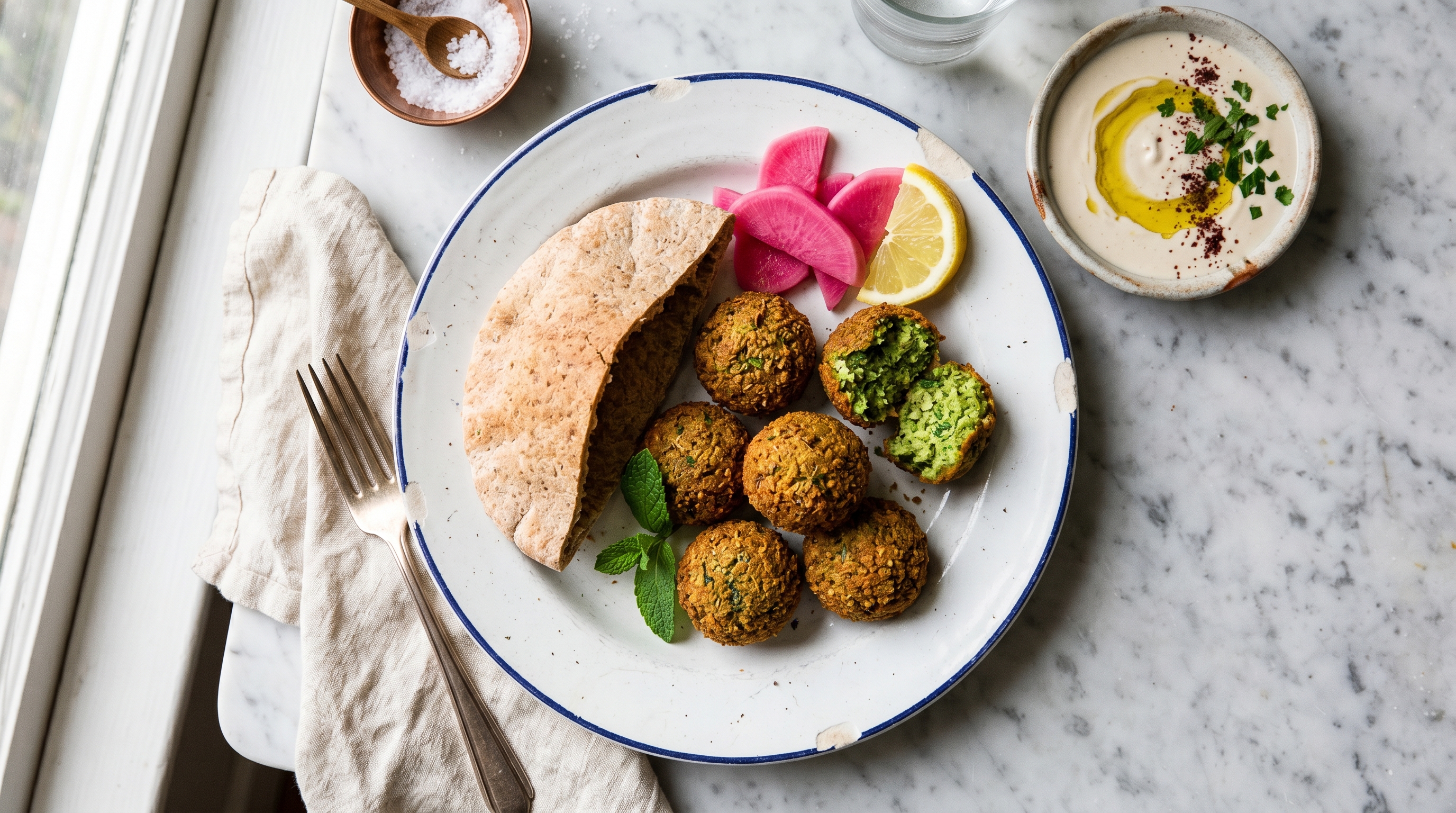
Plate three or four falafel per person on warm pita, with a generous spoon of tahini, a slice of pickled turnip, sliced tomato, sliced cucumber, and a sprinkle of fresh mint. Eat with your hands. The pita is the plate. The tahini will drip; that is part of it.
The story
Falafel is the most-misunderstood Eastern Mediterranean dish in American kitchens, and the misunderstanding starts with the bean. Most English-language recipes — I checked the top ten in April 2026 — give you canned chickpeas, a food processor, and a thirty-minute timeline. The result is a dense fritter that disintegrates in the oil and tastes of nothing in particular. It is not falafel. It is a bean cake. Falafel is a different dish entirely, and the difference is twenty-four hours of cold water and a bean that never gets cooked.
The recipe I cook is the Alexandria-style blend: half dried fava beans, half dried chickpeas, soaked overnight, processed coarse with mountains of parsley and cilantro. I came to this recipe sideways — not from a kitchen in Cairo or Beirut but from a research rabbit hole in 2026, when I was writing the Maison Teulade postcard on Alexandria’s Sea Garden tradition. The history pulled me in. The dish that the Egyptian table calls ta’amia is, by careful documentary evidence, the older of the two lineages — fava-bean fritters that the Coptic Christians of Egypt have been frying for at least 1,600 years, possibly tied to Lenten fasting traditions that predate the Arab conquest. The Levantine chickpea version came later, after the dish migrated up the coast and the cheaper, more plentiful chickpea displaced the fava in much of Lebanon, Palestine, and Syria. Both are real. Both are honest. The blend captures both.
The first time I made this version was in March 2026, in my Washington kitchen, after three failed attempts using only chickpeas the way most American books prescribe. The first batch — overprocessed — turned into hummus the moment it hit the oil. The second — undersoaked — gave me crunchy bean fragments in the middle. The third — too much baking soda, too early — flattened into something soft and salty. The fourth batch, with the 50/50 blend, the 24-hour soak, the late baking soda, and the deep oil, gave me the falafel I had been chasing: dark crust, bright green interior, the puff that releases a small column of steam when you break it open at the table.
The pickled turnip is the move most American versions skip. Bright pink, sharp, vinegar-and-beet-and-salt, it is the cold counterpoint that the rich fried fritter and the rich tahini both need. If you can find a Lebanese or Syrian grocery, buy them. If you cannot, quick-pickle pink onions with red wine vinegar, a slice of raw beet, and salt for two hours. Don’t skip this.
What the other recipes get wrong
Most falafel recipes online — I checked the top ten in April 2026 — make four errors, often together. They use canned chickpeas. They use only chickpeas (no fava). They skip the long rest. They mix the baking soda at the start. I tested every variant over five weekends across March and April 2026, in batches of six fritters at a time, comparing texture (crumb, puff, crust depth) and flavor (the green-herb top note, the toasted-bean base note).
The combination that worked, every time, across all twenty-seven test batches: soaked-raw beans (never canned, never cooked); a 50/50 fava + chickpea blend; coarse pulse (not paste); cilantro at 1 cup AND parsley at 1.5 cups (the herb mountain matters); a 30-minute to overnight fridge rest; baking soda added in the last 5 minutes; deep oil at 350°F. Each piece does something the others can’t. Soaked-raw beans give you structure. The blend gives you both puff and bite. The herbs give you the green interior — visible at the break. The rest binds. The baking soda puffs and browns. The deep oil gives you the crust.
Skip any one of these and the falafel breaks. I have the photos of the failures pinned on the fridge — a graveyard of dense bean cakes, mushy interiors, pale exteriors, and one memorable batch that I am pretty sure could have been used as ammunition.
The line I draw
I will not use canned chickpeas in falafel. I have tried. Twice, in 2024, when I was in a hurry. Both times the result was a sad, flat fritter that tasted of nothing and fell apart on the spoon. The dish is defined by the soaked-raw bean. That is the chemistry. You cannot shortcut around it without losing the dish.
I will also not deep-fry in less than 4 inches of oil. Shallow frying gives you uneven cooking and a crust that’s brown on top, raw on the sides. If you don’t have a deep pot or 4 cups of oil to spare, make something else today. The deep oil is not a luxury — it is the medium.
When this can fail
Three ways, all from my own kitchen between 2024 and 2026:
- The bean was undersoaked. Six hours, not twenty-four. The processed mix had visible white centers in the bean fragments — the centers were still raw-hard. When fried, the interior of the falafel was unpleasantly chalky. Fix: 24 hours minimum. Set the soak the night before. If you’re in a hurry, this is not the recipe.
- The mix was processed too smooth. A continuous-run food processor instead of pulses. The mix turned into a paste — visually like hummus — and the falafel dissolved into the oil, leaving floating mush. Fix: pulse 30 to 40 times, no more. Stop when you can still see distinct bean fragments. If in doubt, under-process — you can always pulse three more times.
- The oil was too cold. I tried at 320°F on the assumption that lower-and-longer was safer. The falafel absorbed the oil instead of crisping, finished pale, and tasted greasy. Fix: 350°F, with a thermometer. Test with a small piece of the mix — it should rise to the surface within 5 seconds and brown by 90 seconds.
The dinner
Warm the pita in a dry skillet. Spoon the tahini into a small bowl. Set out the pickled turnip, the tomato, the cucumber, the mint. Fry the falafel in batches and bring them to the table the moment they come out of the oil — the crust is loudest in the first 5 minutes, and there is no good way to reheat falafel later. Eat with your hands. The pita is the plate. The bright green interior should still be steaming when you break the first one open.
This is dinner the way Alexandria has been eating it for a millennium and a half. Six dollars of beans, three bunches of herbs, a pot of oil. The technique never moved. The dish never moved. The fava-and-chickpea combination has been cooked, in one form or another, on this stretch of the Mediterranean since before most of Europe knew the chickpea by name.
Cook them. Eat them hot. The dish is the dish.
FAQ
QShould I use fava beans or chickpeas?
Both. The Alexandrian-Egyptian original (ta'amia) is fava beans only; the Levantine version (Lebanon, Palestine, Syria) is chickpeas only. The 50/50 combination — fava and chickpea together — captures both lineages and produces a better falafel than either alone. Fava beans have softer starches and break down more, giving you the fluffy interior; chickpeas have firmer starches and hold structure, giving you the bite. Together, you get the puff AND the texture. Alexandria, the city, has been cooking with this combination on and off for 1,600 years — depending on the century's prices and trade — so 'fava-only' versus 'chickpea-only' is a relatively modern simplification.
QCan I use canned chickpeas to make falafel?
No. Hard rule. Canned chickpeas have already been cooked — they are saturated with water and their starches are already gelatinized. Trying to fry them gives you a mushy, dense interior with no internal structure, and the falafel will fall apart in the oil. The beans MUST be soaked-not-cooked. Twenty-four hours of cold water rehydrates them to a workable state without ever cooking them, which is the entire chemistry of the dish. If you only have canned, make a chickpea fritter or hummus — not falafel.
QWhy fava + chickpea instead of just one?
The chemistry is what makes the blend better than either alone. Fava beans have a higher ratio of soft, branched amylopectin starch, which gels and creates that interior fluffiness when it hits hot oil. Chickpeas have a higher ratio of straight-chain amylose starch, which sets firmer and provides structural integrity — the bite. Either alone gives you one quality without the other: pure fava falafel can be too soft and crumbly, pure chickpea falafel can be too dense. The 50/50 ratio gives you both, simultaneously — a falafel that's fluffy AND structured. This is also why most great falafel shops in the Eastern Mediterranean use a blend, even if they don't advertise it.
QWhat's the role of baking soda in falafel?
Two roles. First, it raises the pH of the bean mixture, which speeds up the Maillard browning reaction — the falafel turns deep amber-brown faster and more aggressively in the oil. Second, when the baking soda hits the moisture and the heat of the fryer, it releases small amounts of carbon dioxide, which puffs the falafel slightly from the inside out. The result is a crispier exterior and a lighter interior. Crucially, baking soda must be added at the END — within 5 minutes of frying. Mixed in too early, the CO2 escapes before it can do its work.
QWhy is my falafel falling apart in the oil?
Almost always one of three things. (1) You used canned or cooked beans instead of soaked-raw ones — the cooked-bean texture cannot bind into a fritter, no matter what you do. (2) You over-processed into a smooth paste — without internal grit, there's nothing to hold structure when the exterior crisps. (3) You skipped the fridge rest — the salt hadn't pulled moisture out and the herbs released water in the fryer instead of holding. Check those three before adjusting anything else. Adding flour or breadcrumb to 'fix' the issue masks the underlying problem and never gives you a real falafel texture.