The sea, the garlic, the gloss.
Spaghetti alle Vongole.
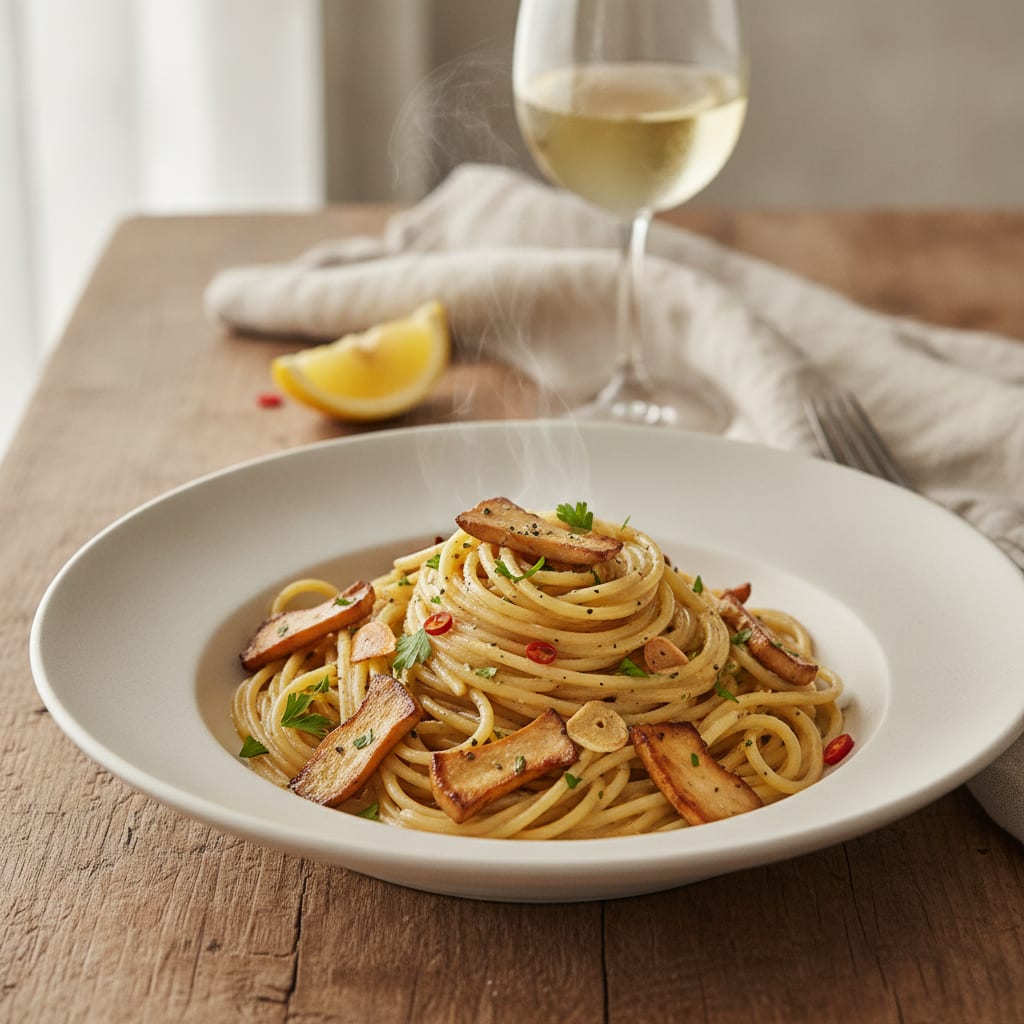
Naples' clam spaghetti, two ways: king oyster 'clams', a kombu-and-dulse sea broth for the briny note, garlic, chilli and parsley, emulsified with pasta water.
- Prep
- 15 min
- Cook
- 25 min
- Total
- 40 min
- Servings
- 4
- Difficulty
- Medium
Getting ready…
Ingredients
For 4 servings · 14 items
For the sea broth
For the clams
For the sauce
Method
7 steps · check as you go
- →
Serve
Serve immediately in warm shallow bowls, each portion twirled into a nest so the glossy sauce clings high and pools nowhere, finished with parsley and a thread of olive oil. No cheese — vongole in bianco never takes cheese in Naples. A cold Falanghina or a Greco di Tufo, the Campanian whites, are the pour.
The story
Spaghetti alle vongole is a Neapolitan argument with a coastline. Naples gave it to the world — vermecielle cu ‘e vongole in the dialect — and the first recipe we can point to, in Ippolito Cavalcanti’s Cucina Teorico-pratica of 1839, was barely five things: pasta, oil, garlic, parsley, clams. No tomato. The tomato came later, and it started a fight that has never ended: in bianco or in rosso, white or red, with the city’s purists holding the line that the real one is white, clear, and tastes only of the sea.
I learned it in the kitchen where I learned everything, in Naples, in the summer of 2015 — Da Concettina, where I spent two years. The cook who taught me, a wiry man from the Spanish Quarter named Salvatore who smoked between courses and called me francese for two years straight, made vongole in bianco at staff meal and would not let me near the cheese. “Niente formaggio sul mare,” he said. No cheese on the sea. He showed me the part everyone gets wrong, too — not the clams, but the wrist. He tipped the pasta in underdone, threw in a ladle of cloudy water, and tossed the pan so hard the spaghetti jumped, and a watery puddle turned glossy in front of me. “Questo è il piatto,” he said. This is the dish. The emulsion, not the shellfish.
This vongole has no clams in it. It has king oyster mushrooms seared hard and brined with miso for the bite, and a quick broth of kombu and dulse for the briny liquor the clams would have given. The method is exactly Salvatore’s — garlic and chilli to pale gold, deglaze, the sea broth, then the hard toss with starchy water until it gleams. It is not a “vegetable version” of vongole. It is vongole in bianco, made with the wrist that matters.
À la maison
The weeknight reading is the recipe above, and it asks one thing of you: toss like you mean it. The sauce is not poured, it is built — you tip in the underdone pasta and a splash of its starchy water and you work the pan hard for a minute and a half until a thin puddle becomes a glossy coat. That motion is the whole dish. Get the sea broth made first (ten quiet minutes), sear the mushrooms hard, take the garlic only to pale gold, and keep a full mug of pasta water within reach. Salt last — the kombu, dulse, and miso have already brought the salinity of the sea.
Au bistrot
The bistronomique reading is the same dish plated as a tight, composed nest with the sea note concentrated and the “clams” presented as a deliberate garnish.
Reduce the kombu-and-dulse broth by half into a glossy, intense clam jus and mount it with a little olive oil so it emulsifies into a sauce that ribbons off the spoon. Take the king oyster further: cut the stems into thick clean medallions, score them in a fine crosshatch, sear them hard, and lacquer them with the miso so they read, unmistakably, as plump shucked clams. Cook the spaghetti, emulsify it with starchy water and a smaller amount of the jus so the strands are glossy but the pasta leads, and roll it into a tight nest with a carving fork and ladle. Stand the nest in a wide shallow bowl. Lay the seared “clams” around it like opened shells, spoon the concentrated jus around the base so it pools and shines, and finish with a fine chiffonade of parsley, a scatter of toasted breadcrumb for crunch, a fleck of red chilli, and a single thread of lemon oil. A dusting of dried dulse, powdered, dusted over the rim like sea spray.
Il piatto — Overhead, then a tight three-quarter on the nest. Wide white bowl, the spaghetti nest centred and high, the seared “clams” arranged around it like opened shells, the reduced jus pooled glossy at the base. Parsley green, a fleck of chilli red, a dust of dulse at the rim. Negative space and steam. The plate should say the sea, distilled — coastal Naples read at a white tablecloth, clean and bright.
What the other recipes get wrong
Most meatless vongole recipes online — I read the top ten in February 2026 — make the same two errors: they fake the sea with a glug of fish-sauce-substitute or nothing at all, and they never build the emulsion, so the dish arrives as oily pasta in a watery puddle. Vongole in bianco is a two-part trick — the briny liquor and the gloss — and most recipes miss both. I ran the test over a week in February 2026, four pans, same mushrooms, same garlic and chilli, same toss, changing only the source of the sea note:
- Water only, no sea element: garlicky, pleasant, but it tasted of aglio e olio with mushrooms in it. No sea, no reason to call it vongole.
- Salt and a squeeze of lemon: brighter, but flatly salty — saline without the mineral, oceanic depth that makes shellfish taste of the sea.
- Kombu broth only: savoury and round but oddly inland; the glutamate was there but the actual smell of the sea was not.
- Kombu + dulse broth + miso on the mushrooms: saline, mineral, faintly oceanic — it smelled like a clam pan the moment it hit the heat. Not close. A different category of dish.
The reason is that the taste of the sea is not just salt. Shellfish get much of their characteristic flavour from succinic acid, which reads as a briny, umami-adjacent shellfish note, working alongside the free glutamate in the clam meat. Kombu supplies the glutamate; dulse supplies the saline, mineral, oceanic character — it is used in Nordic kitchens precisely as a sea-flavour seaweed; and the miso adds a fermented, just-shucked savour. Salt alone gives you saline but flat. Build the broth from kombu and dulse and you rebuild the actual liquor the clams release when they open — the part Salvatore in Naples would catch in the pan and never let me waste. That broth, emulsified glossy with starchy pasta water, is what makes the dish vongole and not garlic mushroom spaghetti.
The line I draw
I will not grate cheese over vongole, and I will not let the sauce stay watery. Two rules, both from Naples. No cheese on the sea — vongole is built on the clean salinity of shellfish, and parmesan smothers exactly the note the whole dish is about; it is the one thing a Neapolitan cook will physically stop your hand to prevent. And no watery sauce — vongole in bianco is defined by its gloss, the emulsion of oil and briny broth and starch tossed until it clings, and a recipe that skips the hard mantecatura gives you a puddle and calls it dinner. Toss the pan until it gleams, and leave the cheese in the fridge. Salvatore was right on both.
When this can fail
Three ways, all from my own kitchen between 2022 and 2026:
- The watery puddle. Tipped the pasta in and stirred it politely instead of tossing it hard; the sauce never came together and sat in a thin pool under the spaghetti. Fix: pull the pasta a minute short, keep a mug of its starchy water, and toss the pan with real energy for a full 60–90 seconds until it turns glossy.
- The bitter garlic. Walked away while the garlic browned past gold; the whole pan carried an acrid, burnt edge that no amount of wine or lemon covered. Fix: cook the garlic gently to pale gold only, and pull the pan off the heat the moment it’s fragrant.
- The flat, inland taste. Used kombu broth alone and skipped the dulse; it was savoury but never smelled of the sea, and the dish read as mushroom pasta. Fix: include the dulse (or nori) for the oceanic note and the miso smear on the mushrooms for the briny savour — that’s what makes it taste of shellfish.
FAQ
QCan you make spaghetti alle vongole without clams?
Yes, because the dish in bianco is built from garlic, chilli, good oil, white wine, parsley, and the briny liquor the clams release — and that liquor is the part you can rebuild. King oyster mushrooms, seared hard and smeared with a little miso, give the dense, springy chew of clam meat. A quick broth of kombu and dulse steeped below a simmer gives the glutamate and the genuine oceanic, saline note. Emulsified glossy with starchy pasta water, it reads as vongole because it follows the same method — the mantecatura and the sea broth doing the work the live clams used to.
QWhat is the difference between vongole in bianco and in rosso?
In bianco (white) is the original Neapolitan version: no tomato at all, the sauce kept clear and built only from olive oil, garlic, chilli, the clams' own briny liquor, and parsley, so the salinity of the sea comes through clean. In rosso (red) adds tomato — either a full sauce or just a handful of crushed cherry tomatoes. Naples argues about it endlessly; the bianco is considered the mother recipe and the purist's choice, and it is the one this recipe follows. The first recorded version, in Ippolito Cavalcanti's 1839 Neapolitan cookbook, was in bianco — pasta, oil, garlic, parsley, clams.
QWhy is my vongole watery instead of glossy?
You skipped or rushed the emulsion. After the pasta goes in the pan, you have to toss it hard over the heat with starchy pasta water for a full 60–90 seconds — the mantecatura — so the oil, broth, and starch bind into a clinging sauce. If you just stir it gently it stays a watery puddle. Pull the pasta a minute short of al dente, keep a mug of its starchy water, and toss with energy, adding splashes until the sauce coats every strand and pools nowhere.
QHow do I get the briny sea flavour without seafood?
Two moves. A quick broth of kombu and dulse (or nori) steeped in hot water below a simmer gives both the glutamate savour and the genuine saline, mineral smell of the sea. Dulse in particular carries that oceanic note. Then a smear of light miso on the seared mushrooms adds the just-shucked, briny savour. Shellfish get much of their distinctive taste from succinic acid alongside glutamate, and that umami-saline combination is exactly what the kombu, dulse, and miso rebuild.
QShould I put cheese on spaghetti alle vongole?
No. In Naples and across coastal Italy, seafood pasta — and vongole above all — is served without grated cheese; the rule is firm enough that asking for parmesan over vongole marks you out instantly. The dish is built on the clean salinity of the sea and the brightness of garlic, chilli, parsley, and lemon, and cheese muddies all of it. Finish with parsley and a thread of raw olive oil instead.