Cheese and pepper, rebuilt.
Cacio e pepe.
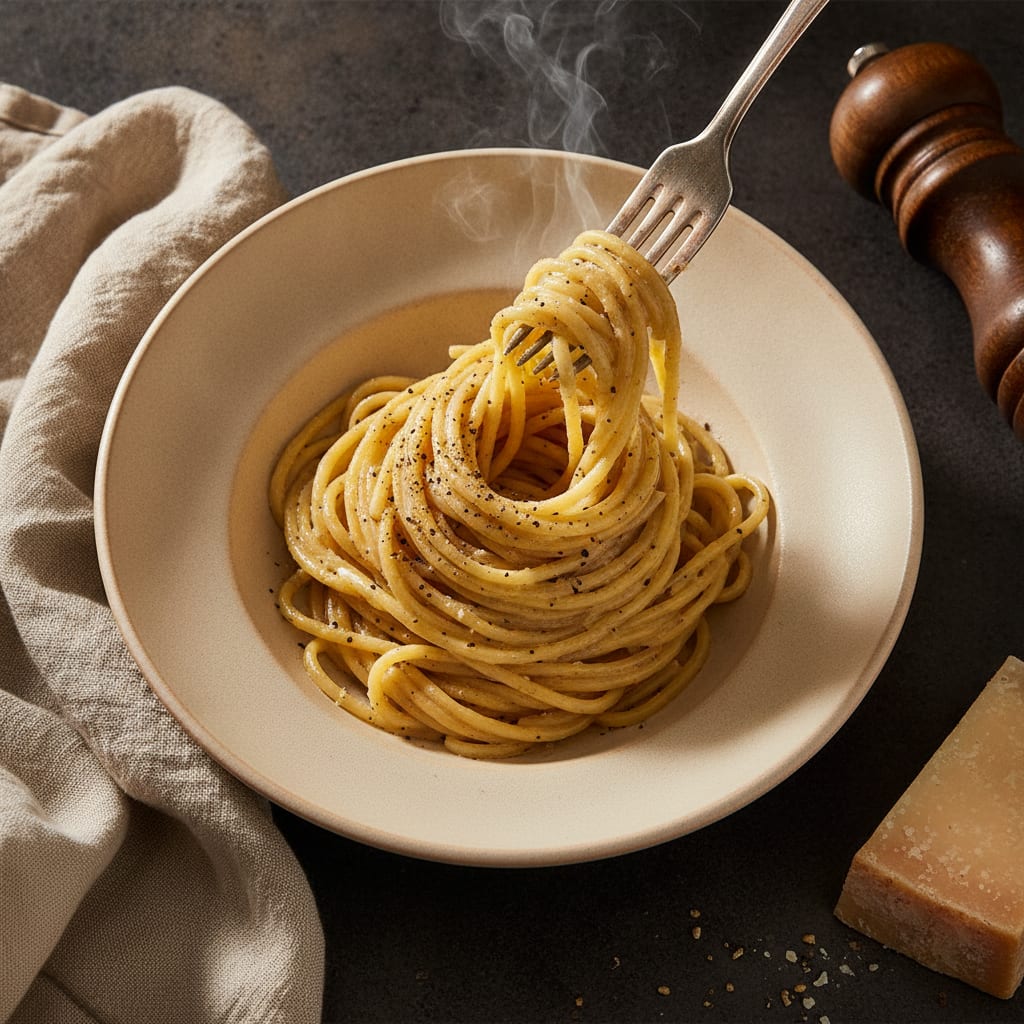
The Roman pasta, two ways: tonnarelli mantecato in a starch-and-savory-cream emulsion standing in for pecorino, with black pepper toasted whole and cracked coarse.
- Prep
- 10 min
- Cook
- 20 min
- Total
- 30 min
- Servings
- 2
- Difficulty
- Medium
Getting ready…
Ingredients
For 2 servings · 10 items
For the savory cream
For the pasta
Method
6 steps · check as you go
- →
Serve
Serve in warm bowls, twirled into tight nests, immediately, with extra coarse black pepper at the table. This is a course on its own — nothing else on the plate. A crisp Frascati or a Cesanese from Lazio is the Roman pour. If the sauce ever tightens before it reaches the table, loosen it with a splash of hot pasta water and toss again.
The story
Cacio e pepe is Roman, but I learned what makes it work in Naples, in the spring of 2015, at Da Concettina, where I spent two years with my hands in dough and salt. It isn’t a Neapolitan dish and nobody pretended it was — but Concettina’s old cook made it for the staff one slow afternoon, and she made it the way she made everything: with violence and attention. She cooked the pasta in barely enough water to cover it, scandalously little, and when I asked why she just said the water had to be thick. Then she tossed the pan off the flame, hard, for a full minute, her wrist a blur, until the cheese and the cloudy water turned to one glossy sauce that hung off every strand. Cacio e pepe — cheese and pepper. Two ingredients and one technique, and the technique is most of it.
The history is shepherds’ history. Cacio e pepe came out of the cucina povera of the Roman countryside and the shepherds who moved their flocks across Lazio in the transhumance, carrying the three things that wouldn’t spoil on the road: dried pasta, hard aged pecorino, and black peppercorns. Durable, light, nourishing. The whole dish is those three things and the starchy water you cook the pasta in — no butter, no cream, no oil, no garlic. The silk is an emulsion, nothing more.
So this one has no pecorino, and it still has the silk, because the silk was never really the cheese — it was the emulsion. A blended cashew-and-miso cream stands in for the pecorino’s body and funk, lemon for its sharp sheep’s-milk tang, and the sauce comes together the way it always did: starchy water, savoury fat, and a hard toss off the heat. It is not a “dairy-free cacio e pepe.” It is cacio e pepe, built on the emulsion that was always the point.
À la maison
The weeknight reading is the recipe above, and it asks for two things home cooks usually skip. First, cook the pasta in less water than feels right, so the cooking liquid runs thick and starchy — that starch is the sauce. Second, do the mantecatura: pull the pan off high heat and toss the pasta hard with the cream and a splash of that starchy water, for a full minute, until it turns glossy and clings. A teaspoon of cornstarch in the pan is cheap insurance against the sauce splitting. Toast the pepper whole and crack it coarse. It’s a fifteen-minute dish that lives entirely in the wrist.
Au bistrot
The bistronomique reading keeps the two ingredients and the one technique, and composes the plate around a perfect nest. Use fresh tonnarelli rolled and cut on the chitarra if you can — its porous, square-cut surface grips the emulsion in a way dried pasta can’t — and cook it to a precise, even doneness. Build the savory cream a touch richer and tighter so the sauce reads as a glossy lacquer rather than a loose coat. Toast the pepper in two grinds: most cracked coarse for the toss, a little ground finer and bloomed in a drop of warm oil to brush as an aromatic base on the warm bowl. Twirl the pasta into a tall, deliberate nest with a fork and ladle, set it dead-centre, and pour any held-back cream around the base as a thin moat so the plate has two textures of the same sauce — the clinging coat and a pooled gloss. Finish with a single coarse crack of pepper laid across the top and, if you like, a feather of crisp toasted pangrattato at the edge for a whisper of crunch against all that silk. Restraint is the plating: one nest, one sauce, one spice, nothing else.
Le dressage — Overhead, tight and centred. Warm-white shallow bowl, one tall twirled nest of glossy tonnarelli dead-centre, a thin moat of pooled cream around the base. Heavy coarse pepper laid across the top, a few crumbs of pangrattato at one edge. Steam, hard side light, dark stone. The plate should say two ingredients, total control — austerity, not garnish.
What the other recipes get wrong
Most plant-based cacio e pepe recipes online — I read the top ten in May 2026 — pour in coconut cream or a roux and call the resulting beige sauce “creamy.” It is creamy. It is not cacio e pepe; it’s an alfredo wearing pepper. The dish is an emulsion, not a cream sauce, so I built the binder as the variable. I ran the test over a week in May 2026, four batches, same savory cream, same pepper, same pasta, only the emulsion strategy changed:
- Savory cream + normal (thin) pasta water, tossed: split on contact with the pasta — clumps of cream and a watery pool, the dreaded broken sauce.
- Savory cream + coconut cream, no toss: smooth but flat and heavy, no cling, no gloss — a beige blanket, not an emulsion.
- Savory cream + very starchy water from less liquid, hard mantecatura: glossy and clinging, real emulsion — but it split the moment the pan stayed over high heat too long.
- Savory cream + starchy water + 1 tsp cornstarch, tossed off the heat: glossy, stable, clinging, repeatable — it held even when I let it sit a minute. This was the one.
The science here is settled, and recently. In 2025, eight Italian physicists — several working at the Max Planck Institute in Dresden — published a phase study of cacio e pepe sauce in Physics of Fluids, and found that starch concentration is the single factor that decides whether the sauce is silky or splits. Below about 1% starch relative to the cheese mass, the proteins clump into what they named the “mozzarella phase”; their optimal window was roughly 2–3% starch, with cornstarch as a reliable stabiliser and too much (above ~4%) turning it stiff. That is exactly what Concettina’s cook knew in her wrist: cook the pasta in less water so the water runs thick, and you’ve loaded the starch the emulsion needs. The cornstarch I add is the lab’s insurance, dialed to that 2–3% window. And the mantecatura — tossing off high heat — is what actually emulsifies it; high heat is what breaks it, every time. Across all four batches, starchy water plus a measured pinch of cornstarch, tossed off the flame, was the only one that held.
The line I draw
I will not finish cacio e pepe over high heat. The temptation is real — the pan is right there on the flame, the sauce looks loose, and the instinct is to cook it tighter. Do that and you break it: the proteins seize, the emulsion splits into greasy clumps and a thin puddle, and there is no tossing it back. The emulsion comes together off the fierce heat, with the pasta’s own warmth and a hard wrist doing the work, the way the Naples cook did it with the pan half off the burner. The moment you chase creaminess with the flame, you lose the creaminess. Mantecare off the heat, or don’t make cacio e pepe.
When this can fail
Three ways, all from my own kitchen between 2022 and 2026:
- The broken sauce. Tossed the savory cream into pasta cooked in a big pot of thin water, over a high flame, in a hurry. It split into clumps and a watery pool instantly. Fix: cook the pasta in less water so it’s properly starchy, add the teaspoon of cornstarch, and emulsify off high heat — the 2025 physics, applied.
- The brutal salt. Salted the pasta water as heavily as usual, forgetting the miso, yeast, and reduced water all carry salt; the finished dish was inedibly sharp. Fix: salt the water lightly, about half normal, and correct at the very end if it needs it.
- The dusty pepper. Used pre-ground pepper once when I was out of whole, and the dish tasted of nothing but a flat, papery heat. Fix: toast whole peppercorns and crack them coarse — the toasting blooms the piperine and oils that pre-ground pepper lost long ago.
FAQ
QHow do you make cacio e pepe without cheese?
Replace the pecorino with a blended savory cream — cashews for body, white miso and nutritional yeast for the aged-cheese glutamate and funk, and lemon juice for the sharp lactic tang of sheep's milk. The silkiness comes the same way the real dish gets it: from emulsifying starchy pasta water through vigorous tossing (mantecatura). A teaspoon of cornstarch stabilises the emulsion so it stays creamy and doesn't split. Toast whole black peppercorns and crack them coarse for the pepper. Built and tossed like the original, it reads as cacio e pepe, not a cream sauce.
QWhy does cacio e pepe sauce break or clump?
Classic cacio e pepe breaks when the cheese hits liquid that's too hot or too thin: the proteins seize into stringy clumps instead of emulsifying. A 2025 physics study of the sauce found that starch concentration is the key — below roughly 1% starch relative to the cheese, the sauce separates into what the authors named the 'mozzarella phase.' The fixes are the same here: use very starchy water from cooking pasta in less liquid, reduce it, add a little cornstarch as insurance, and emulsify off high heat by tossing rather than boiling.
QWhy toast the black pepper for cacio e pepe?
Toasting whole peppercorns in a dry pan blooms their volatile aromatic oils and the piperine that gives pepper its heat and fragrance — compounds that pre-ground pepper has already lost to the air. Toast them whole until just fragrant, then crack them coarsely in a mortar so you get bursts of heat and a little crunch rather than a flat, dusty background. Pepper is half the dish's name; it deserves to be fresh, toasted, and coarse.
QWhat is mantecatura?
Mantecatura is the Italian technique of vigorously tossing and stirring drained pasta with a little of its starchy cooking water and the fat or sauce, off high heat, until it emulsifies into a single glossy sauce that clings to every strand. It's the difference between sauce sitting in a puddle and sauce coating the pasta. For cacio e pepe it's everything: the toss is what binds the starch, water, and savory cream into the creamy emulsion.
QWhat pasta shape is traditional for cacio e pepe?
In Rome, tonnarelli — a fresh square-cut egg-free pasta about as thick as a fat spaghetto, also called spaghetti alla chitarra. Its rough, porous surface grips the sauce better than smooth dried spaghetti. Spaghetti or bucatini are common stand-ins and work well; the key is a sturdy long shape and cooking it in less water so the cooking liquid is good and starchy. Cook to just shy of al dente, since it finishes in the pan.