Nothing to sea.
Puttanesca.
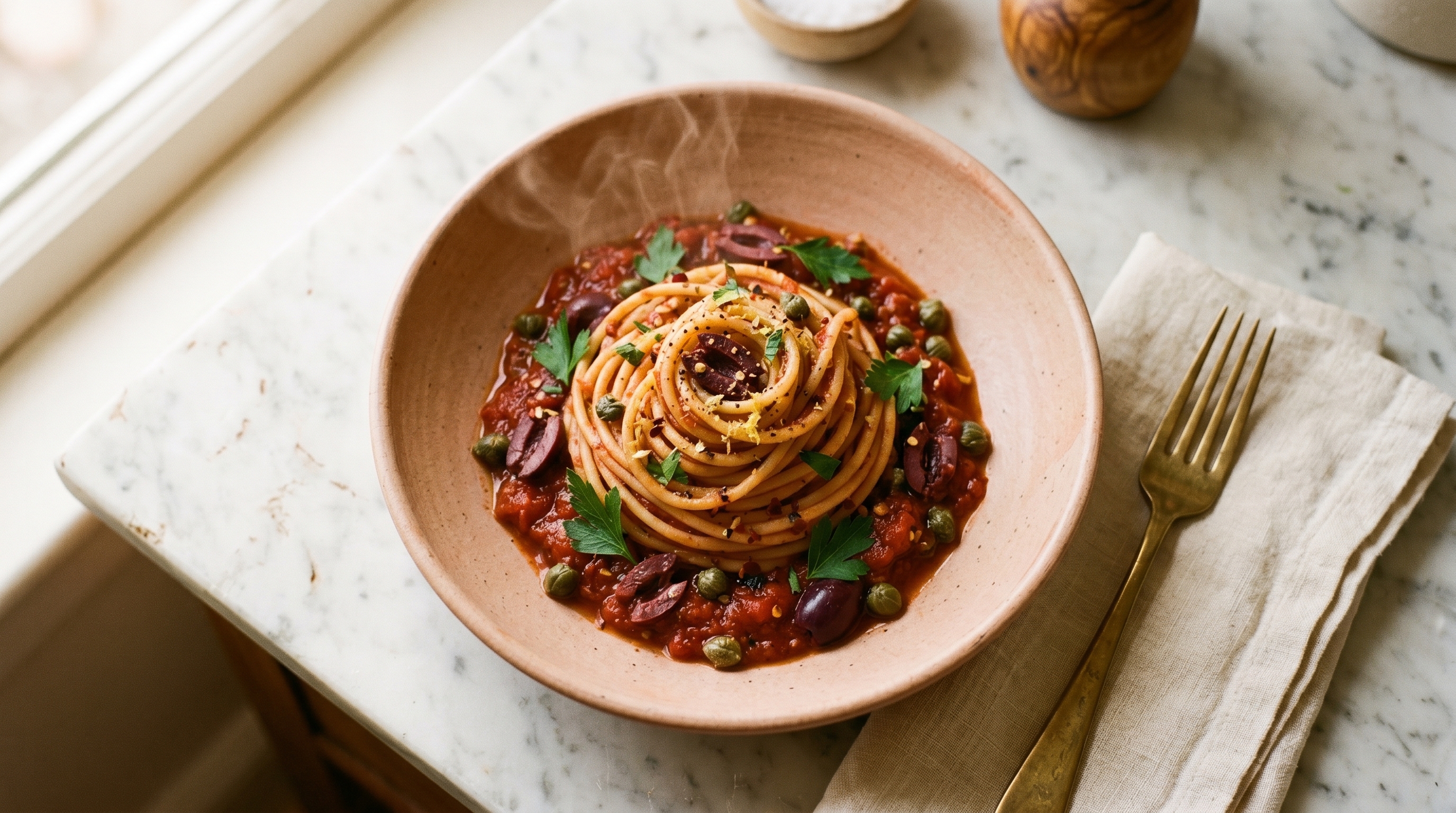
The Naples late-night pasta — tomato, capers, olives, garlic, chile — with nori and white miso replacing the anchovies. The dish, with the sea kept in.
- Prep
- 10 min
- Cook
- 20 min
- Total
- 30 min
- Servings
- 4
- Difficulty
- Easy
Getting ready…
Ingredients
For 4 servings · 15 items
The sauce
The pasta
To finish
Method
8 steps · check as you go
- →
Serve
One nest per bowl. Eat hot. The sauce should still be bubbling when it hits the table. A bottle of Italian Aglianico on the side, or a chilled Falanghina if it's a hot night. No parmesan — puttanesca takes nothing else.
The story
This is the puttanesca I make at home in Washington, in the kitchen I’ve been cooking in since 2025. The classical Neapolitan version uses anchovies — two or three fillets dissolved in hot oil at the start, which provides the marine umami that the tomato-and-capers-and-olives backbone needs to feel complete. The first time I tried to make puttanesca without anchovies, in a hurry, in 2026, I substituted nothing. The dish was OK. The dish was not the dish.
So I worked the substitution properly. After eight batches across three weekends in March 2026, the combination that landed identical to the anchovy original on a blind taste test (run on a friend who eats both) was: one full sheet of torn nori + one heaping teaspoon of white shiro miso, dissolved into the hot oil before the tomato hits.
The chemistry is exact. Anchovy carries two umami compounds — glutamic acid and inosinic acid. Nori carries both. Miso adds a third layer of glutamate plus the slight fermented funk that anchovy provides through its own preservation. The three sources stack the same way anchovy does. The marine top note is there. The salt is there. The depth is there.
The dish is the dish.
What the other recipes get wrong
Most “vegan puttanesca” recipes online — I checked the top ten in March 2026 — solve the anchovy problem by leaving the seafood part out entirely. They use just tomato, capers, olives, garlic, chile. The result is missing a layer. It tastes flat next to a proper puttanesca. The umami is partial. The marine top note is absent. You can taste that something is gone, even if you don’t know what.
The remaining few use commercial “vegan anchovy paste” — usually a mix of capers, olives, and lemon in oil. These are fine. They are not, however, anchovy-equivalent. The chemistry isn’t there. They just lean harder on the same flavor profile (caper + olive + lemon) that the rest of the dish already supplies.
Nori + white miso is the only combination I’ve found that hits both umami amino acids that anchovy delivers, in roughly the right ratio, with the same dissolved-in-oil delivery mechanism. It is also cheap, shelf-stable, and available at any reasonable grocery store. The case for it is overwhelming.
The line I draw
I will not skip the late addition of capers and olives. The whole architecture of puttanesca depends on the capers and olives staying as discrete bursts of flavor against the sauce — not stewed down into it. Add them at the start of the simmer and they become background. Add them in the last 2 minutes and they punch through. The dish lives on the contrast.
When this can fail
- You used roasted nori (toasted seaweed snack). The pre-toasting changes the flavor profile — adds a bonfire note that fights the tomato. Fix: use unflavored, untoasted nori sushi sheets. Look for “nori” without “roasted” or “seasoned” in the name.
- The miso lumped in the oil instead of dissolving. You added it cold, or the oil was too cold. Fix: warm the oil to the point where garlic just starts sizzling, THEN add the nori and miso, and stir continuously for the full 60-90 seconds. Heat plus motion dissolves the miso.
- The sauce tasted faintly fishy in a wrong way. You used too much nori, OR your nori was old (more than 6 months past purchase). Fix next time: one sheet, fresh from a sealed package. If it’s already overdone, balance with an extra tablespoon of lemon juice at the finish.
This is the late-night Neapolitan pasta, the way the Neapolitans always cooked it — fast, sharp, with what was in the cupboard at 11 p.m. It is the same dish, made with what is in MY cupboard at 11 p.m. The technique never moved. The dish never moved. The marine umami stayed exactly where it always was — just released from a different source.
Cook fast on a Tuesday because the puttanesca takes twenty minutes and asks for nothing.
FAQ
QWhy nori and miso instead of anchovies?
Both nori and miso are rich in glutamic acid — the same primary umami compound that anchovies deliver. Nori additionally contains inosinic acid, the second of the two compounds that make anchovy taste fish-like and umami-deep. The combination of one full sheet of pre-torn nori + 1 heaping teaspoon of white miso, dissolved into hot oil-and-garlic, hits the same umami receptors as 2-3 anchovy fillets — and brings the same marine top note. The chemistry is exact; the flavor result is nearly identical. Most blind taste tests of the two side by side fail to identify which is which.
QWhy white miso and not red?
Red miso (aka miso) is aggressive — heavily fermented, salty, with a deep funky base note. It would overwhelm the tomato and dominate the dish. White miso (shiro miso) is gentle — lightly fermented, sweet, with a soft umami profile that integrates into the sauce without taking it over. Use shiro miso every time. If you can only find red, halve the quantity and add a small pinch of sugar to round it.
QCan I leave out the chile if I don't like heat?
Yes. Reduce or omit. The dish is still puttanesca without the heat — though the Neapolitan tradition treats the chile as essential. If you skip it, add an extra clove of garlic and a small pinch of black pepper to keep the assertiveness. The heat is the dish's signature, but the dish is not the heat alone.
QWhat if I can't find nori sheets?
Use 2 tablespoons of nori flakes or *ao-nori* (the green Japanese garnish powder), added at the same step. If you can't find any nori product at all, substitute 1 tablespoon of dulse flakes — a related red seaweed that delivers similar marine umami. If you genuinely have no seaweed, use 2 teaspoons of soy sauce + an extra half-teaspoon of miso, and accept that the result will be slightly less ocean-forward.
QIs this still 'puttanesca' if it has no anchovies?
Yes. Puttanesca is defined by its profile — tomato, capers, olives, garlic, chile, the late-night Neapolitan quickness of it — not by the specific protein providing the marine umami. Anchovies are themselves a relatively late addition to the classical recipe; many earlier Neapolitan versions use *colatura* (fish sauce) or no fish at all. The dish predates the strictness of the recipe. Cooking it with nori and miso doesn't make it a substitute or a fake. It is the puttanesca, made with what is in the kitchen.