Under the forked crust.
Shepherd's Pie.
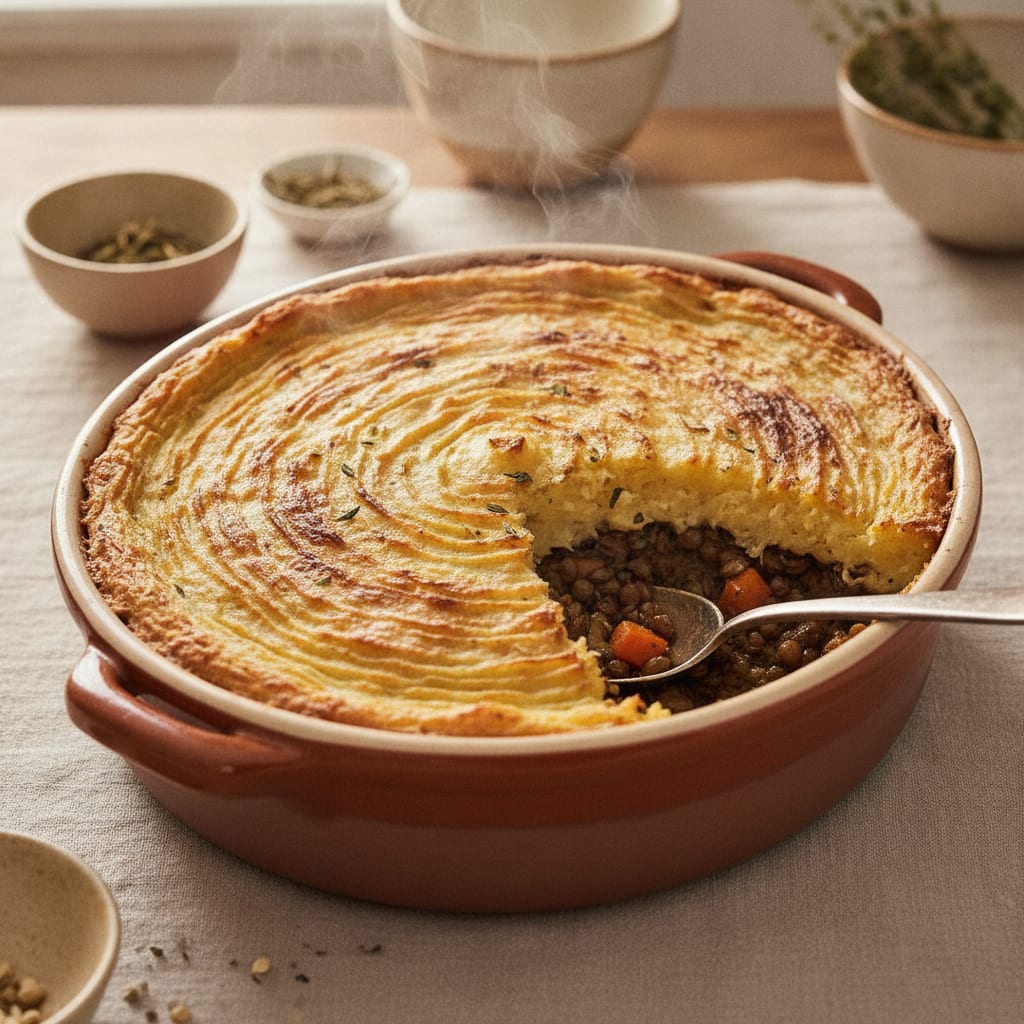
The British comfort classic, two ways: a deep lentil-and-mushroom braise under a forked, crisp-ridged mashed potato crust browned hard at the top.
- Prep
- 30 min
- Cook
- 1h
- Total
- 1h 30min
- Servings
- 6
- Difficulty
- Medium
Getting ready…
Ingredients
For 6 servings · 20 items
For the potato crust
For the filling
Method
7 steps · check as you go
- →
Serve
Scoop straight from the dish, making sure each portion gets crisp crust and dark filling. Serve with buttered greens or minted peas and a slick of more gravy if you like. A pint of bitter or a glass of rough red is the pub pour. Leftovers hold 4 days and reheat well in a hot oven to re-crisp the top.
The story
I cooked through a London season in 2023, the year I spent a good part of the winter behind the pass of a gastropub on a corner in Stoke Newington — the kind of place with a coal fire, a chalkboard, and a Sunday roast that ran out by three. The head chef there made a shepherd’s pie that sold out every service, and the first time I watched him finish one he did something I thought was fussy: he dragged a fork over the whole top, slowly, deliberately, raising it into ridges before it went into the oven. I asked why. He looked at me like I’d asked why the sky was up. “More edges,” he said. “More crisp.” Then he went back to the ticket rail. That was the entire lesson, and it was correct.
There is a tidy story people tell about this pie — shepherd’s means lamb, cottage means beef, and never the two shall meet. It is mostly a modern invention. “Cottage pie” is the older name, written down in 1791 in the diary of a Norfolk clergyman, the Reverend James Woodforde, who recorded eating “Cottage-Pye.” “Shepherd’s pie” doesn’t show up in print until the middle of the next century. For most of their lives the two names were swapped freely and the recipes often didn’t name the meat at all. The pie was always defined by its potato crust over a braise — a thrift dish from the years when the potato arrived as cheap food for the rural poor, and yesterday’s scraps got a mashed lid and a second life.
So this pie has no lamb in it. It has a dark braise of brown lentils and hard-browned mushrooms under a forked, crisp-ridged mashed potato crust. The architecture is the architecture: soffritto, browned umami, thickened gravy, a sealed mash lid dragged into ridges and browned hard. It is not a “vegetable version” of shepherd’s pie. It is shepherd’s pie, made with what is in my hands now.
À la maison
The weeknight reading is the recipe above, and it lives or dies on two moves. First, dry the potatoes: steam-dry them after draining and keep the mash stiff, because a wet, loose mash slumps flat and never crisps. Second, brown the mushrooms until their water is fully gone — that’s where the depth and the minced texture come from. Seal the mash all the way to the edges so the gravy can’t bubble over, then drag a fork across the whole top before it bakes. Every ridge you raise is a peak that goes golden and crunchy. That fork is most of the difference between a pale pie and a proper one.
Au bistrot
The bistronomique reading keeps the braise and the crust but plates them as a composed course instead of a scoop.
Cook the lentil-and-mushroom filling richer and tighter — reduce the gravy until it’s almost a glaze, fold in a little miso and a splash of red wine for length. Pipe the mashed potato instead of forking it: through a star nozzle, lay it as a neat row of golden quenelle-peaks, brushed with vegan butter and browned hard under the broiler so the ridges of each pipe catch and crisp. Set a ring of the dark filling on a warm plate, the row of piped potato peaks alongside it, and finish with a fine jus — the reduced braising liquid strained and mounted with a knob of cold vegan butter until glossy. A scatter of minted peas and a few crisp-fried shallots for height and bite. A single sprig of thyme. The pie, taken apart and rebuilt as a plate, with the crust as the deliberate hero it always secretly was.
Le dressage — Three-quarter, low. Warm matte plate. A neat ring of dark glazed filling, a row of hard-browned piped potato peaks beside it, a glossy line of jus drawn underneath. Minted peas and crisp shallots scattered. Steam. The plate should say a pub classic read at a white tablecloth — humble made precise, the crust front and centre.
What the other recipes get wrong
Most shepherd’s pie recipes — I read the top ten in March 2026 — treat the top as a flat lid you smooth with a spatula and slide into the oven. The top is the dish. I ran the test over a week in March 2026, four pies, identical filling, identical mash, changing only how I finished the surface.
- Smoothed flat with a spatula: browned evenly and dully, like a pale beige plain. No contrast — the crust ate the same as the filling.
- Smoothed flat, then broiled: better colour, but uniform, and it cooked toward leathery before it crisped because there were no high points to crisp first.
- Forked into ridges: the peaks went deep gold and genuinely crunchy in the normal bake while the valleys stayed soft — contrast in every forkful.
- Forked, brushed with oil, then briefly broiled: the best by a clear margin. The oil sped the browning on the ridges and the broiler finished them to a crackle without drying the rest.
The reason is surface area and moisture. A flat mash presents one even plane to the oven; it dries and browns slowly and all at once, so by the time it has any crunch the whole lid is going tough. Dragging a fork multiplies the surface and creates exposed peaks that sit in the driest, hottest air at the top of the dish — those points lose their moisture first and brown first, crisping into ridges while the sheltered valleys stay fluffy. A film of oil or melted vegan butter on the ridges lowers the moisture at the very surface and speeds the browning further. Across all four pies the forked-and-brushed top won every time, and it was the cheapest upgrade in the kitchen: a fork and thirty seconds.
The line I draw
I will not use a loose, wet mash for the crust. Not “to make it spreadable,” not because the mash tasted nice soft off the spoon. A shepherd’s pie crust has to hold a ridge and crisp at the peaks, and a slack mash physically cannot — it slumps into a flat, pale, gluey sheet and weeps water down into the filling from below. The mash for the lid is stiffer than the mash you’d serve as a side: well-dried potatoes, enough fat for flavour, just enough liquid to bind, beaten by hand so the starch doesn’t turn to glue. If the mash can’t hold a peak when you drag a fork through it, it can’t make a crust. Stiffen it before it goes on, every time.
When this can fail
Three ways, all from my own kitchen between 2022 and 2026:
- The watery filling. Stopped browning the mushrooms while they were still releasing water, then didn’t reduce the gravy enough; the filling bled up through the crust and the bottom of the potato went to soup. Fix: brown the mushrooms until the pan is dry, and reduce the gravy until a spoon leaves a clear trail before it goes in the dish.
- The slumped crust. Made the mash with too much milk because it tasted good loose; spread on the pie, it sank flat, never held the fork ridges, and baked pale. Fix: keep the lid-mash stiff enough to hold a peak, and dry the potatoes hard before mashing.
- The flooded plate. Cut into it the second it came out of the oven; the filling, still loose from the heat, flooded across the plate and the slice fell apart. Fix: rest the pie 10 minutes so the gravy re-thickens and each scoop holds its shape.
FAQ
QWhat's the difference between shepherd's pie and cottage pie?
By the modern convention, shepherd's pie is made with lamb (the shepherd tends sheep) and cottage pie with beef — both under a mashed potato crust. But that distinction is recent. 'Cottage pie' is the older term, first recorded in 1791 in the diary of the Reverend James Woodforde, who noted eating 'Cottage-Pye'; 'shepherd's pie' only appears in print in the mid-19th century. For most of their history the two names were used interchangeably and the recipes didn't specify the meat. So a lentil-and-mushroom version sits comfortably in that tradition — the pie was always defined by the potato crust over a braise, not by a single animal.
QWhy is it called shepherd's pie, and where does the potato crust come from?
The 'shepherd' points to sheep and so to lamb, distinguishing it from beef cottage pie. The potato crust is a thrift origin: the dish emerged in the late 18th century as the potato was being introduced as a cheap, filling crop for the rural poor — 'cottage' meaning a labourer's modest dwelling. Topping yesterday's leftover meat with mashed potato turned scraps into a whole new meal. The crust is the dish's defining idea, and it's why a meatless braise under the same crust is still very much a shepherd's pie.
QWhy do you drag a fork over the top before baking?
The fork ridges are the single best trick for the crust. Every raised peak and ridge is a high point exposed to the dry oven heat, so it dries and browns into a crisp, golden crust, while the valleys stay soft. A flat, smooth top browns evenly and dully; a forked top gives you contrast — craggy crunch on the peaks, fluff underneath. Brushing the ridges with a little oil or melted vegan butter pushes the browning further.
QWhat lentils work best for shepherd's pie?
Brown or green lentils, or French Puy lentils — the kinds that hold their shape when cooked. They give the filling a tender bite that reads like minced meat. Avoid red or yellow lentils, which collapse into a purée and turn the filling to mush. Cook the lentils to just-tender before they go in; they'll finish in the gravy. Canned brown lentils, drained, are a perfectly good shortcut.
QCan I make shepherd's pie ahead of time?
Yes — it's an ideal make-ahead. Build the whole pie, cover, and refrigerate up to 2 days before baking; add 10 to 15 minutes to the bake time from cold. It also freezes well assembled but unbaked for up to 3 months — bake from frozen, covered at first, then uncovered to crisp the top. Baked leftovers hold 4 days and reheat best in a hot oven, which re-crisps the forked ridges that go soft in the fridge.