The lentil that holds its shape.
Lentilles du Puy.
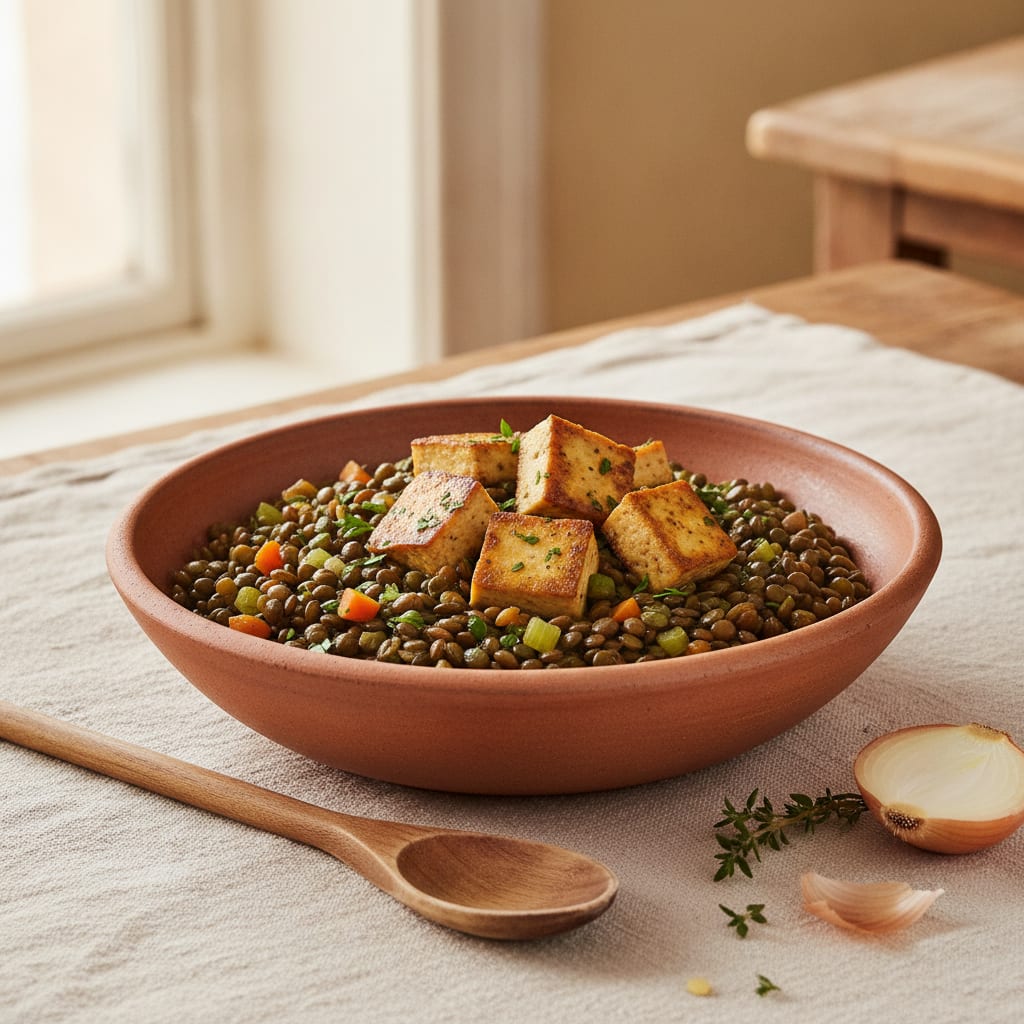
Green Puy lentils braised with mirepoix the Lyonnais way, two readings: a quick weeknight pot, and a plated lentil with smoked-tofu lardons and a sharp jus.
- Prep
- 15 min
- Cook
- 35 min
- Total
- 50 min
- Servings
- 4
- Difficulty
- Easy
Getting ready…
Ingredients
For 4 servings · 18 items
For the lentils
For the mirepoix
For the braise
For the smoked-tofu lardons
To finish
Method
7 steps · check as you go
- →
Serve
Serve the lentilles du Puy warm in shallow bowls, the seared smoked-tofu lardons and a little parsley scattered over, with crusty bread and a sharp green salad. A glass of Côtes du Rhône or a young Beaujolais is the natural pour. It is just as good at room temperature the next day, dressed as a salad with a little extra vinegar.
The story
Lentilles du Puy is the dish that taught me a lentil could be a centrepiece and not a side. I learned it in Lyon, in the winter of 2011, in the back of a bouchon kitchen from a garde-manger named Sylvie who treated her lentils with more respect than the meat cooks gave their cuts. She kept a sack of the AOP lentils — the real ones, small and slate-green with the marbling — apart from everything else, and she would not let anyone salt the pot until the end. The smell of the braise coming up was tomato paste gone dark and thyme and the clove in the onion. “On ne sale pas trop tôt,” she said, the first time I reached for the salt. You don’t salt too early. She was right, and I have not since.
What makes the dish is the lentil itself. The lentille verte du Puy was the first vegetable in France to win an AOC, granted on 7 August 1996, and a European PDO in 2008. It grows on the volcanic soils of the Haute-Loire — soils with a pH held between 6 and 7 and a high mineral load — and the small, thin-skinned, dense kernel is what lets it cook through fast and still hold its round shape instead of going to purée. That is the whole reason it braises so well: it stays distinct.
This is the Auvergne petit salé aux lentilles without the salt pork. The smoke comes from seared smoked tofu instead; the cure-and-smoke note that pork gave the dish is carried by the tofu, the lentils braise in a tomato-darkened mirepoix exactly as they always have. It is not a “vegan version” of lentilles du Puy. It is lentilles du Puy, made with what is in my hands now.
À la maison
The weeknight reading is the recipe above, and it is genuinely a Tuesday dish — under an hour, one pan for the lentils and a small skillet for the tofu. The two moves that matter: do not soak the lentils, and do not salt the pot until the very end. Bloom the tomato paste until it darkens before the stock goes in; that single step is most of the depth. Finish with Dijon and vinegar off the heat — earthy lentils want an acid to keep them bright, and the mustard ties the whole pot together.
Au bistrot
The bistronomique reading is the same braise, broken into its parts and rebuilt as a composed plate around a glossy mound of lentils.
Cook the lentils as above but pull them a minute early and finish them in a little reduced stock so each spoonful is lacquered, not soupy. Build a quick jus alongside: deglaze the tofu pan with a splash of red wine, a spoon of the lentil liquid, and a knob of vegan butter swirled in off the heat until it shines. Sear the smoked tofu in larger batons so they read as proper lardons, and add one more component for contrast — a soft-poached or jammy confit shallot, or a spoon of carrot purée smoothed under the lentils. Plate it as a course: a neat quenelle or ring of the glossy lentils off-centre, the tofu lardons leaned against it, the dark jus spooned around the edge, a few dressed frisée leaves and a dusting of chopped parsley for lift. The same earthy braise, now plated like a main at a white tablecloth — still nothing but lentils, mirepoix, and smoke.
Le dressage — Overhead, tight. A glossy ring of lentils off-centre, smoked-tofu lardons leaned against it, a dark jus spooned in a clean arc around the edge, frisée for height, parsley dusted. Warm directional light to catch the gloss on the lentils. The plate should say the humblest legume in France, plated with intent.
What the other recipes get wrong
Most lentilles du Puy recipes — I read the top ten in February 2026 — get the seasoning order backwards: they tell you to salt the cooking water and simmer hard to “save time.” Both split the lentils. I ran the test over a week in February 2026, four pots, same lentils, same mirepoix, only the salt timing and simmer level changed:
- Salted from the start, hard boil: skins split and curled, the centres still a touch chalky, the liquid gone cloudy with blown-out lentil. Muddy.
- Salted from the start, bare simmer: better held shape than the boil, but the skins were noticeably tougher and a few still split. Seasoned right through, but the texture suffered.
- Unsalted, hard boil: creamy inside but knocked around — a third of them blew out and the pot went stodgy.
- Unsalted, bare simmer, salted at the end: tender, creamy, every lentil still round and distinct, the liquid clear and glossy. This was the dish.
The reason is in the skin. Salt and acid added early interact with the pectin and the mineral content of the seed coat in a way that firms and toughens it, slowing the water’s path into the kernel — so the skin sets before the inside is cooked, and the lagging interior swells until the skin splits. Cook them in plain stock at a bare simmer and the coat stays supple, the kernel cooks evenly, and the lentil holds. Then salt, Dijon, and vinegar go in at the end, when toughening no longer matters and the acid only sharpens. The thin-skinned Puy lentil rewards this more than any other — its whole selling point is that it holds, and salting early throws that away.
The line I draw
I will not salt the lentils until the end. Not “just a pinch to season the water,” not because a recipe told me to. The entire reason to buy the AOP lentil — to pay for the small slate-green ones from the Haute-Loire instead of a bag of generic brown — is that they hold their shape, and salting early is the surest way to split their skins and waste that. Season at the finish, with salt and mustard and a hit of vinegar, and the lentils stay whole and creamy. Sylvie would move the salt out of reach. She was teaching the one thing the lentil asks of you.
When this can fail
Three ways, all from my own kitchen between 2022 and 2026:
- The split, mushy pot. I salted the water early and let it boil to hurry it; the skins curled off and the lentils blew out into a stodge. Fix: no salt until the end, and hold a bare simmer, never a boil.
- The flat, earthy braise. I skipped blooming the tomato paste and forgot the vinegar; the lentils tasted dull and one-note. Fix: fry the tomato paste dark before the stock, and finish with Dijon and red wine vinegar off the heat.
- The dried-out, gluey lentils. I walked away and the liquid cooked off before they were tender, so they caught and turned pasty. Fix: keep warm stock on hand and top up with a splash whenever the surface goes dry, leaving just a little glossy liquid at the end.
FAQ
QWhat makes lentilles du Puy different from ordinary green lentils?
Lentilles vertes du Puy are a specific small, dark-green-marbled lentil grown on the volcanic soils of the Haute-Loire in Auvergne. They earned France's first vegetable AOC on 7 August 1996 and a European PDO in 2008. Their thin seed coat and dense, non-floury kernel let them cook through in about 25 minutes from dry while holding their round shape instead of collapsing into purée, which is exactly what you want in a braise. Ordinary brown or green lentils tend to blow out and go mealy; Puy lentils stay distinct and a little peppery.
QDo you need to soak Puy lentils before cooking?
No. Puy lentils are small with a thin skin and cook in roughly 22–28 minutes straight from dry. Soaking only risks them turning to mush and splitting their skins. Rinse and sort them for grit, then braise them directly. This is part of why they are the weeknight lentil — they go from cupboard to plate in well under an hour.
QWhy shouldn't you salt lentils at the start of cooking?
Salting the cooking water early tends to toughen the lentil skins and slows the interior from softening, so you can end up with split skins around a still-chalky centre. Cook them in unsalted stock or water, then season at the very end with salt, Dijon, and vinegar. Adding the acid and salt late keeps the skins intact and the texture creamy-but-whole.
QWhat replaces the salt pork in a vegan petit salé aux lentilles?
Smoked firm tofu, cut into cubes and seared until golden, gives the cured, smoky, salty note that petit salé (salt pork) lent the classic Auvergne dish. The smoke is doing the work the cure used to. Sear it hard so the edges crisp into lardon-like pieces, and fold it through at the end so it keeps its bite.
QCan you make lentilles du Puy ahead?
Yes, and they improve. The braised lentils keep 4 days in the fridge and deepen overnight as the mirepoix and thyme settle in. Reheat gently with a splash of stock to loosen, and refresh with a little extra vinegar and parsley just before serving. They are also excellent cold the next day as a lentil salad.