The pot in the fire.
Pot-au-feu.
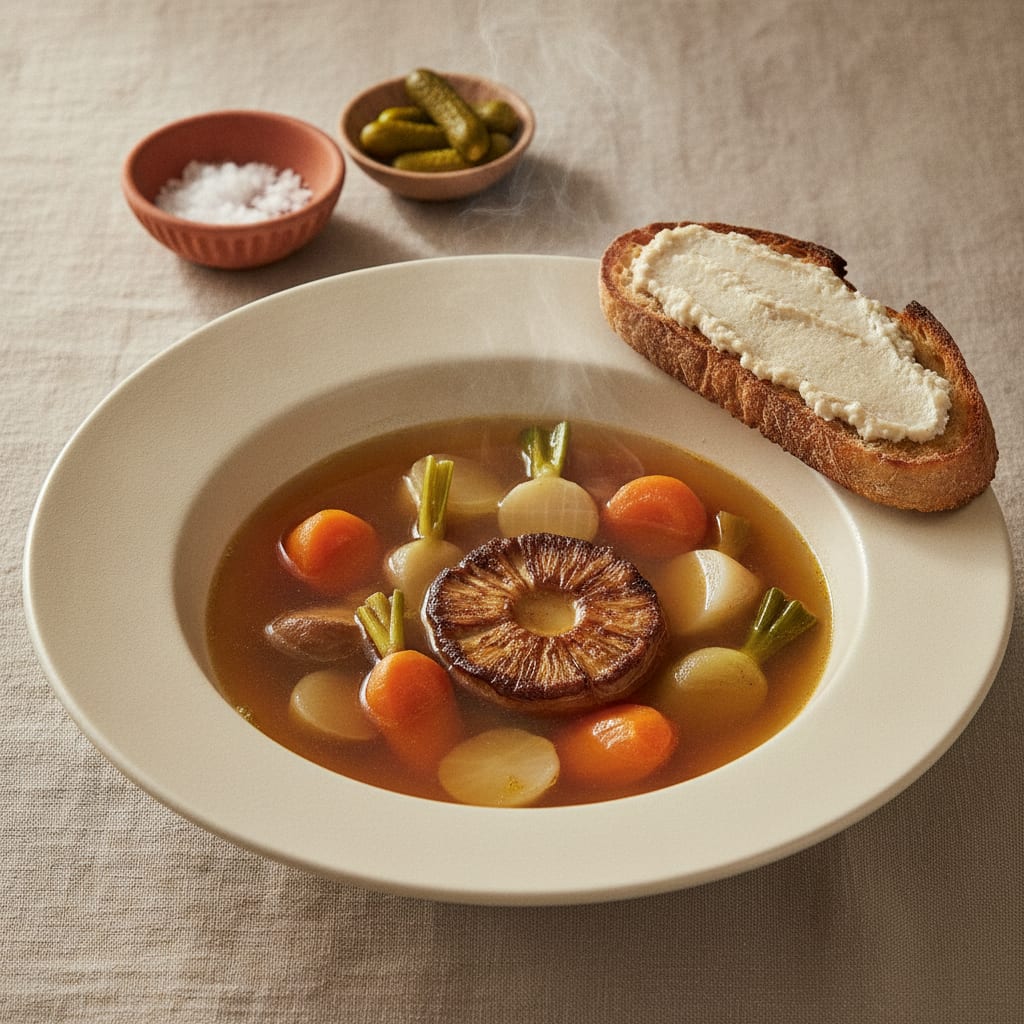
France's pot-in-the-fire, two ways: a trembling kombu-shiitake bouillon, staggered winter vegetables, seared king oyster bouilli, white-bean marrow toast.
- Prep
- 30 min
- Cook
- 2h
- Total
- 2h 30min
- Servings
- 6
- Difficulty
- Medium
Getting ready…
Ingredients
For 6 servings · 28 items
For the bouillon
For the bouilli and vegetables
For the marrow toast
To serve
Method
9 steps · check as you go
- →
Serve
Ladle the hot clear bouillon into cups as a first course — nothing in it but the broth. Then plate the vegetables and the seared king oyster bouilli on a warm platter, glossed with a spoonful of bouillon, with the marrow toast, Dijon, cornichons, and a little pot of gros sel. A light Beaujolais or a Mâcon is the Lyonnais pour.
The story
The pot-au-feu is the oldest argument in French cooking: a pot hung over a fire, fed with whatever the week left behind, simmered until the cheap and the tough turned tender. The name means pot in the fire — a reference to the cauldron that hung over a continuously burning hearth in French homes for centuries, the earliest references reaching back to the twelfth century, when it was spelled pot au fu. By the Bourbon Restoration it had become so central to the French table that Marie-Antoine Carême — the founder of grande cuisine — opened his 1833 L’Art de la cuisine française with a recipe for the “modest pot-au-feu.” The grandest chef in France began his life’s work with a peasant’s pot.
I learned to make it properly in the winter of 2011, in a bouchon in Vieux Lyon, from a chef de cuisine whose name I am ashamed to say I never learned properly — everyone called him by a nickname I won’t repeat. He kept a pot of bouillon going through the whole service and treated a rolling boil as a personal failing. “Ça frémit,” he’d say, tapping the side of the pot. It shivers. It does not boil. If the broth ever clouded, he would pour it out — the entire pot — and start again, muttering. I thought he was being theatrical. He was being correct.
This pot-au-feu has no beef in it. It has a bouillon built on charred onions, kombu, and dried shiitake; king oyster mushrooms as the bouilli; and a marrow toast made from white beans and roasted garlic. The method is unchanged — the cold soak, the tremble, the skim, the stagger, the two-service ritual at the table. It is not a “vegetable version” of pot-au-feu. It is pot-au-feu, made with what is in my hands now.
À la maison
The weeknight reading is the recipe above, and it asks only one thing of you: patience for the tremble. You do not need a thermometer — you need to watch the surface and keep it at a shiver, skimming the grey foam in the first twenty minutes. Everything else is just staggering the vegetables by how hard they are and cooking the potatoes in their own pot so the broth stays clear. Make the bouillon a day ahead if you can; it gets cleaner and deeper overnight. Serve the broth first, in cups, then the platter. That two-act service is most of what makes a bowl of vegetables feel like pot-au-feu.
Au bistrot
The bistronomique reading is the same dish with the bouillon taken one step further — to a true consommé — and the plate composed instead of piled.
Clarify the strained bouillon into a consommé: whisk 3 tablespoons of aquafaba into the cold bouillon, bring it slowly to a tremble without stirring, and let the foam set into a raft that traps the fine particles; ladle the now brilliant, clear liquid out through a cloth-lined sieve. (A faster route: stir in 1 g of agar per 500 ml, set, then let it thaw through a cloth — gel clarification — for a flawless, cold-brilliant broth.) Turn the carrots and turnips into neat seven-sided tournés so they read as deliberate. Sear a single thick king oyster medallion hard, baste it with consommé, and slice it on the bias. Cut the marrow toast into one precise soldier. Build a wide shallow bowl: the turned vegetables and the medallion arranged off-centre, a brushstroke of sauce gribiche or sharp horseradish cream, the marrow soldier balanced on the rim — then pour the hot consommé at the table, in front of the guest, so the steam rises as the bowl fills.
Le dressage — Overhead, then a second frame at the moment of the pour. Wide ivory bowl, vegetables arranged in odd numbers off-centre, the consommé poured tableside so it catches the light gold and clear. Negative space. The plate should say restraint, not abundance — one perfect read of a peasant dish at a white tablecloth.
What the other recipes get wrong
Most vegetable pot-au-feu recipes online — I read the top ten in January 2026 — treat the broth as an afterthought: water, a stock cube, whatever vegetables are around. The broth is not the afterthought. It is the dish. I ran the test over a week in January 2026, four bouillons, same vegetables, same tremble, only the savory base changed:
- Water + vegetables only: thin, sweet, vegetal. Pleasant, but it tasted of a vegetable boil, not a pot-au-feu. No backbone.
- Store-bought vegetable stock: louder but one-note — that flat, slightly sour “bouillon cube” tone that sits on top of everything and never resolves.
- Kombu only: clean and savory but flat in the same way the sea is flat — glutamate without its partner.
- Kombu + dried shiitake + charred onion + miso: round, deep, almost meaty, with a finish that kept going. This was not close. It was a different category of broth.
The reason is not opinion, it’s chemistry. Glutamate (kombu) and guanylate (dried shiitake) are synergistic: together they register as far more savory than the sum of the two — studies put the multiplication as high as eight-fold. It is the same nucleotide-plus-glutamate synergy that beef gets from its own inosinate; the dried mushroom simply supplies a different nucleotide to the same effect. Kikunae Ikeda isolated glutamate from kombu in 1908 and named the taste umami; the synergy was mapped decades later. The charred onion adds the burnt-sugar depth the marrowbone used to give, and the miso adds fermented length. Drop any one and the broth loses a dimension. Together, every time, across all four batches, they made the broth taste like something that had simmered a bone.
The line I draw
I will not let a pot-au-feu boil. Not once, not “just to speed it up,” not while I answer the door. The whole identity of the dish is a clear, trembling bouillon, and clarity is a temperature: a frémissement, around 85–90°C, where the surface shivers and the foam rises in a skimmable layer. The moment it reaches a rolling boil, the particles you skimmed disperse back through the liquid, the broth goes cloudy and dull, and you are no longer making pot-au-feu — you are making a murky vegetable soup that happens to have the same vegetables in it. The Lyon chef poured out clouded pots. He was right to.
When this can fail
Three ways, all from my own kitchen between 2022 and 2026:
- The cloudy broth. Walked away, the pot crept to a boil, and the bouillon I had built clear went grey and flat in ten minutes. There is no rescuing it back to clarity by simmering. Fix: hold the tremble, and if it does cloud, clarify with the aquafaba-raft or agar method from the bistrot section rather than starting over.
- The collapsed leeks. Dropped all the vegetables in together because I was in a hurry; the leeks dissolved into strings while the celeriac was still hard. Fix: stagger by density — hard roots first, leeks and cabbage last — and lift each one out the moment it yields.
- The boiled-in miso. Stirred the miso into the full pot over high heat early on; by serving it had gone sour and lost its perfume. Fix: whisk miso into a ladleful off the heat, at the very end, and stir it back.
FAQ
QCan you make a real pot-au-feu without meat?
Yes, because pot-au-feu is defined by its method and its ritual, not by the beef. The method is a clear bouillon built at a bare tremble, staggered winter vegetables, a dense 'bouilli' element, marrow toast, and the two-service way of eating it. A bouillon built on kombu (glutamate) and dried shiitake (guanylate) carries the savory body that beef's inosinate used to provide — the two compounds together multiply perceived savouriness several-fold. King oyster mushroom stands in for the simmered beef as the bouilli. The dish reads as pot-au-feu because it follows pot-au-feu's rules.
QWhy must pot-au-feu never boil?
A rolling boil churns fine particles back into the liquid and emulsifies them, turning a clear amber bouillon cloudy and giving it a flat, muddy taste. Pot-au-feu is held at a frémissement — a bare shiver where only the occasional bubble breaks the surface, around 85–90°C (185–195°F). At that temperature the broth stays clear, the vegetables hold their shape, and the foam rises in a clean layer you can skim off rather than dispersing through the pot.
QHow do you keep the bouillon clear?
Three moves. First, cold-soak the kombu and never boil it — boiling kombu releases bitter, slick compounds. Second, hold the whole pot at a tremble, not a boil, and skim the grey foam as it rises in the first 20 minutes. Third, cook the potatoes in a separate pot, because their starch is the single biggest cause of a cloudy bouillon. For a restaurant-clear consommé, see the bistrot section below.
QWhat can I use instead of bone marrow in pot-au-feu?
Bone marrow on toast with coarse salt is the traditional ceremonial bite. A warm purée of cannellini beans mashed with the soft roasted garlic from the bouillon and good olive oil gives you the same unctuous, spreadable richness to scrape across hot toast and finish with gros sel. Roasted bone marrow squash, soft-roasted and scooped, is another honest stand-in for the marrow texture.
QCan I make pot-au-feu ahead?
The bouillon improves overnight — make it a day ahead, chill it, and any sediment settles to the bottom so you can decant an even clearer broth. Cook the vegetables and sear the bouilli fresh on the day, gently reheating them in the warm bouillon. The marrow-toast purée holds 4 days in the fridge; warm it with a splash of bouillon to loosen before serving.