No cheese. It never had any..
Gratin dauphinois.
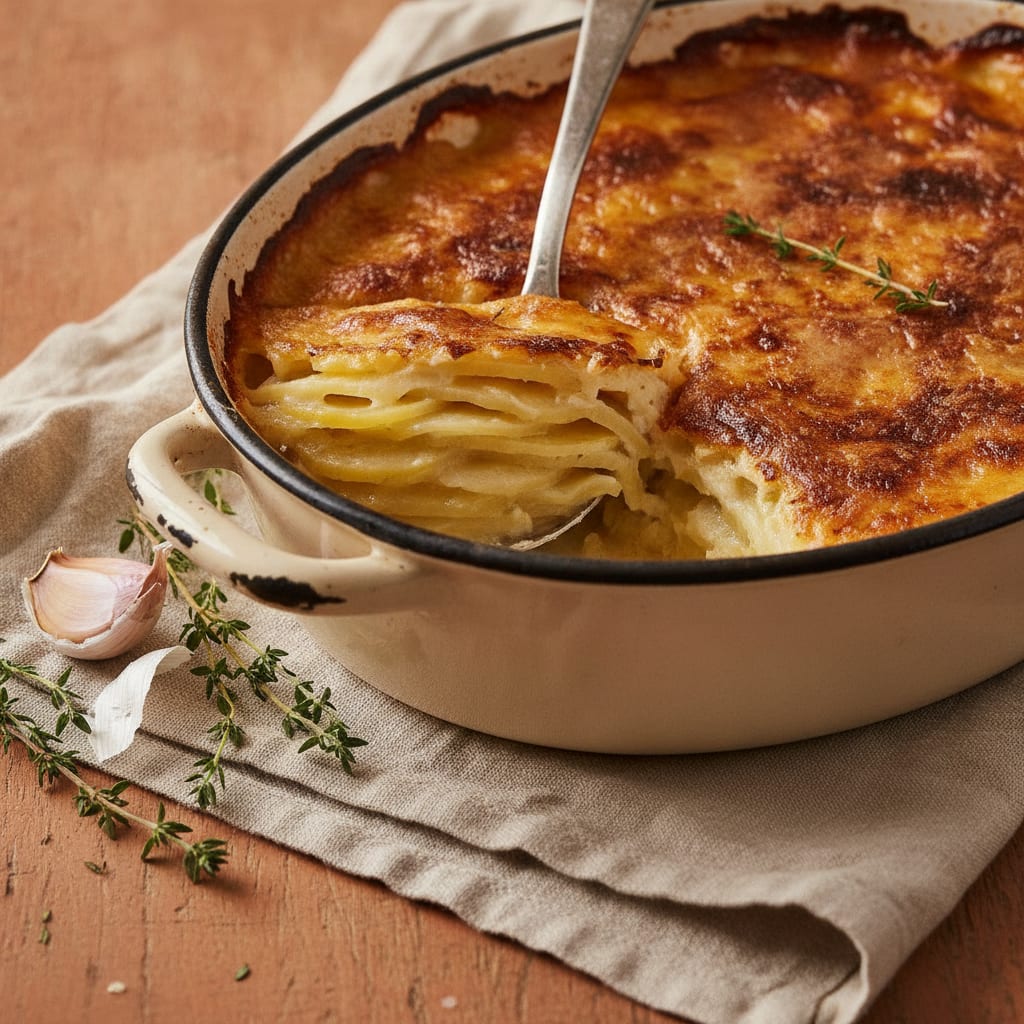
The real Dauphiné gratin, two ways: thin raw potatoes baked slow in garlicky cashew-oat cream, no cheese, until the top bronzes and the inside turns to silk.
- Prep
- 20 min
- Cook
- 1h 15min
- Total
- 1h 35min
- Servings
- 6
- Difficulty
- Easy
Getting ready…
Ingredients
For 6 servings · 11 items
For the gratin
For the cream
Method
7 steps · check as you go
- →
Serve
Serve the gratin dauphinois hot from its dish, scooped or cut into squares, as a side to almost anything — a roast, a braise, a sharp green salad with a mustard vinaigrette to cut the richness. It needs nothing on top: no cheese, no breadcrumbs. The bronzed surface is the crust.
The story
Gratin dauphinois is the dish people argue about without knowing the facts. The argument is always cheese — whether it belongs — and the answer, documented, is no. The first recorded mention is precise: 12 July 1788, a dinner given by Charles-Henri, Duke of Clermont-Tonnerre, lieutenant-general of the Dauphiné, for the municipal officers of the town of Gap, in what is now the Hautes-Alpes. Sliced potatoes, cream, garlic. No cheese. The cheese came later, smuggled in by chefs — Escoffier, Spry, others — who couldn’t leave a thing alone. A true dauphinois has never had cheese, and the moment you add it you’ve made a gratin savoyard, which is a different dish from a different valley.
I learned it in Lyon, in the years I spent cooking there, from a saucier who treated the cheese question as a test of character. The first time I reached for a handful of Gruyère to finish a tray, she moved the bowl out of my reach without a word and pointed at the dish — at the bronzed top that the potatoes and cream had made on their own, no cheese needed. The smell coming off it was garlic and cream and the faint caramel of starch gone gold in a slow oven. “Le fromage, c’est pour cacher la paresse,” she said. Cheese is for hiding laziness. I have never put cheese in a dauphinois since.
This gratin has no dairy in it. It has a cream blended from cashews and oat milk, garlic rubbed into the dish and grated into the pour, and the potatoes’ own starch doing the setting. It is not cheesy because a dauphinois was never cheesy. The method is the dish: coin-thin slices, unrinsed, warmed in the cream, baked low and slow until the top bronzes itself. It is not a “dairy-free version” of a gratin dauphinois. It is a gratin dauphinois, made the way the 1788 record describes it — minus a cow.
À la maison
The weeknight reading is the recipe above, and it is genuinely easy — the only skill it asks is patience with the oven. Slice thin, do not rinse, warm the potatoes in the cream on the stovetop to get the starch going, then bake low at 150°C and leave it alone. The two moves that matter most: keep the potatoes unrinsed so their starch sets the cream, and keep the oven low so the inside turns silky before the top burns. Rest it ten minutes before you cut it. That rest is the difference between clean layered slices and a delicious puddle.
Au bistrot
The bistronomique reading is the same gratin, pressed and cut so it reads as a precise, plated component rather than a scoop from a family dish.
Bake the gratin as above, but in a deep tray lined with parchment. While it is still hot, lay a second tray on top and weight it — a few cans will do — and press it overnight in the fridge. The next day you have a dense, terrine-firm slab you can cut into clean rectangles or rounds with a hot knife. Crisp the cut faces: warm a little vegan butter and a film of oil in a non-stick pan and sear each portion on its top and bottom until the edges go lacquered and golden, the bronzed surface from the bake now sharpened into a real crust. Plate it as a deliberate course: one pressed rectangle off-centre, a brushstroke of garlic-confit purée under it, a few leaves of bitter frisée dressed in mustard vinaigrette to cut the richness, and a scatter of crisp shallot. A spoon of cold cream-and-chive purée on the side. The gratin stops being a side and becomes the centre of the plate — still nothing but potato, garlic, and cream.
Le dressage — Overhead, tight. A single pressed rectangle, edges lacquered gold, the layered interior visible at the cut face. A swipe of pale confit purée beneath, a small tangle of dressed frisée for height and contrast, crisp shallot scattered. Warm directional light to catch the crisped edge. The plate should say precision — that the most rustic dish in France can be cut like a terrine.
What the other recipes get wrong
Most gratin recipes — I read the top ten in March 2026 — make two mistakes that compound: they tell you to rinse the potatoes, and they bake hot to save time. Both wreck the set. I ran the test over a weekend in March 2026, four gratins, same cream, same dish, only the potato prep and oven temperature changed:
- Rinsed potatoes, hot oven (200°C): the top scorched while the centre stayed chalky, and what cream survived stayed loose and watery — no set at all, because the binding starch had been rinsed down the drain.
- Rinsed potatoes, low oven (150°C): cooked through evenly but still slumped into a puddle when cut. Tender, but it never became sliceable.
- Unrinsed potatoes, hot oven: set better, but the top burned before the middle was tender, leaving a bitter crust over an underdone core.
- Unrinsed potatoes, low oven, pre-warmed in the cream: silky all the way through, bronzed not burnt on top, and it cut into clean layered slices after a ten-minute rest. This was the dish.
The reason is starch. The cut surfaces of a potato shed amylose and amylopectin, and as they hydrate and heat in the cream they gelatinise — swelling, bursting, and thickening the liquid into a custard-like set that holds the slices together. Rinse the potatoes and you wash that thickener away; the cream has nothing to set it and stays soup. Bake too hot and the cream’s emulsion breaks and the surface burns before the starch in the centre has had the slow, even heat it needs to gelatinise. Unrinsed potatoes, a pre-warm to wake the starch up, and a long bake at 150°C: that is the whole technical argument, and it won every time.
The line I draw
I will not put cheese in a gratin dauphinois. Not Gruyère on top “for the crust,” not Comté between the layers “for depth.” The dish is documented from 1788 as potatoes, cream, and garlic, and the bronzed top it makes on its own — starch and cream gone gold in a slow oven — is the crust. The second you add cheese you’ve made a gratin savoyard or a generic potato bake, and you’ve hidden the one thing a dauphinois is supposed to prove: that potatoes, cream, and time are enough. The Lyon saucier was right — cheese here is for hiding laziness.
When this can fail
Three ways, all from my own kitchen between 2022 and 2026:
- The watery gratin. I rinsed the sliced potatoes out of habit, washed off the starch, and pulled a loose, soupy tray from the oven that never set. Fix: never rinse the potatoes — slice them straight into the cream, starch and all.
- The burnt top, raw middle. I rushed it at 200°C; the surface went past bronzed to bitter while the centre stayed chalky. Fix: bake low at 150°C, and foil the top for the first 40 minutes if it colours fast.
- The slumping slice. I cut it the second it left the oven and it collapsed into a puddle on the plate. Fix: rest it 10–15 minutes so the starch-set cream firms, then cut.
FAQ
QDoes authentic gratin dauphinois have cheese?
No. Traditional gratin dauphinois contains no cheese at all — only thinly sliced raw potatoes baked slowly in garlicky cream. Adding cheese makes it a different dish closer to a gratin savoyard. The first recorded mention, at a 1788 dinner in the Dauphiné, was potatoes and cream, no cheese. Later chefs including Escoffier added cheese and eggs, which is why so many recipes carry it, but the cheese is the inauthentic part. This version stays true to the original — garlicky cashew-and-oat cream, bronzed on top, no cheese anywhere.
QHow do you make a creamy potato gratin without dairy?
Blend soaked raw cashews with unsweetened oat milk, garlic, and a little nutritional yeast into a smooth pourable cream. The cashews supply the fat and body that dairy cream would, and crucially the potatoes' own surface starch sets the cream into a sliceable custard as it bakes. Do not rinse the sliced potatoes — that starch is the bind. Warm the potatoes in the cream on the stovetop first, then bake low and slow at 150°C (300°F).
QWhy do you not rinse the potatoes for gratin dauphinois?
Because the surface starch on the cut slices is what thickens the cream into a set, sliceable gratin as it bakes. Rinsing or soaking the potatoes washes that starch away and leaves you with a loose, watery gratin that never firms up. Slice the potatoes coin-thin and tip them straight into the cream, starch and all.
QWhy is my gratin dauphinois watery or not set?
Usually one of three things: the potatoes were rinsed and lost their binding starch, the oven was too hot so the cream broke before the starch could set it, or it was cut straight from the oven without resting. Use waxy potatoes unrinsed, bake low at 150°C (300°F), and rest the gratin 10–15 minutes before cutting so the starch-set cream firms into clean slices.
QWhat potatoes are best for gratin dauphinois?
Waxy or all-purpose potatoes like Yukon Gold or Charlotte. They hold their shape in thin slices and release just enough starch to set the cream while staying tender, not collapsing into mash. Avoid very floury baking potatoes, which break down and turn the gratin grainy. Slice them 2–3 mm thick on a mandoline for even cooking.