No boiled potato. Nice insists..
Salade niçoise.
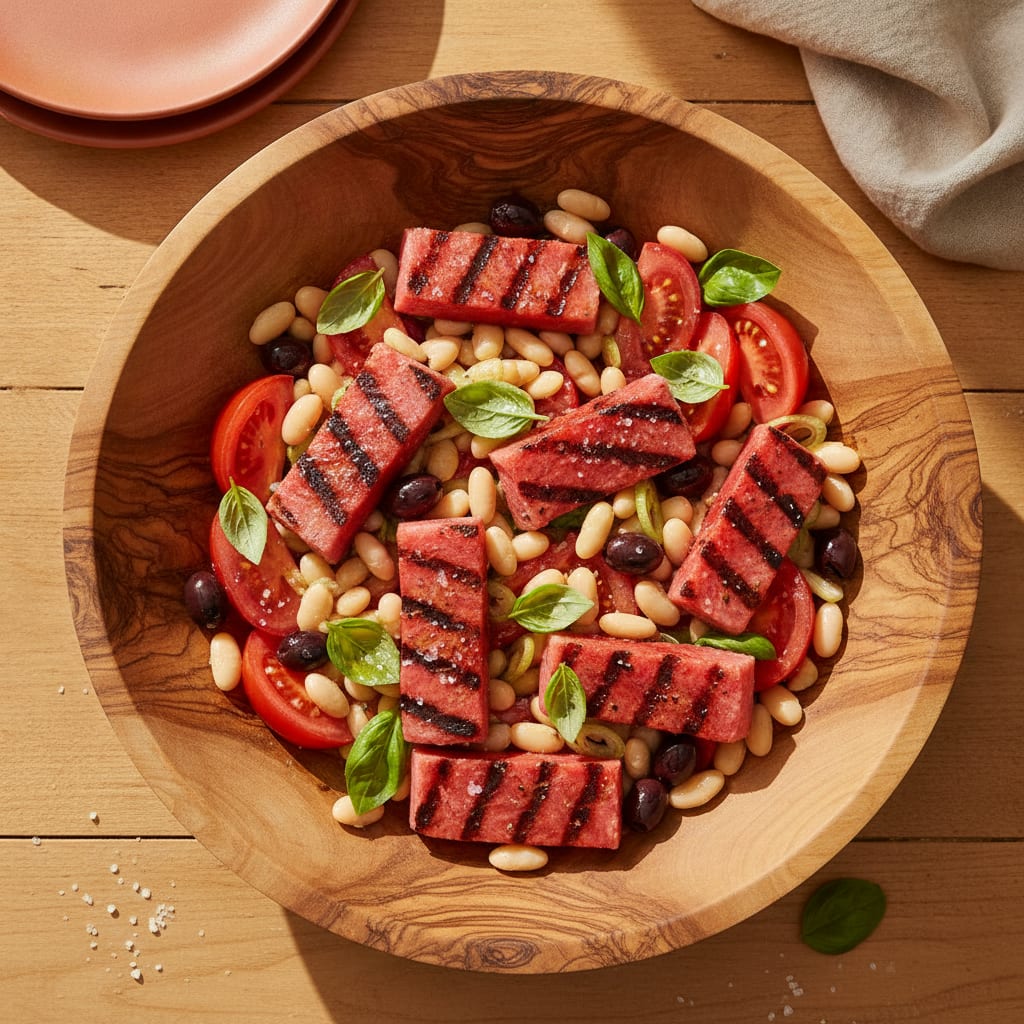
The real Niçoise, two ways: thrice-salted raw tomatoes, white beans, olives, and a seared watermelon 'tuna' — no boiled potato, no cooked vegetable.
- Prep
- 30 min
- Cook
- 15 min
- Total
- 45 min
- Servings
- 4
- Difficulty
- Easy
Getting ready…
Ingredients
For 4 servings · 17 items
For the watermelon 'tuna'
For the salad
For the dressing
Method
6 steps · check as you go
- →
Serve
Serve immediately in the garlic-rubbed bowl, at room temperature, with crusty bread and a glass of chilled Provençal rosé. Bring it to the table whole and undressed-of-lettuce — the point is the raw tomatoes and beans glossed in olive oil with the seared 'tuna' on top. Never refrigerate it stone-cold; cold mutes the tomatoes.
The story
The salade niçoise is the most argued-over salad in France, and almost everyone arguing about it is wrong about the potato. The man who set the rules was Jacques Médecin — cookbook author, longtime mayor of Nice, later a fugitive from a corruption conviction, but on this one subject an unbending authority. In his 1972 La Cuisine du Comté de Nice he laid down the law: a salade niçoise contains no cooked vegetable except the hard-boiled egg. No boiled potato. No green beans. No lettuce. No vinegar. Tomatoes salted three times, dressed in olive oil, in a bowl rubbed with garlic. Everything most restaurants serve as a Niçoise, he would not have called a Niçoise at all.
I didn’t take this seriously until I cooked it for someone from Nice. This was the summer of 2025, in Washington, a heat-flattened July afternoon, and a guest named Sylvie watched me reach for boiled potatoes and stopped my hand. “Non. Pas dans une niçoise.” She rebuilt it in front of me — salted the tomatoes three times, rubbed the bowl with a cut clove, dressed it in nothing but olive oil — and it was sharper, lighter, and more alive than any Niçoise I’d made with the works. The tomatoes did everything. I had been drowning them for years.
This one has no tuna and no egg. White beans give the soft, savory body the tuna used to carry, and a thick baton of watermelon — marinated in soy and nori, seared hard, peppered — stands in for the seared fish. Everything else obeys Médecin: raw, salted, oiled, no potato, no vinegar, no lettuce. It is not a “vegetable niçoise.” It is a salade niçoise, made the way Nice insists it be made, with the fish swapped and not one of the rules broken.
À la maison
The weeknight reading is the recipe above, and it is genuinely easy — the discipline is in what you leave out. Salt the tomatoes three times and let them drain; that single habit is the difference between a bright Niçoise and a watery one. Dress in olive oil alone, no vinegar. Rub the bowl with garlic instead of tossing minced garlic through. Keep everything raw except the seared watermelon. The only technique that asks for attention is searing the watermelon hard and dry on high heat so it grills rather than stews. Build it at the last minute, serve it at room temperature, and skip the bed of lettuce entirely.
Au bistrot
The bistronomique reading keeps every rule and composes the plate instead of tumbling it into a bowl. Sear a single, larger watermelon “tuna” loin, marinated longer and pressed firmer, and slice it across into neat rare-pink fans so the seared edge and juicy centre read in cross-section. Concassé the thrice-salted tomatoes into a tidy quenelle, their drained juice whisked with olive oil into a loose vinaigrette-without-vinegar to dot around the plate. Dress the white beans separately in a little of that tomato oil and a torn basil leaf, and spoon them in a low line. Add a few raw artichoke shavings — purple ones if you can find them, exactly as Médecin allowed — a scatter of fried capers, halved Niçoise olives, and a single radish sliced to translucence. Lay the watermelon fans over the beans, drizzle the tomato oil, and finish with basil oil, flaky salt, and a crack of pepper. Same salad, same rules, read as a composed first course.
Le dressage — Overhead, then a low three-quarter on the seared watermelon fan. Pale ceramic plate, components in odd-numbered groups with negative space, tomato oil dotted, basil oil dragged once. Bright Mediterranean light, a linen napkin, a glass of pale rosé soft behind. The plate should say Nice at midday, plated — raw, sunlit, precise.
What the other recipes get wrong
Almost every salade niçoise online — I read the top ten in July 2025 — buries the dish under boiled potato and green beans, exactly what Médecin spent a chapter forbidding, and barely salts the tomato at all. The tomato is the whole salad, so I made the tomato the variable. I ran the test over a week in July 2025, four bowls, identical beans, olives, oil, and watermelon, only the tomato treatment changed:
- Unsalted tomatoes, straight in: the salad wept within minutes, the dressing turned to pink water, and every bite was diluted. The tomato tasted of nothing in particular.
- Salted once, briefly: better, but still loose, and the seasoning sat on the surface rather than running through the fruit.
- Boiled potato added, tomato salted once: heavier, starchier, and muddier — it tasted like a deli salad, the tomato lost in the bulk. This is the version most people make.
- Tomatoes salted three times and drained, no potato: bright, concentrated, almost jammy at the edges, the olive oil clinging instead of pooling. This was unmistakably the dish.
The reason is osmosis, not opinion. Salt draws water out of the tomato’s cells across about fifteen minutes; do it in three stages and you pull out the thin, flavour-diluting juice while seasoning the flesh all the way through. What’s left is a denser, sweeter, more savory tomato that holds its shape and lets the olive oil coat it instead of sliding off into a watery pool. The potato, by contrast, adds nothing but starch and bulk — it absorbs the dressing and dulls the tomatoes it’s crowded against. Across all four batches, the thrice-salted, potato-free bowl was the only one where the tomato tasted like the centre of the dish, which is exactly where Nice puts it.
The line I draw
I will not put boiled potato in a salade niçoise. Not “for substance,” not “because guests expect it,” not the green beans either. A Niçoise is a raw salad — its lightness, its sharpness, the way the salted tomatoes carry everything, all of it depends on nothing being boiled. The moment you add boiled potato you have made a different, heavier dish and stuck a famous name on it; the tomatoes drown, the olive oil gets soaked into starch, and the whole thing goes muddy and earnest. Médecin was right to write a chapter against it. The seared watermelon is the only thing on the plate that ever sees heat, and that is exactly as far as I will go.
When this can fail
Three ways, all from my own kitchen between 2022 and 2026:
- The watery bowl. Skipped the triple-salting, dressed the tomatoes raw, and within ten minutes the salad was sitting in pink water and the oil had split off. Fix: salt the tomatoes three times over fifteen minutes and drain them well before they go in — and dress at the last minute.
- The stewed watermelon. Put wet watermelon into a not-hot-enough pan; it released its juice and simmered into mush instead of searing. Fix: pat it bone-dry, get the pan almost smoking, sear hard and fast, and let it firm as it cools.
- The fridge-cold salad. Served it straight from the refrigerator to be safe in summer, and the cold flattened the tomatoes and stiffened the oil to nothing. Fix: serve at room temperature — pull everything from the fridge half an hour ahead, because cold mutes a Niçoise.
FAQ
QWhat makes a salade niçoise authentic?
The purist standard comes from Jacques Médecin, the former mayor of Nice, in his 1972 La Cuisine du Comté de Nice: no cooked vegetables at all (the hard-boiled egg was the only cooked thing he allowed), no boiled potato, no green beans, no lettuce, and no vinegar. The salad is built on raw tomatoes salted three times and dressed in olive oil, with raw vegetables, olives, and basil. This version keeps every one of those rules — raw throughout, dressed in oil alone — and swaps the fish for white beans and a seared watermelon 'tuna.'
QWhy no boiled potato in a real salade niçoise?
Because Niçoise purists, led by Jacques Médecin, hold that boiled potato (and any boiled vegetable) has no place in the salad. His recipe explicitly excludes them; the potato-and-green-bean version most people know is a later, heavier adaptation. A traditional Niçoise is a raw salad of tomatoes and crunchy vegetables glossed in olive oil — light, sharp from the tomatoes, never starchy. Keeping it raw is the whole point.
QHow do you make salade niçoise without tuna?
Two stand-ins do the work. White beans give the soft, savory, protein-rich body that oil-packed tuna brings to the bowl. And a thick baton of watermelon, marinated in soy and nori then seared hard on high heat, takes on the colour, the firm-edged texture, and the marine note of seared rare tuna. Firm tofu, pressed and marinated the same way, is an alternative if you'd rather. The salad reads as Niçoise because everything around the 'tuna' follows the purist rules.
QShould salade niçoise have vinegar in the dressing?
No — not in the traditional Niçoise. Médecin's version is dressed in olive oil alone, with the acidity coming entirely from the tomatoes, which is why salting them three times to concentrate their juice matters so much. A whisper of raw garlic, from rubbing the bowl and a little in the oil, rounds it out. Vinegar makes it taste like a generic French salad rather than a Niçoise.
QCan I make salade niçoise ahead?
Prep the components ahead but assemble at the last minute. Salt the tomatoes and drain them up to an hour before; marinate the watermelon ahead; drain the beans and cut the vegetables. Then build and dress just before serving, because dressed raw tomatoes weep and the salad goes watery if it sits. Sear the watermelon fresh and lay it on top at the table. Serve at room temperature, never fridge-cold.