The onion tart Nice never calls pizza.
Pissaladière.
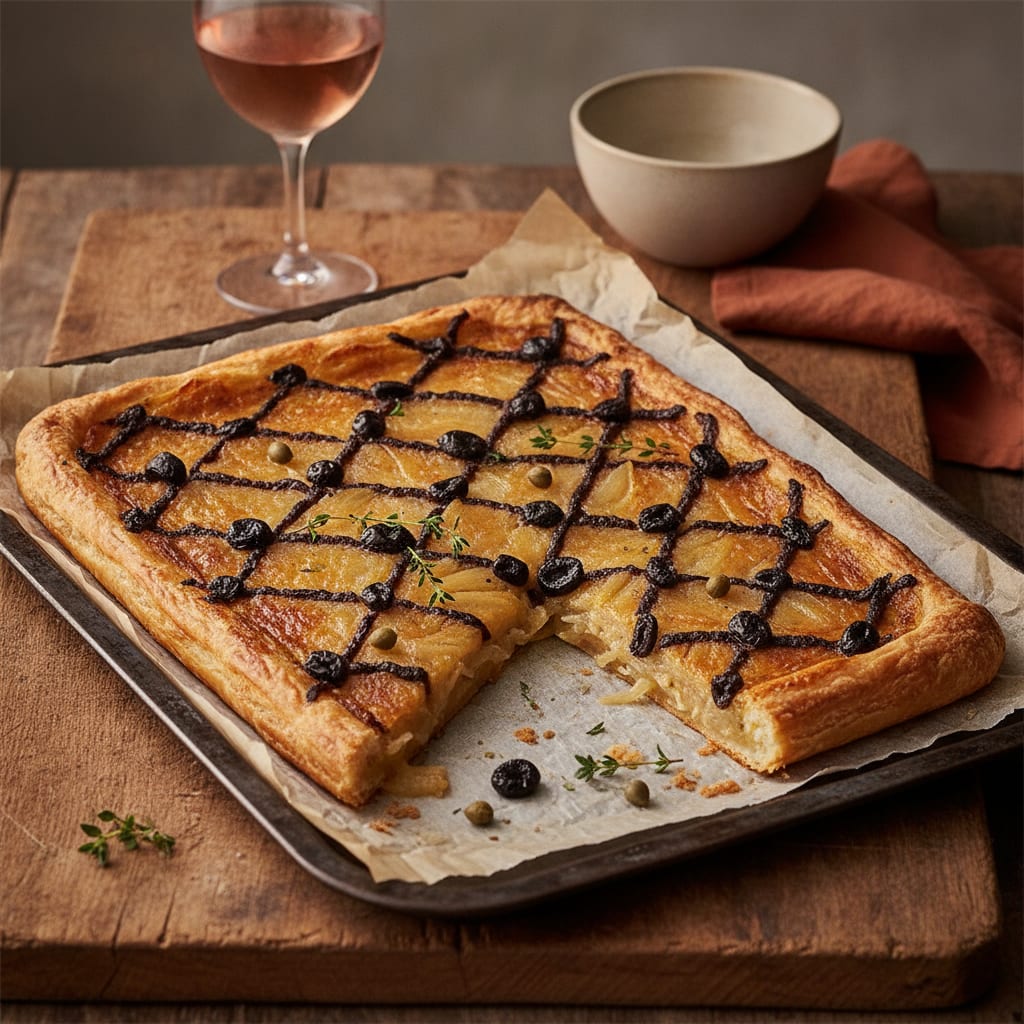
Nice's onion tart, two ways: long-cooked golden onions, a caper-olive-nori pissalat, black olives and thyme on a thin crisp base — and not a pizza.
- Prep
- 30 min
- Cook
- 1h 10min
- Total
- 1h 40min
- Servings
- 6
- Difficulty
- Medium
Getting ready…
Ingredients
For 6 servings · 18 items
For the base
For the onions
For the pissalat (the sea note)
To finish
Method
6 steps · check as you go
- →
Serve
Cut into squares or fingers and serve warm or at room temperature, as an apéritif bite or a starter, with a few extra olives and a glass of chilled Provençal rosé or a dry white. It travels well and improves an hour out of the oven, which is exactly how it is sold from bakeries in the old town of Nice.
The story
A pissaladière is what happens when a region refuses to let a pizza happen. It is older than the tomato in Europe — its ancestor, the Ligurian sardenaira and pissalandrea of the western Riviera, was a white flatbread of onions, salted fish, olives, capers, and garlic, and the tomato only reached Ligurian kitchens in the early 1700s, long after the form had set. Nice kept the older version. No tomato, no cheese, no apology. The name itself is a receipt: it comes from pissalat, in Niçard peis salat — salted fish — the anchovy purée, seasoned with clove and thyme, that gives the tart its backbone.
I came to make it properly only recently, in the autumn of 2025, in my kitchen in Washington, working from a stained photocopy of a Niçoise recipe a cook named Béatrice had pressed on me years before. I remember the smell more than anything — six large onions going down to almost nothing over the better part of an hour, the whole apartment turning sweet and low and a little smoky at the edges. My neighbor knocked to ask what I was cooking. I said an onion tart. She looked unconvinced. It does not photograph like much. It tastes like patience.
This pissaladière has no anchovy in it. The pissalat is rebuilt from black olives, capers, and toasted nori — the cured salt and funk from the first two, the marine, sea-iodine note from the seaweed — seasoned with the traditional pinch of clove. Everything else is unchanged: the long-sweated onions, the thin bready base, the diamond lattice of black olives, the thyme. It is not a “vegetable pissaladière.” It is pissaladière, built the way Nice builds it, with the salted fish swapped for the sea itself.
À la maison
The weeknight reading is the recipe above, and it asks for exactly one thing: that you let the onions take their time. Forty-five minutes minimum, on low, stirred often, until they are a soft golden jam and not a pan of browned shreds. Everything else is quick — the base is a single rise, the pissalat is a thirty-second blitz, the bake is twenty minutes. Spread the pissalat under the onions as well as on top so the whole base is seasoned, lay the olives in a loose diamond so it reads as Niçoise, and serve it warm or cool rather than hot. If you make the onions and the pissalat a day ahead, this is a half-hour assembly that tastes like the old town.
Au bistrot
The bistronomique reading keeps every instinct of the bakery square and tightens it into a plated starter. Roll the base thinner and bake it blind to a proper cracker-crisp on a hot steel, so the structure reads as deliberate rather than rustic. Take the onions one shade further with a splash of white wine and a few threads of saffron cooked in at the end — the Provençal grace note — so the jam turns faintly amber and perfumed. Pipe, rather than spread, the pissalat into fine lines beneath the onions. Cut the tart into a clean rectangle, crusts trimmed, and dress it at the plate: a smear of the saffron-onion jam dragged across, three plump Niçoise olives and a few fried caper buds for salt and crunch, a single anchovy-less pissalat dot at each corner, micro-thyme and a thread of the best olive oil you own. The point is to make a peasant square read as a composed course without losing the smell of the onions.
Le dressage — Overhead, then a tight three-quarter on the cut edge. Dark slate or matte plate, the trimmed rectangle off-centre, saffron-onion jam dragged in one stroke, olives and fried capers in odd numbers, a glint of olive oil. Warm side light, negative space, a Provençal-rosé mood. The plate should say old-town apéritif, plated — not pizza.
What the other recipes get wrong
Most vegan pissaladière recipes online — I read the top ten in October 2025 — drop the pissalat entirely and call it “caramelized onion tart,” then wonder why it tastes flat. The pissalat is not optional garnish; it is where the name comes from and where half the savour lives. So I built the sea note as the variable. I ran the test over a week in October 2025, four batches, identical onions and base, only the salted-fish stand-in changed:
- No pissalat, onions only: sweet and pleasant and one-dimensional. A nice onion tart. Not a pissaladière — it had no spine, no salt-funk, nothing marine.
- Capers and olives only: briny and sharp but strangely terrestrial, all vinegar and cure with no sea behind it. Closer, still missing a dimension.
- A drop of fish sauce stand-in (extra soy): salty and savory but the wrong shape — soy reads of fermented bean, not of the ocean.
- Olives + capers + toasted nori + a pinch of clove: cured, briny, and unmistakably marine, with the clove giving the exact warm-spice fingerprint real pissalat carries. This was the one that read as the dish.
The reason is specific, not vague. Anchovy’s savour is free glutamate plus a marine, iodine-tinged note from the sea. Toasted nori is one of the most glutamate-dense seaweeds there is, and it carries that same oceanic iodine signature — it occupies the part of the palate the anchovy used to. Olives and capers, both cured in brine, supply the salt and the funky edge. And the clove is not a flourish: traditional pissalat is seasoned with clove, thyme, and pepper, so the pinch of clove is what makes the paste smell like pissalat rather than like tapenade. Drop the nori and it goes terrestrial; drop the clove and it stops smelling like Nice. Across all four batches, the seaweed-and-clove paste was the only one that tasted of the sea and of the place at once.
The line I draw
I will not put tomato on a pissaladière, and I will not rush the onions to fake the dish in twenty minutes. The whole identity of pissaladière is that it is the pre-tomato tart — the older Mediterranean flatbread that Nice kept while the rest of the coast moved on to the red one. Add tomato and you have not modernized it; you have erased the one thing that makes it itself and turned it into a sad, crustless pizza. And onions cooked hot and fast are sharp and scorched, not sweet and melting — they read as a topping, not as the body of a tart. Slow onions, no tomato. The bakeries in the old town would not recognize anything else, and they would be right not to.
When this can fail
Three ways, all from my own kitchen between 2022 and 2026:
- The scorched onions. Turned the heat up to save time, walked away, and came back to a pan that was brown and bitter at the edges and still raw in the middle. There is no sweetness to recover. Fix: low heat, stir often, and budget the full 45–55 minutes — start the onions before anything else.
- The soggy base. Spread very wet onions onto an underbaked base and the bottom steamed instead of crisping; the slice flopped. Fix: cook the onions until they are jammy and have given up their water, drain off any pooled liquid, and bake the tart hot enough to set the underside crisp.
- The flat, anchovy-less tart. Early on I skipped the pissalat entirely and made a plain onion tart, and it was forgettable. Fix: always build the pissalat, spread a thin layer under the onions as well as dotting on top, and do not omit the clove — that is what makes it pissaladière and not just onions on bread.
FAQ
QIs pissaladière a pizza?
No, and Nice is firm about it. Pissaladière is an onion tart on a thin bready base, descended from the medieval Ligurian flatbreads (sardenaira, pissalandrea) that predate the tomato in European cooking. There is no tomato and no cheese — only long-cooked sweet onions, a salted-fish seasoning called pissalat, black olives, and thyme. It shares an ancestor with pizza but kept the older, white, tomato-free form. The name comes from pissalat, the anchovy condiment, not from anything to do with pizza.
QWhat does pissaladière mean and where does the name come from?
The name comes from pissalat, in Niçard peis salat — 'salted fish.' Pissalat is a purée of salted anchovies (historically also tiny sardine and anchovy fry called poutine) seasoned with clove, thyme, and pepper, spread on the base. The whole tart is named for that condiment. Here a paste of black olives, capers, and toasted nori carries the same cured, briny, marine note, seasoned with the traditional pinch of clove.
QHow do you make pissaladière without anchovies?
Build the pissalat from olives, capers, and toasted nori. Olives and capers give the cured salt and funk; nori, a glutamate-rich seaweed, supplies the actual marine, sea-iodine note that anchovy contributes — they share that savory profile. Season it with the traditional scant pinch of ground clove and a little garlic. Spread a thin layer under the onions so it perfumes the base, then dot more on top. It reads as pissaladière because it keeps pissalat's role and its clove fingerprint.
QWhy must the onions be cooked so slowly?
Because the onions are the body of the tart, and they need to be sweet and jammy, not browned and sharp. Cooked low for 45 to 55 minutes, they release their water slowly and their sugars concentrate into a soft, melting, almost spreadable jam. Cooked fast on high heat, they scorch at the edges and stay raw-sharp in the middle. There is no shortcut — this is the slowest and most important step.
QCan I make pissaladière ahead?
Yes, and it is arguably better an hour or more after baking, at room temperature — the way it is sold from bakeries in old Nice. The onion jam and the pissalat both hold 4 days in the fridge, so you can make them ahead and assemble on the day. A baked pissaladière keeps a day, well wrapped; warm it briefly to re-crisp the base before serving.