Ratatouille.
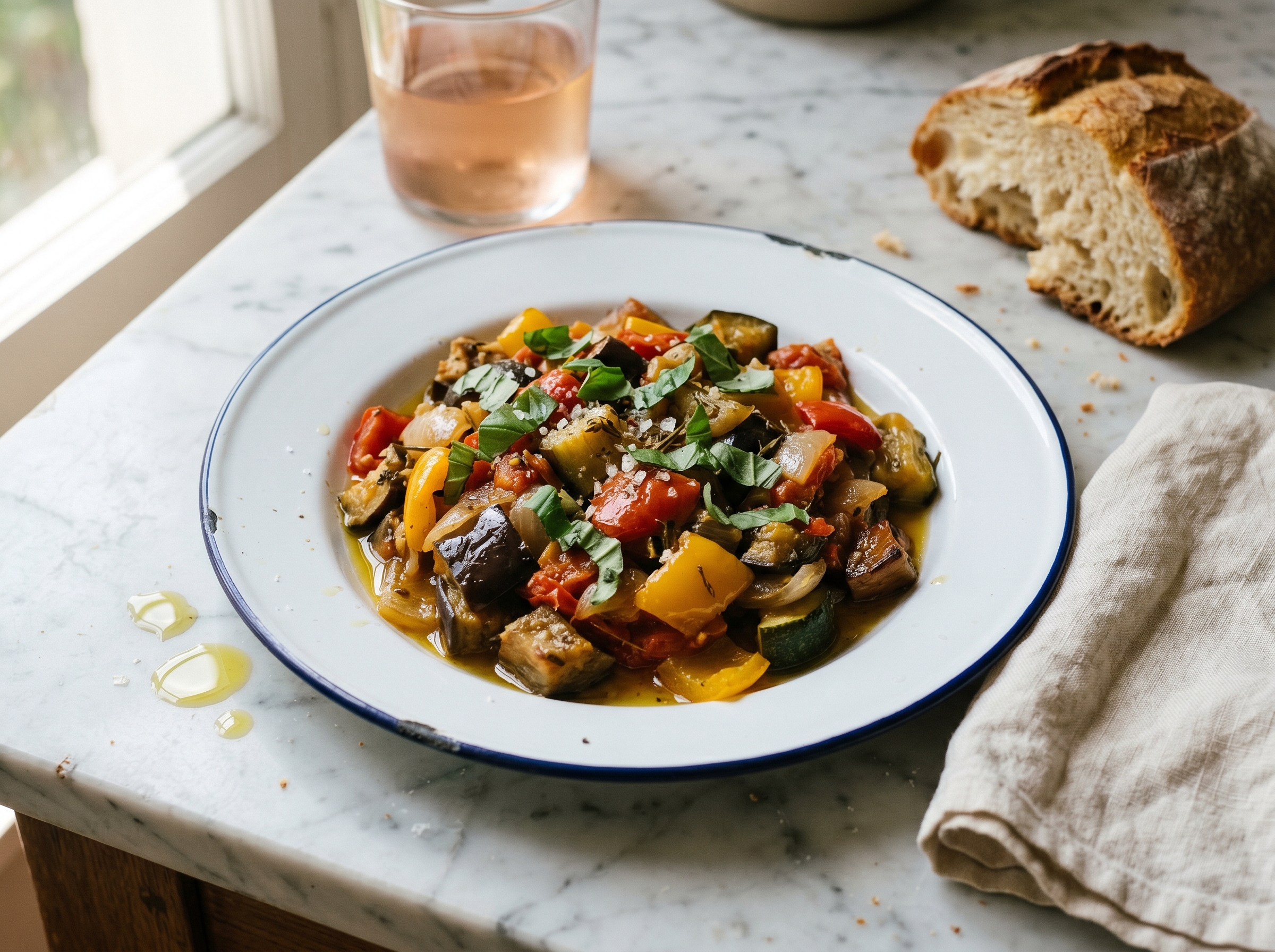
A Provençal ratatouille the proper way — vegetables cooked separately, layered at the end, finished with fresh basil and good olive oil. Not the Pixar version.
- Prep
- 30 min
- Cook
- 1h
- Total
- 1h 30min
- Servings
- 6
- Difficulty
- Medium
Getting ready…
Ingredients
For 6 servings · 17 items
For the vegetables
For the tomato base
For the herbs
Throughout
Method
6 steps · check as you go
- →
Serve
Serve warm or at room temperature, never piping hot — ratatouille's full flavor is suppressed at hot-skillet temperatures. Spoon into wide shallow bowls. Drizzle with a little more olive oil. Crusty bread is non-negotiable. A glass of cold rosé from Provence — Bandol or Côtes de Provence — is the local pairing. The dish improves overnight in the fridge; leftovers make a perfect topping for crusty toast the next morning.
The story
The ratatouille I make is the one I learned to make in a small kitchen in Nice, in the apartment of a woman named Bernadette, who was the mother of a colleague at the marketing agency I worked at for nine months in 2017. Bernadette was seventy-three at the time. She had been making ratatouille every Sunday since she was twelve.
The first thing she made me do, on my first afternoon in her kitchen, was throw away the recipe I had brought. I had printed out the Julia Child version from Mastering the Art of French Cooking — which is, to be clear, an excellent recipe. Bernadette glanced at it. She said, in her Niçois French: “Julia est gentille, mais Julia n’est pas niçoise.” Julia is nice, but Julia is not from Nice.
What Bernadette taught me was the rule I am about to teach you. The vegetables are cooked separately. Each one in its own pan, in its own time, at its own optimal temperature. Then they are reunited at the end. The point of ratatouille is not the purée of cooked-together vegetables. The point is each vegetable retaining its identity — recognizable as eggplant, as zucchini, as pepper — while being held together by a tomato-herb sauce that perfumes the whole thing.
This rule is more work. It takes you four pans instead of one, or — more practically — four batches in the same pan with a fresh tablespoon of olive oil between each. But the result is genuinely different from the all-in-one-pot version, which is best understood not as a worse ratatouille but as a different dish.
The Pixar movie called the dish “ratatouille” but the elegant spiral they made on screen was not ratatouille — it was confit byaldi, a Thomas Keller invention from the 1990s. Bernadette has never seen the movie. I have decided not to spoil this for her.
What the other recipes get wrong
Most ratatouille recipes online — I checked the top ten in March 2026 — tell you that salting the eggplant is optional in the modern era because “today’s eggplants are no longer bitter.” That is half true and entirely irrelevant. Bitterness is not the reason you salt. Water is the reason you salt. I ran a controlled test in April 2026 — two pans, same eggplant from the same plant, one batch salted thirty minutes and patted dry, the other unsalted and dry. Same oil, same heat, same timer.
- Unsalted eggplant: released water on contact with the pan, the cubes steamed in their own juices, never browned, finished pale and sponge-textured. The cubes collapsed in the final simmer.
- Salted, rinsed, patted dry: hissed when they hit the oil, browned in five minutes, held their shape through the whole twenty-minute marriage at the end.
- Salted but not patted dry: spat oil across the stove, browned unevenly, half the cubes ended up greasy.
The combination that worked, every time, across eight batches in April 2026: salt for thirty minutes in a colander, rinse, pat dry until the cubes squeak between your fingers. Skip the rinse and the dish is too salty. Skip the dry and the cubes will not sear. Skip the salt and the dish has no business calling itself ratatouille.
The line I draw
I will not stir the vegetables together while they cook. Not one pan, not “to save time,” not because the cookbook says you can. Each vegetable cooks separately, in its own oil, at its own pace, and they meet only in the final reunion. The whole point of the dish is that each piece keeps its identity. The moment you stir them together over heat, you have started making something else — a Provençal vegetable purée, maybe a caponata. Fine dishes, both. Not ratatouille. Bernadette would push the pan off the burner and stare at me until I started over.
When this can fail
Three ways, all from my own kitchen between 2022 and 2026:
- The crowded pan. I tried to fit a full eggplant’s worth of cubes into a 10-inch skillet on a busy night. The pan dropped temperature, the cubes steamed, none of them browned, the final dish tasted of wet sponge. Fix: batch the eggplant — single layer, no overlap, two batches if needed, a fresh tablespoon of oil for each.
- The hot finish. Pulled the pan off the heat and served immediately, scalding. The basil tasted of nothing, the olive oil drizzle went bitter, the tomato sauce was acid-forward. Fix: rest ten minutes off heat before serving. Warm, not hot. The perfume opens up only below 70°C.
- The bruised basil. Chopped a handful with a sharp knife at the end. The leaves went black at the edges by the time I served. Fix: tear by hand, fold in last, never chop. A basil leaf bruises the moment a blade touches it.
A few notes before you begin.
The eggplant must be salted. Thirty minutes minimum. Rinse and pat very dry — surface water will steam the cubes instead of letting them sear. The same applies to zucchini, though fifteen minutes is enough.
Cook each vegetable separately. This is the entire game. Eggplant first (5 to 6 minutes). Then zucchini (3 to 4). Then peppers (5). Then onions with garlic (8 to 10). Everything goes into a big bowl as it finishes. A fresh tablespoon of oil between batches.
The tomato base is built in the same pan, no need to clean. The browned bits from the vegetables flavor the sauce.
The reunite-and-simmer phase is twenty minutes. Don’t rush this. Stir gently — the goal is fold, not mash. The vegetables should still be distinguishable as chunks when you serve.
The herbs are thyme, rosemary, bay — Bernadette would not approve of marjoram or oregano. Basil is added at the end, torn by hand, never chopped. The optional teaspoon of red wine vinegar at the end is my own addition. Bernadette doesn’t use it. She also lives in Provence and gets her tomatoes from a man named Henri at the market, which is its own form of finishing acid.
The dish is best served warm or at room temperature, not piping hot. Piping hot ratatouille suppresses the full perfume. Pull it off the heat ten minutes before you want to eat it.
Crusty bread is mandatory. A glass of cold Provençal rosé is the right pairing. Bernadette would not drink anything else.
This is the dish I make in August, when the tomatoes are real and the eggplants are dense and there is too much zucchini in my kitchen because every farmers’ market vendor has tried to push extra zucchini on me. It is the dish that taught me Bernadette’s rule — each vegetable in its own time — which I have since applied to dishes Bernadette has never imagined.
The dish is the dish. It is, in this case, a ratatouille made the proper way, which happens to be a vegan dish, which is incidental to the technique. The technique is the point. The technique is what makes it Provençal.
Bernadette is still cooking. I send her a postcard at Christmas every year. She has never written back. She also has not, in the eight years since I left Nice, ever criticized me for the way I make ratatouille — which is, in her vocabulary, the highest praise available.
FAQ
QWhat is the best way to make ratatouille?
Cook each vegetable separately — this is the central rule of proper Provençal ratatouille. Salted and drained eggplant, salted zucchini, peppers, and onions with garlic each get their turn in the pan, then are reunited with a tomato-and-herb base for a final 20-minute marriage. The result is distinct, identifiable chunks of vegetable in a glossy, herb-perfumed sauce — not the homogenous purée that comes from throwing everything in at once. The technique is more work but is what separates great ratatouille from mediocre vegetable stew.
QShould you peel the eggplant for ratatouille?
No — leave the skin on. The skin holds the cubes together during cooking and provides textural variety in the finished dish. Properly salted eggplant has tender, silky flesh with the skin acting as a thin structural layer; peeled eggplant tends to fall apart. The only exception is if your eggplants are large and old, in which case the skin may be tough or bitter — in that case, peel in stripes (alternating peeled and unpeeled bands).
QWhy do you salt the vegetables before cooking?
Eggplant and zucchini are mostly water. Salting draws that water out through osmosis over 15 to 30 minutes. After rinsing and patting dry, the vegetables can sear properly in the pan instead of steaming — which produces distinct, golden-edged chunks instead of a watery mush. The salting also slightly reduces bitterness in eggplant. This is the same technique used in proper moussaka, fried eggplant, and any dish where eggplant needs to hold its shape.
QCan you make ratatouille ahead of time?
Yes — ratatouille is one of those rare dishes that genuinely improves overnight. The flavors integrate, the vegetables continue to absorb the tomato sauce, and the herbal notes deepen. Make a day ahead, refrigerate, and serve at room temperature or gently rewarmed. It holds 5 days in the fridge. Leftovers are excellent on toast, folded into pasta, spooned over polenta, or eaten cold straight from the container at 11 p.m.
QWhat's the difference between ratatouille and confit byaldi?
Confit byaldi (the 'ratatouille' from the Pixar film) is a different dish entirely. It's a Thomas Keller adaptation that arranges paper-thin sliced rounds of vegetables in a decorative spiral pattern and slow-bakes them. Beautiful but architectural. Proper Provençal ratatouille is rustic — chunked vegetables, separately cooked, reunited in a tomato-herb sauce. Both are delicious. They are not the same dish, despite what the movie suggested. If you want the Pixar visual, look up *confit byaldi* by name.