All'onda — it has to move.
Risotto ai funghi.
Mushroom risotto, two ways: toasted Carnaroli loosened with porcini-soaking broth, beaten to a wave with vegan butter and cashew parmesan, deep and savoury.
- Prep
- 20 min
- Cook
- 35 min
- Total
- 55 min
- Servings
- 4
- Difficulty
- Medium
Getting ready…
Ingredients
For 4 servings · 14 items
For the mushroom broth
For the risotto
For the mantecatura
Method
7 steps · check as you go
- →
Serve
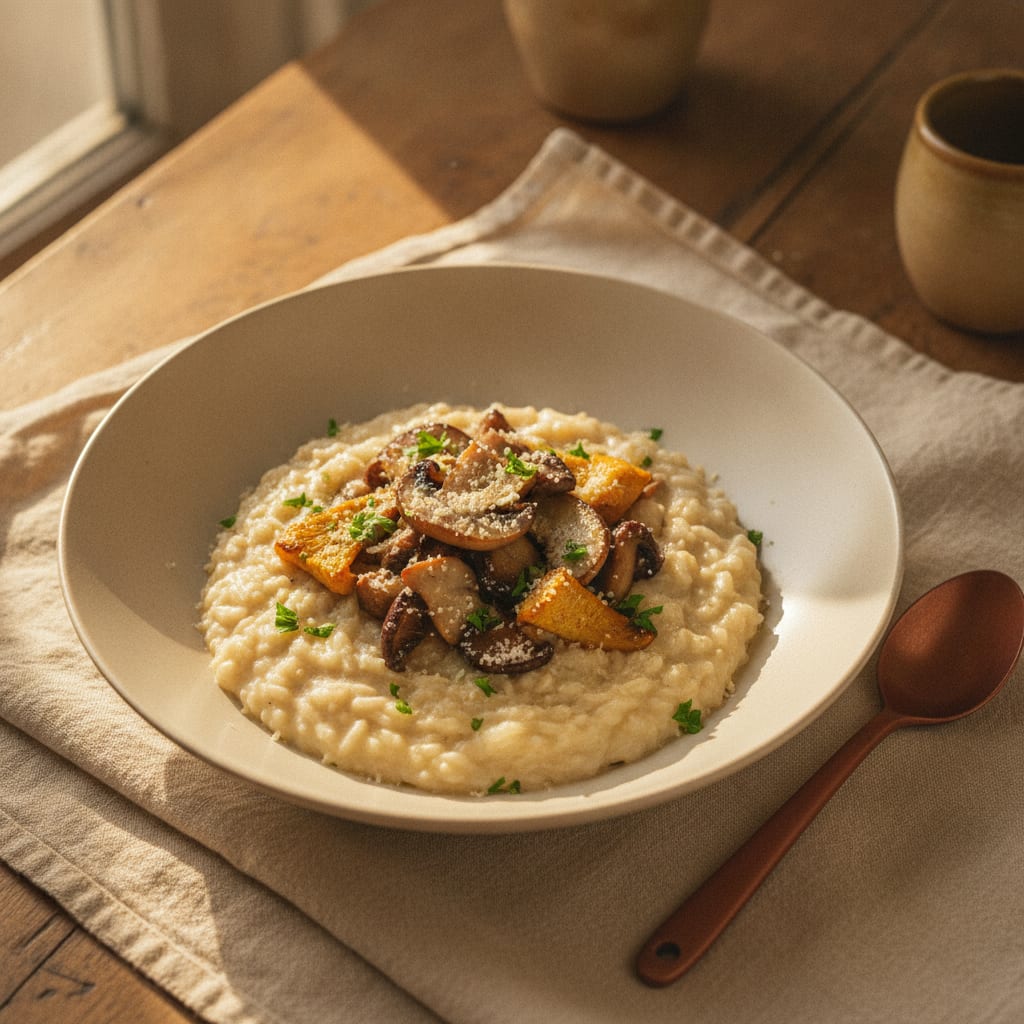
Spread it loose into warm shallow bowls so it almost reaches the rim and moves when you tap the bowl. Crown with the seared mushrooms, a last grating of cashew parmesan, black pepper and flaky salt. A Tuscan red — a young Chianti — or a fuller white like a Vermentino. Serve and eat it immediately.
The story
There is a moment at the end of a risotto that the whole dish is built toward, and it lasts about ninety seconds. The rice is just cooked, the pan comes off the flame, and you beat in cold fat hard enough to make the surface turn glossy and slack — the mantecatura — until the risotto loosens into a wave that moves when you tap the bowl. All’onda, they call it: in a wave. If it sits in a stiff mound, you have made rice. If it ripples, you have made risotto. Everything before that minute is preparation for it.
I learned it in Florence, in 2014, in a kitchen off Via dei Neri in the Oltrarno, from a sous-chef named Tommaso who treated risotto like a small religious observance and the mantecatura like its sacrament. He would not let me plate one that didn’t move. He’d tilt the bowl toward me and watch the surface: if it slid, it went out; if it stuck, it came back. “Deve fare l’onda,” he’d say — it has to make the wave. He beat in the butter off the heat, always off the heat, always cold, shaking the pan like he was angry at it, and then a last splash of hot broth to slacken it right before it hit the bowl.
This risotto has no butter or Parmigiano in the old sense — cold vegan butter and finely grated cashew parmesan do the mantecatura, and a brown broth made from porcini soaking-water does the depth. Nothing about the method changes: the tostatura, the ladle-by-ladle broth, the stir that pulls the starch out, the cold-fat emulsion at the end, the wave. It is not a “vegetable version” of risotto ai funghi. It is risotto ai funghi, beaten to a wave the way Tommaso made me do it forty times before he nodded.
À la maison
The weeknight reading is the recipe above, and two moves carry it. First, the porcini soaking liquid: soak the dried mushrooms, strain that brown water into your stock, and you have built more mushroom depth than fresh mushrooms could ever give. Second, the mantecatura: pull the pan off the heat, beat cold vegan butter and cashew parmesan in hard, and loosen with a last splash of broth until the risotto spreads like slow lava. Finish the rice al dente, not soft, or it can’t hold the wave. Spread it thin into a warm bowl and eat it the second it’s done. A risotto that waits ten minutes is a different, sadder dish.
Au bistrot
The bistronomique reading is the same risotto, finished even looser, with the mushroom flavour split into three textures on the plate.
Keep the base identical but push the components. Reduce a second batch of the strained porcini broth with a splash of wine down to a dark, glossy jus you can dot around the plate. Sear a few choice mushrooms — a king oyster fanned, a couple of whole small chestnut caps — hard and separately, to lay on top as the textural hero rather than stirring them all through. Crisp a handful of thinly sliced mushroom in a low oven or a little oil into savoury chips. Finish the risotto a touch looser than usual — beat in the cold vegan butter and cashew parmesan, then slacken with extra hot broth until it almost pours — and spread it thin across a wide warm bowl so it reaches the rim in a single even layer. Lay the seared mushrooms off-centre, dot the dark porcini jus around, stand a few crisp mushroom chips up for height, a grind of pepper, a single thyme tip. The risotto should be the loose, glossy ground; the mushrooms, the relief.
Il piatto — Overhead, slightly tilted, raking low light to catch the sheen. Wide shallow ivory bowl, the risotto spread thin and glossy almost to the rim, moving. Seared mushrooms arranged off-centre, dark porcini jus dotted around, crisp mushroom chips stood for height, one thyme tip. Negative rim, faint steam. The plate should say it moves — a loose wave of risotto read once, at a white tablecloth.
What the other recipes get wrong
Most plant risotto recipes online — I read the top ten in March 2026 — reach for cream or a thick cashew sauce to get “creamy,” and finish the rice soft, and the result is a heavy, stodgy mound that never moves. I ran the test over a week in March 2026, three pans, same rice and same broth, only the finish changed:
- Cream stirred in, rice cooked soft: heavy and flat, a uniform pudding with no grain definition; it held a peak and tasted of fat, not mushroom.
- No mantecatura, just rice and broth: clean but thin and dry, the grains loose and separate with no glossy sauce binding them — a pilaf, not a risotto.
- Al dente rice, cold-butter mantecatura off the heat, loosened with broth: glossy, slack, rippling in the bowl, with distinct grains suspended in a sauce that tasted of mushroom. The wave. Not close.
The science is starch and emulsion. Risotto rice sheds amylopectin starch as the grains rub together under stirring; that starch, suspended in the broth, is the sauce — no cream required, and cream actually mutes it by diluting the starch with fat and water. The mantecatura then does the real work: beating cold fat into the hot, starchy rice off the heat causes a temperature shock that drives the fat and starch into a stable emulsion, the gloss and body you can see. Heat it too much or use warm fat and the emulsion breaks oily. And al dente matters because overcooked grains have burst and gone pasty — they can’t stay suspended, so the whole thing slumps. Cold fat, off the heat, al dente rice, loosened with broth. That is the wave, and it is chemistry, not a flourish.
The line I draw
I will not finish a risotto into a stiff mound, and I will not reach for cream to fake the gloss. The identity of the dish is the wave — all’onda — and the wave is an emulsion of starch and cold fat, beaten off the heat, loosened until the risotto ripples in the bowl. Cream is a confession that you didn’t pull enough starch out of the rice or beat the mantecatura hard enough; it gives you a smooth heaviness that flattens the mushroom and never moves like a real risotto. Tommaso tilted every bowl toward me and watched the surface slide before he’d send it. A risotto that holds a peak is rice. A risotto that ripples is risotto. I plate it loose or I don’t plate it.
When this can fail
Three ways, all from my own kitchen between 2022 and 2026:
- The cake. Plated it, got distracted, served it eight minutes later; it had kept cooking and tightening off the heat into a solid, gluey block. Fix: beat in the mantecatura, loosen with a splash of broth, and serve and eat it immediately — spread thin so it stays loose.
- The broken butter. Beat the vegan butter in over the heat to rush it; the fat split out greasy instead of emulsifying. Fix: pull the pan off the flame first, use cold cubed fat, and beat hard off the heat so the temperature shock binds it.
- The gritty bowl. Poured the porcini soaking liquid straight in without straining; fine grit from the dried mushrooms ended up in every bite. Fix: strain the soaking liquid through a fine sieve or a cloth before it goes near the rice.
FAQ
QWhat makes risotto creamy without cream or dairy?
Starch and emulsion, not cream. As you add hot broth a ladle at a time and stir, the grains rub together and shed surface amylopectin starch into the liquid, thickening it into a natural sauce. Then the mantecatura — beating cold fat into the hot rice off the heat — emulsifies that fat and starch into a glossy, cohesive coating. Cold vegan butter and finely grated cashew parmesan give you exactly that emulsion. No risotto, dairy or not, needs cream; cream is a shortcut that flattens it.
QWhy is the porcini soaking liquid so important?
It is the single most flavour-dense ingredient in the dish. Dried porcini are packed with glutamate and the nucleotide guanylate, and rehydrating them leaches both into the soaking water. Strained into your stock, that liquid carries deep, almost meaty savour into every grain — fresh mushrooms alone can't reach it. The one rule: strain it through a fine sieve or a cloth, because porcini carry grit that will otherwise end up in the bowl.
QWhat does all'onda mean and how do I get it?
All'onda means 'in a wave' — the texture a properly finished risotto has: loose and flowing, so it ripples when you tap the bowl rather than sitting in a stiff mound. You get it two ways. Finish the rice al dente, not soft, so the grains stay distinct. Then, off the heat, beat in cold fat and a little extra hot broth — the mantecatura — until it turns glossy and slack, and spread it thin into a warm flat bowl. If it holds a peak, it's too tight; loosen with a splash of broth.
QArborio or Carnaroli for mushroom risotto?
Both work; Carnaroli is the safer choice. It is higher in amylose and holds a firm al dente core through a longer cook, so it is more forgiving of an extra minute and gives a looser, more separate grain. Arborio releases starch faster and turns creamy quickly but also goes soft and sticky faster, so it is less forgiving. For a risotto you want to finish all'onda, Carnaroli gives you a wider window before it overcooks.
QCan you reheat risotto?
It is never quite as good — risotto is a serve-immediately dish because it keeps cooking and tightening off the heat. But leftovers reheat decently in a pan with a good splash of hot stock or water, stirred until loose again, with a little extra cold vegan butter beaten in at the end to bring back the gloss. Better still, turn cold risotto into arancini: it is what the rice was practically made for.