Grate expectations.
Parmesan.
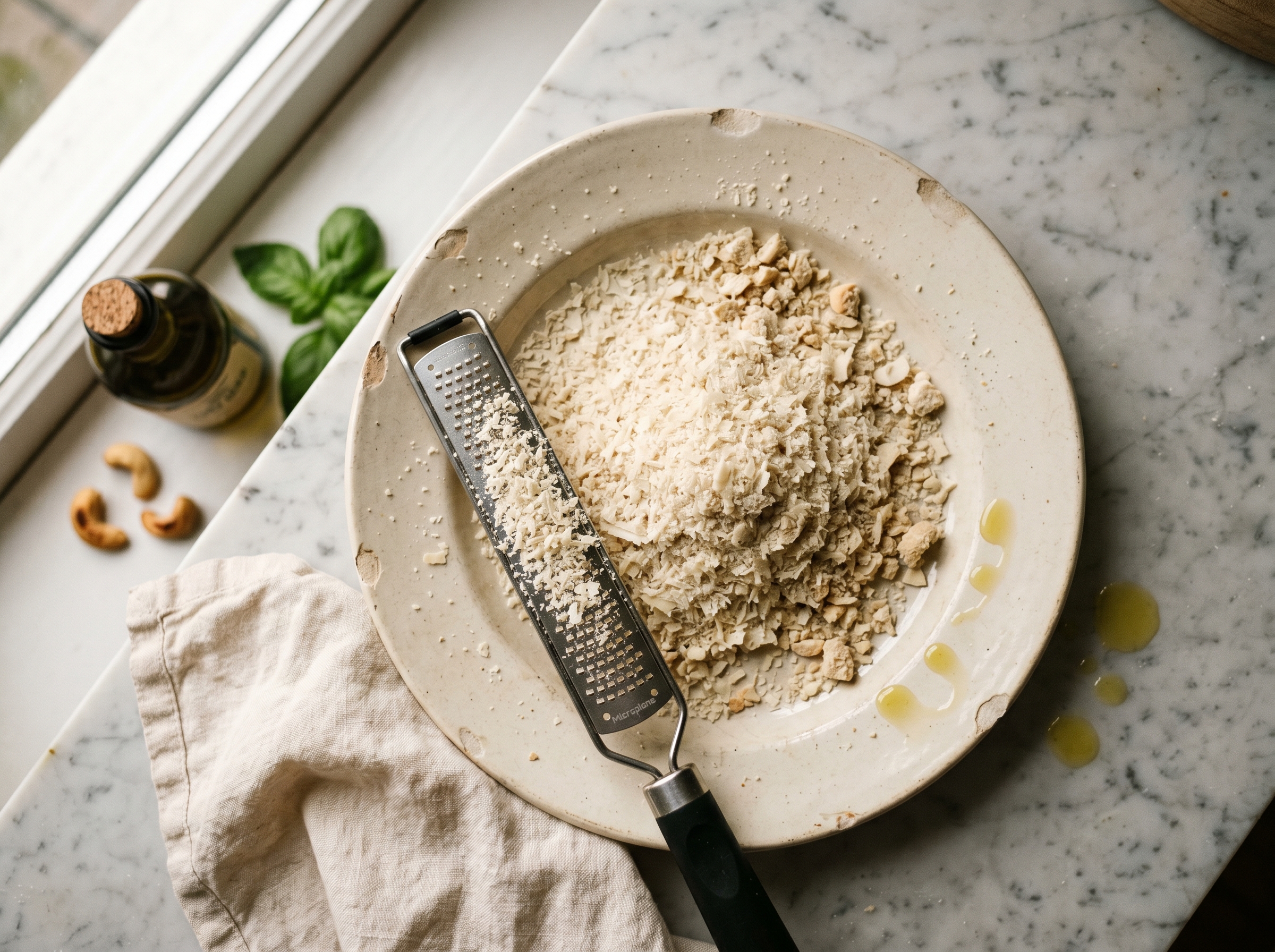
Three ingredients, five minutes — toasted cashews, nutritional yeast, salt. Grates over pasta the way the real one does, with the umami the real one wishes it had.
- Prep
- 5 min
- Cook
- 3 min
- Total
- 8 min
- Servings
- 12
- Difficulty
- Easy
Getting ready…
Ingredients
For 12 servings · 5 items
The whole list
Optional but recommended
Method
3 steps · check as you go
- →
Serve
Use exactly as you would aged parmesan — grated over hot pasta at the moment of serving, sprinkled into salads, folded into soups off the heat, dusted over roasted vegetables. The flavor profile is umami-forward, slightly nutty, with the faint sharp-funk that nutritional yeast provides. Do not stir it into hot sauces during cooking — high heat dulls the nutritional yeast notes; finish at the table.
The story
I invented this in my Washington kitchen in February 2025, on a Sunday afternoon, the day after a pesto pasta where the supermarket vegan parmesan I’d bought at Whole Foods had tasted like sandy yeast and ruined an otherwise honest plate. I had a jar of raw cashews on the counter, a tin of nutritional yeast in the cupboard, and an hour before guests arrived. The first batch was too coarse — closer to crushed nuts than to grated cheese. The second batch ran too long in the processor and turned to cashew butter inside thirty seconds. The third batch, with the cashews dry-toasted first and the processor used in twelve sharp pulses, was the version below. The guests asked where I had bought it. I told them I had not. That was the moment I knew it was worth writing down.
There is a category of plate where a finishing dust of something savory-nutty is the right move. Pesto pasta. Moussaka béchamel. Risotto mantecatura. Roasted broccoli with lemon. Any soup that wants a tablespoon of crunch and umami at the table. The supermarket versions of vegan parmesan — the small green tubs at Whole Foods, the Violife shakers, the Follow Your Heart blend — are all serviceable. They will not embarrass anyone. They are also, almost without exception, more sandy than crumbly, more flavored-rice-flour than aged-cheese-mimic, and more expensive per ounce than what you can produce at home in eight minutes.
The recipe below is not a parmesan substitute in the sense that it tries to convince you it is parmesan. It is a parmesan-shaped object — same role on the plate, same finishing method, same eat-it-grated-fresh ritual — but with its own character. It is its own thing. It happens to be excellent.
The recipe is what it is. Three core ingredients. Two optional. Pulse, don’t run. Eight minutes start to finish.
A few notes worth knowing.
Toast the cashews. This is the only step that requires watching. Three minutes in a dry skillet over medium heat, swirling constantly, until they turn pale gold and smell nutty. They go from golden to burnt in about fifteen seconds — pull them at the first hint of color and let residual heat finish the job on the plate.
Pulse, don’t run. The food processor or blender must operate in short sharp pulses, not continuous. Continuous running heats the cashews from friction and starts pulling out their oils, which turns the mixture from grateable powder into cashew butter within thirty seconds. Twelve to fifteen quick pulses gets you the right texture. Stop the moment it looks like grated parmesan.
The optional miso. Half a teaspoon of white miso paste in the mix adds the aged-cheese depth that fully imitates parmesan’s umami profile. More than that and the texture turns sticky and clumpy. Half a teaspoon is the right amount. Trust me on this — I have done the experiment many times.
The cashew parmesan keeps three weeks in the fridge, three months in the freezer. It clumps slightly over time; a fork through the jar before serving solves this. Bring to room temperature before grating — cold cashew parmesan grates slightly stickier than warm.
The use is identical to real parmesan, with one critical exception: it does not go into hot sauces during cooking. The flavor of nutritional yeast is dulled by sustained heat. Use cashew parmesan at the table, grated fresh, folded off the heat. Real parmesan can be cooked into a béchamel or stirred into hot pasta water; cashew parmesan should not. This is a small adjustment to the technique, not a flaw in the ingredient.
What the other recipes get wrong
Most plant-based parmesan recipes online — I checked the top ten in March 2026 — skip the toasting step entirely. Raw cashews into the processor, nutritional yeast, salt, pulse, done. The result is pale, mild, and tastes more like nutritional yeast than like cheese. I tested four roasting temperatures in my Washington kitchen on a single Saturday in March 2026, with four identical 130-gram batches of raw cashews, side-by-side in the same oven, twelve minutes each:
- No roast (raw cashews straight in): pale, mild, the nutritional yeast does all the heavy lifting and tastes lonely doing it. The parmesan-shaped object is shaped like parmesan but tastes like its supporting cast.
- 250°F: barely any color change, marginal flavor improvement, not worth the oven time.
- 300°F: pale gold, faint roast aroma, a clear step up from raw. Acceptable.
- 350°F: deep gold, the cashew oils starting to rise to the surface, the aroma noticeably nutty. The closest analog to the Maillard-developed flavor compounds of aged parmesan. The winner.
- 375°F (off-protocol, tested after): a few nuts at the edge of the tray scorched within ten minutes. Bitter, acrid, the whole batch ruined.
The combination that worked, every time: 350°F oven for 12 minutes, or 3 minutes in a dry skillet on medium heat (swirling constantly). Toast the cashews. The flavor depth is the difference between a cashew parmesan that imitates the role and one that imitates the soul.
The line I draw
I will not use cashew pieces — always whole raw cashews. Cashew pieces look identical to whole cashews in a food processor, except they are not. Pieces are the broken bits left over from grading whole cashews, and they have a higher surface-area-to-volume ratio, which means they oxidize faster on the shelf and toast unevenly in the pan. Some pieces will be pale, some will be scorched, the result will be muddy and a little bitter. Whole raw cashews toast evenly because they are roughly the same size. Pay the extra two dollars for whole cashews. The bag is the same size; the parmesan is twice the dish.
When this can fail
Three ways, all from my own kitchen between 2024 and 2026:
- The over-pulsed batch. Got a phone call mid-pulse, ran the processor on continuous for fifteen seconds while I answered. The mixture went from grateable powder to a sticky paste — cashew butter, essentially, with nutritional yeast trapped inside it. Fix: pulse only. Twelve sharp pulses, then stop and look. If it still has visible cashew chunks, two more pulses. Never run continuous.
- The under-cooled cashews. Tipped warm cashews straight from the skillet into the processor. The residual heat softened the nuts and released their oil; the batch went paste within ten pulses. Fix: cool the toasted cashews on a plate for ten full minutes. They should be at room temperature before they meet the blade.
- The over-misoed batch. Added a full teaspoon of white miso because more is better, right? Wrong. The miso moisture turned the texture from crumbly powder to slightly tacky clumps that refused to grate cleanly through a microplane. Fix: half a teaspoon of miso, no more. The miso is a flavor amplifier, not a structural ingredient.
For the worked use case, see the pesto pasta recipe — which deliberately calls for this cashew parmesan to be added by the diner at the plate, in the Camogli tradition. Edda would still correct me, probably. But she would not correct the cashew parmesan. She would correct the part where I’m using a substitute at all. The argument with Edda is for a different essay.
FAQ
QWhat is the best vegan parmesan substitute?
A blend of toasted raw cashews, nutritional yeast, and salt — processed into a fine, dry, grateable powder. This three-ingredient combination provides the structural role parmesan plays in finishing dishes: umami depth (from the nutritional yeast and the toasted cashews), a slightly nutty character, and the textural quality of finely-grated cheese sprinkled at the moment of serving. A small amount of white miso paste in the mix adds the aged-cheese depth without changing the texture.
QHow long does cashew parmesan last in the fridge?
Three weeks in a tightly-sealed jar in the fridge, three months in the freezer. The mixture stays fresh because the cashews are dry-toasted (no oils added) and the nutritional yeast is shelf-stable. Bring to room temperature before serving for best texture — cold cashew parmesan grates slightly clumpier. To freshen after storage, stir gently with a fork to break up any settling.
QCan I use cashew parmesan in hot sauces?
It works but is wasted there. Cashew parmesan's flavor profile depends on the nutritional yeast remaining un-cooked — high heat dulls its character. Use cashew parmesan exactly as you'd use real grated parmesan: grated at the table, folded into pasta off the heat, sprinkled over finished soups, dusted over warm roasted vegetables. For hot cooking applications (béchamel, baked dishes, simmered sauces), use a different vegan cheese stand-in built around miso or fermented cashew.
QWhy do you toast the cashews for cashew parmesan?
Toasting raw cashews develops nutty, caramelized flavor compounds via the Maillard reaction. Aged parmesan develops similar flavor compounds over the long curing process (typically 12 to 36 months). Toasting the cashews is the time-compressed analog — three minutes of dry heat produces flavor depth that takes parmesan over a year of aging. Untoasted cashew parmesan tastes flatter and milder. The toasting step is brief and significant.
QWhat's the difference between cashew parmesan and other vegan parmesans?
Most commercial vegan parmesans are based on either rice flour and added flavorings, or fermented coconut. Both work but have characteristic textures (rice-flour versions are sandy; coconut versions are slightly sweet). Cashew parmesan has a closer textural match to real grated parmesan — fine, dry, slightly crumbly — and a more authentic umami profile because of the toasted nut backbone. Almonds work as a substitute for cashews but produce a darker, slightly more bitter result. Macadamia nuts work too but cost more without significantly improving the result.