Little oranges, fried gold.
Arancini.
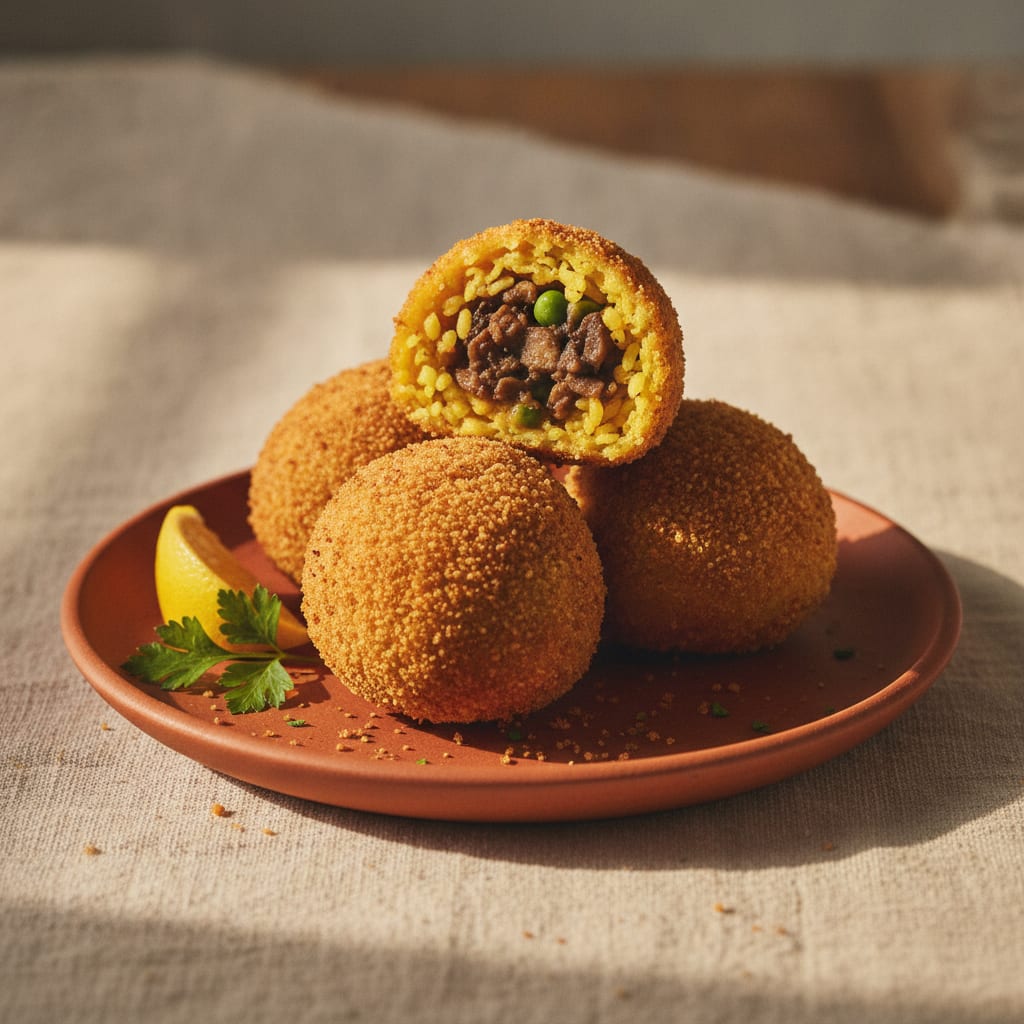
Sicilian fried rice balls, two ways: saffron rice around a mushroom-pea ragù, breaded and fried to a crackling shell that gives way to a molten, savoury centre.
- Prep
- 40 min
- Cook
- 40 min
- Total
- 1h 20min
- Servings
- 4
- Difficulty
- Medium
Getting ready…
Ingredients
For 4 servings · 18 items
For the saffron rice
For the ragù filling
For breading and frying
Method
6 steps · check as you go
- →
Serve
Serve hot, two or three per person, on a plate with lemon wedges and a little flaky salt. They are a starter or a snack, eaten with the hands. A chilled Sicilian white — a Grillo or Catarratto — is the local pour.
The story
Arancini are little oranges, and that is not a metaphor someone reached for after the fact — it is the whole name. The rice ball was shaped and coloured to look like the citrus the Arabs brought to Sicily, arancia, and the resemblance gave the thing its word. The dish’s foundations are Arab too: saffron and rice both arrived on the island during the long centuries of Arab rule, roughly 827 to 1091, and saffron rice stuffed with savoury bits is the medieval heart of it. The crisp breaded shell came later. The story Sicilians tell credits the cooks of Frederick II of Swabia, in the thirteenth century, with crumbing the rice balls so the king could carry them on hunting trips — the crust as a lunchbox. I cannot prove the Frederick II part; it is repeated everywhere and documented almost nowhere, so I hold it as lore. The saffron and the rice are not lore. They are Arab Sicily, fried gold.
I learned to roll them in Naples, in 2015, at Da Concettina, from the cuoca — though arancini are Sicilian, not Neapolitan, and she said so every single time, half-apologising for making them at all. She had grown up in Catania, so for her they were arancini, masculine, and pointed, and she would shape them into little cones with a turn of the wrist I spent a month failing to copy. “Troppo bagnato,” she’d say, prodding my rice. Too wet. She cooked her rice dry as sand and cold before she’d let me touch it.
This arancini has no meat and no cheese in the old sense — a mushroom and pea ragù bound with concentrated porcini liquid, saffron rice beaten with vegan butter and cashew parmesan, an eggless batter to grip the crumb. The method is the method: dry starchy rice, a jammy filling, a sealed shell, hot oil. It is not a “vegetable version” of arancini. It is arancini, rolled and crumbed and fried the way they have been for centuries.
À la maison
The weeknight reading is the recipe above, and it lives or dies on two words the cuoca repeated at me: too wet. Cook the rice drier and starchier than you would ever serve as a risotto, and cool it completely — that starch is the only glue holding the ball together. Reduce the ragù until it is jammy, not saucy, so it doesn’t burst the rice from inside. Bread twice, batter then crumb, and chill the shaped balls before they go in the oil. Fry at a true 175°C. Get those right and you get a crackling shell over a molten saffron centre; get them wrong and you get rice soup in hot fat.
Au bistrot
The bistronomique reading is the same arancino, made small and precise and given a sauce to sit in rather than a lemon to squeeze.
Shape them half the size — eight becomes sixteen neat spheres, each around a single bead of the ragù — and bread them in panko-fine crumb for a sharper, more even crackle. Fry them to an exact deep gold and drain hard on a rack so the shell stays brittle. Meanwhile reduce the leftover porcini soaking liquid with a little stock and vegan butter into a glossy, dark mushroom jus, and whip a spoon of cashew parmesan into a loose, pourable cream. Plate: a comma of the mushroom jus swept across a warm plate, two or three of the small arancini set on it, a quenelle’s worth of the parmesan cream, a dusting of fine breadcrumb toasted in oil for extra crunch, a single saffron thread and a small basil or parsley leaf laid on top. Cut one open as you set it down so the bright yellow rice and dark centre show. The shell should shatter; the inside should run.
Il piatto — Three-quarter, close, shallow depth of field. Warm pale plate, a dark mushroom jus swept low, two small arancini and one cut open to show the saffron core. Crisp golden crumb catching light, a quenelle of pale parmesan cream, a single saffron thread. Negative space, faint steam. The plate should say one crackling bite, made deliberate — Sicilian street food read once, upright, at a white tablecloth.
What the other recipes get wrong
Most plant arancini recipes online — I read the top ten in February 2026 — treat the rice like leftover risotto and the filling like a sauce, then act surprised when the balls dissolve in the oil. I ran the test over a week in February 2026, three batches, same shell and same fry, only the rice-and-filling moisture changed:
- Loose serving-risotto rice, saucy filling: split in the oil within a minute, leaked ragù, and what survived was greasy and slumped. A failure of moisture, top to bottom.
- Dry rice, saucy filling: held its shape but burst at the seam where the wet filling steamed through and pushed the rice apart.
- Dry, starchy rice, ragù reduced to jammy: sealed clean, fried to an even gold, and cut open to a molten centre that stayed put. No splits across all eight.
The reason is starch and water, not luck. Risotto rice — Arborio, Carnaroli — sheds amylopectin starch as it cooks, and that starch is the binder; cook the rice drier and you concentrate it, so the cooled ball holds together like a paste rather than a pile of grains. Water is the enemy on both sides: a wet filling flashes to steam in 175°C oil and blows the ball open from inside, while a wet shell lets oil in and grease out. That is also why the porcini matters beyond flavour — reducing its soaking liquid into the ragù gives you deep, glutamate-rich savour without adding loose moisture, the way a watery mushroom sauce would. Dry the rice, dry the filling, seal the shell. Everything else is just oil temperature.
The line I draw
I will not fry arancini in oil that isn’t at temperature, and I will not shape rice that is still warm or wet. Both are the same impatience the cuoca prodded out of me. Warm, loose rice has no set starch to bind, so the ball falls apart the moment it’s stressed; oil below about 170°C soaks in before the crumb can set, and you get a greasy, sodden shell instead of a crackling one. The whole pleasure of an arancino is the contrast — a shell that shatters over a centre that flows — and that contrast is a function of dry starchy rice and oil at a true 175°C. Skip either and you are deep-frying a wet rice ball, which is a sad thing to do to saffron.
When this can fail
Three ways, all from my own kitchen between 2022 and 2026:
- The blowout. Filled with a ragù that was still saucy; the ball burst at the seam in the oil and bled its centre into the pot. Fix: reduce the filling until it is jammy and holds on a spoon, and chill the shaped balls before frying.
- The greasy shell. Dropped the arancini into oil that had dropped to 160°C after the previous batch; the crumb drank fat and never crisped. Fix: fry in small batches and let the oil come back to 175°C between them.
- The collapse. Shaped the balls from rice that was still warm and slack, skipped the cool-down to save time; they slumped in the breading and split on contact with the oil. Fix: spread the rice to cool fully and shape it cold, with damp hands.
FAQ
QWhy are some called arancina and some arancino?
It is a real, affectionate Sicilian dispute. In Palermo and the west the ball is round and called arancina (feminine), named for the orange — arancia — it resembles; in Catania and the east it is often cone-shaped and called arancino (masculine). Both names trace to the citrus the Arabs brought to Sicily. The 1917 Zingarelli dictionary recorded arancina first, but neither side concedes. They are the same dish; the gender follows the town.
QAre arancini really of Arab origin?
The foundations are. Saffron and rice both entered Sicilian cooking under Arab rule, roughly 827 to 1091, and saffron rice stuffed with savoury bits is the dish's medieval core. The breaded, fried shell is later — popularly credited to the cooks of Frederick II of Swabia in the 13th century, who are said to have crumbed the rice balls so the king could carry them on hunting trips, where the crust kept the rice and filling for the journey. The breading-as-portability story is tradition more than documented fact, so treat it as lore, but the saffron-and-rice base is genuinely Arab-rooted.
QWhy is my arancini falling apart in the oil?
Almost always one of three things. The rice was too wet or too loosely cooked, so it had no starch to bind — cook it drier and starchier than a serving risotto, and cool it fully. The filling was too wet and burst the ball from inside — reduce the ragù until it is jammy. Or the shell was too thin — bread twice, batter then crumb, and chill the shaped balls before frying so they hold the first shock of heat.
QCan you bake or air-fry arancini instead of deep-frying?
You can, and they will be good, but they will not be the same. Deep-frying at 175°C sets the whole crumb shell at once into an even, crackling crust while the centre goes molten. Baking or air-frying browns the crumb unevenly and dries the rice more than it crisps the shell. If you bake, spray the breaded balls generously with oil and bake hot, around 220°C, turning once, and accept a softer, less uniform crust.
QCan I make arancini ahead?
Yes — they are built for it. Make the rice and the ragù a day ahead and chill both; the rice firms up and shapes better cold. Shape and bread the balls and refrigerate them up to a day, or freeze them breaded and fry from frozen at a slightly lower oil temperature so the centre catches up. Fried arancini reheat well in a hot oven for 10 minutes to bring the shell back to crisp.