Upside down, on purpose.
Tarte Tatin.
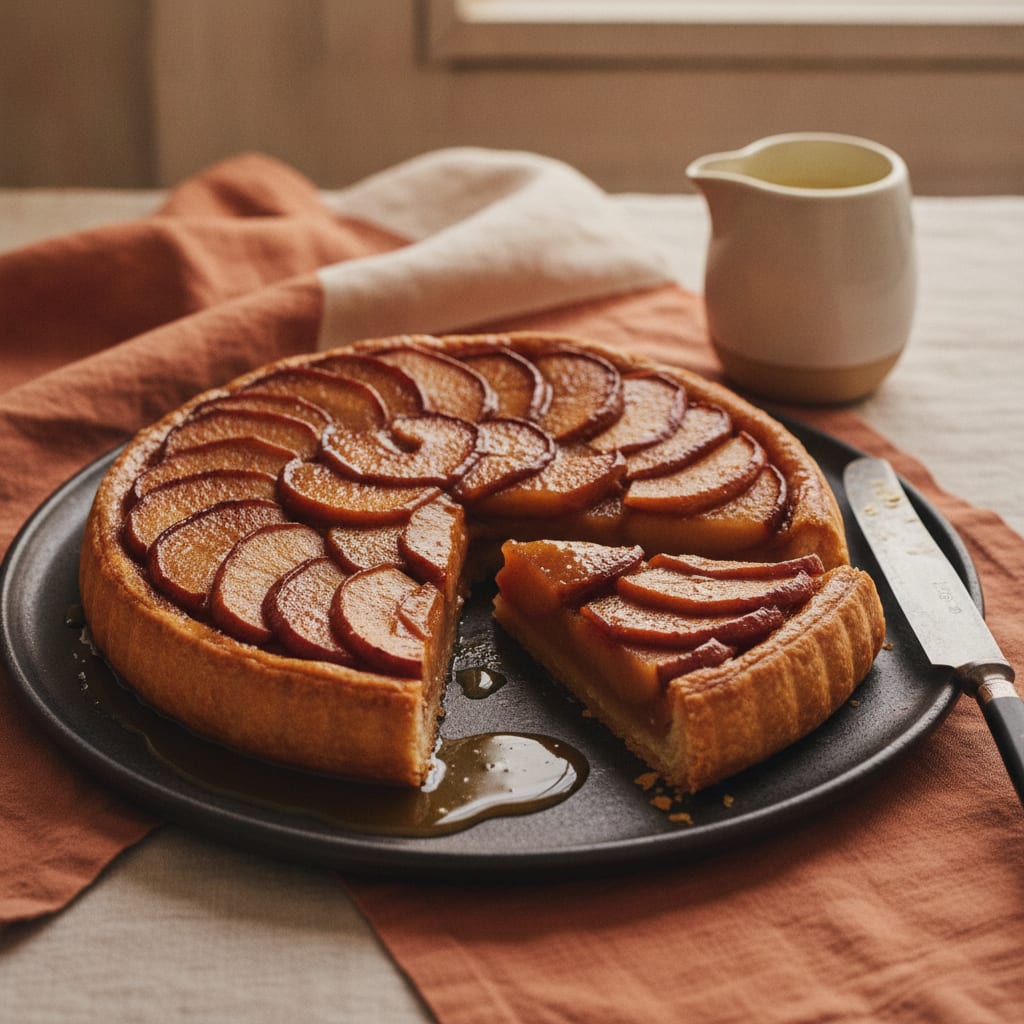
The upside-down apple tart, two ways: apples cooked dark in vegan butter caramel under a lid of puff, baked, then flipped to a lacquered amber dome.
- Prep
- 30 min
- Cook
- 50 min
- Total
- 1h 20min
- Servings
- 8
- Difficulty
- Medium
Getting ready…
Ingredients
For 8 servings · 8 items
For the apples
For the caramel
For the pastry
To serve
Method
7 steps · check as you go
- →
Serve
Serve the tarte Tatin warm, within the hour, cut into generous wedges with the caramel still glossy. A spoon of cold vegan crème fraîche or lightly whipped cold oat cream alongside is the classic counter to the hot caramel. It does not keep well flipped — make it, flip it, eat it.
The story
A tarte Tatin is an upside-down apple tart — apples cooked dark in caramel, lidded with pastry, baked, and flipped so the fruit comes out on top, glossy and amber. The origin story is famous and mostly apocryphal: that in the 1880s, at the Hôtel Tatin in Lamotte-Beuvron in the Sologne, the overworked Stéphanie Tatin forgot the pastry base, salvaged a pan of caramelising apples by laying dough on top, and flipped the result. No contemporary record from the 1880s confirms the accident. The sisters — Stéphanie, born 1838, and Caroline, born 1847 — never named the tart or wrote it down; it was the gastronome Curnonsky who pinned their name to it in his 1926 La France gastronomique, to create a buzz, and Maxim’s in Paris that made it famous. An upside-down caramel apple tart, the tarte solognote, already existed in the region. The accident is a better story than it is a fact.
I learned to flip one without fear in Lyon, in the years I cooked there, from a pastry chef who had no patience for a nervous turn. The flip is the whole dish, she said — hesitate and the caramel runs out the side and you’ve made a mess in a pan. She would set the plate over the skillet, count to three out loud, and turn the whole thing in one motion, hold it, lift the pan, and there it was: a dome of dark amber apples, caramel just dropping off the edge, the smell of burnt sugar and butter filling the room. The first time I tried, I tilted it slowly to peek and lost half the caramel onto the floor. “Décidé,” she said. Decided. You flip it like you mean it.
This tarte Tatin has no dairy in it. The caramel is built on vegan butter whisked into deep-amber sugar; the lid is all-butter-style vegan puff. Everything else — the firm tart apples, the long stovetop cook, the tuck, the flip — is exactly as it has always been done. It is not a “dairy-free version” of a tarte Tatin. It is a tarte Tatin, flipped the way the Lyon pastry chef taught me: decided, in one motion, no peeking.
À la maison
The weeknight reading is the recipe above, and it lives or dies on two moments. The first is the caramel: take it to a deep amber — past golden, toward the edge of dark — because that is where the flavour is, then whisk in the vegan butter off the heat for the glossy sauce. The second is the stovetop pre-cook: give the apples 20–25 minutes in the caramel before the pastry goes on, to drive off their water and thicken the syrup, or the tart will weep and the base will steam. Then it’s just the tuck, the bake, and the flip. Flip it warm, in one decided motion, and serve it within the hour with something cold and creamy alongside.
Au bistrot
The bistronomique reading is the same tart, made as a single precise portion so the caramel reads as lacquer and the flip becomes a moment.
Make individual Tatins in small ovenproof pans or rings. Take the caramel a shade darker, near the point of bitterness where it stops being merely sweet, and salt it a little more firmly — a salted caramel that cuts the apple’s sweetness. Use a single large apple per portion, the halves cut and fanned, or core a whole apple and pack it dense so it flips out as one tight rosette. Cook each one down on the stovetop until the apple is translucent and the caramel clings, lid with a disc of puff cut clean with a ring cutter, bake, and flip onto a warm plate so the rosette stands proud. Brush the hot apple with a little extra reduced caramel to lacquer it to a mirror. Plate it with a quenelle of cold vanilla oat-cream, a few toasted hazelnuts for crunch against the soft fruit, and a single thread of the salted caramel drawn across the plate. The tart becomes a composed dessert — but it is still apples, sugar, butter, and pastry, flipped.
Le dressage — Three-quarter, low, to catch the shine. A single small Tatin, apple rosette lacquered to a mirror, on a dark plate. A clean quenelle of pale cream to the side, toasted hazelnuts scattered, one thread of caramel drawn across. Warm directional light raking the glossy fruit. The plate should say the flip — that the whole drama is a tart turned upside down at the last second.
What the other recipes get wrong
Most tarte Tatin recipes — I read the top ten in May 2026 — skip or shortchange the stovetop cook and tell you to go straight from raw apples into the oven, then wonder why the tart is soggy and the caramel thin. I ran the test over a week in May 2026, four tarts, same apples, same puff, only the apple treatment changed:
- Raw apples straight to the oven under the puff: the apples released a flood of water, the caramel thinned to a pale liquid, and the pastry base steamed soggy. Wet and sweet, no depth.
- Apples briefly softened, 5 minutes, then baked: better, but still watery at the centre and the caramel never thickened past a syrupy slick.
- Apples cooked down 20–25 minutes but the caramel only taken to golden: dry enough, but flat and one-note sweet — no roasted, bittersweet edge.
- Apples cooked down 20–25 minutes, caramel taken to deep amber, watery juice tipped out: dense, glossy, distinct apple wedges in a thick bittersweet caramel over crisp puff. This was the dish.
The reason is water and sugar chemistry. An apple is roughly 85% water, and all of it has to leave before the tart can set into a dense dome rather than a soup — the stovetop cook drives it off and concentrates the apple’s pectin into something that holds its shape. Meanwhile the caramel only develops its hundreds of bittersweet flavour compounds once the sugar passes about 170°C and the molecules break down and recombine — that is the deep-amber stage, the line between “sweet” and “caramel.” Take it pale and you’ve made syrup; take it dark and you’ve made flavour. Drive off the water, take the caramel deep: that won every time.
The line I draw
I will not flip a tarte Tatin slowly. Not a cautious tilt, not a peek under the corner to see if it’s ready, not a nervous two-stage turn. The flip is the entire identity of the dish — it is an upside-down tart, and the upside-down happens in one decided motion or it doesn’t happen well at all. Tilt it slowly and the molten caramel runs out the low side, the apples slide, and you arrive at the table with a pan of caramel and a plate of bare pastry. Plate over pan, count to three, turn it like you mean it, lift the pan. The Lyon pastry chef was right: décidé. You flip it once, committed, or you don’t flip it at all.
When this can fail
Three ways, all from my own kitchen between 2022 and 2026:
- The soggy, weeping tart. I went straight from raw apples to the oven to save time; they flooded the caramel with water and the base steamed limp. Fix: cook the apples down in the caramel on the stovetop for 20–25 minutes first, and tip out any thin juice that pools.
- The stuck flip. I let it rest too long after baking; the caramel cooled and glued the apples to the pan, and half the tart tore off on the turn. Fix: flip after just 5–10 minutes while the caramel is still fluid, or rewarm the pan a minute to loosen it before flipping.
- The pale, flat caramel. Nervous about burning it, I pulled the caramel at golden; the finished tart was sweet but had no roasted depth. Fix: take it to a genuine deep amber, just to the edge of bitter — that is where the flavour is.
FAQ
QHow do you make a tarte Tatin without butter or dairy?
The two dairy moments in a Tatin are the caramel and the pastry, and both have honest stand-ins. For the caramel, cook sugar and water to a deep amber, then whisk in block-style vegan butter off the heat — it emulsifies into a glossy sauce exactly the way dairy butter does. For the pastry, use all-butter-style vegan puff pastry, which most block puff already is; check the label. Cook the apples in the caramel on the stovetop first, lid with the puff, bake, and flip.
QWas the tarte Tatin really invented by accident?
The famous story — that Stéphanie Tatin, overworked at the Hôtel Tatin in Lamotte-Beuvron, forgot the pastry base and salvaged the apples by laying dough on top and flipping it — is anecdotal, with no contemporary record from the 1880s to confirm it. The Tatin sisters never named or published the tart; the gastronome Curnonsky attached their name to it in his 1926 La France gastronomique, partly to create a buzz, and Maxim's in Paris put it on the map. An upside-down caramel apple tart, the tarte solognote, already existed in the region. The accident is a good story; the technique is older than the sisters.
QWhat are the best apples for tarte Tatin?
Firm, tart apples that hold their shape through a long cook in caramel — Reine des Reinettes, Belle de Boskoop, Pink Lady, or Braeburn. Soft apples like McIntosh collapse into sauce. You want halves that shrink and concentrate but keep their wedge shape, so the flipped tart is a dense dome of distinct, glossy pieces rather than a layer of apple purée.
QWhy is my tarte Tatin soggy or watery?
Almost always because the apples weren't cooked down on the stovetop before baking. Apples hold a lot of water; if you go straight to the oven, that water floods the caramel, thins it, and steams the pastry from below. Cook the apples in the caramel on the stovetop for 20–25 minutes first to drive off the water and thicken the caramel, tip out any thin juice that pools, then lid with puff and bake.
QWhen should you flip a tarte Tatin?
While it is still warm — rest it only 5–10 minutes after baking. At that point the caramel has settled from a hard bubble to a thick, fluid syrup that releases cleanly, but it hasn't cooled enough to set hard and glue the apples to the pan. Flip it in one decisive motion onto a serving plate. If you wait until it is cold, gently rewarm the pan on the stovetop for a minute to loosen the caramel before turning it out.