Named for an opera. Fried, never roasted..
Pasta alla norma.
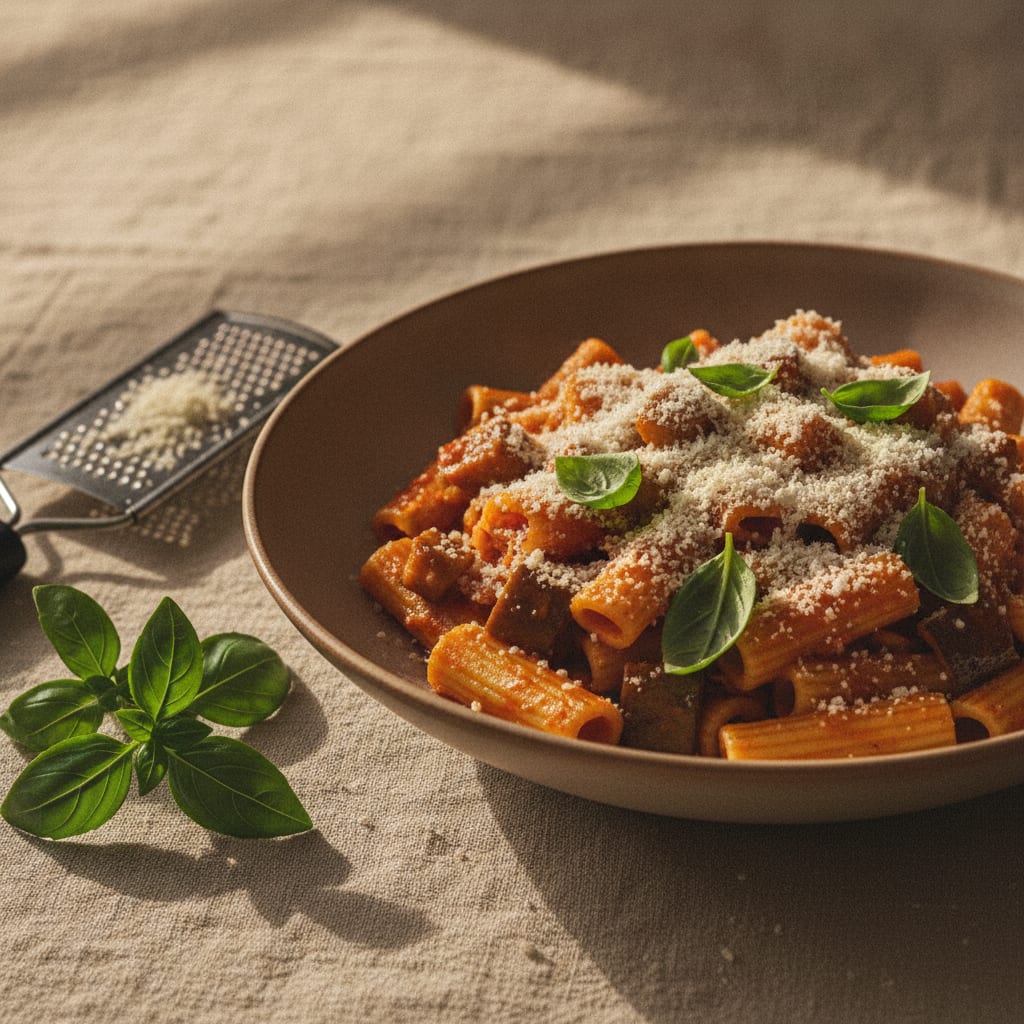
Catania's eggplant pasta, two ways: fried aubergine folded through a bright tomato sauce over rigatoni, finished with torn basil and salty grated ricotta salata.
- Prep
- 30 min
- Cook
- 25 min
- Total
- 55 min
- Servings
- 4
- Difficulty
- Easy
Getting ready…
Ingredients
For 4 servings · 11 items
For the eggplant
For the tomato sauce
For the pasta and finish
Method
6 steps · check as you go
- →
Serve
Serve in warm bowls, the reserved fried eggplant piled on top and a generous, snowy grating of the ricotta salata analog over each — be heavy-handed; the salty cheese is the seasoning. Torn basil and a thread of olive oil to finish. A Sicilian red like Nero d'Avola or a chilled Etna Rosato suits it. Eat it hot.
The story
Pasta alla norma is named for an opera, which is the kind of detail that sounds invented until you learn that Catania produces both. The dish is Catanese, and so was Vincenzo Bellini, who wrote Norma; the tradition holds that the writer Nino Martoglio, tasting a plate of this eggplant pasta, declared in Sicilian “Chista è ‘na vera Norma!” — this is a real Norma! — meaning it was a masterpiece on the level of Bellini’s. In Catania, to say a thing is “‘na Norma” became a way of saying it is the best of its kind, the non plus ultra. I love the story and I won’t oversell it: the Martoglio line is repeated everywhere and pinned down nowhere, so I hold it as the city’s cherished lore. What is not lore is that this is Catania’s dish, named for Catania’s composer, and that it is built on fried eggplant — fried, never roasted.
I cooked it in Naples, in 2015, at Da Concettina, where it lived on the menu all summer and where the cuoca — Catanese herself, and proud of it among Neapolitans — treated the frying as the one thing you could not negotiate. “Si frigge,” she said, the same two words she used for the parmigiana. You fry it. She salted the cubes, pressed them dry under a weight, and fried them in olive oil until they were the colour of dark honey and gave way like custard inside. Then a quick tomato sauce, basil torn at the last second, and — the part she watched me on — a heavy, snowy grating of salted ricotta over the top. Not a polite dusting. A real fall of it. “È il condimento,” she’d say. It’s the seasoning.
This norma has no dairy ricotta salata — a firm salty cashew cheese, or a pressed and salt-cured tofu, grated heavy at the end. Nothing else changes: the salted eggplant, the frying, the bright sauce, the al dente tube, the snowfall of salty cheese. It is not a “vegetable version” of pasta alla norma. The eggplant was always the point. It is pasta alla norma, fried and salted the way Catania makes it.
À la maison
The weeknight reading is the recipe above, and it is the easiest dish in this batch to get right and the easiest to get wrong. Salt and press the eggplant so it fries crisp instead of greasy. Fry it — do not roast it; the silken, custardy interior is the whole soul of the dish and the oven cannot make it. Keep the tomato sauce short and bright. Toss the pasta in the sauce with a splash of its water so it clings. And be heavy-handed with the grated ricotta salata at the end: it is the seasoning, the salty sharp counterpoint that makes the plate snap into focus. A timid grating leaves the dish flat and sweet.
Au bistrot
The bistronomique reading is the same norma, taken apart into its three clean notes and rebuilt on the plate.
Cut the eggplant into neat, even cubes and fry them precisely golden so they read as deliberate, holding a few back to fry a shade darker and crisper for texture on top. Reduce the tomato sauce further and pass it into a smooth, glossy coulis. Cook the pasta — here, swap rigatoni for a sleek mezze maniche or a single nest of long maccheroncini — and toss it tight in the coulis with the eggplant folded gently through so the cubes stay whole. Plate into a warm shallow bowl, the pasta twirled or stacked neat and high, the crisp reserved eggplant set on top, a sweep of extra coulis at the edge, a few fried basil leaves for crackle and fresh ones for lift. Then the ricotta salata, grated into a fine even snow over the whole thing tableside — the salty white against the red, generous, the dish’s seasoning made into its finishing gesture. Sweet tomato, silken-then-crisp eggplant, salty cheese: three notes, plated so you taste each.
Il piatto — Three-quarter, close, shallow depth of field. Warm shallow bowl, pasta twirled neat and centred, glossy red coulis swept at the edge, golden-crisp eggplant on top, fried and fresh basil. A snowfall of white ricotta salata grated over, falling tableside. Warm light, deep shadow, faint steam. The plate should say three notes, sweet, silken, salty — Catania’s opera dish read once, upright, at a white tablecloth.
What the other recipes get wrong
Most plant pasta alla norma recipes online — I read the top ten in May 2026 — roast the eggplant “to keep it light” and skip the salt-and-press, then go shy on the salty cheese, and the dish comes out lean and sweet and flat. I ran the test over a week in May 2026, three pans, same sauce and same pasta, only the eggplant and the finish changed:
- Roasted, unsalted eggplant, light grating of cheese: dry, firm, slightly bitter eggplant; a sweet tomato pasta missing its silken texture and its salty edge. Pleasant, but not Norma.
- Fried, unsalted eggplant, light grating: silkier and richer, but greasy where the raw cubes drank the oil, and still oddly sweet and one-dimensional without enough salty cheese to cut it.
- Salted, pressed, fried eggplant, heavy grating of salty ricotta salata: custardy golden eggplant, bright sauce, and a salty sharp counterpoint that pulled the whole plate into three clear notes. Not close. This is the dish.
The reasons are texture and balance. Eggplant flesh is full of open, air-filled cells; salting collapses them osmotically, so the fried cubes absorb far less oil and give up their water at the towel rather than in the pan — that is why the salted batch fried crisp and golden while the unsalted one went greasy and grey. And frying, not roasting, drives the deep savoury, almost custardy transformation that is the eggplant’s whole contribution; the oven’s dry heat firms and dries instead. The salty cheese is the third leg: pasta alla norma is a balance of sweet tomato, rich eggplant, and sharp salt, and a thin grating leaves it sweet and unresolved — the salt is what makes it taste finished. Salt, press, fry, and grate the cheese like you mean it. Roast it and go light on the salt and you have a nice eggplant pasta that isn’t a Norma.
The line I draw
I will not roast the eggplant for a norma, and I will not be shy with the ricotta salata. Both are quiet betrayals of the dish. Roasting gives you a lean, firm, sometimes bitter eggplant; frying gives you the silken, custardy richness that is the entire reason the dish carries an opera’s name, and there is no oven shortcut to it. And the salty grated cheese is not a topping — it is the seasoning, the sharp salty note that balances the sweet tomato and the rich eggplant into the three-part chord that makes a Norma a Norma. A polite dusting leaves the plate sweet and flat. The Catanese cuoca fried the eggplant dark and grated the ricotta in a snowfall, and both were the dish defending itself against being made lesser. I fry it and I salt it heavy, or I don’t call it norma.
When this can fail
Three ways, all from my own kitchen between 2022 and 2026:
- The greasy eggplant. Skipped the salt-and-press to save half an hour and fried raw cubes; they drank the oil and the pasta came out slick and heavy. Fix: salt the cubes 30 minutes and press them genuinely dry before they hit the pan.
- The flat, sweet plate. Went light on the ricotta salata, treated it as a garnish; the dish tasted sweet and unfinished with no salty edge. Fix: grate it on heavy at the end — it is the seasoning, not a sprinkle.
- The watery sauce. Used an under-reduced, loose tomato sauce; it pooled in the bowl instead of clinging to the rigatoni. Fix: simmer the sauce thick and glossy, and toss the pasta in it with a splash of starchy water to emulsify rather than dilute.
FAQ
QWhy is it called pasta alla Norma?
It is named, by tradition, for the opera Norma by Vincenzo Bellini, a composer born in Catania — the same city the dish comes from. The story credits the Catanese writer Nino Martoglio (1870–1921), who is said to have tasted it and exclaimed in Sicilian, 'Chista è 'na vera Norma!' — 'This is a real Norma!' — meaning it was a masterpiece on the level of Bellini's opera. In Catania, 'a Norma' came to mean the best of its kind. The story is well-loved but hard to document precisely, so treat the Martoglio quote as cherished lore rather than recorded fact; the Bellini-and-Catania connection is solid.
QShould you fry or roast the eggplant for pasta alla Norma?
Fry it. Frying is the traditional Catanese method and it is not interchangeable with roasting. Hot oil gives the eggplant a silken, almost custardy interior and a deep savoury richness that the dry heat of an oven simply cannot produce — that texture is the heart of the dish. Roasting is lighter and lower in oil and makes a perfectly nice pasta, but it is a leaner, different thing. If you fry, salt and press the cubes dry first so they drink less oil and fry crisp and golden rather than greasy.
QWhat is ricotta salata and what can I use instead?
Ricotta salata is ricotta that has been salted, pressed and aged into a firm, dry, salty cheese for grating — sharp and milky, the salty counterpoint that defines pasta alla Norma. For a dairy-free version, use a firm, salty cashew or almond cheese you can grate, or press and salt-cure tofu into a crumbly 'feta' and grate that over. Be generous: it is the dish's seasoning, not a sprinkle. Grate it on at the end so it stays distinct.
QWhy salt the eggplant before frying?
Eggplant flesh is a sponge of open, air-filled cells that soak up oil and hold water. Salting draws out moisture and collapses those cell walls, so the cubes absorb far less oil and fry crisp and golden instead of greasy and grey — and they don't later weep water into the sauce. Salt the cut eggplant about 30 minutes, rinse briefly, then press it genuinely dry before it goes in the pan. It is the single biggest difference between a clean Norma and a greasy one.
QWhat pasta shape is best for pasta alla Norma?
A short, ridged or tubular shape — rigatoni, maccheroni, or the Sicilian favourite, the long hollow maccheroncini. The ridges and hollows catch the tomato sauce and cradle the cubes of fried eggplant so every forkful carries all three elements. Spaghetti is used too and is traditional in some versions, but a sturdy short tube holds the eggplant best and is the easier, more forgiving choice.