Not from Parma. It never was..
Parmigiana di melanzane.
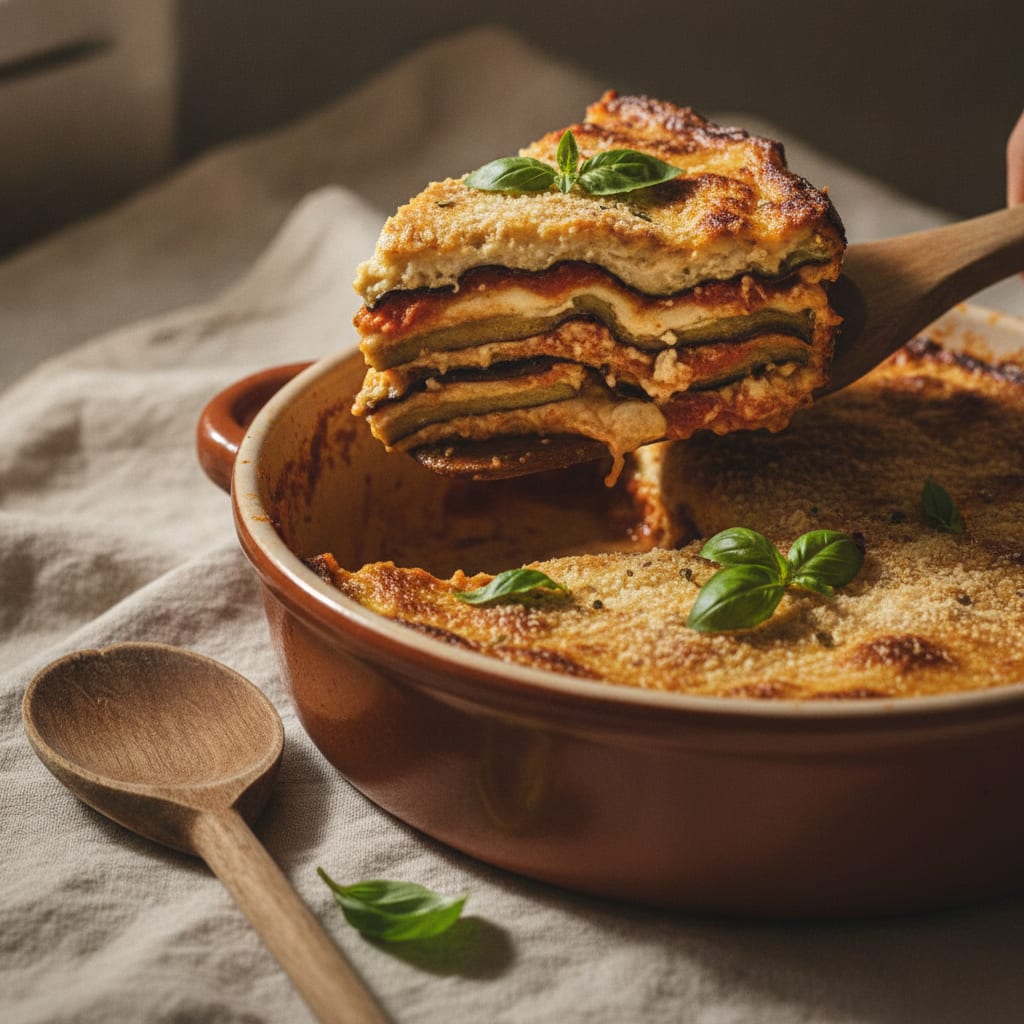
Eggplant parmigiana, two ways: salted and fried aubergine layered with tomato, basil, and cashew parmesan, baked until it sets into slices you can cut.
- Prep
- 40 min
- Cook
- 45 min
- Total
- 1h 25min
- Servings
- 6
- Difficulty
- Medium
Getting ready…
Ingredients
For 6 servings · 11 items
For the eggplant
For the tomato sauce
For the layers
Method
6 steps · check as you go
- →
Serve
Rest it, then cut into squares or wedges that hold their layers, with a little extra basil and a thread of olive oil. Serve warm, not scorching, as a main with bread and a sharp green salad — or at room temperature the next day, when it is arguably better. A glass of Aglianico holds up to it.
The story
Parmigiana di melanzane is not from Parma, and the name is one of the better small mysteries in Italian food. The dish is southern — Naples and Sicily both claim it, and it is essentially missing from the traditional cooking of Parma up north — which means the obvious reading, that it is named for the city or its cheese, runs into a wall: nobody in Parma was making it. The likeliest explanation points instead at the Sicilian word parmiciana, the overlapping horizontal slats of a wooden window shutter, which is exactly what a cross-section of layered eggplant looks like. Others argue for a dialect verb meaning to layer, and the Parmesan-cheese theory has its defenders too. The honest answer is that the name is contested and the dish is southern. I will not pretend the etymology is settled; the food historians themselves don’t agree.
I cooked it for two years in Naples, at Da Concettina, in 2015, where parmigiana was a Sunday thing and a point of regional pride, and where the cuoca who ran the kitchen treated grilling the eggplant as something close to a moral failure. “Si frigge,” she said — you fry it. She salted the slices, pressed them flat under a board weighted with a pot of water, fried them the colour of dark honey, and built the dish in patient layers that she would not let me rush. And then, infuriatingly, when it came out of the oven golden and bubbling and I reached for the knife, she stopped my hand. “Aspetta.” Wait. She let it rest the better part of an hour, and only then did it cut into clean wedges that held every layer.
This parmigiana has no dairy in it — cashew parmesan crumbled between the layers, a torn cashew mozzarella for the melt if you want it, breadcrumbs for the crust. Nothing else changes. The eggplant is salted, pressed, and fried; the sauce is thick and Neapolitan; the bake sets the layers; the rest makes them sliceable. It is not a “vegetable version” of parmigiana — it was always a vegetable at its heart. It is parmigiana, fried and layered and rested, the way it is supposed to be.
À la maison
The weeknight reading is the recipe above, and three moves carry it. Salt and press the eggplant hard, so it fries crisp instead of greasy and does not leak water into the bake. Keep the tomato sauce thick, not loose. And rest the finished parmigiana at least twenty minutes — longer is better — before you cut it. A watery, sloppy parmigiana is almost always one of three failures: wet eggplant, loose sauce, or an impatient knife. Fix those and you get clean wedges that hold their layers, and a dish that is honestly better the next day.
Au bistrot
The bistronomique reading is the same parmigiana, built as a precise individual portion that holds its layers like architecture.
Build it for the plate, not the pan. Fry the eggplant and trim the slices to even rounds with a ring cutter, then layer them in that ring — eggplant, a spoon of reduced sauce, crumbled cashew parmesan, basil — into a tall, neat tortino, pressing each layer so it sets dense. Bake the little towers, then rest them fully so they hold when you lift the ring away. Reduce extra tomato sauce to a glossy coulis you can pool and stripe. Plate: a clean sweep of the tomato coulis on a warm plate, the eggplant tower stood at the centre, a drift of finely grated cashew parmesan, a few crisp-fried basil leaves and toasted breadcrumbs scattered for crunch, a single basil oil dot or two. The cross-section should show the parmiciana — the shutter-slats of eggplant stacked clean — when the guest cuts in.
Il piatto — Three-quarter, close, shallow depth of field. Warm pale plate, a glossy tomato coulis pooled and striped, the eggplant tortino standing tall and centred, its layered cross-section the hero. Crisp basil and breadcrumbs catching light, basil-oil dots. Negative space and a wisp of steam. The plate should say layers, set and clean — a Sunday casserole read once, upright, at a white tablecloth.
What the other recipes get wrong
Most plant parmigiana recipes online — I read the top ten in May 2026 — grill the eggplant to “keep it light” and skip the salt-and-press, then wonder why the bake comes out watery and pale. I ran the test over a week in May 2026, three trays, same sauce, same cashew parmesan, only the eggplant handling changed:
- Grilled, unsalted: lean and a little bitter, with eggplant that stayed firm and slightly rubbery, and a tray that wept water into a soupy bottom layer.
- Fried, unsalted: richer, but greasy where the raw slices had drunk the oil, and still watery underneath because the eggplant’s own moisture leaked into the bake.
- Salted, pressed, fried golden: silken, deeply savoury eggplant in a bake that set into clean, sliceable layers with no puddle at the bottom. Not close. This is parmigiana.
The science explains the gap. Eggplant flesh is a sponge of open cells full of air and water, which is why raw slices both soak up oil and later weep liquid. Salting collapses those cell walls — the same osmotic move that makes salted eggplant fry crisp — so the fried batch absorbed far less oil and, crucially, gave up its water at the towel rather than in the oven. That is why the salted-and-fried tray set clean while the others wept. And frying, not grilling, is the traditional Neapolitan method for a reason: the oil drives a deeper savoury, almost meaty transformation in the flesh that grilling’s dry heat never reaches, which is the silken richness people mean when they say a parmigiana tastes “complete.” Salt, press, fry, then layer thick and rest. Skip the salt and the press and you are baking a sponge full of water.
The line I draw
I will not cut a parmigiana straight out of the oven, and I will not skip the salt-and-press to save time. Both are the same impatience, and both wreck the dish. Out of the oven the layers are molten — the sauce and cheese have not set, and the first wedge slides apart into a heap. Twenty minutes of rest, ideally more, lets the structure firm so it lifts clean and shows its layers, the parmiciana slats that give the dish its name. And the salt-and-press is what stands between a silken, sliceable bake and a grey, weeping sponge. The cuoca in Naples weighted the eggplant under a pot of water and stopped my hand at the oven door, and both times she was protecting the dish from me. Salt it, press it, fry it, and let it rest. The waiting is the recipe.
When this can fail
Three ways, all from my own kitchen between 2022 and 2026:
- The soupy bottom. Skipped the salt-and-press, layered wet eggplant, and the finished tray sat in a puddle of its own water with a collapsed bottom layer. Fix: salt the slices 40 minutes and press them genuinely dry before frying.
- The sliding slice. Cut it the second it came out of the oven; the wedge fell apart into a molten heap with no layers left. Fix: rest it at least 20 minutes — longer is better — so the structure sets before the knife goes in.
- The greasy, heavy bake. Fried raw, unsalted slices that drank the oil, and the parmigiana came out leaden and slick. Fix: salt and press so the cells collapse and the slices fry crisp on far less oil.
FAQ
QIs parmigiana from Parma?
Almost certainly not. Despite the name, eggplant parmigiana is a southern dish — claimed by both Campania (Naples) and Sicily — and is essentially absent from the traditional cooking of Parma in the north. The leading theories derive the name not from the city but from the Sicilian word parmiciana, meaning the overlapping horizontal slats of a wooden shutter, which the layered eggplant slices resemble. Others point to the dialect verb for layering, or to the Parmesan cheese used. The dish is southern; the name is a happy accident.
QShould you fry or grill the eggplant for parmigiana?
The classic Neapolitan parmigiana is fried, and frying gives a silkier, richer result than grilling — the eggplant takes on a savoury depth and a melting texture that grilled slices never quite reach. Grilling is lighter and lower in oil, and it is a legitimate choice, but it is a different, leaner dish. If you fry, salt and press the slices dry first so they absorb less oil and fry crisp and golden rather than greasy.
QWhy is my eggplant parmigiana watery?
Three usual causes, all fixable. The eggplant was not salted and pressed, so it leaked water into the bake — salt the slices 40 minutes and press them dry. The tomato sauce was too loose — simmer it thick before layering. Or it was not baked long enough uncovered to drive off moisture, or not rested before cutting — bake until the top is deep gold and the sauce bubbles, then rest at least 20 minutes so it sets into sliceable layers.
QCan you make eggplant parmigiana without cheese?
Yes — and it stays parmigiana, because the dish is defined by layered fried eggplant baked in tomato, not by a particular cheese. Use cashew parmesan crumbled between the layers for the savoury, nutty, aged note, and add a torn cashew-based mozzarella if you want the melt and pull. A breadcrumb topping gives the golden crust in place of a heavy cheese crust. The eggplant, the sauce, and the basil carry the dish.
QIs eggplant parmigiana better the next day?
Yes. Like many baked, layered dishes, parmigiana improves with a rest — the layers firm up, the flavours meld, and it cuts into far cleaner slices once it has cooled and set. Reheat it gently in a moderate oven, or eat it at room temperature, which is how it is often served in southern Italy. Make it a day ahead on purpose; it is one of the rare bakes that is genuinely better reheated.