The agrodolce, on a knife-edge.
Caponata.
Sicilian sweet-and-sour eggplant, two ways: fried aubergine, celery, capers, olives, balanced on a knife-edge of vinegar and sugar. Served cold.
- Prep
- 25 min
- Cook
- 35 min
- Total
- 1h
- Servings
- 6
- Difficulty
- Easy
Getting ready…
Ingredients
For 6 servings · 15 items
For the eggplant
For the base
For the agrodolce
To finish
Method
6 steps · check as you go
- →
Serve
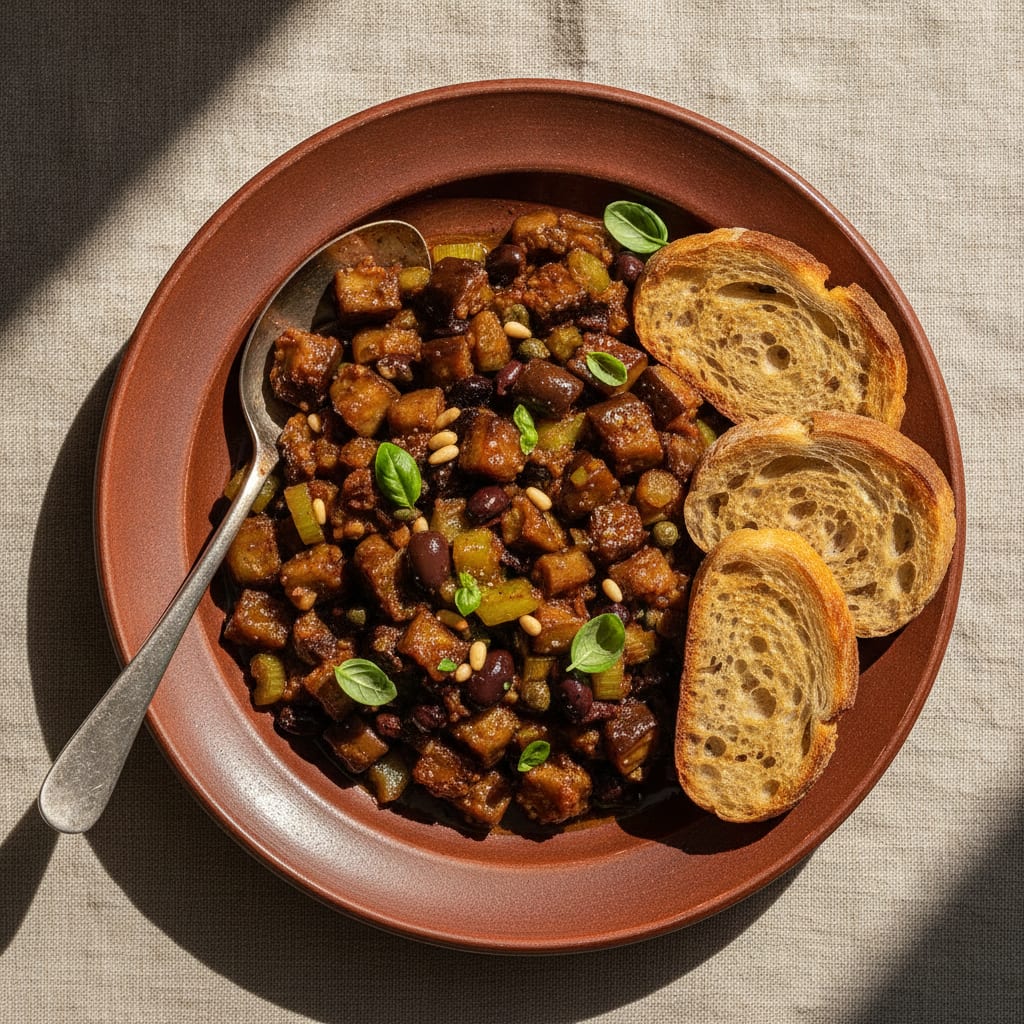
Serve at room temperature, never hot, mounded on a plate with the pine nuts and torn basil scattered over and a slick of good olive oil. Toasted country bread alongside. It is a starter, an antipasto, a side to almost anything off the grill — and it is better on the second day than the first.
The story
Caponata is the most argued-over dish in Sicily, and no two cooks make it the same. By some counts there are around thirty-seven regional versions — Palermo plain and direct, Catania with peppers, Agrigento and Trapani each insisting on their own — and the disagreements run all the way down to the name. Some trace it to the Spanish caponada; some to capone, the Sicilian word for mahi-mahi, a fish the poor could not afford and so replaced with cheap eggplant; some to the Roman caupona, a roadside tavern where cheap vegetables were dressed in oil and vinegar. The first written record is a 1709 Sicilian glossary that defines caponata as a cold dish of small cooked things — which is to say it has been served cold, and argued about, for at least three centuries.
I learned it not in Sicily but in Naples, in the summer of 2015, at Da Concettina, from an old Sicilian nonna who came in twice a week to cook the staff family meal and considered the kitchen’s caponata an embarrassment. She made it on a Tuesday to prove a point, fried the eggplant in batches until it was the colour of dark honey, and would not let me add the vinegar and sugar separately. “Insieme,” she said — together. She dissolved the sugar into the vinegar first so they hit the pan as one thing, and she tasted it four times, frowning, before she was satisfied that neither the sweet nor the sour was winning. Then she covered it and told me, almost angry, not to touch it until tomorrow.
This caponata is the same dish she made — fried eggplant, celery, olives, capers, the agrodolce struck and balanced, rested overnight, served cold. There is nothing to take out of it; it was never built on meat. It is not a “vegetable version” of anything. It is caponata, and the only argument worth having about it is whether the vinegar and the sugar have cancelled into the right kind of tension.
À la maison
The weeknight reading is the recipe above, and it asks for two things: fry the eggplant properly, and strike the agrodolce by taste. Salt the cubes so they fry crisp instead of greasy, and fry them in unhurried batches until they are deep golden — pale, limp eggplant ruins caponata. Then dissolve the sugar into the vinegar and add them together, so the sweet and the sour arrive as one note, and taste until neither wins. The last instruction is the hardest: make it a day ahead and leave it alone. Caponata served cold the next day is a different, better dish than caponata served warm the same night.
Au bistrot
The bistronomique reading is the same caponata, deconstructed into its parts and recomposed on the plate so the agrodolce reads as a deliberate seasoning rather than a stew.
Keep the elements distinct. Fry small, even eggplant cubes so each holds its shape and its gloss, and confit a few separately in olive oil until silken for contrast. Reduce the agrodolce on its own — vinegar, sugar, a little of the tomato — to a glossy, syrupy gastrique you can paint and spoon with control. Blanch the celery so it keeps a hard snap and cut it into neat batons; tear the olives; fry the capers until they bloom open and crisp. Then build: a wide warm spoon-sweep of the gastrique across a flat plate, the fried and confit eggplant arranged off-centre in odd numbers, celery batons and torn olives placed rather than scattered, the crisp-fried capers and toasted pine nuts dropped on top for crunch, basil and a few drops of good oil. A crouton of grilled country bread leaned against the edge. Served, of course, at room temperature — caponata is never hot.
Il piatto — Overhead, close, hard daylight shadow. Flat pale plate, a glossy dark gastrique swept across, eggplant and celery arranged off-centre in odd numbers, crisp capers and pine nuts catching the light. A grilled bread crouton at the edge. Negative space. The plate should say agrodolce, balanced — a humble Sicilian relish read once, deliberately, at room temperature.
What the other recipes get wrong
Most caponata recipes online — I read the top ten in April 2026 — treat the eggplant as just another vegetable to soften in the pot, and add the vinegar and sugar separately and by eye at the end. Both are mistakes. I ran the test over a week in April 2026, three batches, same ingredients, only the eggplant handling and the agrodolce method changed:
- Eggplant unsalted, simmered soft in the sauce: greasy where it had fried, mushy where it had stewed, and it dissolved into the tomato so the dish had no distinct eggplant left in it. Flat.
- Eggplant salted and fried, vinegar and sugar added separately at the end: better texture, but the agrodolce never resolved — I could taste the vinegar and the sugar as two separate spikes instead of one balanced note.
- Eggplant salted and fried golden, agrodolce pre-mixed and struck by taste: distinct, glossy eggplant holding its shape in a sweet-sour that landed as a single bright tension. Not close. This is caponata.
The science backs both moves. Salting does not pull meaningful bitterness from a modern aubergine — the cultivars are bred mild, and studies suggest salt masks bitter compounds rather than extracting them — but it collapses the eggplant’s open, sponge-like cell walls so the cubes absorb far less oil and fry crisp instead of soaking the pan. That is why the salted-then-fried batch held its shape and gloss while the simmered one turned to grease and mush. And the agrodolce is a balance you can only hit by tasting: dissolving the sugar into the vinegar first means the two arrive together and cancel into a single lifted note, rather than reading as a sour spike and a sweet spike fighting. Fry properly, strike the balance by taste, rest overnight. Skip any step and it slumps into a sweet-and-sour vegetable stew.
The line I draw
I will not serve caponata hot, and I will not serve it the same day I make it. The dish is defined by being cold and rested — it has been a cold dish for three hundred years, since that 1709 glossary called it exactly that. The agrodolce needs time to knit: straight off the heat the vinegar is raw and the sugar sits separate, and the brine of the olives and capers has not yet married into the eggplant. Give it a night in the fridge and it rounds, deepens, resolves. Serve it warm and fresh and you are tasting an unfinished dish — every sharp edge still showing. Make it the day before. The waiting is not optional; it is the last step of the recipe.
When this can fail
Three ways, all from my own kitchen between 2022 and 2026:
- The greasy mush. Skipped the salt, threw raw eggplant straight into a hot pan, and it drank every drop of oil and collapsed to a slick paste. Fix: salt the cubes 30 minutes, squeeze them dry, and fry in unhurried batches until deep golden.
- The fighting agrodolce. Added the vinegar and the sugar separately at the end, by eye, and ended up with a sour spike and a sweet spike that never met. Fix: dissolve the sugar into the vinegar first so they hit the pan as one, then adjust by taste until neither wins.
- The raw, sharp first taste. Served it the same evening, hot from the pan, and the vinegar stung and the dish tasted unfinished. Fix: cool it, rest it overnight, and bring it back to room temperature before serving — caponata is a tomorrow dish.
FAQ
QWhat is caponata?
Caponata is a Sicilian dish of fried eggplant in a sweet-and-sour (agrodolce) sauce with celery, onion, tomato, green olives, and capers, finished with vinegar and sugar and served cold or at room temperature. It is an antipasto, a side, and a relish all at once. The defining note is the agrodolce balance — assertively sweet and sour at the same moment — set against the brine of the olives and capers and the crunch of the celery.
QWhy is caponata served cold?
Because it was built to be. The earliest references, back to a 1709 Sicilian glossary, describe caponata as a cold dish of cooked vegetables dressed in vinegar — a way to preserve and carry food in a hot climate. Resting it lets the sweet-sour and the brine knit together and mellow; served hot and fresh the agrodolce tastes raw and sharp. It is almost always better on the second day than the first.
QShould you salt eggplant for caponata?
Yes, but not for the reason most people think. Salting modern eggplant does little to remove 'bitterness' — today's cultivars are bred mild, and research suggests salting masks rather than extracts the bitter compounds anyway. What salting genuinely does is collapse the eggplant's spongy cell structure so it absorbs far less oil when fried. Salt the cubes 30 minutes, squeeze them dry, and they fry crisp and golden instead of soaking the pan dry.
QWhy does caponata recipes differ so much across Sicily?
Because there is no single caponata — by some counts there are around 37 regional versions. The simplest is the Palermo style; Catania, Agrigento, and Trapani each have their own, and some add peppers, raisins, pine nuts, cocoa, or even seafood. The name itself is contested, linked variously to the Spanish caponada, to capone (the Sicilian word for mahi-mahi, replaced by cheaper eggplant), and to the Roman caupona, a tavern. The constant is fried eggplant in agrodolce; almost everything else is local.
QHow long does caponata keep?
Five days in the fridge, and it improves for the first two or three — the vinegar acts as a mild preservative and the flavours deepen with rest. Store it covered, and always bring it back to room temperature before serving, since cold dulls the agrodolce. It also freezes reasonably well for up to three months, though the celery softens. Make it ahead on purpose; this is a dish that rewards waiting.