Bread saved by tomatoes.
Panzanella.
Tuscany's bread-and-tomato salad, two ways: stale bread soaked and squeezed, ripe tomatoes, red onion, basil and good vinegar — thrift married to ripeness.
- Prep
- 25 min
- Cook
- 0 min
- Total
- 45 min
- Servings
- 4
- Difficulty
- Easy
Getting ready…
Ingredients
For 4 servings · 12 items
For the bread
For the salad
For the dressing
Method
5 steps · check as you go
- →
Serve
Serve at room temperature, never from the fridge, in a wide shallow bowl so the juices pool. Make it 30–60 minutes ahead so the bread softens and the flavours marry, but eat it the same day — by the next day the bread goes from craggy to sodden. Finish with torn basil and a last thread of your best olive oil. It is a starter, a light lunch, the answer to a glut of August tomatoes.
The story
Panzanella is what you make when the bread has gone hard and the tomatoes are falling off the vine at the same time — a summer rescue dish, thrift married to ripeness. Most people think of it as a tomato salad with bread in it. It started the other way around: it was a bread salad, and for most of its history it had no tomatoes at all. Its ancestor shows up in Boccaccio’s Decameron in the 14th century as pan lavato — washed bread. In the 16th century the painter Agnolo Bronzino wrote a poem in praise of the onion, Della Cipolla, and inside it described a salad of bread, onion, cucumber, and herbs — recognisably panzanella, with not a tomato in sight. Tomatoes only reached Italy after 1548, and didn’t become standard in the dish until roughly the twentieth century. The onion is the old soul of panzanella. The tomato is the newcomer that took over.
I learned it in Florence in the summer of 2014, in the San Frediano quarter of the Oltrarno, from my landlady — a sharp-eyed woman named Liana who grew tomatoes on her terrace and considered a soft, wet panzanella a moral failing. She soaked the stale bread for barely a minute, then wrung each piece out over the sink with both hands, hard, like a washcloth. “Strizza,” she said — squeeze. The bread had to be damp and craggy, never sodden, so it could drink the tomato juice instead of the tap water. She salted the tomatoes first and saved every drop they wept, folding it back into the oil and vinegar. “L’acqua del pomodoro,” she called it — the water of the tomato — like it was the secret it is.
This panzanella has no meat and never did — it’s bread, tomatoes, onion, oil, the plainest summer food there is. It is not a “vegan version” of anything. It is panzanella, made Liana’s way: stale bread soaked and squeezed craggy, the tomatoes salted and their juices saved, everything rested until the bread drinks it all in.
À la maison
The weeknight reading is the recipe above, and it lives or dies on two moves: the bread and the tomato juice. The bread must be properly stale — soaked briefly, then squeezed firmly dry so it rehydrates craggy instead of dissolving into mush. And the tomatoes get salted first so they release their juices, which you fold into the dressing; that acqua del pomodoro is what makes panzanella taste of more than oil and vinegar. After that, let it sit half an hour so the bread drinks everything in, and serve it at room temperature. It asks for no cooking at all — only ripe tomatoes and a little patience.
Au bistrot
The bistronomique reading keeps every element but composes the plate — the soaked bread as a deliberate component, the tomatoes treated for intensity, the dish read as a still life rather than tossed.
Treat the bread two ways: soak and squeeze some into the traditional craggy chunks, and cut a few more into neat cubes, toss in oil, and toast to golden croutons for contrast of texture. Intensify the tomatoes — halve cherry tomatoes and slow-roast or lightly confit a few in oil with thyme until sweet and slumped, alongside fresh ripe wedges, so the plate has both raw and cooked. Reduce the saved tomato water with a little vinegar to a bright, glossy vinaigrette you can spoon with control. Quick-pickle the red onion in vinegar so it’s sharp and pink and tamed. To plate: sweep a little of the tomato vinaigrette across a wide plate, arrange the soaked bread, the fresh and confit tomatoes, the croutons, and the pickled onion off-centre in odd numbers, then a scatter of small basil leaves, a thread of your best oil, flaky salt, and cracked pepper. The same humble salad, read as a composition of ripe, sharp, soft, and crisp.
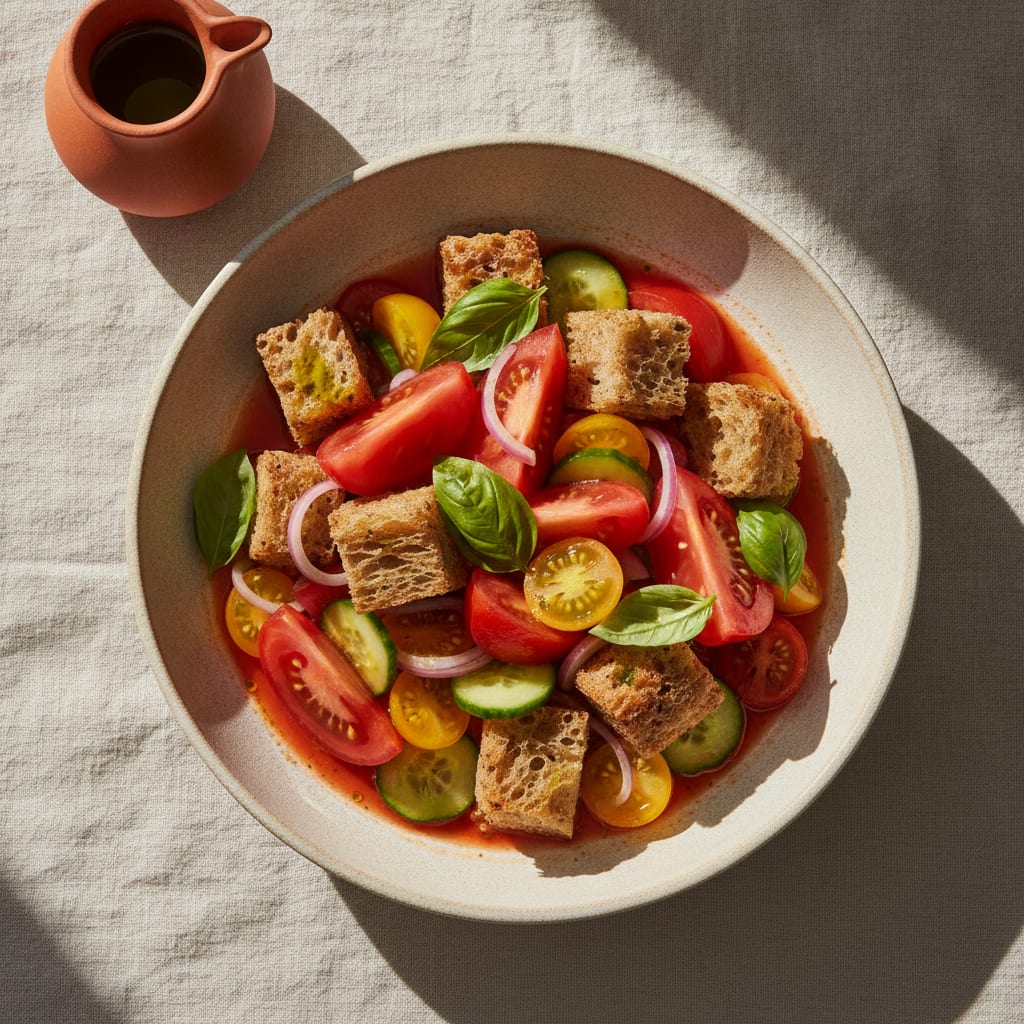
Il piatto — Overhead, close, hard summer daylight and strong shadow. Wide pale plate, a sweep of glossy tomato vinaigrette, soaked bread and red and yellow tomatoes arranged off-centre in odd numbers, golden croutons, pink pickled onion, small basil leaves. Pooling juices, a thread of green oil. Negative space. The plate should say ripeness and thrift, composed — a peasant bread salad read once, at room temperature.
What the other recipes get wrong
Most panzanella recipes online — I read the top ten in May 2026 — either toast the bread into hard croutons and toss them in raw at the end, or skip salting the tomatoes and lose their juices. Both miss the point. I ran the test over a week in May 2026, three bowls, same tomatoes and dressing, only the bread and the tomato handling changed:
- Hard toasted croutons, tomatoes unsalted: the croutons stayed crunchy and dry in the middle, the salad was watery from un-drained tomatoes, and the bread tasted of toast, not of tomato. Two separate things in a bowl.
- Soaked-and-squeezed bread, tomatoes unsalted, served immediately: better bread texture, but thin and under-flavoured — no concentrated tomato juice in the dressing, and the bread hadn’t had time to drink it in.
- Soaked-and-squeezed bread, tomatoes salted and their juices saved, rested 30 minutes: craggy bread soaked through with savoury tomato dressing, the tomatoes sweet and concentrated, everything married. Not close. This was panzanella.
The reasons are physical. Stale bread has lost much of its free water and its starch has partly retrograded, so when you soak and then squeeze it, the structure holds and it rehydrates into tender chunks with room to absorb more liquid — the flavourful kind. Wring out the plain soaking water and you make space for the tomato juices and dressing; leave it sodden, or use fresh bread, and there’s no room and no structure, so it slumps to paste. Salting the tomatoes first draws out their juice by osmosis and concentrates what’s left, and that released acqua del pomodoro, folded into the dressing, is sweeter and rounder than vinegar could ever be. Then the rest: half an hour for the bread to drink it all in. Soak and squeeze, salt and save, then wait. Skip any one and it’s bread and salad sitting next to each other.
The line I draw
I will not make panzanella with toasted croutons, and I will not skip salting the tomatoes. Panzanella is a soaked-bread salad — the craggy, dressing-drunk bread is the entire identity of the dish, and you only get it from properly stale bread soaked and squeezed, never from hard croutons tossed in dry. Croutons stay crunchy and aloof; they never drink the tomato juice, so you’ve made a tomato salad with bread on top, not panzanella. And tomatoes thrown in unsalted weep their juice into a watery puddle instead of into a concentrated dressing you control. Liana wrung the bread out over the sink and saved every drop the tomatoes wept for a reason. Soaked, squeezed, salted, saved. Toast the bread instead and you’ve made a different salad and called it by the wrong name.
When this can fail
Three ways, all from my own kitchen between 2022 and 2026:
- The sodden mush. Used bread that wasn’t stale enough and soaked it too long; it disintegrated into wet paste the moment I tossed it. Fix: use properly stale, dry bread (dry it in a low oven if needed), soak only briefly, and squeeze each piece firmly so it’s craggy, not soaked.
- The watery, thin bowl. Skipped salting the tomatoes and they wept their juice into a flavourless puddle in the bottom of the bowl. Fix: salt the tomatoes 15–20 minutes first, catch and save their juices, and fold that concentrated acqua del pomodoro into the dressing.
- The flat, cold leftovers. Made it the day before and served it straight from the fridge; the bread had gone fully sodden and the cold killed the tomatoes. Fix: combine it only an hour before serving, eat it the same day, and always bring it to room temperature — never serve panzanella chilled.
FAQ
QWhat is panzanella?
Panzanella is a Tuscan bread salad of stale bread soaked and squeezed, then tossed with ripe tomatoes, red onion, basil, olive oil, and vinegar, served at room temperature. It's a cucina povera dish built to use up day-old bread in high summer, when tomatoes are at their peak. The defining technique is the bread: properly stale bread is briefly soaked and then squeezed dry so it rehydrates into tender, craggy chunks that drink the tomato juices and dressing rather than dissolving into mush.
QDid panzanella originally have tomatoes?
No — and this surprises people. Panzanella began as a bread-and-onion dish, with tomatoes added only much later. Its ancestor appears in Boccaccio's 14th-century Decameron as 'pan lavato' (washed bread). In the 16th century the painter and poet Bronzino praised a version in his poem 'Della Cipolla' (Of the Onion), describing a salad of bread with onion, cucumber, and herbs — no tomato. Tomatoes only reached Italy after 1548 and didn't become standard in panzanella until roughly the 20th century. The onion, not the tomato, is the older soul of the dish.
QWhat bread should I use for panzanella?
Stale, dry country bread — ideally the saltless Tuscan loaf (pane sciocco), but any sturdy, crusty rustic bread works. It must be properly stale: fresh bread falls apart when soaked, but stale bread has lost its free moisture and its structure holds, so it rehydrates into tender chunks you can squeeze dry. Avoid soft sandwich bread entirely. If your bread isn't stale enough, dry the chunks in a low oven for 10–15 minutes first.
QWhy do you soak and squeeze the bread?
Because it's the technique that makes panzanella work. Soaking briefly rehydrates the stale bread; squeezing it dry removes the plain soaking water so the bread has room to absorb the flavourful tomato juices and dressing instead. The result is craggy, tender chunks that carry flavour, not a wet sponge of tap water. Don't soak so long the bread disintegrates, and squeeze firmly but don't pulverise it — you want rough chunks that hold their shape.
QCan you make panzanella ahead?
Partly. Panzanella needs 30–60 minutes of sitting after dressing so the bread softens and the flavours marry — that resting time is part of the recipe, not a make-ahead bonus. But it doesn't keep well overnight: by the next day the bread crosses from pleasantly craggy to fully sodden, and the tomatoes go watery. Prep the components ahead (salt the tomatoes, soak and squeeze the bread, mix the dressing) and combine them an hour before serving for the best result. Always serve at room temperature.