Some like it cold.
Gazpacho.
The Andalusian cold soup that breaks every northern rule — raw bread, ripe tomato, olive oil emulsified by hand. Summer in a glass.
- Prep
- 20 min
- Cook
- 0 min
- Total
- 4h 20min
- Servings
- 6
- Difficulty
- Easy
Getting ready…
Ingredients
For 6 servings · 17 items
The soup
Garnish
Method
9 steps · check as you go
- →
Serve
Wide shallow bowls, ice-cold soup, garnish the moment before serving (the croutons go soggy in 90 seconds otherwise). Eat with a small spoon, with bread alongside, and a glass of chilled fino sherry or rosé. The Andalusian summer move is gazpacho as the starter, then nothing — it is filling enough to be lunch.
The story
The first gazpacho I drank that actually tasted like the dish was in the summer of 2018, on a free weekend during the Valencia arroces season at La Riuà. I drove south, alone, into the heat of August Andalusia — the road from Valencia to Seville is a furnace, six hours, the air-conditioning in the rental Renault working at half-strength most of the way. I stopped at a small venta off the highway outside Cordoba, more out of exhaustion than appetite. The woman who ran it had three things on the menu that day. I ordered the gazpacho.
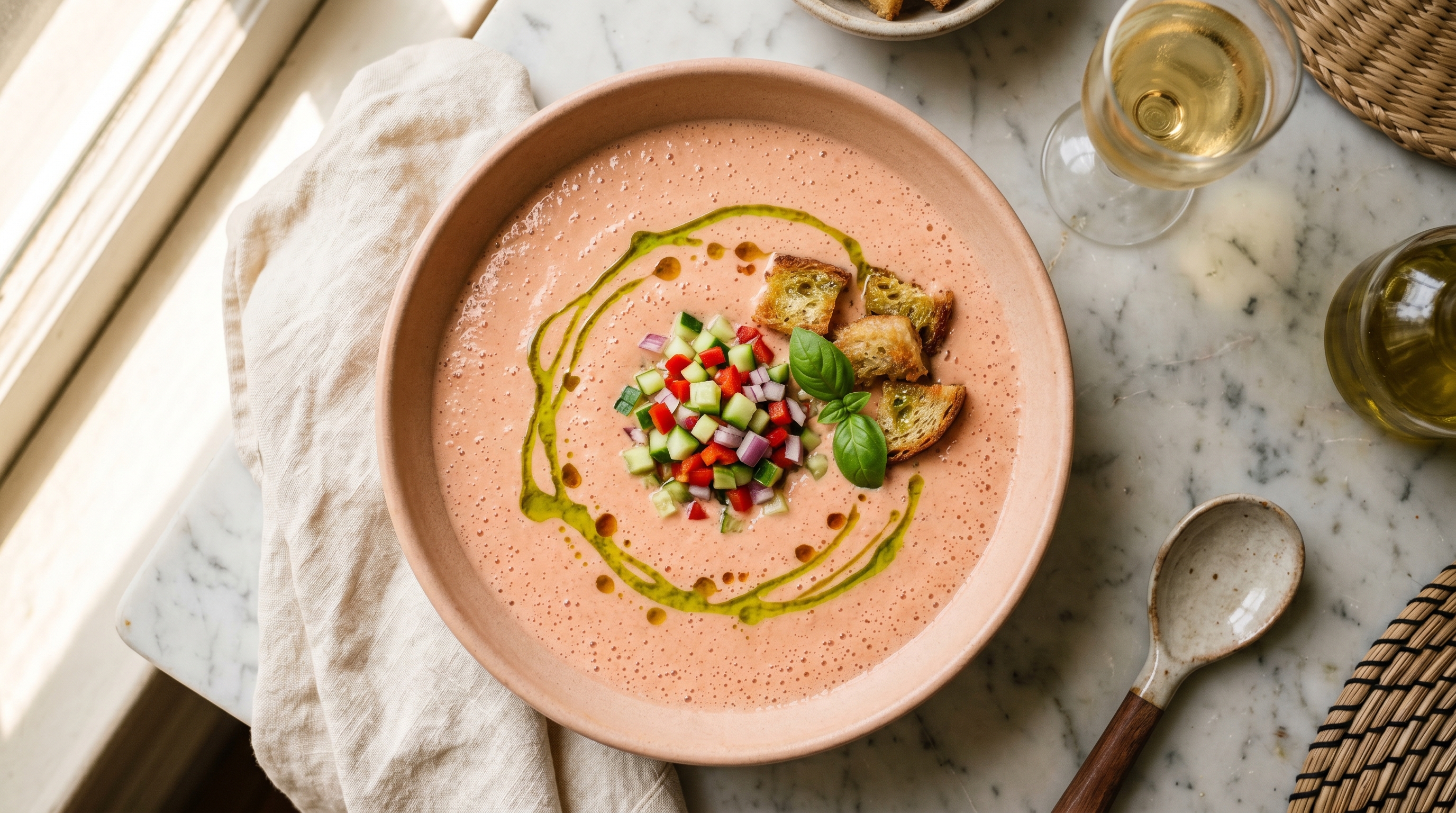
What arrived was a wide shallow ceramic bowl of something pale pink-orange and ice cold, with a small dish of diced cucumber, pepper, and red onion on the side. I had eaten gazpacho before — in Madrid, in Barcelona, in restaurants in Valencia. It had always been a thin red liquid that tasted like cold tomato juice. This was different. Creamy, faintly pink, with a silky texture and a deep tomato-and-bread depth. I drank the bowl in about ninety seconds. She refilled it without asking and watched me drink that one too.
I asked her, in clumsy Spanish, what was in it. She walked me to her tiny kitchen and pointed at a half-loaf of three-day-old bread on the counter, then at a bottle of sherry vinegar, then at a green bottle of Andalusian olive oil. El pan es el secreto, she said. The bread is the secret. The rest was tomatoes, cucumber, pepper, garlic, salt, ice water, and one of the older blenders I have ever seen. I did not catch her name. I have been making it her way ever since.
The bread part — soaked stale white country bread, blended into the soup until it emulsifies into a stable cream — is what nearly every English-language recipe leaves out. The rest is variations on a theme any cook can hit. The bread is the thing.
The other non-negotiable is the tomatoes. Gazpacho is uncooked. There is no heat to develop flavor, no Maillard reaction to deepen anything, no reduction. The tomato is the dish in its raw, undiluted form. If your tomatoes are pale winter tomatoes — hard, pale-pink, more crunch than juice — the gazpacho will taste of nothing. This is a summer dish. June through September in the Northern Hemisphere, with heirloom or vine-ripened tomatoes. Out of season, make something else. I do not joke about this.
What the other recipes get wrong
Most gazpacho recipes online — I checked the top ten in May 2026 — make one or both of two errors. They leave out the bread (5 out of 10), or they use the wrong vinegar (8 out of 10 default to red wine vinegar instead of sherry vinegar). A few do both. The result, in either case, is a thin, separated, red liquid that tastes of raw tomato and acid — not gazpacho.
I tested every variant over three weekends in May 2026, in small batches of one liter each, comparing color, texture, mouthfeel, and the depth of flavor at the 30-minute and 4-hour marks:
- No bread, red wine vinegar: thin, red, watery. Tastes like spicy tomato juice. The bottom of the bowl shows the oil separating out within 60 seconds.
- No bread, sherry vinegar: slightly less aggressive but still thin. The sherry vinegar is doing its job; the absence of bread is the failure.
- Bread, red wine vinegar: creamy texture, proper color, but the flavor profile is wrong — sharp where it should be deep.
- Bread, sherry vinegar (the proper Andalusian combination): pale pink-orange, silky, with the integrated tomato-and-bread depth and the slight wood-aged sherry note in the background. The dish.
The combination that worked, in every test: soaked stale bread, sherry vinegar, hand-emulsified Spanish olive oil streamed during the blend, 30-minute maceration before blending, 4-hour minimum chill, garnish the second you plate. Each piece does something. Skip any one and the soup degrades. Skip the bread and the soup separates. Skip the maceration and the flavors don’t integrate. Skip the emulsion stream and you get an oil slick. Skip the chill and the flavors taste raw and disjointed.
I have a row of photos from those test batches on my fridge, side by side. The visual difference between the no-bread version and the proper version is unmissable — one is a thin red liquid, the other is a creamy pink-orange. Same ingredients minus the bread, completely different dish.
The line I draw
I will not make gazpacho with out-of-season tomatoes. I have tried. Twice, in March 2026, with the best-looking tomatoes I could find at the Whole Foods on P Street. Both times the result was a flat, vegetal soup that no amount of salt or sherry vinegar could rescue. Gazpacho is summer. The dish lives or dies on the tomato. From October to May, I make something else — a roasted tomato soup, or salmorejo with canned tomatoes (which works because it’s cooked-style), or just dinner. From June through September, gazpacho is on the table twice a week.
I will also not use red wine vinegar. The aged sherry vinegar from Jerez is non-negotiable. If you cannot find sherry vinegar, the dish is not gazpacho. Don’t substitute. Buy a bottle — it lasts forever and improves any vinaigrette you make.
When this can fail
Three ways, all from my own kitchen between 2020 and 2026:
- The tomatoes were pale and hard. February attempt. The blended soup was a flat, vegetal red with no aromatic depth. The bread emulsified properly, the sherry was correct, the technique was right — but there was nothing to emulsify. Fix: do not make gazpacho between October and May in the Northern Hemisphere. The dish has a season.
- The bread was bad bread. A test with sliced supermarket sandwich bread. The bread dissolved into the soup but contributed a sugary, slightly chemical note that fought everything else. Fix: use real country bread, day-old. Pain de campagne, ciabatta, or a hearty white sourdough. Crust off.
- The garnish went on too early. Tested by garnishing 10 minutes before serving — by serving time, the croutons had absorbed cold soup and gone limp, the cucumber dice had bled water. Fix: garnish the moment the bowl hits the table. Have everything chopped and ready. Plate one bowl at a time if you must.
The dinner
Make the soup the morning before, or the night before. Make the croutons the moment of serving. Chop the garnish to a fine dice and keep it in a bowl in the fridge. Pour the cold gazpacho into wide shallow bowls, scatter the garnish, drop the croutons, drizzle the green oil. Eat with a small spoon, with the rest of the bread alongside, and a glass of chilled fino sherry or pale rosé.
It is the right dinner for an August evening when the kitchen is too hot to cook in and the tomatoes on the counter are at their peak. The bread is the secret. The tomato is the dish. Everything else is technique.
Cook it when summer asks for it. The dish is the dish.
FAQ
QWhy is my gazpacho tasting flat?
Almost always one of two things. (1) Under-ripe tomatoes — gazpacho is uncooked, raw-blended; there's no heat to develop flavor. If your tomatoes are pale, hard, supermarket winter tomatoes, the soup will taste of nothing. The dish is a summer dish for a reason. Use August tomatoes only. (2) You skipped the bread — most American recipes leave the soaked stale bread out, treating gazpacho as a tomato puree. The bread is what carries the olive oil emulsion, gives the soup body and creamy mouthfeel, and develops the deep pale color that signals real gazpacho. Without the bread you have raw vegetable juice.
QCan I use red wine vinegar instead of sherry vinegar?
No, and this is the change that most strongly ruins the dish. Sherry vinegar (vinagre de Jerez) has an aged, woody, slightly nutty profile that integrates with the tomato and bread into a single harmonious flavor. Red wine vinegar is bright and acidic without the depth — the soup ends up tasting of vinegar-and-tomato instead of gazpacho. Balsamic is even worse (the sweetness fights everything). Aged sherry vinegar is available at any reasonable grocery store in the international or Spanish section. The dish is not gazpacho without it.
QDo I have to peel the tomatoes?
Not absolutely, but it makes a noticeable difference. Tomato skin contains compounds that read as bitter and grainy when blended raw and served cold. A high-speed blender will pulverize the skin but never dissolve it — you end up with tiny fragments that catch on the tongue. Peeling adds 10 minutes and removes that small textural defect. For an everyday gazpacho with very thin-skinned tomatoes, you can skip it. For a special occasion, peel.
QWhy does the gazpacho turn pale pink-orange instead of red?
Because the bread is emulsifying with the olive oil and the tomato juice into a stable suspension — exactly like mayonnaise. The pale pink-orange (sometimes called *salmon* color in Spain) is the visual marker that the emulsion has formed. A red, watery soup means the bread was omitted, the blender didn't run long enough, or the oil was dumped in too fast. The color change from red-and-watery to pale-and-creamy happens around the 60-90 second mark of high-speed blending, while the olive oil is being streamed in. Watch for it; it's the indicator.
QCan I make gazpacho the day before?
Yes, and you should. Gazpacho actually improves with a night in the fridge — the flavors integrate, the rough edges smooth, the raw garlic mellows. Make it the morning of, or the night before, and let it sit covered in the fridge. Just before serving, taste cold and adjust salt and vinegar (cold dulls both, you'll likely need slightly more). The croutons and the diced garnish should be added the moment of serving — they go soggy quickly in the cold soup.