The big soup, whatever the week left.
Minestrone.
Italy's big seasonal soup, two ways: a slow soffritto base, beans, whatever the market gave you, short pasta, and a Parmesan-rind-deep umami broth.
- Prep
- 20 min
- Cook
- 50 min
- Total
- 1h 10min
- Servings
- 6
- Difficulty
- Easy
Getting ready…
Ingredients
For 6 servings · 19 items
For the soffritto
For the soup
To finish
Method
7 steps · check as you go
- →
Serve
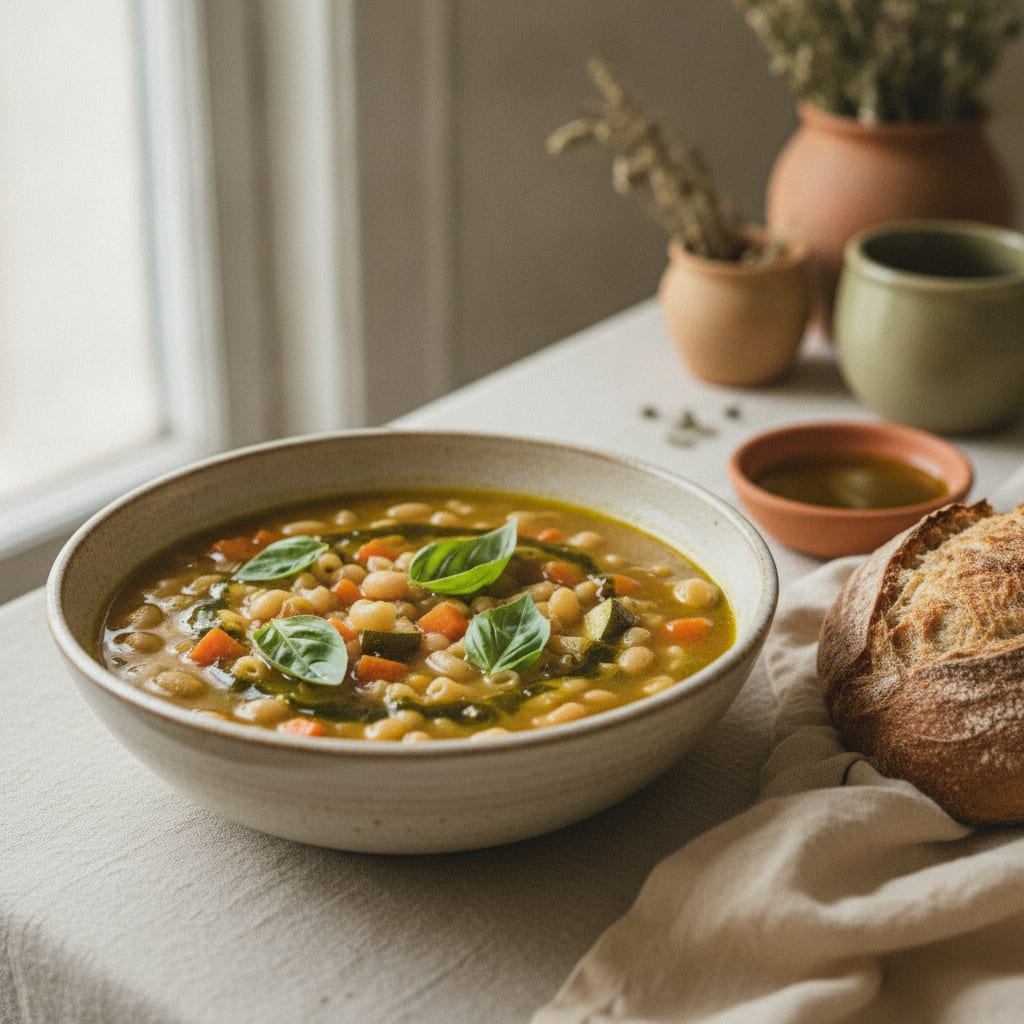
Serve hot but rested, thick enough that the spoon stands up, with a generous swirl of your best olive oil, torn basil, and cashew parmesan grated over. A heel of crusty bread to drag through it. Like most cucina povera soups it is even better the next day, reheated gently — though if you're keeping it, cook the pasta separately so it doesn't swell.
The story
Minestrone is the least fixed dish in Italy. There is no recipe for it — there is a method and a season, and the rest is whatever the market gave you that morning. The name is simply minestra, soup, made bigger: minestrone. It is one of the oldest things Italians eat, a direct descendant of the thick farro-and-bean pottages Romans were spooning up by the second century BC, the kind of dish Apicius wrote down in the first century with chickpeas and fava beans and whatever greens were around. Tomatoes and potatoes only joined the pot after the 16th century, when they arrived from the New World. Everything about minestrone is accumulation — centuries of cooks adding what they had.
I learned to stop treating it like a recipe in the autumn of 2014, in Florence, in the Sant’Ambrogio market quarter, from a vegetable seller named Fiorella who sold me a sad bag of bruised, end-of-day produce for almost nothing and then told me, unprompted, exactly what to do with it. “Soffritto piano,” she said — slow soffritto — miming a low flame with her hand pressed flat and pushing down, as if holding the heat under the pan. Sweat the onion and carrot and celery until they go sweet and almost dissolve. Everything after that, she said, is just the season. She was right. The soffritto is the only part of minestrone that is not negotiable.
This minestrone has no meat in it and never needed any — it is a vegetable soup by birth, peasant food built on beans and bread and whatever grew. It is not a “vegan version” of anything. It is minestrone, made the way it has always been made: a slow base, beans for body, the season in the pot, and a quiet umami anchor in the broth where an Italian nonna would have dropped a Parmesan rind.
À la maison
The weeknight reading is the recipe above, and it asks for two honest things: a slow soffritto and an umami anchor. Sweat the onion, carrot, and celery gently for a full fifteen minutes — this is where the flavour is made, and you cannot hurry it. Then drop a strip of kombu into the broth where tradition would put a Parmesan rind; both give the soup its savoury backbone. The last trick is mashing half the beans, which thickens the broth to a creamy body without a drop of cream. Beyond that, use whatever vegetables you have. That freedom is the whole point of minestrone.
Au bistrot
The bistronomique reading keeps the soul of the soup but composes the bowl, separating the broth from its garnish so each reads clean and deliberate.
Build the soffritto and broth as before, but push the umami: simmer the kombu with a few dried porcini, and at the end blitz a ladle of the beans and broth into a smooth, glossy purée to pool at the base of the bowl. Cook each tender vegetable separately and briefly — zucchini, green beans, a few cavolo nero leaves — so each keeps its own colour and bite, then warm them through in a little of the broth to order. Toast the pasta dry before cooking it for a nutty depth, or swap it for a quenelle of soft farro. To plate: spoon the warm bean purée into a wide shallow bowl, arrange the bright vegetables and a few whole beans off-centre in odd numbers, lift the farro or pasta on top, then pour the clear, glutamate-rich broth at the table so it rises around the garnish. A thread of basil oil, a crisp of fried cavolo nero, a grating of aged cashew parmesan.
Il piatto — Overhead, then a second frame at the pour. Wide shallow bowl, pale bean purée at the base, bright vegetables and beans arranged off-centre in odd numbers, broth poured tableside so it catches the light gold. A thread of green basil oil, one crisp cavolo nero leaf. Negative space. The plate should say the season, composed — a peasant soup read once, with intention.
What the other recipes get wrong
Most minestrone recipes online — I read the top ten in February 2026 — make two mistakes: they rush the soffritto, and they leave the broth thin and unanchored, trusting the vegetables alone to carry it. They don’t. I ran the test over a week in February 2026, four pots, same vegetables and beans, only the base and the broth changed:
- No soffritto, vegetables dumped into stock: thin, scattered, a vegetable boil. The flavours sat next to each other instead of marrying. No depth.
- Slow soffritto, water, no umami anchor: rounder and sweeter from the base, but the broth still tasted flat and short — savoury character missing.
- Slow soffritto, store-bought stock: louder but one-note, that flat bouillon-cube tone sitting on top of everything.
- Slow soffritto + kombu in the broth + half-mashed beans: deep, savoury, creamy, with a finish that kept going. Not close. This was minestrone.
The reasons are chemistry, not opinion. A slow soffritto over low heat gives the onion, carrot, and celery time to release and caramelise their sugars without scorching the alliums — that sweet, dissolved base is the platform everything else stands on. The umami anchor matters just as much: a Parmesan rind develops up to 2200 mg of free glutamate per 100 g over its long ageing, and slow-simmering it (or a strip of kombu, which carries glutamate from the sea) leaches that savouriness straight into the broth. And the half-mashed beans release starch that thickens the liquid to a silky body, the same way a roux would, but cleaner. Skip the soffritto and it’s scattered; skip the anchor and it’s thin; skip the bean-mash and it’s watery. Do all three and a bowl of vegetables tastes like it simmered for hours.
The line I draw
I will not rush the soffritto, and I will not start minestrone in a hot pan. The base is built low and slow — twelve to fifteen minutes of gentle sweating until the onion is translucent and sweet and the carrot has softened — because that is where the entire flavour of the soup is decided. Crank the heat to save five minutes and you brown the garlic bitter, scorch the onion sharp, and you have lost the sweet foundation before the soup has even begun. There is no fixing a harsh soffritto later; every ladle will carry the burnt note. The vegetable seller in Sant’Ambrogio held her hand flat over the pan and pressed down for a reason. Low. Slow. Then everything else.
When this can fail
Three ways, all from my own kitchen between 2022 and 2026:
- The harsh, raw base. Hurried the soffritto over high heat to get dinner moving; the garlic browned bitter and the onion stayed sharp, and the whole pot carried that acrid edge. Fix: low heat, fifteen minutes, garlic only in the last minute — the soffritto is finished when it is sweet, not when it is brown.
- The bloated, gluey leftovers. Cooked the pasta in a big batch of soup, refrigerated it, and by the next day the pasta had drunk all the broth and swelled into porridge. Fix: if you want leftovers, cook the pasta separately and add it per bowl, loosening the soup with a splash of water on reheating.
- The thin, flat broth. Skipped the rind-or-kombu anchor one night, trusting the vegetables; the soup tasted washed-out no matter how I salted it. Fix: always simmer a Parmesan rind or a strip of kombu in the broth, and mash half the beans for body — salt cannot replace umami.
FAQ
QWhat is minestrone?
Minestrone is a thick Italian vegetable soup built on a slow-cooked soffritto of onion, carrot, and celery, with seasonal vegetables, beans, and small pasta or rice in a savoury broth. The word comes from minestra (soup) plus the suffix -one, making it 'big soup.' It is a cucina povera dish with no fixed recipe — it changes with the market and the season — and the defining moves are a properly slow soffritto, beans for body, and an umami anchor like a Parmesan rind or kombu in the broth.
QHow old is minestrone?
Very old. Romans ate a version since at least the 2nd century BC — a thick pottage of farro, onions, garlic, and greens — and Apicius's first-century cookbook De Re Coquinaria describes a related dish of farro, chickpeas, and fava beans with vegetables. Minestrone as we know it took its modern shape over centuries, gaining tomatoes and potatoes only after they arrived from the New World in the 16th century. It has always been a way to turn whatever vegetables were on hand into a filling meal.
QHow do you make minestrone taste rich without meat or cheese?
Three moves. First, take your time with the soffritto — a slow 15-minute sweat builds the sweet, deep base. Second, simmer a strip of kombu in the broth in place of a Parmesan rind: both leach free glutamate, the savoury compound that makes the soup taste finished, and kombu does it without dairy. Third, mash half the beans so their starch thickens the broth to a creamy body. A swirl of good olive oil at the end is the final lift.
QShould you cook the pasta in the minestrone?
If you're eating it the same day, yes — cooking the small pasta directly in the soup lets it release starch that thickens the broth and lets it drink up the flavour. But pasta keeps absorbing liquid as it sits, so if you're making minestrone ahead or want leftovers, cook the pasta separately and add it to each bowl, or it will bloat and turn the soup to porridge overnight.
QWhat vegetables go in minestrone?
Whatever is in season — minestrone has no fixed vegetable list. The constant base is the soffritto (onion, carrot, celery) and beans. From there: potato, zucchini, green beans, cabbage or cavolo nero, spinach, peas, leeks, or tomatoes, added in order of how long they take to cook so each stays at its right doneness. In winter lean on hardy greens and root vegetables; in summer use zucchini, beans, and fresh tomato.