Green pasta, slow ragù, real besciamella.
Lasagne alla Bolognese.
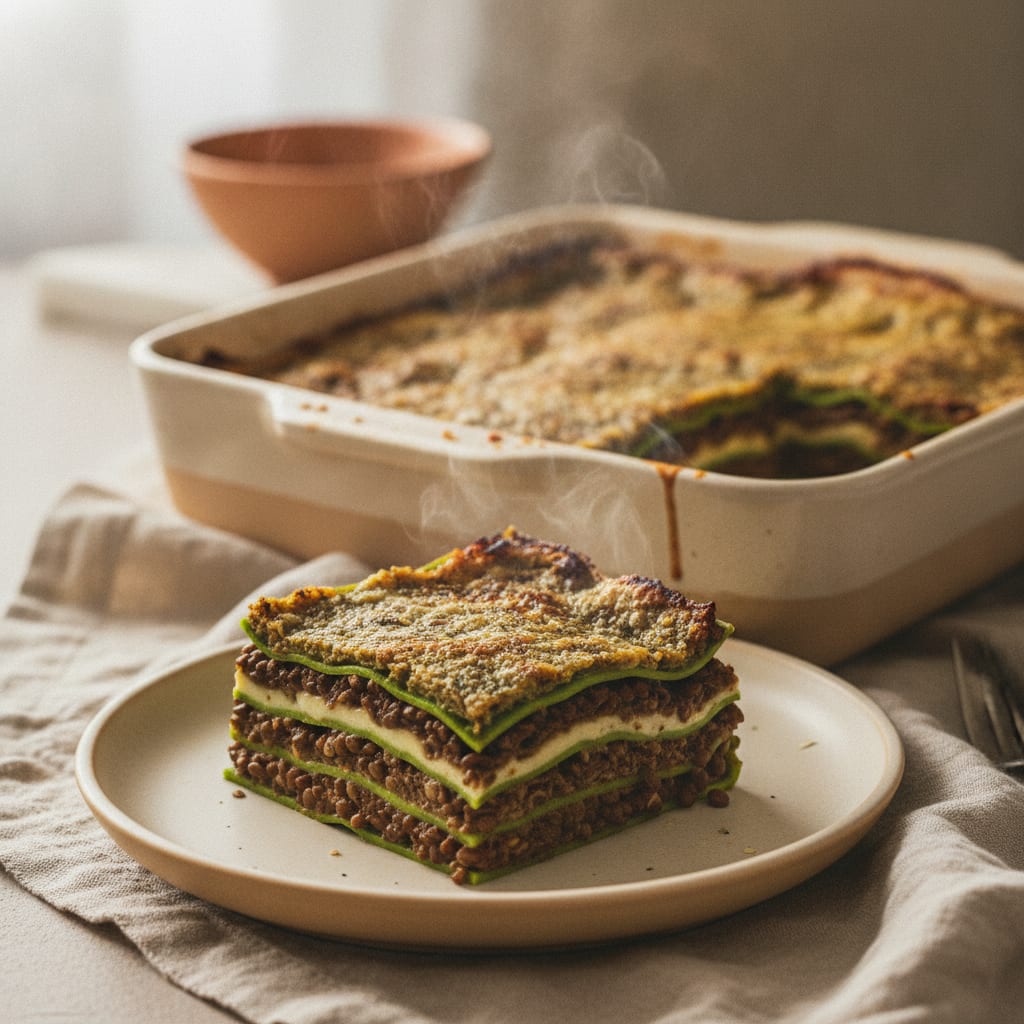
Bologna's layered ragù lasagne, two ways: a slow lentil-and-mushroom ragù, silky besciamella, and green spinach pasta verde, baked until the edges crack.
- Prep
- 45 min
- Cook
- 2h 15min
- Total
- 3h
- Servings
- 8
- Difficulty
- Ambitious
Getting ready…
Ingredients
For 8 servings · 20 items
For the ragù
For the besciamella
To assemble
Method
8 steps · check as you go
- →
Serve
Cut into generous squares and serve on warm plates with a little extra cashew parmesan and a grind of pepper. Nothing else — lasagne alla bolognese is a first course that eats like a main, and it wants only a sharp green salad after, dressed in lemon. A Sangiovese or a Lambrusco from Emilia is the regional pour.
The story
Lasagne is the most architectural thing in Italian home cooking — a dish you build, layer by layer, like a mason. I learned to build it properly in Naples, in the autumn of 2015, at a trattoria called Da Concettina where I spent two years and most of my twenties. The pastry corner had a sfoglina who came in twice a week, an older woman from Emilia who had married south and never stopped saying so, and who rolled pasta so thin you could read a menu through it. She was making lasagne for a christening order the first time I watched her, and she stained the dough green with a fistful of cooked spinach wrung dry in a cloth. “A Bologna è verde,” she said. In Bologna it is green. She said it the way you state a fact about gravity.
The ragù she layered into it was not a tomato sauce. That was the thing that stayed with me — barely a slick of tomato, the colour of old brick, the whole pan built on a slow soffritto and a long, low simmer and a quiet splash of milk near the end. She would have been horrified by the scarlet, soupy thing most people call Bolognese. Her ragù had simmered for two hours and it tasted like it.
This lasagne has no meat in it. The ragù is built on brown lentils for the grain and chopped chestnut mushrooms and soaked dried porcini for the depth; the besciamella is set with soy milk; the pasta is green with spinach, the Bologna way. The method is unchanged — the slow soffritto, the milk, the ninety-minute simmer, the thin even layers, the rest before cutting. It is not a “vegetable version” of lasagne alla bolognese. It is lasagne alla bolognese, built the way it is built.
À la maison
The weeknight reading is the recipe above, and the one thing it asks is that you not hurry the ragù. There is no shortcut for the ninety-minute simmer — that is where a pan of vegetables turns into something that tastes like it cooked all afternoon. Make the ragù a day ahead if you can; it deepens overnight, and then the assembly is a calm twenty minutes. Use green spinach sheets if you can find them, soy milk for the besciamella so it sets, and rest the baked dish a full twenty minutes before you cut it. The rest is just layering, patiently and thin.
Au bistrot
The bistronomique reading is the same dish, deconstructed onto the plate as a single composed portion instead of a cut square — what a Bologna kitchen might send out as a primo.
Make the ragù and besciamella as above, but cook the pasta verde fresh and cut it into neat squares the size of your palm. Build a single portion by hand, on the plate or in a ring mould: a square of pasta, a spoon of ragù pressed flat, a pool of besciamella, a dust of cashew parmesan, repeated four times to a low, precise tower. Run a blowtorch or a few minutes under a hot grill across the top so the besciamella blisters and browns in spots — the gratinato crust, isolated and deliberate. Around the base, spoon a bright, loose tomato sugo reduced from the same passata with basil, so there is a clean acid note to cut the richness. A frond of fried sage on top, a thread of good olive oil, a final grind of pepper. The tower holds because you built it tight and let the besciamella set; you slice down through it at the table and the strata show.
Il piatto — Three-quarter, close, shallow depth of field. A low square tower centred on a wide white plate, the blistered besciamella top catching the light, a ring of bright tomato sugo at the base. Green pasta edges just visible at the corners. Negative space, one sage leaf, steam. The plate should say strata and restraint — a built dish read as a single course, not a slab.
What the other recipes get wrong
Most meatless lasagne recipes online — I read the top ten in March 2026 — make one of two mistakes: they drown the thing in tomato until it is a vegetable bake in red sauce, or they reach for a single sad ingredient (just lentils, just chopped walnuts) and call it ragù. Neither is lasagne alla bolognese, which is barely tomato at all and lives or dies on the savoury depth of the ragù. I ran the test over a week in March 2026 — five ragùs, same besciamella, same green pasta, same bake — changing only what carried the meaty body:
- Lentils only: pleasant, earthy, but flat and one-note. It tasted of stewed lentils, not ragù. No depth, no length.
- Mushrooms only: savoury but loose and slippery; with no grain it read as a mushroom sauce, and it wept water into the layers.
- Walnut “mince”: the texture was right but it turned the whole dish bitter and oily as it baked.
- Tomato-heavy lentil sauce: bright and acidic and totally wrong — a red sauce wearing lasagne, exactly the mistake the Bologna sfoglina would have poured out.
- Lentils + browned mushrooms + soaked porcini + a little tomato + milk: deep, round, long on the finish, with a grain that held. Not close. A different category of ragù.
The reason is chemistry, not preference. Dried porcini are loaded with guanylate, a savoury nucleotide, and tomato and soy are rich in glutamate; put the two families together and they multiply each other’s perceived savouriness many times over — the same nucleotide-plus-glutamate synergy that long-simmered meat gets from its own inosinate. The lentils supply the grain and bite that minced meat gives, the browned mushrooms supply body, and the porcini-and-tomato synergy supplies the depth. Drop the porcini and the ragù goes flat; drown it in tomato and you bury the synergy under acid. The Accademia Italiana della Cucina registered the real ragù with the Bologna Chamber of Commerce in 1982 — and even there, the tomato is a supporting note, not the lead. Build it that way and the dish tastes like Bologna. Build it red and soupy and it tastes like a tray bake.
The line I draw
I will not make lasagne alla bolognese into a tomato bake. Bolognese ragù is the colour of old brick, not a fire engine — it is a meaty, slow-simmered sauce with a quiet thread of tomato through it, never a tomato sauce with things in it. The moment you tip in a whole jar of passata to make it look “saucier,” you have buried the soffritto, drowned the umami synergy, and made a different, lesser dish. Less tomato, longer simmer, the splash of milk. That is the ragù of Emilia, and the green-pasta lasagne it builds. The sfoglina in Naples would have poured a scarlet ragù straight down the drain, and she would have been right.
When this can fail
Three ways, all from my own kitchen between 2022 and 2026:
- The soupy lasagne. Layered the ragù while it was still loose and wet, and it wept into the pasta and pooled at the bottom of the dish. There is no draining it back once it’s baked. Fix: simmer the ragù until it is thick and spoonable, mounding on the spoon, before it ever touches a sheet.
- The leathery edges. Used dried sheets without blanching them and without enough sauce around the corners; the exposed edges baked to cardboard. Fix: blanch dried sheets, make sure besciamella touches every sheet, and cover with foil if the top is racing ahead of the middle.
- The collapsed slice. Cut it straight from the oven, proud and impatient, and the whole square slumped into a heap on the plate. Fix: rest the baked lasagne 20 minutes so the besciamella sets enough to hold a clean cut, then serve it hot but standing.
FAQ
QCan you make a real lasagne alla bolognese without meat?
Yes, because the dish is defined by its architecture — green spinach pasta, slow ragù, and besciamella in thin even layers — not by the beef. A ragù built on brown lentils for grain and chopped mushrooms plus soaked dried porcini for depth carries the long-simmered savour that minced meat gives, because the porcini's guanylate and the tomato's glutamate multiply each other's savouriness. Keep the traditional splash of milk and the long low simmer, layer it with a proper soy-milk besciamella, and it bakes and cuts as lasagne alla bolognese should.
QWhy is Bolognese lasagne green?
The traditional lasagne of Bologna uses pasta verde — egg pasta with cooked spinach worked into the dough, which turns the sheets green and makes them a touch softer and more porous. That softness matters: the green sheets drink up ragù and besciamella and meld into the layers more than plain yellow pasta does. Bologna restaurateurs popularised the spinach sheets in the early twentieth century, and when the Accademia Italiana della Cucina registered the recipe with the Bologna Chamber of Commerce, green spinach pasta was one of its three defining elements.
QWhat can I use instead of meat in lasagne ragù?
Brown or green lentils for the grain and chew, finely chopped chestnut mushrooms browned hard for the meaty body, and 15 g of dried porcini with their soaking liquid for concentrated depth. The lentils hold their shape through a 90-minute simmer the way mince does; the mushrooms supply the savour. A tablespoon of soy sauce and the traditional splash of plant milk round it out. Brown the mushrooms until the edges catch before adding liquid — that browning is most of the flavour.
QWhy does my lasagne fall apart when I cut it?
It was cut too hot. Straight from the oven the besciamella is molten and the layers slide off each other on the knife. Rest the baked lasagne 20 minutes — the besciamella firms just enough to hold a clean square while staying creamy. Thin, even layers and besciamella touching every pasta sheet also help the whole thing bind rather than slip apart.
QCan I make lasagne ahead of time?
Yes — it is better for it. Assemble the whole lasagne, cover, and refrigerate up to 2 days before baking; the layers settle and the flavours marry. Add 10–15 minutes to the bake from cold. The ragù alone keeps 4 days in the fridge and freezes well, and a fully baked lasagne reheats cleanly in a moderate oven, covered, so the top doesn't dry out.