Churn of events.
Vegan Butter.
Cultured plant butter from coconut oil and cocoa butter — the French method. It spreads cold, browns in the pan, and tastes of buttermilk, not coconut.
- Prep
- 15 min
- Cook
- 5 min
- Total
- 2h 20min
- Servings
- 16
- Difficulty
- Medium
Getting ready…
Ingredients
For 16 servings · 9 items
The cultured milk
The fats
The emulsion
Optional but recommended
Method
4 steps · check as you go
- →
Serve
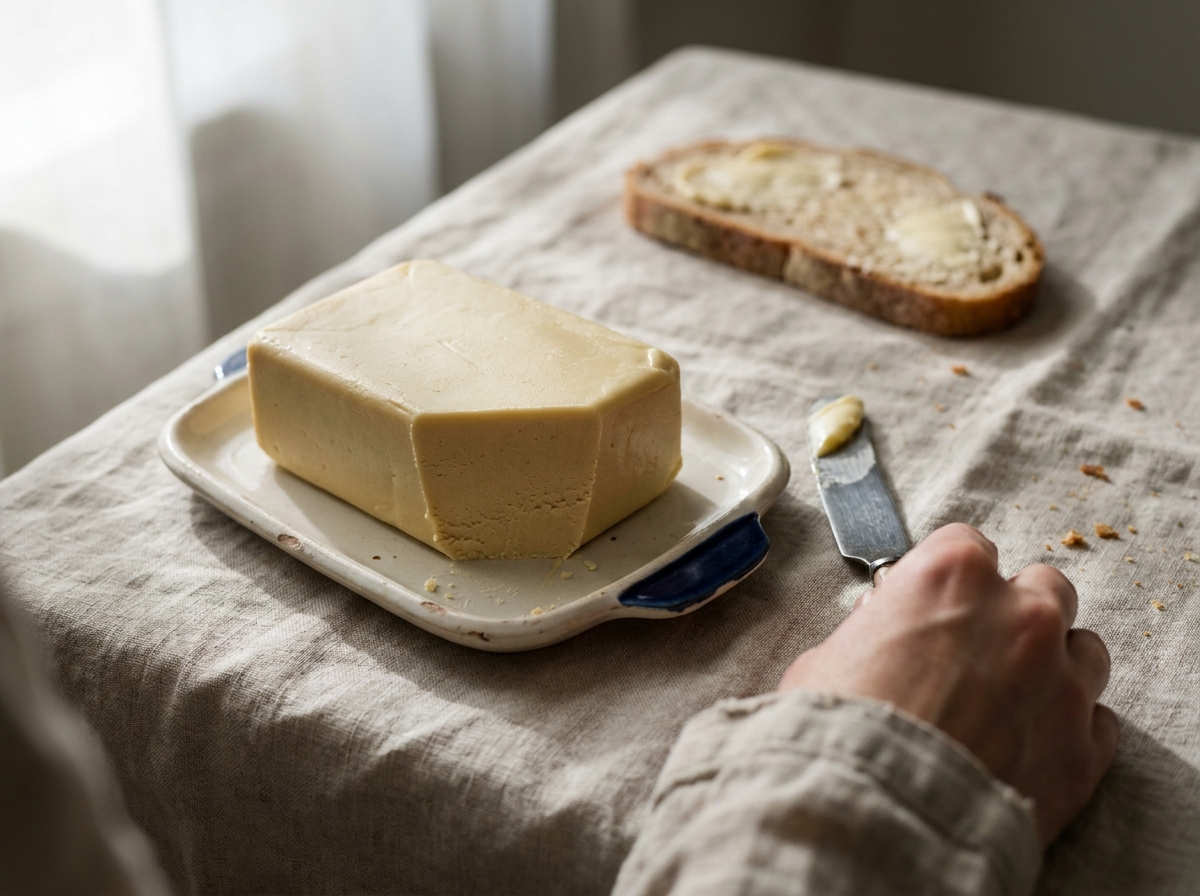
Use it exactly as dairy butter. It spreads straight from the fridge after five minutes on the counter, melts cleanly on hot toast, foams and browns in the pan for searing or a beurre noisette (watch it — it browns faster than dairy), and creams with sugar for baking. The cocoa butter gives it a real snap and melt-in-the-mouth point near body temperature, which is why it does not feel greasy the way pure-coconut-oil 'butters' do. For finishing — a knob melted over steamed greens, swirled into a sauce off the heat — it is indistinguishable from the real thing to most people at the table.
The story
I learned the bones of this in a French kitchen, from a chef who had gone fully plant-based two years before I met him and refused, absolutely refused, to put a tub of supermarket margarine on his pass. He called the bright-yellow stuff de l’huile déguisée — disguised oil — and he was right. He made his own butter every week, in a blender, in about the time it takes to read this paragraph, and the first time I tasted it on bread I genuinely had to ask. It was cultured, it was firm, it browned in the pan. It was the recipe below, more or less, before I spent a year tightening the ratios in my own kitchen across ten countries’ worth of slightly different coconut oils.
The whole problem with vegan butter is that most versions are solved coconut oil and not much else. They spread, in the sense that any soft fat spreads. They do not taste of anything, they smell faintly of the tropics, and the moment they hit a warm pan they collapse into a greasy slick. The fix is two things the cheap versions leave out: a second, higher-melting fat, and an actual flavour.
The second fat is cocoa butter. This is the part people skip because cocoa butter costs more and feels exotic, and it is exactly the part that matters. Coconut oil alone melts at one temperature and melts all at once — that is why pure-coconut butters feel waxy cold and oily warm. Cocoa butter melts a little higher, right at the edge of body temperature, so the blend stays firm in the fridge, snaps under a knife, and then melts cleanly on the tongue instead of coating it. That snap-then-melt is the entire sensory difference between “a fat” and “butter.” Twenty grams. Do not leave it out.
The flavour is buttermilk, and you build it in ninety seconds by souring soy milk with a teaspoon of vinegar. Soy protein curdles against acid the way dairy does, and that curdle is the lactic tang your tongue reads as butter rather than oil. This single step is what pulls the whole thing away from coconut and toward the dairy case.
The recipe is what it is. Sour the milk. Melt the hard fats gently. Blend everything for a full minute. Pour before it sets. Chill.
A few notes worth knowing.
Refined coconut oil, never virgin. I cannot say this loudly enough. Virgin coconut oil will perfume everything you make for the next week. Refined — sometimes labelled “deodorized” or “neutral” — is steam-cleaned of its coconut aroma and is the correct ingredient. If your butter tastes of a beach holiday, this is why.
Blend for the whole minute. The emulsion is the only thing that can go wrong here, and it goes wrong from impatience. The lecithin and soy proteins need time under the blade to wrap every droplet of water in fat. Thirty seconds gives you a loose, grainy butter that weeps. Sixty seconds gives you a tight one that sets like a brick of the real thing. Watch the colour: it should turn from translucent oily-yellow to opaque pale cream. That colour change is the emulsion forming. Wait for it.
Pour before it sets. The blend stays fluid for maybe three or four minutes after blending, then the coconut and cocoa butter start to firm up fast. Have your mould ready before you blend, not after.
The lecithin is not optional unless you want a butter that sweats. Sunflower lecithin is flavourless and easy to find; soy lecithin works identically. A teaspoon of the liquid or half a teaspoon of granules. It is the difference between a butter that stays a clean solid and one that beads oil on the dish.
The butter keeps two weeks in the fridge and three months in the freezer, where it slices straight from frozen. Treat it as a fresh product — the cultured soy milk means it is not the immortal jar of oil that store tubs pretend to be.
What the other recipes get wrong
I read through a stack of vegan-butter recipes — blogs, two cookbooks, a few of the viral ones — over a wet week in 2026, and made six of them back to back. Three failures show up again and again.
- All coconut oil, no second fat. The most common version by far. It sets, it spreads, and it has one melting point, so it is waxy from the fridge and a grease slick in the pan. There is no snap, no clean melt, no body. Cocoa butter is the fix and almost nobody includes it.
- Virgin coconut oil “for health.” The butter then tastes aggressively of coconut, which is fine in a curry and ruinous on a baguette. Refined coconut oil is not the less-healthy choice here; it is the correct choice for a thing meant to taste of dairy.
- No culturing step. Plain plant milk straight into the blend. The result spreads and does nothing else — flat, oily, anonymous. The teaspoon of vinegar that sours the milk is the cheapest, fastest, most important flavour move in the whole recipe and it is the one people cut.
The version that works, every time: two fats, refined coconut, soured soy milk, a full minute in the blender. None of those steps is hard. All of them get skipped.
The line I draw
Soy milk, specifically — not oat, not almond, not coconut milk. I have tested all of them. Oat and almond have too little protein to hold the emulsion and to curdle properly against the acid; the butter comes out looser and blander, and oat milk’s faint sweetness reads wrong in a savoury fat. Coconut milk drags you straight back to the coconut problem you spent the whole recipe escaping. Soy has the protein and the natural lecithin that make the emulsion want to happen. If soy is genuinely off the table for you, pea-protein milk is the only decent substitute — it has the protein, if not quite the lecithin. Everything else makes a weaker butter. Use soy.
When this can fail
Three ways, all from my own kitchen.
- The split emulsion. Poured the hot fats in too fast, all at once, onto cold milk, and under-blended on top of it. The butter set with visible oil-and-water marbling and wept the moment it warmed. Fix: warm fats, not hot; add them in a steady stream with the blender already running; blend the full sixty seconds. If it splits, you can sometimes rescue it by re-melting the lot gently and re-blending with an extra half-teaspoon of lecithin.
- The coconut-bomb. Used virgin coconut oil because it was what the shop had. Every slice tasted of macaroon. There is no fixing this after the fact. Buy refined coconut oil and keep a jar for this purpose only.
- The set-in-the-jar disaster. Got distracted, left the blended mixture on the counter for ten minutes, came back to a half-firm sludge that I then had to spoon and smear into the mould in ugly lumps. It still tasted right but it looked like nobody’s idea of butter. Fix: have the mould out and ready before you turn the blender on. Pour the instant it is blended.
For where this butter earns its keep, see the French onion soup — the toast that floats under the cheese wants real butter, and this is it. And it shares a shelf, and a philosophy, with the cashew parmesan: a dairy-shaped object that has stopped apologising for not being dairy and simply does the job.
FAQ
QWhat makes vegan butter firm enough to spread and melt like real butter?
The combination of two hard fats with different melting points. Refined coconut oil is solid below about 24°C and gives the block its body, but on its own it shatters and melts greasily. Cocoa butter melts higher — around 34°C, just below body temperature — which adds firmness in the fridge and the clean snap-then-melt sensation of dairy butter on the tongue. A measure of liquid neutral oil keeps the set block spreadable rather than brittle. It is this three-fat balance, not any single ingredient, that produces butter that behaves like butter.
QWhy use refined coconut oil instead of virgin?
Flavour. Virgin (unrefined) coconut oil carries a strong coconut aroma that survives everything you do to it — your toast, your croissants, your beurre blanc will all taste of coconut. Refined, or deodorized, coconut oil has been steam-treated to strip that aroma, leaving a neutral solid fat that takes on the cultured-buttermilk flavour you build in instead. For a butter that tastes of butter, refined is not optional.
QCan I make vegan butter without lecithin?
You can, but it will weep. Lecithin is the emulsifier that keeps the water from the plant milk bound into the fat. Without it the butter still sets, but it sweats beads of oil at room temperature and turns grainy when it melts. Soy milk contributes some natural lecithin, which is why soy specifically is the milk of choice, but a teaspoon of added sunflower or soy lecithin is what makes the emulsion truly stable. If you must skip it, reduce the soy milk to 60 ml to lower the water content.
QHow long does homemade vegan butter keep?
Two weeks in the fridge in a sealed container, and at least three months in the freezer, where it keeps perfectly and cuts straight from frozen. Because it is built on shelf-stable fats and only a small amount of cultured plant milk, it is slower to spoil than dairy butter, but the soy milk means it is not indefinitely stable — treat it like a fresh dairy product, not like a jar of oil.
QWhy does my vegan butter taste of coconut?
You used virgin coconut oil instead of refined, or you skipped the souring step. Refined coconut oil is the single most important ingredient swap. The brief culturing of the soy milk with vinegar then layers a lactic, buttermilk tang over the neutral fat, which actively pushes the flavour away from coconut and toward dairy. Both steps together are what erase the tropical note.
QCan I bake with this vegan butter?
Yes, and it is one of its strengths. It creams with sugar, laminates into pastry, and browns in cookies because it contains real solid fat and a little water rather than being pure liquid oil. For baking, make the unsalted version. Note that it has a slightly lower melt point than dairy butter, so doughs that depend on cold butter — shortcrust, puff, croissants — benefit from chilling the dough a little longer and working quickly.