The herdsman's red soup.
Goulash.
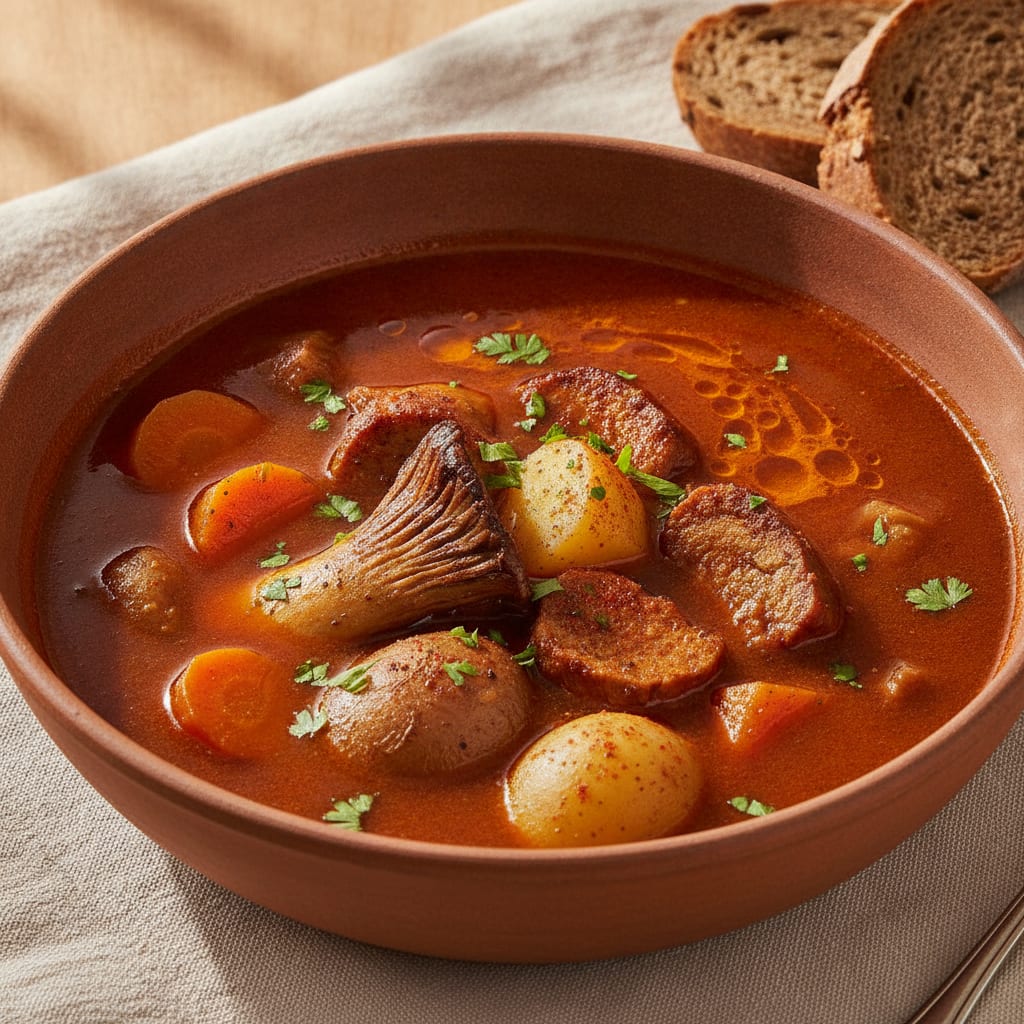
Hungarian gulyás, two ways: a paprika-rich herdsman's soup of seared mushrooms and seitan, soft potatoes and onion, brothy and deep red, never floured.
- Prep
- 25 min
- Cook
- 1h 10min
- Total
- 1h 35min
- Servings
- 6
- Difficulty
- Medium
Getting ready…
Ingredients
For 6 servings · 18 items
For the base
For the 'meat'
For the soup
Method
6 steps · check as you go
- →
Serve
Serve in deep bowls as a soup — brothy, deep red, with rye or crusty bread to dunk. A dollop of unsweetened plant yoghurt or vegan sour cream and a scatter of parsley if you like. The pot deepens overnight and holds 4 days in the fridge; loosen with stock when reheating, as the potatoes drink the broth.
The story
I learned to take goulash seriously in the winter of 2025, in Washington, at a long table in a Hungarian family’s row house off 16th Street where a friend had dragged me to a Sunday lunch I had no business being invited to. The grandmother — I never caught her name over the noise of the kitchen and the three conversations happening at once — was making gulyás in a pot the size of a bucket, and the thing I remember is the colour. Not brown. Red. A deep, living paprika red I had never gotten at home, because I had been doing the one thing she would have smacked my hand for: frying the paprika in hot oil until it burned. She added hers off the heat, fast, with the pot pulled to the side of the flame, and chased it instantly with stock. The whole pot went the colour of garnet. That was the lesson, and it is the only one that matters.
The name tells you what goulash is. Gulya is a herd of cattle; gulyás is the herdsman who drove it across the Hungarian plains. The dish was his — gulyáshús, goulash meat, cooked over open fire, in the early days just meat and onion, sometimes dried and carried in a bag to be brought back to life with water on the road. And here is the part the thick, noodle-smothered American “goulash” forgets: the dish only became red after paprika spread through Hungary in the 18th and 19th centuries. Before paprika, gulyás wasn’t red and wasn’t the thing we picture. It was a herdsman’s brothy soup, and a soup is what it has stayed in Hungary — loose, spoonable, deep — while the English-speaking world quietly turned it into a stew over pasta. That stew is really pörkölt wearing the wrong name.
So this goulash has no beef in it. It has hard-seared king oyster mushrooms and seitan for the braising bite, a great mass of onion cooked to jam for the body, paprika bloomed off the heat for the red soul of it, and potatoes to thin and thicken it into a soup. No flour. It is not a “vegetable version” of goulash. It is gulyás, the herdsman’s red soup, made with what is in my hands now.
À la maison
The weeknight reading is the recipe above, and it comes down to two rules the herdsmen would recognise. First, never brown the paprika: pull the pot off the heat, stir the paprika in fast, and add the stock immediately — paprika is loaded with sugar and scorches bitter in seconds on a dry hot pan. Second, no flour. Cook the onions down to a sweet jam (roughly the weight of the “meat,” that’s the old ratio) and let the potatoes break at the edges, and the soup thickens itself into exactly the right brothy body. Sear the mushrooms and seitan hard before they go in, keep it loose and spoonable, and finish with a spoon of vinegar to wake it up.
Au bistrot
The bistronomique reading keeps the herdsman’s soup honest but plates it as a precise paprika course.
Build the same base, then split it. Pass half the brothy soup through a blender and a fine sieve into a smooth, intense, deep-red paprika velouté — the body coming from the onion jam and a single potato, never flour. Keep the other half as the garnish: a few hard-seared king oyster chunks glazed dark, a spoon of the seitan, a brunoise of carrot and pepper cooked just-tender. Make a quick paprika oil — bloom a teaspoon of paprika in warm oil off the heat, let it settle, spoon off the clear red top. In a warm shallow bowl, arrange the glazed mushroom and the vegetable garnish off-centre, add a quenelle of soured cashew cream dusted with caraway, then pour the hot velouté around it at the table so it floods up red and clean. Finish with three drops of the paprika oil and a single caraway-toasted crouton of rye. The soup, refined to its essence, with the herdsman’s pot still legible underneath.
Le dressage — Overhead, then a second frame at the pour. Wide pale bowl, the paprika velouté poured tableside so it floods deep garnet-red. Glazed mushroom and bright vegetable garnish off-centre, a pale quenelle of cashew cream, three drops of paprika oil, one rye crouton. Negative space, steam. The plate should say a herdsman’s fire read at a white tablecloth — rustic depth, made clean.
What the other recipes get wrong
Most goulash recipes in the English-speaking world — I read the top ten in March 2026 — do two things the Hungarians never would: they fry the paprika in hot oil, and they thicken with flour into a stew. Both are wrong, and I ran the test to be sure. Five pots over two weekends in March 2026, same onions, same mushrooms, same stock, changing only how the paprika went in and whether I floured it.
- Paprika fried in hot oil, floured: bitter and dull brown, the spice scorched in the first thirty seconds, the flour turning it stodgy. A muddy stew, not gulyás.
- Paprika fried in hot oil, no flour: still bitter — the burn happened before any liquid arrived. Better texture, ruined flavour.
- Paprika bloomed off the heat, floured: sweet and red on top, but thick and gluey underneath, the flour flattening the broth into gravy.
- Paprika bloomed off the heat, no flour, onion-jam base: bright, deep, garnet-red, brothy and clean — the soup the grandmother made.
- Same, plus a spoon of vinegar to finish: the best by a clear margin, the acid lifting the sweet paprika and rounding the whole pot.
The chemistry is simple and unforgiving. Paprika is up to roughly 6% sugar, and sugar on a dry pan above frying temperature caramelises and then burns within seconds, throwing acrid, bitter compounds that no amount of simmering removes — that is why a fried-paprika pot tastes scorched no matter what you do next. Blooming it off the heat in the oil and onion juices, then flooding it with stock immediately, keeps the spice well below burning temperature so you get its colour and sweet aroma instead. And flour is simply the wrong tool: gulyás was a herdsman’s soup thickened by its own onion and potato starch, and a roux turns that loose, spoonable broth into the noodle-stew that isn’t really gulyás at all. Off the heat, no flour, finished with vinegar — every time, across all five pots.
The line I draw
I will not let paprika hit a hot dry pan. Not for “a quick toast,” not because another recipe says to fry it with the onions. Paprika’s sugar scorches to bitterness in seconds, and a scorched pot cannot be rescued — you taste the burn under everything for the rest of the meal. The move is fixed: pull the pot off the heat, stir the paprika into the oil and onion until it’s coated and fragrant, and get the stock in within thirty seconds so it can never reach burning temperature again. The grandmother off 16th Street did it that way without thinking, and her pot was garnet-red and sweet. Mine is now too, because I stopped frying the soul of the dish.
When this can fail
Three ways, all from my own kitchen between 2022 and 2026:
- The burnt paprika. Tossed the paprika into the hot oil with the onions and let it cook a minute “to bloom it”; it scorched and the whole pot tasted faintly of ash for the rest of the night. Fix: off the heat, stir it in fast, add stock within thirty seconds.
- The gluey stew. Stirred in flour out of habit to thicken it, and turned a brothy soup into a stodgy gravy that coated the spoon like wallpaper paste. Fix: no flour — cook the onions to a jam and let the potatoes break down to thicken it as a soup should be.
- The rushed onions. Hurried the onion base to seven minutes because I was hungry; the body never developed and the soup tasted thin and sharp even with the paprika in. Fix: cook the onions a full 15 to 20 minutes to a soft golden jam before anything else goes in.
FAQ
QIs goulash a soup or a stew?
Authentic Hungarian gulyás is a soup — brothy, spoonable, deep paprika-red. The word gulyás means 'cattle herder', and the dish was a herdsman's pot, thinned with water on the plains. The thick, dark, stew-like 'goulash' served over noodles in much of the English-speaking world is closer to the Hungarian dish pörkölt and is really a separate thing. Hungarians keep gulyás loose and brothy; that is the version made here. If you want it thicker, let the potatoes break down a little more, but it should never be a gravy.
QWhere does goulash come from?
From the Hungarian plains and their cattle herders. 'Gulya' means a herd of cattle and 'gulyás' the herder who tended it; the dish was gulyáshús, 'goulash meat', cooked by herdsmen over open fires. The early versions were simply meat and onion, even dried and carried in bags to be reconstituted with water on the move. Critically, the dish as we know it — red, paprika-forward — only emerged after paprika spread through Hungary in the 18th and 19th centuries. Before paprika, goulash wasn't red at all.
QWhy must you not brown the paprika?
Paprika contains a lot of sugar — up to around 6% — and that sugar scorches almost instantly on a hot, dry pan, turning the spice acrid and bitter and ruining the pot. It's the single most common goulash mistake. The fix is to take the pan off the heat, stir the paprika into the oil and onion juices for twenty or thirty seconds until it smells sweet and toasty, then add liquid immediately so it can never burn. Bloomed gently, paprika gives colour and sweet aroma; scorched, it gives bitterness you can't remove.
QWhy is there no flour in real goulash?
Because gulyás is thickened by its ingredients, not by a roux. A big quantity of onion — traditionally close to the weight of the meat — cooks down to a sweet jam that gives the soup body, and the potatoes leach starch as they simmer and break at the edges. That's all the thickening it needs. Flour would make it a gravy and turn a brothy soup into a stodgy stew, which is the Anglo 'goulash' error, not the Hungarian dish. Leave the flour out and let the onion and potato do the work.
QWhat mushrooms and proteins work best in goulash?
King oyster mushrooms are the closest to the dense, braised bite of the original beef — torn into thick chunks and hard-seared, they hold up through a long simmer and drink the paprika broth. Seitan adds a firmer, chewier bite alongside them. Sear both hard before they go in the pot; the browning is the umami backbone the soup is built on. Cremini or portobello can fill in but release more water, so sear them longer to drive it off.