Bourguignon.
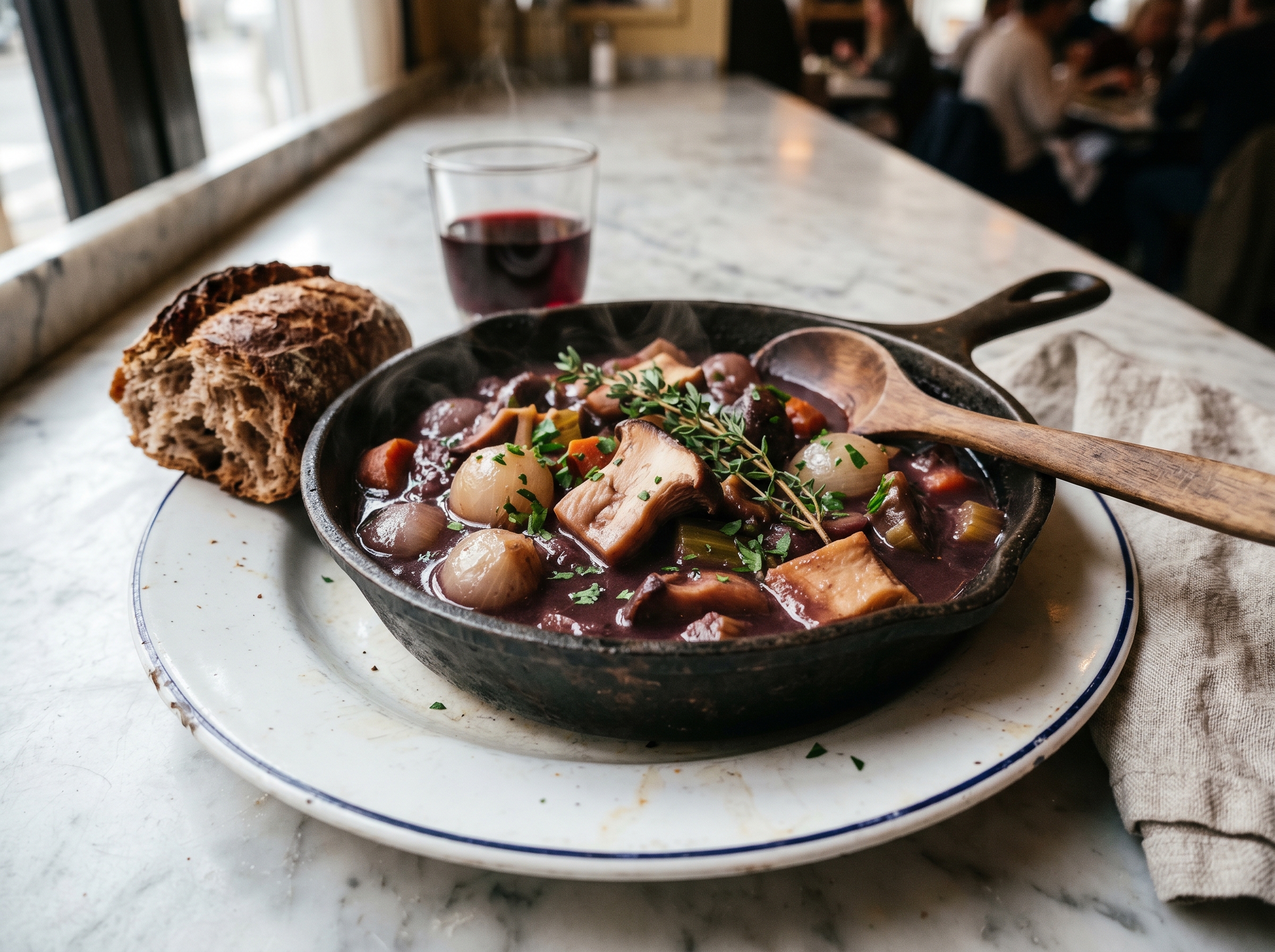
King oyster mushrooms slow-braised in a heavy red Burgundy, with pearl onions and the kind of glossy reduction that doesn't miss what isn't in the pan.
- Prep
- 45 min
- Cook
- 2h 30min
- Total
- 3h 15min
- Servings
- 6
- Difficulty
- Ambitious
Getting ready…
Ingredients
For 6 servings · 23 items
For the mushrooms
For the smoky base
For the braise
To serve
Method
9 steps · check as you go
- →
Serve
Serve in shallow bowls over buttery mashed potatoes or alongside thick slices of warm crusty bread. Scatter fresh parsley over each portion. Open a second bottle of the same Burgundy you used in the braise. The dish improves overnight — leftovers tomorrow are arguably better than tonight. Hold for up to 4 days in the fridge or freeze for 3 months.
The story
I spent the autumn of 2013 doing a Burgundy stint between Lyon and my return to Paris — six months in Beaune, the small wine town that smells of cellars and damp stone from October through March, where the tourist trade keeps the boulangeries open until 7 p.m. and the local bourgognes are cheaper at the wine shop than the cheap stuff is in Paris. I lived in a one-bedroom over a charcuterie on the Rue du Faubourg Saint-Nicolas (the irony of which has not been lost on me). The landlady was a woman in her seventies named Madame Carrère, who had been a sous-chef in a Beaune restaurant for thirty years before retiring to manage the building.
Madame Carrère made boeuf bourguignon every Sunday. She made it for herself and for whichever tenants she happened to like that month. I was, fortunately, one of the tenants she liked. Every other Sunday she would knock on my door at 1 p.m. with a small plate in her hands and say, “Goûte-moi ça, et dis-moi si c’est trop salé.” Taste this and tell me if it’s too salty. It was never too salty.
I asked her once for the recipe. She looked at me for a long time. She said, in her slow Burgundian French: “Le bourguignon, ça ne se mesure pas. Ça se sent.” The bourguignon does not measure. It feels.
That was the entire recipe.
I have spent the years since converting Madame Carrère’s sentiment into something measurable. The version below is what I have arrived at. It uses king oyster mushrooms as the structural protein — the stems, scored and hard-seared, behave under long braising in a way that is the closest plant analog I have found to braising beef. Smoked tofu plays the role of the lardons, the small crispy salty bits that thread through every bite. Pearl onions are themselves. Carrots are themselves. The wine is themselves. Everything else is what it was.
A few things to know before you begin.
The mushrooms must be seared hard. Three minutes a side, in a single layer, in oil hot enough to shimmer. Crowding the pan steams them, which gives you mushroom stew. Pat them very dry first. Salt lightly before searing. Don’t move them for the full three minutes — moving them too early tears the crust.
The smoked tofu is the load-bearer. Regular firm tofu does not work — it is too soft and breaks down in the braise. Smoked tofu (sometimes labeled baked smoked tofu) has been pressed harder and infused with smoke, which makes it both structurally and flavor-wise the right substitute for lardons. SoyBoy and Wildwood are the two American brands I trust. If you cannot find smoked tofu, dice and pan-fry firm tofu until very crisp, then toss with a teaspoon of smoked paprika.
The wine is a real bottle. Madame Carrère used the cheapest bourgogne in the local wine shop, which in Beaune means a bottle that would cost $25 in the US. A $12-15 Pinot Noir is the right American substitute. Cooking wine from the grocery store will produce a dish that tastes like cooking wine. Open a second bottle to drink with the meal.
The braise is two hours, no less. The braise is the dish. The flavors integrate slowly; the wine cooks down; the mushrooms become silky. Rushing this with higher heat boils the wine off without integrating it. Set the oven to 325°F (160°C) and walk away. Read a book. Make the side dishes. Open the second bottle and start it on the counter to breathe.
The montée au beurre at the end is the classical French finishing move and it is worth the extra two minutes. Cold vegan butter, swirled into the hot sauce off the heat, emulsifies into a glossy, silky coating that lifts the entire dish from rustic to restaurant.
This is a Sunday-afternoon dish. Make it in the morning if you can; the second-day version is better than the first-day version. Serve it over creamy mashed potatoes — really, the only acceptable accompaniment. The bread is for mopping. Madame Carrère would approve. I think.
What the other recipes get wrong
Most online bourguignon recipes built around mushrooms — I checked the top ten in February 2026 — pick one variety and call it done, usually cremini or portobello. I ran the test in my Washington kitchen across two weekends in January 2026, five batches, five different mushrooms, same wine, same braise time, same pot.
- Cremini-only: watery. The braise ended up looking like onion soup that had lost a fight. Body collapsed at the 90-minute mark.
- Shiitake-only: too assertive. The mushroom flavor steamrolled the wine. By minute 45 you couldn’t tell the Pinot from a hot bath.
- Maitake-only: shredded into thread by the second hour. Texture vanished. The bourguignon ate like a stew of wet paper.
- Porcini-only: too expensive to justify, and too pungent on top of the wine reduction. Tasted like the floor of an Italian wine cellar in mushroom season — interesting, not bourguignon.
- King oyster, scored, hard-seared: held shape, held flavor, drank the wine like it was supposed to. The crust survived three hours of braise. The bite stayed.
The combination that worked, every time, across all five batches once I mixed: king oyster (scored stems, seared hard) as the structural protein, smoked tofu cubed as the lardons, pearl onions seared whole. Each piece does something the others can’t. King oyster carries the bite. Smoked tofu carries the salt and the smoke. Pearl onions carry the sweetness. The wine carries everything else.
The line I draw
I will not use a wine I would not drink. I have watched home cooks pour the $4 “cooking wine” from the supermarket into a Dutch oven over what was about to be a six-hour Sunday, and I have wanted, every time, to take the bottle out of their hands. Cooking wine is salted, oxidized, and chemically stabilized. It produces a bourguignon that tastes like cooking wine — which is to say, like nothing you would want to eat. A $14 bottle of Burgundy or Oregon Pinot is the floor. If you can’t bring yourself to pour that into the pot, make something else.
When this can fail
Three ways, all from my own kitchen between 2022 and 2026:
- The crowded sear. Tried to do all 700g of mushrooms in one batch in a 5-quart Dutch oven. They steamed instead of seared, the pot filled with mushroom water, and the final braise ended up pale and thin. Fix: two batches, single layer, three minutes a side, do not touch.
- The wet pearl onions. Threw them in frozen, straight from the bag, and rolled them around without drying. They popped, spit, and never took color. The braise lost the candied note they should add. Fix: thaw on a towel, pat dry, then sear.
- The reduction skipped. Pulled the lid off at 90 minutes because dinner was waiting, served before the sauce had concentrated. The result tasted like cassis tea over mushrooms. Fix: the two-hour braise is the dish. There is no shortcut. Make it the day before.
FAQ
QWhat is the best plant-based substitute for beef in boeuf bourguignon?
King oyster mushrooms (also called trumpet mushrooms) are the closest structural and textural analog to braising beef. Their dense, meaty stems hold up under long slow-cooking, develop a deeply seared crust, and absorb braising liquid the way beef does. Scored, hard-seared, and braised in red wine, they produce a result that is genuinely close to the original — not as identical, but as its own complete dish. Cremini and portobello mushrooms can supplement if king oyster is unavailable, but they release more water and need extra searing time.
QWhat wine should I use for boeuf bourguignon?
A Pinot Noir, ideally from Burgundy (a true *bourgogne rouge*). The classic rule is to cook with a wine you would also drink. Avoid 'cooking wine' from the supermarket — it is over-salted and the flavor profile is wrong. A bottle in the $12-20 range is the sweet spot for home cooking. Côtes du Rhône and other dry Pinot Noirs work in a pinch but produce a different (still good) result. Open a second bottle to drink alongside the meal.
QWhy do you sear the mushrooms before braising?
The sear builds the umami backbone of the dish. The Maillard reaction on the mushroom surface produces hundreds of new flavor compounds — browned, savory, almost meat-like notes — that are essential to a real bourguignon. Mushrooms added raw to the braise produce a watery, pale stew. Hard-seared mushrooms produce a dish with depth that you can taste at every spoonful. Pat them very dry first; wet mushrooms steam rather than sear.
QCan you make vegan boeuf bourguignon in a slow cooker?
Yes, with a critical caveat: you must sear the mushrooms, tofu, and onions on the stovetop first. The slow cooker provides excellent low-temperature braising but cannot achieve the Maillard reaction the dish depends on. Once everything is seared and the base is built (steps 1-7), transfer to a slow cooker on low for 6 hours. The texture and flavor will match an oven braise.
QHow long does boeuf bourguignon keep, and does it improve overnight?
Yes — boeuf bourguignon improves overnight in the fridge as the flavors continue to integrate and the sauce thickens further. Keeps 4 days in the fridge, tightly covered. Freezes well for up to 3 months — the texture of the mushrooms and pearl onions holds remarkably well through a freeze-thaw cycle. Reheat gently on the stovetop over low heat with a splash of stock to loosen the sauce.