Brine in the dimples, cloud in the crumb.
Focaccia.
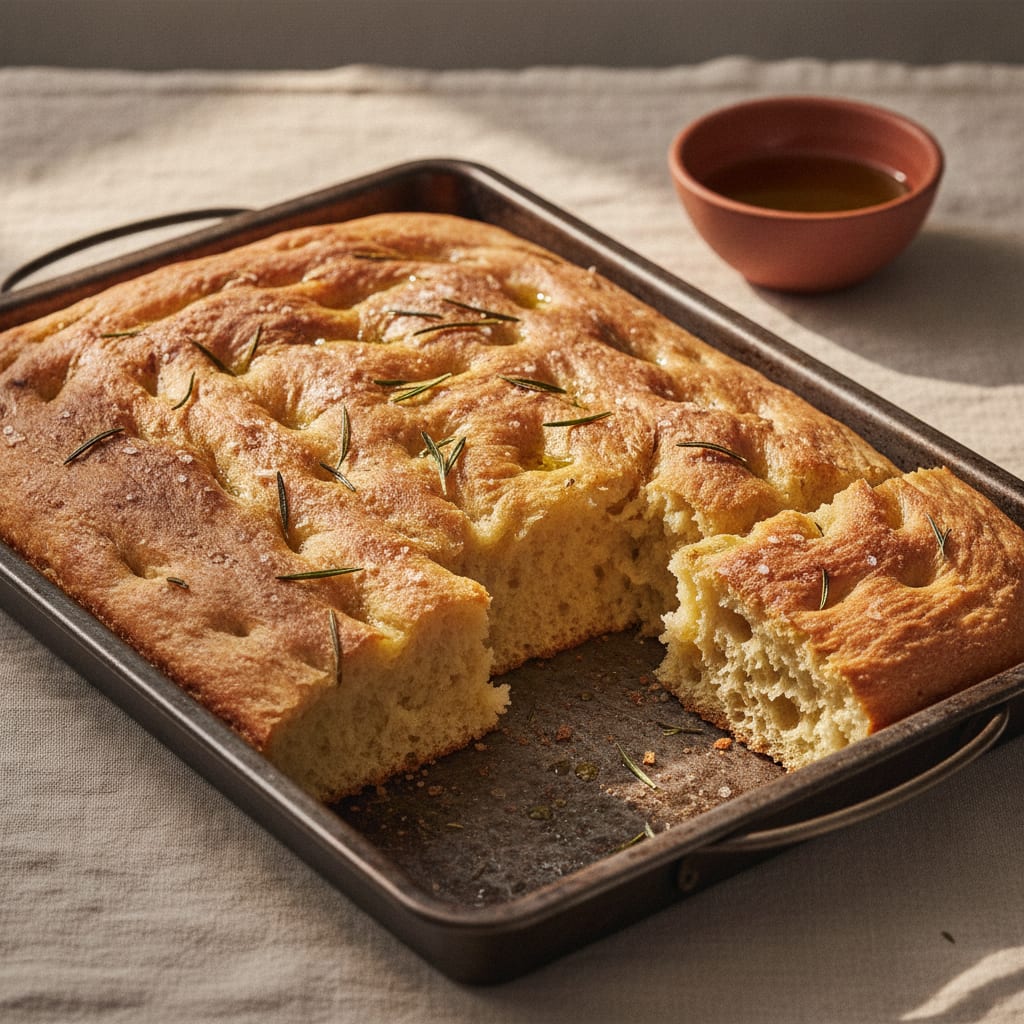
Ligurian focaccia, two ways: a high-hydration dough dimpled under a salt brine, baked golden and oil-glossed, soft as a cloud with a crisp, lacquered base.
- Prep
- 30 min
- Cook
- 25 min
- Total
- 5h
- Servings
- 8
- Difficulty
- Medium
Getting ready…
Ingredients
For 8 servings · 11 items
For the dough
For the salamoia (brine) and top
Method
8 steps · check as you go
- →
Serve
Tear into rough squares and serve warm or at room temperature — focaccia is a side, a table bread, a thing to mop a plate with. Split a square and fill it with tomato and basil, or serve it alongside soup, antipasti, or oil and vinegar for dipping. A glass of cold Vermentino, the Ligurian white, is the natural pour.
The story
Focaccia is the oldest bread idea there is: flatten the dough, bake it by the fire, and the name still says so. Panis focacius — hearth bread — from the Latin focus, the fireplace, the centre of the Roman home. Two thousand years ago it was dough cooked on hot stones in the ashes; Liguria spent those centuries turning it into the dimpled, oil-pooled, salt-flecked thing we mean now. The Genoese call it fügassa and eat it at every hour, dunked in milky coffee at breakfast as readily as torn over an aperitivo.
I learned to make it in Florence, in the autumn of 2014, in a bakery on the edge of Sant’Ambrogio where I’d talked my way into a few unpaid mornings before I went south to Naples. The baker — a Ligurian transplant named Pietro who got to the bench at four and never once looked rushed — handled a dough so wet I was sure he’d measured wrong. I told him so. He laughed and pushed his oiled fingers straight down through it to the bottom of the tin, dimpling the whole slab, then poured a milky brine over the top that pooled in every hole. “L’acqua è l’aria,” he said. The water is the air. He meant that all that water in the dough becomes steam in the oven, and steam is what blows the crumb open. The wetter the dough, the more I wanted to add flour, the more he told me to leave it alone.
This focaccia is the Ligurian one, made the way Pietro made it — a slack 80% dough, built with folds instead of kneading, dimpled to the base, flooded with salamoia and good oil, baked until the bottom is lacquered crisp. There’s no animal product in it and there never needed to be; focaccia is flour, water, yeast, salt, and olive oil, the way it always was. It is not a “vegan focaccia.” It is focaccia, the bread of the hearth.
À la maison
The weeknight reading is the recipe above, and the one thing it asks is that you trust the wet dough. Do not add flour to make it manageable — that water is the whole point, and you handle the dough with oiled, not floured, hands. Build the gluten with a few stretch-and-folds instead of kneading, let it rise slow (overnight in the fridge if you can, for the best crumb), be lavish with oil in the tin, and dimple your fingers right down to the bottom before you flood the top with brine. Bake it properly golden — pale focaccia is gummy focaccia — and lift it onto a rack so the base stays crisp.
Au bistrot
The bistronomique reading is the same dough, baked thinner and more precisely, and finished as a composed bread course rather than a torn slab.
Take the dough a touch wetter still and bake it in a smaller, oiled tin so it rises tall and even, the crumb a fine, glossy lacework. While it’s warm, brush it with an infused oil — rosemary and garlic gently warmed in good olive oil, then strained — so the perfume goes deep without burning. Cut it into clean, sharp rectangles with a serrated knife, edges true. Plate three batons leaning against each other on a long board or slate, the dimpled, salt-flecked tops catching the light, with a small well of the same infused oil and a few flakes of finishing salt for dipping. A confit cherry tomato or two, blistered and sweet, and a smear of olive tapenade if the course wants more. The point is restraint: focaccia treated as the considered bread it is at the start of a meal, not the basket you forget about.
Il piatto — Three-quarter, raking light. A long dark slate, three clean focaccia batons leaning together, dimpled tops glistening with oil and flecked with salt and rosemary. A small dish of green infused oil beside them, one blistered tomato. Negative space, warm light catching the oiled dimples. The plate should say the simplest bread, made with care — hearth bread brought to the white tablecloth.
What the other recipes get wrong
Most focaccia recipes online — I read the top ten in November 2025 — quietly dial the water down to make the dough easier to handle, and skip the salamoia for a bare drizzle of oil and a pinch of salt. Both shortcuts cost you the actual focaccia. I ran the test over a week in November 2025, four slabs, same flour, yeast, oil, oven, and bake time, changing only hydration and the top treatment:
- 65% hydration, oil-and-salt top: easy to handle, but it baked tight and breadlike — a decent flatbread, not focaccia. Dense crumb, no big holes.
- 70% hydration, oil-and-salt top: better crumb, but the bare salt scorched in dry patches and the top baked hard and dull where there was no brine.
- 80% hydration, oil-and-salt top: lovely open crumb, but the unbrined surface still dried and the dimples didn’t glisten.
- 80% hydration, full salamoia brine: airy, open, cloud-soft crumb with a crisp lacquered base, and a glistening golden top seasoned evenly to the edges. Not close. This was focaccia.
The science is straightforward. At 75–80% hydration the dough holds far more water, which does two things in the oven: it lets the starches fully gelatinise into a flexible structure that expands hard, and it flashes to steam that inflates the gas bubbles into big, open holes — you need bread flour at 12%-plus protein to build a gluten net strong enough to trap that gas. A drier dough simply can’t make that crumb. The salamoia is the other half: an emulsion of oil, water, and salt that sits in the dimples, keeps the surface moist so it browns evenly instead of scorching in dry spots, and pools into the glistening golden pockets that are the visual signature of focaccia genovese. Pietro’s l’acqua è l’aria was exactly right — and the brine is what carries the seasoning and the gloss the high-hydration crumb deserves. Drop the water or drop the brine and you’ve made good bread that isn’t focaccia.
The line I draw
I will not add flour to a focaccia dough to make it easier to handle. The whole identity of the bread is the high-hydration crumb — the slack, sticky, almost pourable dough that turns to steam and blows open into that cloud-soft interior. Every gram of flour you add to make it behave is a gram of air you take out of the finished bread. Oil your hands, not the bench; build the gluten with folds; trust that the wet dough knows what it’s doing. The moment you knead in enough flour to make a tidy ball, you’ve made a flatbread that happens to have dimples — competent, and not focaccia. Pietro handed me a dough I was sure was wrong, and he was right.
When this can fail
Three ways, all from my own kitchen between 2022 and 2026:
- The dense, breadlike slab. Added flour because the dough was too sticky to handle, and baked a tight-crumbed flatbread with no big holes. Fix: keep the dough at 80% hydration, handle it with oiled hands only, and build the gluten with stretch-and-folds instead of kneading in flour.
- The pale, gummy middle. Pulled it from the oven the moment the top looked golden, but the base was pale and the crumb stayed gummy. Fix: bake until the underside is genuinely browned — lift a corner to check — and don’t trust the top alone; pale focaccia is undercooked.
- The scorched, dry top. Skipped the salamoia and just scattered oil and coarse salt, and the surface baked hard with burnt salt in dry patches. Fix: whisk the proper brine of oil, water, and salt and flood it into the dimples before baking, so the top stays moist and browns evenly to the edges.
FAQ
QWhat makes focaccia different from other bread?
Three things: a very wet, high-hydration dough; a generous amount of olive oil both under and over it; and the dimpled, brined top. The name comes from the Latin panis focacius — 'hearth bread' — from focus, the fireplace, because the earliest focaccia was a flatbread baked in the ashes of a Roman hearth. The modern Ligurian style, focaccia genovese, is the definitive one: tall, soft, and spongy, with high ratios of water and oil and finger-pressed dimples pooled with oil and brine. The wet dough gives the airy crumb; the oil gives the crisp, lacquered base.
QWhat is the salamoia and why does focaccia need it?
Salamoia is the Ligurian brine: an emulsion of olive oil, water, and salt whisked until milky and poured over the dimpled dough just before baking. It does three jobs — it seasons the top evenly, it keeps the surface moist so it bakes soft rather than dry, and it pools in the dimples to create the glistening golden pockets that define focaccia genovese. Without it the salt scorches in dry patches and the top bakes hard. Whisk 3 tbsp each of water and oil with 1/2 tsp salt until emulsified, and pour it on so it fills the holes.
QWhy is my focaccia dense instead of airy?
Usually the dough wasn't wet enough or wasn't risen enough. Focaccia wants roughly 75–80% hydration — a slack, sticky dough that you handle with oiled hands, not a firm one you can knead smooth. That water turns to steam in the oven and blows the crumb open. Then give it two real rises, build the gluten with stretch-and-folds rather than kneading, and don't deflate it when you stretch it into the tin. A cold overnight first rise gives the most reliable open crumb.
QCan I make focaccia dough the day before?
Yes, and it's better for it. After mixing and the stretch-and-folds, cover the bowl and rest the dough in the fridge overnight (up to 24 hours). The slow cold fermentation deepens the flavour and improves the crumb, and the dough is easier to handle cold. Bring it back to room temperature, then stretch it into the oiled tin and give it its second rise before dimpling and baking as usual.
QHow do I get a crisp bottom on focaccia?
Be generous with olive oil in the bottom of the tin — a full slick across the base — and bake hot, at 220°C (425°F), until the underside is genuinely browned, not pale. The oil fries the base as it bakes, giving that crisp, almost lacquered crust. Then lift the baked focaccia out of the tin onto a wire rack immediately so the steam escapes and the base doesn't go soft sitting in the hot tin.