Pesto, presto.
Pesto Pasta.
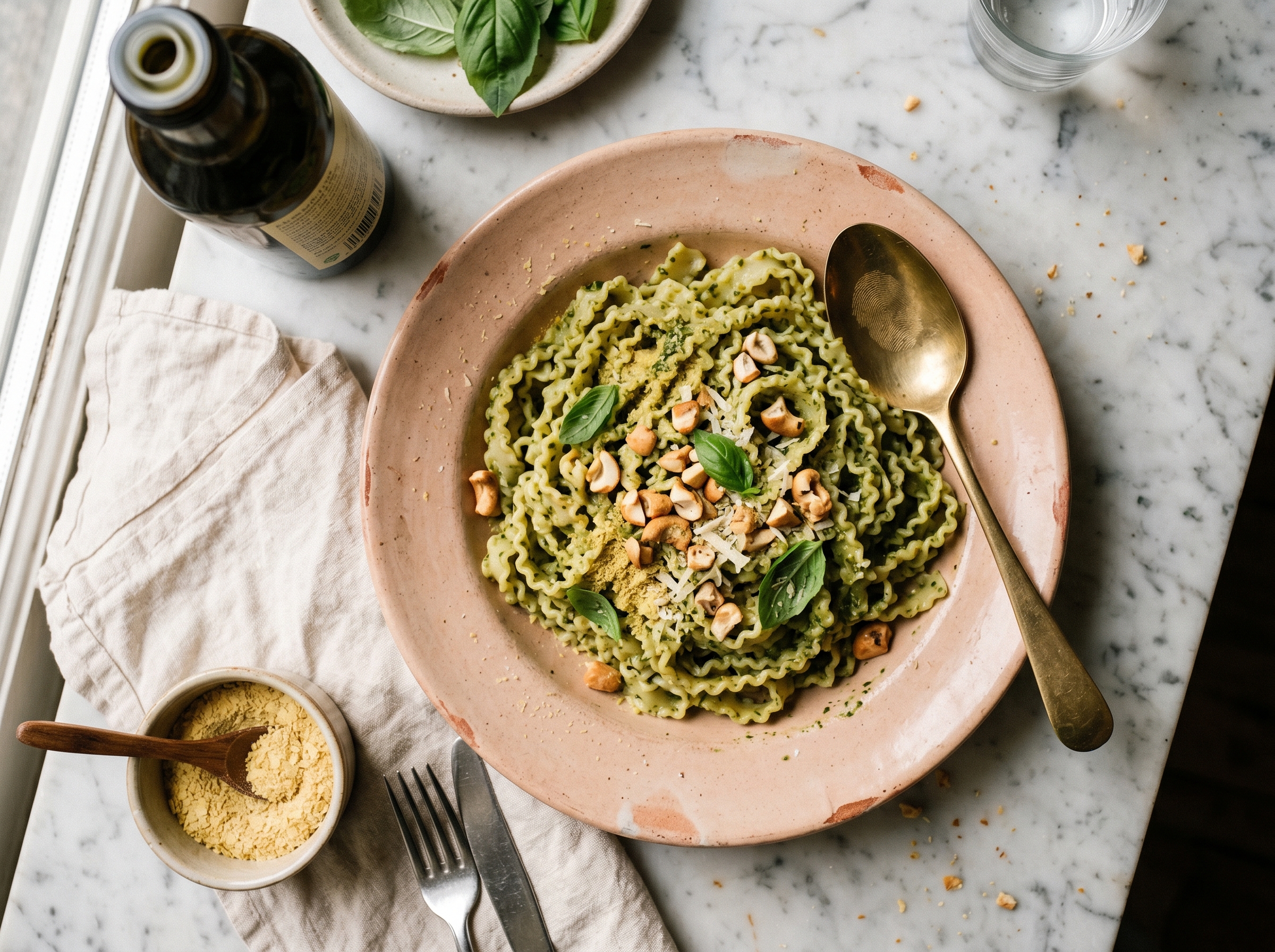
Pesto pasta the Ligurian way — basil-and-pine-nut paste folded with toasted cashews and nutritional yeast at the plate, never in the mortar. Edda's rule.
- Prep
- 15 min
- Cook
- 15 min
- Total
- 30 min
- Servings
- 4
- Difficulty
- Easy
Getting ready…
Ingredients
For 4 servings · 15 items
For the pesto
For the at-plate finish
For the pasta
To serve
Method
7 steps · check as you go
- →
Serve
Eat immediately, while the surface still gleams and the basil still smells like a window box. A glass of cold Vermentino — ideally one from Liguria — is the obvious local pairing. Crusty bread on the side. No additional garnish; the pasta is its own garnish.
The story
The first proper pesto I made — proper meaning by the rules Edda taught me in Camogli over four days in July 2015, proper meaning at the plate not in the mortar — was for a friend named Andrea in a small apartment on rue Cadet, in the 9th arrondissement of Paris, in October of that same year. He had asked me to make him dinner because his fiancée had just left him and he was, in his words, malnutri par le chagrin. Malnourished by grief. The kitchen smelled of an old gas range and the basil I had carried up four flights from a herbalist near the Folies Bergère.
I made trofie with the pesto I had been working on since Camogli. I made a small bowl of grated cashew-and-nutritional-yeast on the side. I served the pasta in a wide bowl, the cheese-blend on the table beside it, and I told him — as Edda had told me — that he should add the cheese himself, at his plate, by hand. He looked at me suspiciously. He added a small spoonful. He took a bite. He said nothing. He added a much larger spoonful. He took another bite. He looked up at me and said, in his Genovese-Italian-by-way-of-Paris accent: “C’est ça le pesto?”
That’s the pesto?
I told him yes. I told him about Edda. I told him the rule. He shook his head slowly the way Italians shake their heads when they have been told something they should have known their entire life. He ate the rest of his bowl in about ninety seconds. He asked for seconds. There were no seconds because I had not made enough. He looked offended.
We have stayed friends. I make this pesto for him every time I visit Paris. He has not, to my knowledge, ever made it himself — he insists I make it because, he says, his version comes out correct but mine comes out Lyonnais, which I think he means as a compliment but with him I am never entirely sure.
The recipe below is the one I have been making for ten years. It uses cashews and nutritional yeast as the grated finish — toasted, then finely ground, mixed with a small amount of salt. It is structurally a parmesan stand-in. It is not blended into the pesto. It is set on the table in a small ramekin and added by the diner at the plate. This is Edda’s rule. It is the entire game.
What the other recipes get wrong
Most pesto recipes that swap out the parmesan online — I checked the top ten in March 2026 — solve the problem by blending a single substitute into the paste itself. I tested four substitutes across sixteen batches over two weeks in February 2026, same basil, same pine nuts, same oil. Here is what I found:
- Cashew alone: blended into the mortar, the paste turned pale and a little dusty on the tongue. The dish read as flat.
- Almond alone: a thinner mouthfeel, a faint marzipan note that fought the basil. The pesto smelled like a Christmas cake.
- Hemp seed alone: a grassy aftertaste piled on top of an already grassy paste. Too much of one note.
- Nutritional yeast alone: bright umami at the front, but no fat, no body. The sauce slid off the trofie.
The combination that worked, every time, across all sixteen batches: toasted cashews and nutritional yeast, ground fine, mixed with salt, served separately in a ramekin and added at the plate. The cashew supplies the fat and the body. The yeast supplies the umami. The salt sharpens both. Keeping it out of the mortar is what lets the basil read as basil. Edda’s rule, restated as a chemistry note.
The line I draw
I will not blanch the basil. Not for color, not for shelf life, not for anything. The instinct to plunge basil into boiling water and then ice to lock in the green is a French trick that does not belong here. Blanching cooks the basil. It dulls the flavor by about a third. It produces a sauce that looks like an Instagram pesto and tastes like a frozen one. Raw basil, bruised gently in the mortar or pulsed briefly in a processor, gives you the pungent, peppery, slightly aniseed top note that is the whole point of the dish. If your pesto turns brown an hour after you make it, you over-processed it. The fix is technique, not blanching.
When this can fail
Three ways, all from my own kitchen between 2022 and 2026:
- The blender brown. A blender, not a food processor, run continuously for thirty seconds. Heat from the blade cooked the basil mid-blend. The pesto came out the color of dried oregano and tasted faintly of hay. Fix: mortar or short pulses in a processor, never a blender. Stop the moment the green is uniform.
- The garlic-bread pesto. Four cloves instead of one. The basil disappeared. The pine nuts disappeared. The dish became a garlic paste with green flecks in it. Fix: one small clove. Possibly half a clove. The American instinct to over-garlic is the single most common pesto failure.
- Cheese in the mortar. Grated cashew-yeast blend folded into the paste before the pasta. Within an hour, the pesto turned grainy as the dry powder pulled water from the basil. By the next day the texture had broken. Fix: keep the blend separate, in its ramekin, on the table. Each diner grates and folds at the plate.
A few notes before you begin.
The pine nuts must be toasted — gently, briefly, in a dry pan, until just pale gold. Untoasted pine nuts taste like a Pinterest version of pesto. Toasted pine nuts taste like Liguria. Sixty to ninety seconds. Watch them.
The garlic is one small clove. Possibly half a clove. The American instinct to add four cloves to anything garlic-adjacent will produce something that is not pesto. It will be garlic basil paste, which is a fine thing, but it is not pesto. One small clove.
The mortar is the right tool. The food processor is the acceptable tool. The blender is the wrong tool — it heats the basil too aggressively and you end up with khaki-colored pesto that tastes faintly like grass. If you have a mortar, use it. If not, pulse in a food processor — short pulses, not continuous. The moment the pesto looks uniformly green, stop. Past that, the color and the flavor both degrade fast.
The pasta water is the emulsifier. Reserve a cup. Toss the pasta with the pesto and 2 to 3 tablespoons of pasta water in a warmed bowl. The pesto should turn glossy and slightly creamy. This move makes the dish.
The cheese-blend goes on the table. Not in the pasta. Each diner adds their own. This is the entire point of the dish. If you skip this step, you have made a perfectly fine pesto pasta. If you do this step, you have made pesto the way Edda made it, with a small ritual of participation at the table that turns the meal from delivery into dinner.
The pasta should be trofie if you can find it. Fusilli works. Casarecce works. Penne does not work, and I am no longer going to apologize for that opinion.
Wine: Vermentino, ideally Ligurian. The Pigato variety is the local match. Any cold, mineral, dry white will do in a pinch.
This is the dish I make when I want to remember Camogli. It is the dish I make for newly heartbroken friends. It is the dish I make on a hot Tuesday in August when there is nothing else in the fridge except basil from the windowbox. It is the dish that taught me Edda’s rule, which I have applied to a hundred other dishes since, with results that always — without exception — improve.
The pesto is the pesto. The cheese is the cheese. You put them together on the plate.
FAQ
QHow do you make vegan pesto that tastes like real pesto?
Build a traditional Ligurian pesto — basil, toasted pine nuts, garlic, salt, olive oil — in a mortar or with brief pulses in a food processor. Leave the cheese out of the paste entirely. Grate a finely-ground blend of toasted cashews and nutritional yeast over the finished pasta at the table, the way parmesan is grated in Liguria. This separation of pesto and cheese is the original Ligurian method, not a vegan adaptation, and produces a more layered flavor than blending everything together.
QWhy shouldn't you put parmesan in pesto?
In traditional Ligurian cooking, cheese is grated over pasta at the moment of serving, not blended into the pesto itself. Two reasons. Flavor: keeping the elements separate produces a layered taste experience (basil, then garlic, then pine nuts, then the savory cheese on top) rather than a homogenous paste. Storage: cheese in the mortar breaks down within 24 hours, turning the pesto gritty; cheese-free pesto keeps a week in the fridge under a film of olive oil. See our [Pesto Without Parmesan essay](/essays/pesto-without-parmesan) for the long argument.
QWhat's the best pasta shape for pesto?
Trofie or trofiette — twisted Ligurian pastas with rough surfaces that grab the oil-based sauce. The second-best choice is any short pasta with surface texture: fusilli, casarecce, gemelli. Spaghetti and linguine work but require careful tossing because the smooth strands don't anchor the sauce as well. Avoid penne, rigatoni, and other large hollow shapes — the pesto pools in the cavities and doesn't coat evenly.
QShould I add potato and green beans to pesto pasta?
Yes — the original Ligurian *trenette al pesto* includes a diced waxy potato and a handful of green beans cooked with the pasta. The potato adds a creamy element that thickens the sauce; the beans add color and crunch. Both are added directly to the pasta water at different stages (potato first, beans last) so everything finishes together. This is one of the few classic Italian dishes that genuinely incorporates a starchy vegetable alongside the pasta, and it is delicious. Try it once.
QHow do you keep pesto green?
Three things. Use fresh basil with no bruised leaves — bruising starts oxidation immediately. Process or pound briefly, not extensively — heat from the food processor blade turns basil brown within 30 seconds of continuous running. And cover the finished pesto with a thin film of olive oil if storing — oxygen contact is what darkens it. Stored in the fridge under oil, pesto stays bright green for 5 to 7 days.