Ñora, not bell pepper.
Romesco.
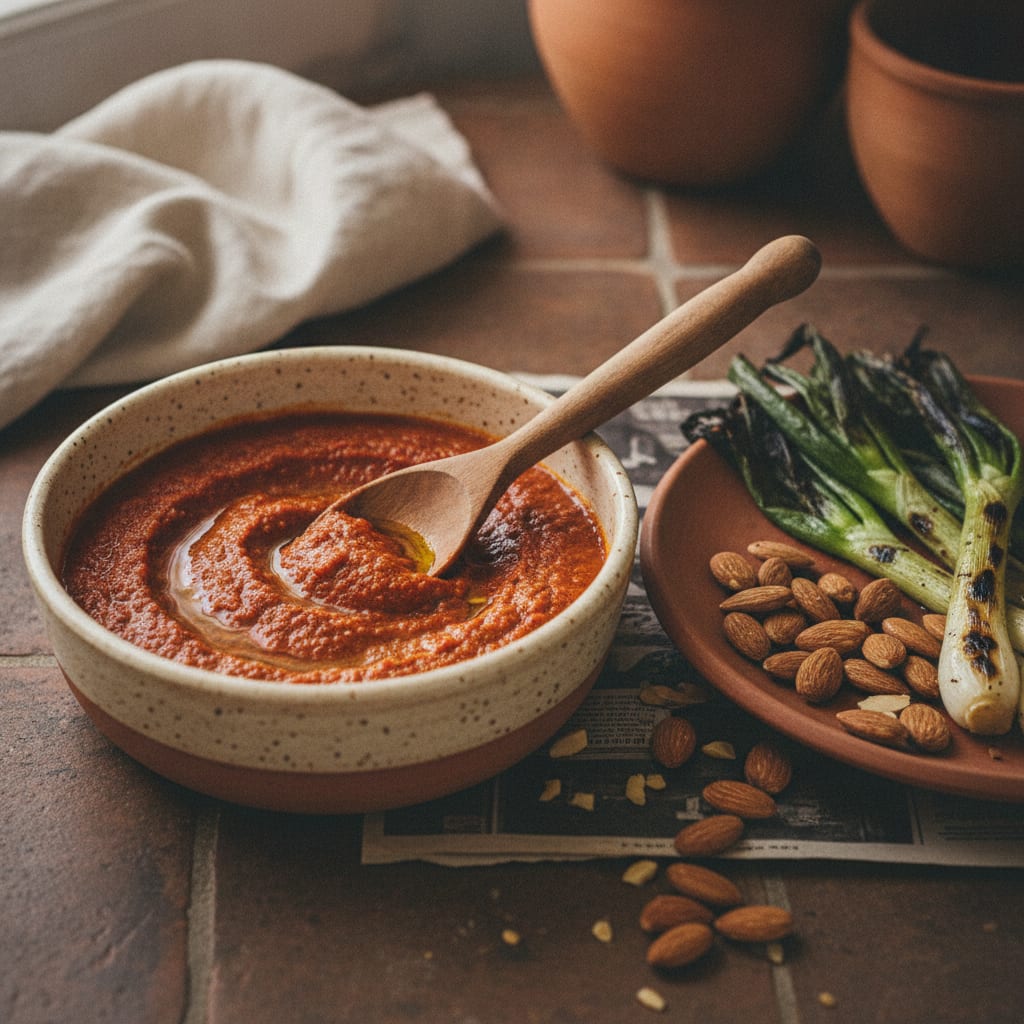
Tarragona's ñora-and-almond sauce, two ways: dried ñora peppers, charred tomato, fried bread and toasted nuts pounded into the rust-red sauce of the calçotada.
- Prep
- 20 min
- Cook
- 20 min
- Total
- 40 min
- Servings
- 6
- Difficulty
- Easy
Getting ready…
Ingredients
For 6 servings · 11 items
For the sauce
To serve (optional)
Method
5 steps · check as you go
- →
Serve
Serve at room temperature, thick, as a sauce or a dip. The classic partner is charred calçots or spring onions — grilled black, peeled, and dragged through the sauce by hand. It is also superb with roasted vegetables, grilled leeks, potatoes, or smeared under anything from the grill. Make it a day ahead if you can; it only improves.
The story
Romesco is a sauce that the rest of the world keeps trying to make with the wrong pepper. It comes from Tarragona, in southern Catalonia, where the story goes that fishermen pounded dried peppers, nuts, stale bread, garlic and oil into a rust-red paste to dress whatever they couldn’t sell — the name itself thought to come from a Mozarabic word for to mix. The pepper they used was the ñora: a small, round, sun-dried sweet pepper, earthy and faintly smoky, that you rehydrate and scrape for its pulp. Swap it for roasted fresh red bell pepper, as a thousand blogs do, and you have made a pleasant pink sauce that is not romesco.
I met it properly in the summer of 2018, cooking arroces at La Riuà in El Carmen in Valencia. A cook from Reus, just outside Tarragona, made romesco for a staff meal and was scandalised — genuinely, hand-to-heart scandalised — that the version I’d met abroad was built on roasted bell peppers. “Eso no es romesco. Eso es otra cosa.” That is not romesco. That is something else. He soaked his ñoras, scraped the pulp off the skins with the tip of a knife, and ground the nuts before anything wet went in, so the sauce stayed coarse. I have made it his way ever since.
This romesco has nothing animal in it and never asked for any — it never did. Ñora pulp, charred tomato and garlic, toasted almonds and hazelnuts, fried bread, sherry vinegar, olive oil. The method does not move: the soak and scrape, the char, the toast, the coarse grind with the nuts first, the rest. It is not a “vegan version” of romesco. It is romesco, the way the cook from Reus made it, made with what is in my hands.
À la maison
The weeknight reading is the recipe above, and it stands or falls on two things: use real ñoras, and keep the sauce coarse. The ñora is non-negotiable — it is what makes romesco taste like romesco rather than like a nut-and-pepper dip. Soak them, scrape the pulp, discard the skin. Then grind the nuts and fried bread to a rubble before the wet ingredients go in, so the sauce keeps its texture and the nuts don’t turn to paste. Stream the oil at the end to emulsify it. Let it rest an hour. It will be better tomorrow.
Au bistrot
The bistronomique reading keeps the coarse sauce intact and builds a plate around the calçotada it belongs to. Pass half the romesco through a fine sieve into a smooth, glossy base, and keep the other half rustic — two textures of the same sauce on one plate. For the vegetables, do what the calçotada does, only neater: char spring onions or thin leeks hard over a flame until the outsides blacken, then peel back to the sweet, soft, smoky cores. Confit a few baby potatoes or wedges of celeriac in oil until tender, then crisp their faces. Toast extra almonds and crush them coarse for a finishing crunch.
Plate it as a study in the calçotada: a clean swipe of the smooth romesco dragged across a long plate, a spoonful of the coarse version mounded at one end. Lay the charred, peeled alliums in a loose diagonal, their black-and-green ends catching the light, the confit potatoes tucked between. Scatter the crushed toasted almonds and a few young celery or parsley leaves. Finish with a thread of the greenest oil and a few drops of sherry vinegar. The whole plate is the calçotada read at the table — char, sweetness, and the rust-red sauce you drag everything through — just composed instead of eaten with bibs and stained fingers off newspaper.
El emplatado — Three-quarter, long plate. A smooth swipe of romesco, a coarse spoonful at one end, charred peeled alliums laid in a loose diagonal, confit potatoes between, crushed almonds scattered. Warm, slightly smoky light, a thread of green oil. The plate should say calçotada, plated — the wood-fire feast in restraint.
What the other recipes get wrong
Most romesco recipes online — I read the top ten in June 2026 — replace the ñora with jarred roasted red peppers, and many blend the whole thing to a smooth purée. Both are the same mistake: stripping out what makes romesco romesco. I ran the test over two days in June 2026: eight batches, same nuts, same bread, same tomato, comparing the pepper base and the grind.
- Roasted bell pepper, smooth blend: bright, sweet, pretty — and generic. It tasted of roasted pepper and almonds, a fine sauce that any Mediterranean kitchen might make, with none of the dried-pepper depth. Smooth, it read as hummus’s cousin.
- Ñora pulp, smooth blend: the right flavour but the wrong body — pasty and dense, the ground nuts lost into a uniform purée, missing the rustic texture that makes you reach for more.
- Ñora pulp, coarse grind, nuts first: deep brick-red, earthy and smoky from the dried pepper, with visible ground nuts and a body that clings to a charred onion. The real thing, by a distance.
The reason is the ñora and the order of grinding. The ñora is a sweet pepper picked ripe and sun-dried, which concentrates its sugars and develops dried, earthy, faintly smoky notes through slow dehydration — flavours a fresh roasted pepper, full of water, simply does not have. Rehydrating and scraping the pulp gives you that concentrated character without the bitter skin. And grinding the toasted nuts and fried bread to a rubble before the wet ingredients go in keeps them as particles rather than paste, so the finished sauce has the coarse, mounding texture that is half the pleasure of romesco. Across all eight batches, only ñora-plus-coarse-grind gave the sauce the cook from Reus would have recognised.
The line I draw
I will not make romesco with roasted bell pepper in place of ñora. Not because of purism for its own sake, but because the ñora is the dish — its dried, earthy, smoky sweetness is the flavour the whole sauce is built around, the thing that separates romesco from every other nut-and-pepper sauce on the Mediterranean. Swap in fresh roasted pepper and you have made something sweeter, brighter, and anonymous: a good sauce with no homeland. If you cannot find ñoras, reach for another dried pepper and lean on smoked pimentón — but do not pretend a jar of roasted red peppers is romesco. It is, as the man said, otra cosa. Something else.
When this can fail
Three ways, all from my own kitchen between 2022 and 2026:
- The bitter sauce. Left the papery ñora skin in and toasted the nuts a shade too dark; the whole sauce carried a bitter, scorched edge. Fix: scrape only the soft pulp from the rehydrated ñora and toast the nuts strictly to golden — pull them the moment they smell nutty, not when they look brown.
- The pasty purée. Threw everything in the processor at once and ran it smooth; the romesco set into a dense paste with no texture, like a thick spread. Fix: pulse the nuts and fried bread to a coarse rubble first, then add the wet ingredients and pulse only to combine.
- The flat, watery batch. Used raw tomato and skipped the char to save time; the sauce came out thin and sharp, with no depth behind the vinegar. Fix: char the tomatoes and garlic until blistered and soft — that smoky concentration is the backbone the sauce stands on.
FAQ
QWhat makes romesco different from a roasted red pepper sauce?
The pepper. Authentic romesco is built on the ñora — a small, round, sun-dried sweet red pepper from Spain's east coast, rehydrated and scraped for its concentrated, earthy, lightly smoky pulp. A sauce made with roasted fresh red bell peppers is a different, sweeter, brighter thing. The ñora gives romesco its deep brick-red colour and its characteristic dried-pepper flavour, alongside toasted nuts, fried bread, charred tomato and garlic. Paprika can top up the ñora but never replaces it.
QWhere does romesco come from?
Tarragona, in southern Catalonia. It is traditionally credited to fishermen who pounded dried peppers, nuts, bread, garlic and oil into a sauce to dress their catch. The name is thought to come from a Mozarabic word meaning 'to mix.' Today it is inseparable from the calçotada — the late-winter feast where grilled calçots, a kind of sweet spring onion grown around Valls near Tarragona, are dragged through romesco and eaten by hand.
QWhat can I use instead of ñora peppers in romesco?
Ñoras are best, but if you can't find them, the closest substitute is dried choricero peppers, or a mix of a rehydrated mild dried red chilli (like New Mexico or ancho for body) plus an extra teaspoon of sweet smoked pimentón to mimic the ñora's earthy, smoky sweetness. Avoid relying on fresh roasted bell pepper alone — it makes a sweeter, brighter sauce that lacks the dried-pepper depth that defines real romesco.
QWhy is my romesco bitter or gritty?
Two common causes. Bitterness usually comes from the ñora skins or from burnt nuts or garlic — scrape the soft pulp from the rehydrated ñora and discard the papery skin, and toast the nuts only to golden, not brown. Grittiness comes from under-grinding the nuts; pulse the toasted nuts and fried bread to a fine rubble before adding the wet ingredients. The sauce should be coarse but cohesive, not sandy.
QHow long does romesco keep and can I make it ahead?
It keeps 5 to 7 days covered in the fridge and genuinely improves over the first day or two as the flavours marry. The oil may firm up cold — bring it back to room temperature and stir before serving. It also freezes well for up to 3 months. Making it a day ahead is the best move for a calçotada or a dinner; it is one of the rare sauces that is better for the wait.