The flame cake.
Flammekueche.
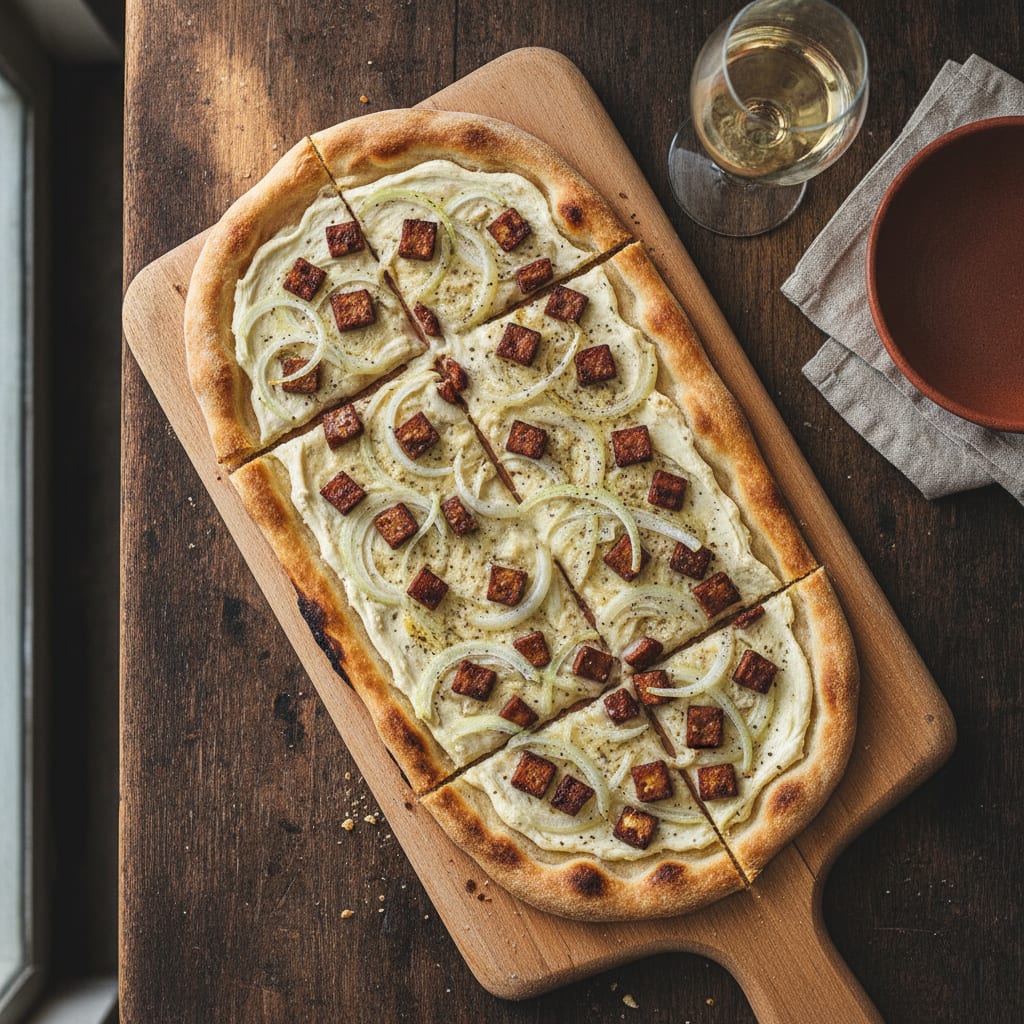
Alsace's tarte flambée, two ways: cashew fromage blanc, raw onion, smoked-tofu lardons on paper-thin no-yeast dough, baked blistering-hot until the edges char.
- Prep
- 25 min
- Cook
- 10 min
- Total
- 35 min
- Servings
- 4
- Difficulty
- Medium
Getting ready…
Ingredients
For 4 servings · 17 items
For the dough (no yeast)
For the cashew fromage blanc
For the topping
Method
6 steps · check as you go
- →
Serve
Cut into squares and eat immediately, hot off the steel, ideally with your hands. Serve with a cold, dry Alsace white — a Riesling, a Sylvaner, or a Pinot Blanc — or a crisp lager. In Alsace the table eats it communally, one tart after another straight from the oven; make and bake them one at a time and pass them around as they come.
The story
Flammekueche is a test that became a meal. In the farms of the Kochersberg, north of Strasbourg, families baked their bread in a communal wood-fired oven only a few times a week, and before the loaves went in they needed to know the oven was hot enough. So they pressed a scrap of leftover dough paper-thin, smeared it with fresh cream, scattered onion and pork trimmings, and slid it into the fiercest part of the fire. If it baked fast and charred at the edges, the oven was ready for bread. The flames blackened its rim — and that is the whole name. Tarte flambée: flamed tart. The test pie was so good they kept making it. The form goes back at least to the 16th century.
I made my first proper ones in Paris, in 2013, in a cramped apartment kitchen in the 11th near rue Oberkampf, working from a recipe a line cook from Strasbourg named Théo had scribbled on the back of a prep list. His one instruction, underlined twice: FOUR À FOND. Oven flat-out. My first tart came out pale and floppy because I’d been polite with the heat. Théo would have laughed. The second, baked on a tray I’d left in a 270-degree oven for half an hour, came out in nine minutes with a blistered black rim and a base that snapped — and that was it, that was the dish. The heat was the recipe.
This flammekueche has no cream cheese and no bacon. The base is a cashew fromage blanc with soy yogurt for the lactic tang; the lardons are smoked tofu, glazed and seared. Everything else is exactly as Alsace does it: the unleavened dough rolled translucent, the raw onion, the brutal oven, the charred edge. It is not a “vegetable tarte flambée.” It is flammekueche, baked the way the Kochersberg baked it, with the dairy and the pork swapped and the fire kept savage.
À la maison
The weeknight reading is the recipe above, and it rises or falls on two things: a paper-thin base and a savagely hot oven. Roll the dough until it’s almost translucent — thick dough steams and goes bready, killing the snap. And get a steel or an upturned tray as hot as your oven goes, a full half-hour of preheat, because the fierce heat is what chars the rim and crisps the base in under ten minutes. The cream blends in a minute, the onion goes on raw, the tofu lardons take three minutes to glaze. Bake one at a time and eat them straight off the steel with your hands, the Alsace way. Pale and timid is the only way to ruin it.
Au bistrot
The bistronomique reading keeps the fire and tightens the frame. Roll the dough thinner still and dock it, so it bakes to an even, blistered cracker. Build the cashew fromage blanc richer and pipe it in a fine even layer, then add a second register the classic gratinée version hints at: a scatter of caramelized onion cooked down slow and sweet beneath the raw onion, and a few wisps of grated smoked-tofu over the lardons so the top gilds in patches. Bake it brutal, then finish at the pass — a drift of finely sliced chive, a crack of black pepper, a few drops of toasted hazelnut oil for the Alsatian nuttiness, and, if you want the forestière nod, a handful of sautéed wild mushrooms folded over the top off the heat. Cut it into clean fingers rather than rough squares and serve it on a warm board. Same flame, same tart, read as a shareable plated course.
Le dressage — Overhead, then a low raking shot down the charred edge. Long warm board on dark wood, the tart cut into even fingers, blistered rim catching the light, chive and pepper scattered, a thread of hazelnut oil. Negative space, an Alsace-white glass soft behind, hard low light. The plate should say winstub, refined — flame-cooked, not fussy.
What the other recipes get wrong
Most vegan tarte flambée recipes online — I read the top ten in May 2026 — bake at a sensible 200°C on a cool tray and end up with a pale, soft, bready disc that tastes of raw flour and flat cream. They miss the one thing the dish is named for: the flame. So I made the oven the variable. I ran the test over a week in May 2026, four tarts, identical dough, cream, and topping, only the bake changed:
- 200°C (400°F), cold tray, 18 min: pale, floppy, bready. The base never crisped, the cream dried to a skin, the onion stewed. It tasted of nothing and read as a sad flatbread.
- 230°C (450°F), cold tray, 14 min: better colour but still soft underneath — the base steamed before it could crisp, and there was no char at all on the rim.
- 270°C (520°F), preheated tray, 11 min: crisp base, set cream, sweet onion, the rim just catching. Close, and genuinely good.
- 270°C+ (520°F+), preheated steel, 9 min: snapping crisp base, gold-spotted cream, and a blistered, smoky-bitter charred edge. This was the dish — unmistakably flammekueche.
The reason is heat transfer, not opinion. A flammekueche is paper-thin, so the bake is a race: the base must crisp and the rim must char before the thin layer of cream dries out and the onion stews. A preheated steel holds and dumps enormous heat into the dough the instant it lands, flashing the underside crisp in seconds — a cold tray has to heat up first and steams the base while it does. And the fierce top heat scorches the exposed edges to the bitter, smoky char that is literally the dish’s name, flambée, flamed — the same char the wood-fired bread oven gave it for five centuries. At a polite 200°C none of that happens fast enough; the tart dries and softens instead of crisping and charring. Across all four batches, only the screaming-hot steel gave both the snap and the char, which together are the whole identity of the tart.
The line I draw
I will not bake a flammekueche at a polite temperature, and I will not make the dough thick to play it safe. The dish is named for fire — tarte flambée, the tart the flames blackened in the bread oven — and its entire character is a paper-thin base that snaps and a rim charred smoky-bitter, both delivered by a savage, short bake. Drop the oven to a comfortable 200°C, or roll the dough thick “so it holds,” and you get a soft, pale, bready disc with stewed onion on top: a different, lesser thing wearing the name. The Kochersberg slid this into the hottest part of a wood fire on purpose. Anything cooler is not flammekueche; it is flatbread with cream on it.
When this can fail
Three ways, all from my own kitchen between 2022 and 2026:
- The pale, bready tart. Baked at a moderate heat on a cold tray and pulled it the colour of a dinner roll; it was soft, floury, and had no char at all. Fix: preheat a steel or upturned tray for 30 minutes at the oven’s maximum and bake fast — the heat is the recipe.
- The thick, doughy base. Didn’t roll it thin enough out of nervousness; the base steamed under the cream and went bready instead of crisp. Fix: roll it almost translucent, edge to edge, and keep the topping a thin single layer.
- The soggy, sat-out tart. Topped four tarts and let them wait while the oven came up; the cream soaked into the dough and no bake could crisp them after. Fix: assemble each tart only when the steel is fully hot, and slide it straight in — prep the components ahead, build at the last second.
FAQ
QWhat is flammekueche and is it a pizza?
Flammekueche, also called tarte flambée or Flammkuchen, is an Alsatian flatbread from the German border region near Strasbourg. It is not a pizza: the dough has no yeast, it is rolled paper-thin to bake flat and cracker-crisp, and it is topped with a fresh cream base (fromage blanc), thin onion, and lardons rather than tomato and cheese. It originated as a way to test a wood-fired bread oven's heat — peasants slid a thin sheet of leftover dough into the blazing oven before the bread went in. The fierce flames charred its edges, which is where 'flambée,' flamed, comes from.
QWhy does flammekueche need such a hot oven?
Because the dish was born in a wood-fired bread oven at its absolute hottest, before the loaves were loaded, and that fierce heat defines it. A blistering oven — 270°C or higher, ideally on a preheated steel — bakes the paper-thin tart in under ten minutes: the base crisps, the cream sets, and the exposed edges char to a smoky, slightly bitter rim. That char is literally the dish's name — flambée means flamed. A moderate oven gives you a pale, bready, soft tart that misses the entire point.
QHow do you make flammekueche without bacon and cheese?
Two stand-ins. For the fromage blanc cream, blend soaked cashews with soy yogurt and lemon — the cashews give richness, the yogurt the lactic tang of real fresh cheese. For the lardons, cut smoked firm tofu into small batons, glaze them with soy, maple, and smoked paprika, and sear until the edges bronze; the smoke and salt-sweet glaze read as cured pork. Keep the dough unleavened and paper-thin, the onion raw, and the oven brutal. It reads as flammekueche because it's built and baked like one.
QWhy is the flammekueche dough made without yeast?
Because flammekueche is meant to be flat and crisp, not risen and bready. An unleavened dough — just flour, water, oil, and salt — rolls out paper-thin and bakes into a cracker-crisp base that shatters under the topping. Yeast would make it puff and go soft and bread-like, turning it into something closer to pizza. A short rest relaxes the gluten so it rolls thin without springing back; that's all the dough needs.
QCan I make flammekueche ahead?
Prep ahead, bake fresh. The cashew cream holds 4 days in the fridge and the dough can rest, wrapped, for several hours or overnight. Glaze and sear the tofu lardons ahead too. But assemble and bake at the last minute on a fully preheated steel, because a topped tart left to sit goes soggy and a flammekueche is only itself straight from the screaming oven — crisp, hot, and charred at the edge.