Migaine, lardons, no cheese.
Quiche lorraine.
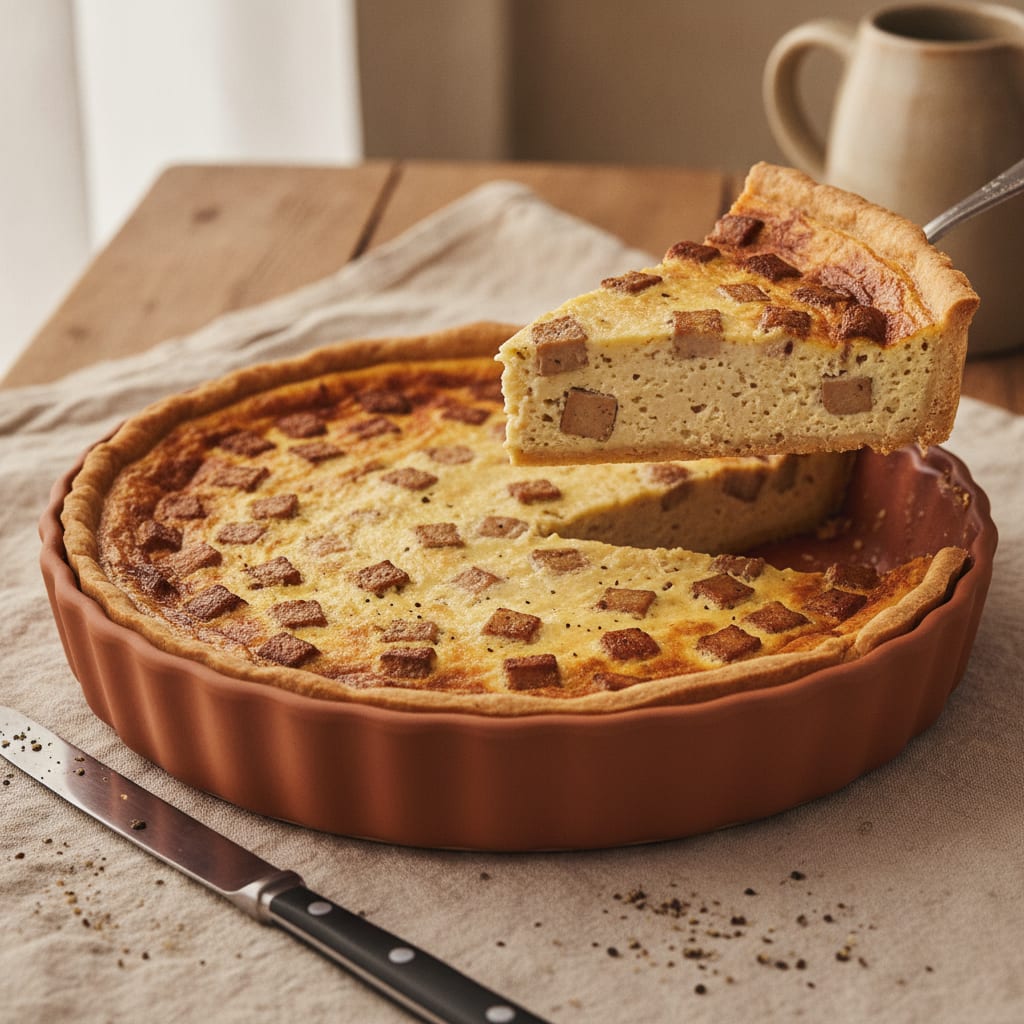
The real Lorraine tart, two ways: smoked-tofu lardons in a silken-and-chickpea migaine, set just-trembling in a butter pâte brisée. No cheese, the old way.
- Prep
- 30 min
- Cook
- 45 min
- Total
- 1h 45min
- Servings
- 6
- Difficulty
- Medium
Getting ready…
Ingredients
For 6 servings · 18 items
For the pâte brisée
For the lardons
For the migaine (custard)
Method
7 steps · check as you go
- →
Serve
Serve the quiche warm rather than hot, in generous wedges, with a sharp green salad — frisée or arugula in a mustard vinaigrette to cut the richness. It is a whole light meal at lunch, or a starter in smaller slices. A glass of dry Alsatian white, a Riesling or a Pinot blanc, is the regional pour.
The story
A quiche lorraine is a pastry shell, a savoury custard, and browned smoked pork — and famously, in its honest form, no cheese. The word quiche comes from the Lorraine dialect, from the German Kuchen, cake, and it is old: first attested in Lorrain in 1605, in French in 1805, and it reached English — as “quiche lorraine” — only in 1925. The earliest versions had neither cheese nor bacon, just a creamy custard the Lorrains call the migaine, baked in a base that began as scraps of bread dough. The smoked lardons arrived in the 19th century. The cheese arrived later still, riding the dish’s fame outward, and Lorraine has been complaining about it ever since.
I learned to set a migaine properly in Paris, in the years I cooked there, from a chef de partie on the cold-and-pastry side who treated overbaked quiche as a small moral failure. She’d pull a quiche the moment the centre still trembled — earlier than felt safe — and stand it on the rail to finish setting in its own heat. The first time I let one bake until it was firm and golden all the way through, she cut a wedge, watched it sit there rubbery and weeping, and slid it back to me without a word. The smell of it was nutmeg and pepper and smoke. “Une quiche, ça tremble,” she said. A quiche trembles. I pull them early now.
This quiche has no egg, no cream, and no pork. It has a migaine of silken tofu and chickpea flour, smoked-tofu lardons browned hard in the pan, and a butter pâte brisée blind-baked dry. It carries no cheese because a real quiche lorraine never did. The method is the dish: blind-bake the shell, brown the lardons, set the migaine soft and trembling, rest it before you cut. It is not a “dairy-free version” of a quiche lorraine. It is a quiche lorraine, set the way the chef on the pastry rail taught me — pulled while it still shivers.
À la maison
The weeknight reading is the recipe above, and most of it is patience rather than skill. The two moves that decide everything: blind-bake the shell properly so the base is dry and sealed before any wet custard touches it, and pull the quiche while the centre still trembles, then let it set as it rests. Brown the smoked-tofu lardons hard — that browned, smoky edge is the flavour of the dish, and raw tofu would only weep water into the custard. Serve it warm, not oven-hot, with a sharp salad. A quiche eaten the moment it leaves the oven has not finished becoming itself.
Au bistrot
The bistronomique reading is the same quiche, built small and precise so the migaine reads as the silk it is.
Make individual quiches in straight-sided rings rather than one large tin — a tart that’s all custard and barely any crust, the migaine standing tall and trembling. Roll the pâte brisée thinner and line the rings, blind-bake them dark gold. Brown the smoked-tofu lardons as before, but reserve a few of the crispest for the top. Enrich the migaine with a spoon of caramelised onion blended through it, so it carries the sweetness that pairs with smoke, and bake the little quiches low and slow until they’re set with a centre that still shivers when you tap the ring. Unmould one onto the plate while just warm. Crown it with the reserved crisp lardons, a few young frisée leaves dressed in mustard vinaigrette, and a turn of black pepper and grated nutmeg over the top. A small quenelle of cold chive cream alongside. The quiche becomes a plated course — custard, smoke, pastry, and nothing hidden.
Le dressage — Overhead, then a low side angle to show the height of the migaine. A single tall individual quiche, unmoulded clean, pale custard flecked dark with lardons, crowned with crisp lardons and a tangle of dressed frisée. A quenelle of chive cream to the side. Soft daylight, a grating of nutmeg caught mid-fall. The plate should say trembling — that the whole point is a custard pulled before it ever firmed up.
What the other recipes get wrong
Most eggless quiche recipes — I read the top ten in April 2026 — reach for a single ingredient to do the whole job of the egg, and a single ingredient can’t, because an egg does two things at once. I ran the test over a weekend in April 2026, four migaines, same shell, same lardons, only the binder changed:
- Silken tofu alone: soft and wobbling but it never firmed — it sliced wet and slumped on the plate, all egg white and no yolk.
- Chickpea flour custard alone: it set firm enough to slice, but dense and faintly grainy, with a beany edge — all yolk-bind and no silk.
- Cornstarch-thickened cream: set into a smooth gel that sliced clean cold but turned gluey and slick warm, with no custard character at all.
- Silken tofu plus chickpea flour: soft, trembling, sliceable warm, with the clean wobble of a real migaine. This was the dish.
The reason is that an egg in a custard does two separate jobs. The white’s proteins coagulate to give the soft, jelly-set wobble; the yolk’s proteins and lecithin firm and enrich it so it holds a clean slice. Silken tofu, which is essentially a soy protein gel, mimics the white’s soft coagulation; chickpea flour, whose proteins and starch set firm on baking, mimics the yolk’s firming bind. Use one and you get half a custard. Use both, baked low at 170°C so they set smooth rather than puffing and weeping, and you get the trembling, sliceable migaine the dish is named for — every time, across all four batches.
The line I draw
I will not overbake a quiche. Not “just to be sure it’s set,” not until it’s firm and golden through and through. A quiche lorraine’s whole texture is a soft, trembling custard pulled while the centre still shivers and left to finish setting in its own heat. Bake it until it’s firm in the oven and it puffs, cracks, weeps water, and slices rubbery and grainy — you’ve made a baked savoury cake, not a quiche. The migaine is supposed to wobble. The chef on the pastry rail was right to slide the firm wedge back at me: a quiche that doesn’t tremble has already failed.
When this can fail
Three ways, all from my own kitchen between 2022 and 2026:
- The soggy bottom. I skipped the blind-bake to save twenty minutes and poured the wet migaine into a raw shell; the base came out pale and limp, steamed from below. Fix: always blind-bake the shell dry and pale gold before filling, beans in then beans out.
- The weeping custard. I baked it hot and long until it was firm; it puffed, then sank and wept a ring of water onto the plate. Fix: bake low at 170°C and pull it while the centre still trembles, then rest it.
- The watery lardons. I scattered raw smoked tofu straight into the migaine once; it leached water as it baked and left the custard loose and pale. Fix: brown the lardons hard in the pan first, so they go in dry, smoky, and lacquered.
FAQ
QDoes real quiche lorraine have cheese?
No. In its earliest and most authentic form, quiche lorraine contained neither cheese nor — at first — even bacon: just a savoury custard called a migaine, made of eggs and cream, baked in pastry. Smoked pork was added in the 19th century; cheese came later still as the dish spread, and it has long been criticised as inauthentic by Lorraine purists. This version keeps faith with the original — a smooth migaine and browned smoked lardons, no cheese — using smoked tofu for the lardons and silken tofu with chickpea flour for the custard.
QWhat is the migaine in a quiche lorraine?
Migaine is the Lorraine-dialect word for the savoury custard that fills the tart — classically a mixture of eggs, cream, and milk, seasoned with salt, pepper, and nutmeg. It is the heart of the quiche. Here the migaine is built from blended silken tofu for the wobble and white-of-egg set, chickpea flour for the yolk-bind that firms on baking, and oat cream for richness, so it sets into the same soft, sliceable custard without eggs or dairy.
QHow do you make an eggless quiche that actually sets?
Use two proteins doing two jobs: silken tofu for the soft, wobbling body that egg white gives, and chickpea flour for the firming bind that egg yolk gives. Blended smooth with oat cream and baked low at 170°C (340°F), they set into a clean, sliceable custard. Bake it gently until just-trembling in the centre and rest it 20 minutes — the migaine keeps setting as it cools, exactly like an egg custard.
QHow do you avoid a soggy bottom on quiche?
Blind-bake the pastry shell before filling it. Line the raw shell with parchment and baking beans, bake at 190°C (375°F) for 15 minutes, then remove the beans and bake another 8 minutes until the base is dry and pale gold. A quiche filling is wet, so the crust must be pre-cooked and sealed or it bakes limp. Browning the lardons separately, rather than adding them raw and watery, also keeps the base from steaming.
QWhat can I use instead of bacon lardons in quiche lorraine?
Firm smoked tofu, cut into short batons and fried hard in a little oil until golden and crisp at the edges, with a splash of soy sauce and a trace of maple in the last 30 seconds to lacquer them. That gives the browned, smoky, faintly sweet bite that rendered pork lardons bring. Smoked coconut or marinated tempeh also work, but smoked tofu is the closest in texture and the easiest to brown.