Soup there it is.
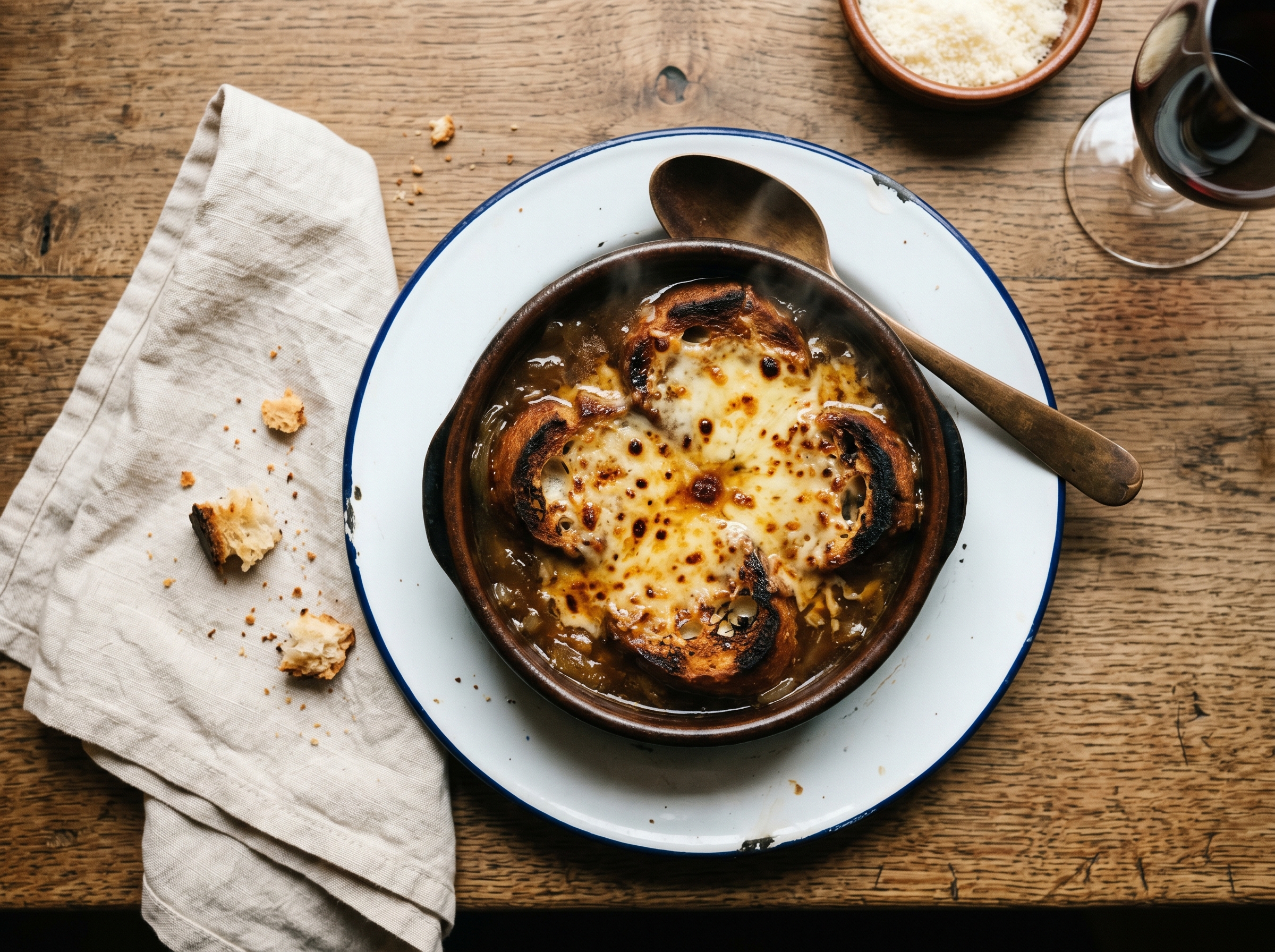
French Onion Soup.
Six onions, forty-five minutes of patience, a miso-darkened broth that earns the gruyère it doesn't need. A Lyon bistro soup, the slow way.
- Prep
- 15 min
- Cook
- 1h 15min
- Total
- 1h 30min
- Servings
- 4
- Difficulty
- Medium
Getting ready…
Ingredients
For 4 servings · 20 items
For the soup
For the topping
Method
8 steps · check as you go
- →
Serve
Set each bowl on a plate. Tuck a spoon in. Serve with no garnish — the dish is its own garnish. The first spoonful should break through the bread cap and pull a strand of melted cheese to the rim. The second spoonful is the broth. The third is everything together. That's the order.
The story
In Lyon, soupe à l’oignon gratinée is not a starter. It is a meal you eat at 1 a.m. after a long night, in a bouchon with paper menus and a waiter who knows your name because he has been working there for thirty years. The first bowl I had like that was in February 2012, in a bouchon a block off Place des Terreaux, a cold Tuesday night when I had finished a school service at 11 and walked over to eat alone. The bowl arrived black on top — a crust of cheese and bread broiled to the edge of burnt — and underneath that crust was forty-five minutes of patience, six onions, a glass of wine, and a few things you could not see but could taste. The room smelled of butter and burnt sugar. The napkins were paper. The waiter set the bowl down and walked away.
I learned to make it from a man named Pascal who ran that bouchon, a block from the Saône, between 2012 and 2014. Pascal did not measure. He cooked onions for “the time it takes to read Le Monde” — about an hour, depending on the headlines. He believed in white wine over red for the deglaze and brandy over cognac for the lift. He did not believe in beef stock, despite the dish being Lyonnais and the city being deep in cattle country. “Le bœuf, c’est pour le steak,” he would say. “Pas pour la soupe.” Beef is for the steak. Not for the soup. The soup is onions. The onions do the work.
I have kept that philosophy. The version below replaces nothing — there was never beef in Pascal’s soup. The brown depth comes from the onions themselves, plus a small load of umami built from white miso, dried shiitake, and a tablespoon of soy sauce. The miso is the Japanese trick I added; Pascal would have called it bizarre and then tasted it and shrugged. The shiitake is the move that locks in the meaty backbone you might miss otherwise. Together they do the work the beef stock would have done — without the beef, without apology.
What the other recipes get wrong
Most onion soup recipes online — I checked the top ten in March 2026 — claim caramelization in 15 to 20 minutes. They are lying or they have never tasted a Lyonnais bowl. I cooked six side-by-side batches on a Saturday in February 2026 — same onions from the same bag, same pot, same heat — pulled at 15, 30, 45, 60, 75, and 90 minutes. Here is what I found:
- 15 minutes: pale gold, sweet but raw, the broth ended up thin and metallic.
- 30 minutes: amber on the edges, still wet, a stewy flavor that fought with the wine.
- 45 minutes: deep mahogany on the bottom, sticky fond on the pot, the broth had body and a long finish.
- 60 minutes: same color, slightly drier onion, still excellent — Pascal’s “Le Monde hour.”
- 75 minutes: edges scorching, bitter notes in the broth.
- 90 minutes: burnt sugar, irretrievable, the pot went straight in the sink.
The window that worked, every time: 45 to 60 minutes of low-and-slow uncovered cooking after the initial 15-minute sweat. Anything less is wilted onion in flavored water. Anything more is bitter. I keep the six bowls in mind every time I start the pot.
The line I draw
I will not skip the 45-minute caramelization. Not for a weeknight, not for a guest who is hungry, not for a recipe video that needs to fit in five minutes. The soup is the caramelization. If you stop at 20 minutes, you have onion broth with a bread cap, and that is a different dish — a worse one. I would rather you cook a leek and potato soup honestly than serve a gratinée with under-cooked onions. Pascal would have walked out of his own kitchen if he saw it.
When this can fail
Three ways, all from my own kitchen between 2022 and 2026:
- The crowded pot. Tried it once in a 3-quart saucepan because the Dutch oven was dirty. The onions steamed instead of caramelized, never browned, stayed limp for an hour. Fix: use a 5-to-7-quart pot, wide enough that the onions sit in a layer two fingers deep at most.
- The boiled miso. Stirred the miso into the simmering broth and walked away for ten minutes. The fermented depth flattened, the broth tasted of generic salty stock. Fix: temper it in a ladle off the heat, fold it back in at the end. Treat it like the last move, not the first.
- The under-watched broiler. Set the bowls under high broil and turned to slice bread. Came back to four bowls of black foam. Fix: stand at the oven door, do not blink, pull at amber-bubbling. Two minutes is right. Four minutes is past.
A few notes before you begin.
The caramelization is forty-five minutes. Set a timer for fifteen minutes covered, then thirty minutes uncovered, stirring every four. There is no shortcut. The onions begin translucent, pass through gold, settle into amber, and end at mahogany. If they dry out at any point, add a splash of water — never more oil. You’re trying to develop sugar reactions, not deep-fry.
The miso goes in at the end. Off the heat. Tempered through a ladle of hot broth. Adding it directly to the boiling pot kills its complexity. Treat it the way a ramen-ya treats it — fold it in last, gently, with respect.
The bread cap is gratineed under the broiler. Watch it like it owes you money. Two minutes is right. Four minutes is past. The line between perfect amber and bitter char is short.
This is a soup for an October Sunday. Make it in the afternoon. Eat it when the light goes. Have a glass of the same white wine you used in the pot. If a friend joins, double the recipe — onions cook in the same time whether you have six or twelve, and the soup keeps for three days in the fridge, getting better each one.
FAQ
QWhat is the secret to a great vegan French onion soup?
Two things. First, real caramelization of the onions — 45 minutes of low-and-slow cooking until the onions are mahogany-colored. Rushing this step is the most common failure mode. Second, building umami into the broth with white miso, dried shiitake, and a small amount of soy sauce. These three together produce the deep savory backbone that beef stock normally provides. Both moves are non-negotiable.
QCan I make French onion soup without cheese?
Yes. The soup itself is the dish — the cheese is a finishing element. A traditional French onion soup tradition called *gratinée* adds the cheese-and-bread cap, but the un-gratined version (called *soupe à l'oignon* without the *gratinée* qualifier) is equally Lyonnais and entirely satisfying. Float the garlic-rubbed toast on the surface and skip the broil. The dish stands without it.
QWhat kind of miso works best in onion soup?
White miso (*shiro miso*). It has the mildest flavor and the lightest color, so it adds umami without coloring the broth too dark or competing with the caramelized onion sweetness. Red miso or *awase miso* work but produce a heavier, almost stewy result — less elegant. Add the miso at the end, off the heat, tempered through a ladle of hot broth, to preserve its depth.
QWhy do you salt the onions at the start?
Salt draws moisture out of the onions through osmosis, which accelerates the initial wilting phase. Adding salt at the beginning means the onions release their water quickly, sweat to translucent in 15 minutes under the lid, and then begin to caramelize once the liquid evaporates. Salt at the end won't fix onions that didn't sweat properly at the start.
QHow long does it really take to caramelize onions?
45 to 60 minutes for dark mahogany caramelization, after the initial 15-minute sweat under the lid. Recipes promising 10-minute caramelized onions are producing wilted golden onions — useful in some dishes, wrong for French onion soup. The deep flavor of the broth depends entirely on this slow color development. There is no shortcut that doesn't compromise the dish.