The black-bean Saturday.
Feijoada.
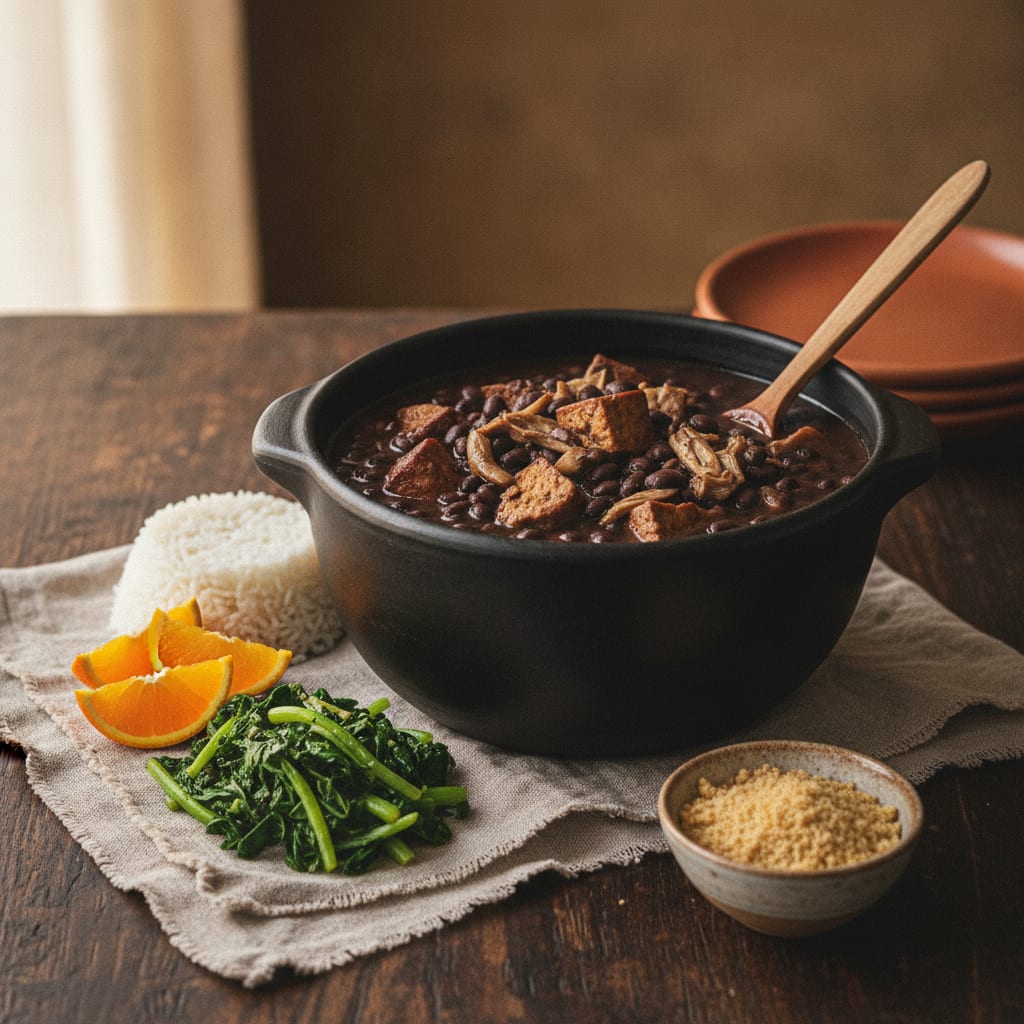
Brazil's black-bean feast, two ways: smoked tofu, charred mushrooms and seitan deep in a dark bean pot, served with orange, couve and farofa.
- Prep
- 30 min
- Cook
- 2h 30min
- Total
- 12h
- Servings
- 8
- Difficulty
- Ambitious
Getting ready…
Ingredients
For 8 servings · 18 items
For the beans
For the smoked elements
For the bean pot
To serve
Method
7 steps · check as you go
- →
Serve
Serve the dark bean pot in its own vessel, with white rice, finely sliced sautéed couve, toasted farofa, and plenty of sliced orange around it. A caipirinha is the Brazilian pour; a cold lager works too. Build each plate at the table. Leftovers deepen overnight and hold 5 days in the fridge.
The story
Feijoada found me in the spring of 2025, on a Saturday in Washington, in a basement community kitchen off Columbia Road where the Brazilian families of the DMV gather to cook the way you cook when you are a long way from home. I had been invited by a friend of a friend; I will not pretend I remember every name around that pot, because there were a dozen people moving through the room and I was the foreigner with the notebook. But I remember the smell — black beans that had been going since before dawn, a deep, almost-meaty darkness in the air — and I remember a woman in her sixties tasting the pot with a wooden spoon, frowning, adding nothing, and walking away satisfied. That frown was the whole lesson. The pot was not done being itself yet, and she was not going to rush it.
The story they tell about feijoada — that enslaved people invented it from the scraps their masters threw away — is the story I had believed too, until the historians corrected me. The cuts the myth calls scraps, the ears and trotters and tails, were prized in Portuguese cooking, not discarded. Feijoada looks a great deal like the European bean-and-pork stews the colonizers brought, the Portuguese cozido chief among them. The honest history is messier and more interesting: a Brazilian dish built on a European template, shaped decisively by the hands and palates of Black cooks, and eaten up and down the social scale. I tell it that way because the truth is more respectful than the legend.
This feijoada has no pork in it. It has black turtle beans cooked in their own dark liquor, a charred onion melted into the pot, and three smoked-and-seared elements — tofu, seitan, king oyster mushroom — standing in for the salt pork, the sausage, the dried beef. It comes to the table the only way feijoada comes to the table: with white rice, bright sautéed couve, toasted farofa, and sliced orange. It is not a “vegetable version” of feijoada. It is feijoada, made with what is in my hands now.
À la maison
The weeknight reading is the recipe above, and it asks for one thing: do not drain the beans. The near-black liquor they cook in is the entire body of the dish — pour it out and you are making bean soup, not feijoada. Soak overnight so the skins survive, salt only at the end, and char one onion half black over the flame to give the pot the smoky backbone the pork used to carry. Sear the tofu, seitan, and mushroom hard before they go in; that browning is flavour you cannot get back later. Everything else is just the spread around it — rice, couve, farofa, orange — and the spread is half the dish.
Au bistrot
The bistronomique reading keeps the soul of the pot and composes the plate instead of building it at the table.
Cook the beans exactly the same, then divide the pot: reduce half the bean liquor hard into a glossy, almost-lacquered jus you can draw across a plate. Crisp the smoked tofu into neat seared batons and glaze them in that jus. Sear a single thick king oyster medallion, baste it dark, and fan it on the bias. Turn the couve into two registers — a smooth bright purée of blanched leaves, and a few leaves fried to a translucent crisp for height. Toast the farofa finer, almost a savoury sand, and use it as a textural line, not a heap. For the orange, supreme the segments clean and add three blistered-by-blowtorch half-moons whose bitter edge plays against the beans. Build a wide plate: a swipe of bean jus, the glazed tofu and the mushroom medallion off-centre, a quenelle of couve purée, the orange supremes, the farofa drawn in a single line, a shard of crisp collard standing up. A spoonful of the whole beans alongside, so no one forgets what this is.
Le dressage — Overhead, tight. Dark matte plate, the bean jus drawn in one confident swipe. Glazed tofu and a fanned mushroom medallion off-centre, a pale quenelle of couve, three orange supremes catching the light, a single line of farofa, one upright crisp collard shard. Negative space. The plate should say a Saturday feast read at a white tablecloth — generosity, made precise.
What the other recipes get wrong
Most plant-based feijoada recipes online — I read the top ten in February 2026 — treat the bean liquor as something to drain and replace with stock. That is the one move that breaks the dish. I ran the test over three Saturdays in February 2026, same beans, same charred onion, same smoked elements, changing only the liquid the beans finished in.
- Drained, finished in vegetable stock: clean, but generic. It tasted like a good black-bean stew from anywhere. The defining near-black depth was gone, replaced by a flat commercial-stock tone.
- Drained, finished in water + extra soy: darker, but thin and one-note salty. The body never arrived; it stayed soupy no matter how long it reduced.
- Cooked and finished in its own undrained liquor, with a charred onion: glossy, deep, the colour of strong coffee, with a savoury length that kept going. This was not close. It was a different category of pot.
The reason is not opinion. The dark liquor is loaded with the pigments and dissolved starch the black skins shed during cooking — that starch is what lets the pot reduce to a spoon-coating gloss instead of staying watery, and the pigments are literally what feijão preto, the black bean, is named for. The charred onion adds the burnt-sugar backbone the cured pork used to give, dissolving slowly into the liquor over the long simmer. Drain that liquor and you throw away both the body and the colour, then spend the rest of the cook trying to fake them back with stock cubes. Keep it, and the pot thickens itself. Across all three Saturdays, the undrained pot won every time, and it was never a near thing.
The line I draw
I will not drain the beans. Not to “make it cleaner,” not because a recipe told me to rinse off the “muddy” liquid, not to save time straining. The black liquor is the dish — its colour, its body, its name. The moment you pour it down the drain, you are committed to rebuilding from stock cubes what the beans gave you for free, and you will never quite get it back. A feijoada finished in its own liquor reduces to gloss on its own. A feijoada drained and re-wetted stays soup forever. If clear and clean is what you want, make a different bean dish.
When this can fail
Three ways, all from my own kitchen between 2022 and 2026:
- The blown-out skins. Boiled the soaked beans hard to save twenty minutes; the skins burst, the pot went to gritty mud, and there was no walking it back to whole beans. Fix: a gentle simmer, never a rolling boil, and salt only at the end so the skins stay intact through the cook.
- The thin pot. Drained the beans the first time I made this, “to control the liquid,” then tried to rebuild the body with stock. It stayed watery and tasted of nothing in particular. Fix: never drain — finish the beans in their own dark liquor and mash a ladleful against the side to thicken.
- The left-on orange. Served the orange as a wedge on the rim, the way you’d plate a lemon, and watched everyone ignore it. The pot felt heavy and the iron went to waste. Fix: slice the orange into easy half-moons and tell people to eat it between bites — its acid cuts the richness and lifts the iron you absorb from the beans.
FAQ
QCan you make a real feijoada without meat?
Yes, because feijoada is defined by its black beans, its dark reduced bean liquor, its layered smoked-and-dense elements, and the way it is served — with rice, couve, farofa, and orange. Smoked tofu carries the salt-cured pork, smoked seitan the sausage, and hard-seared king oyster mushrooms the dried carne-seca chew. The pot reads as feijoada because it follows feijoada's structure and service, not because of the meat.
QIs feijoada really a 'slave dish' invented from scraps?
Probably not, and food historians have pushed back hard on that romantic story. The cuts the myth calls 'scraps' — pig's ears, trotters, tails — were prized in Portuguese and broader European food culture at the time, not discarded. Feijoada closely resembles European bean-and-pork stews like the Portuguese cozido, and the likeliest history is that it was a Brazilian take on those elite European stews — cooked by enslaved and free Black cooks whose techniques shaped it, but eaten across the social scale. It is an honest, mixed history, not a single tidy origin.
QWhy is feijoada served with orange?
The orange is functional, not decorative. Black beans and collard greens are rich in non-heme iron, which the body absorbs poorly on its own. The vitamin C (ascorbic acid) in orange dramatically raises that absorption — studies have shown orange juice with a meal increasing iron uptake several-fold. The bright acidity also cuts the richness of the pot. Eat the orange between bites, not as a garnish you leave on the plate.
QWhat beans should I use for feijoada?
Black turtle beans (feijão preto) are the defining bean of Rio-style feijoada — dense, with a near-black skin that tints the whole pot the colour it is named for. Brazilian feijão preto is ideal; any good black turtle bean works. Soak them overnight so the skins stay intact, cook them gently rather than at a hard boil, and never drain off the dark liquor — that cooking liquid is the body of the dish.
QCan I make feijoada ahead of time?
Yes — feijoada famously improves overnight as the beans keep drinking the smoked liquor and the flavour deepens. Make the bean pot a day ahead, cool, and refrigerate; it thickens, so loosen with a little water when you reheat gently. Make the couve, farofa, and rice fresh on the day, and slice the orange just before serving. The pot holds 5 days in the fridge and freezes for 3 months.