Hail seitan.
Chorizo.
Smoked paprika, toasted fennel, a 24-hour fridge cure. The Spanish chorizo that holds its bite and pan-fries crisp — built on seitan.
- Prep
- 30 min
- Cook
- 45 min
- Total
- 24h
- Servings
- 6
- Difficulty
- Ambitious
Getting ready…
Ingredients
For 6 servings · 21 items
For the wet base
For the spice mix
For the seitan
For the steaming and curing
Method
8 steps · check as you go
- →
Serve
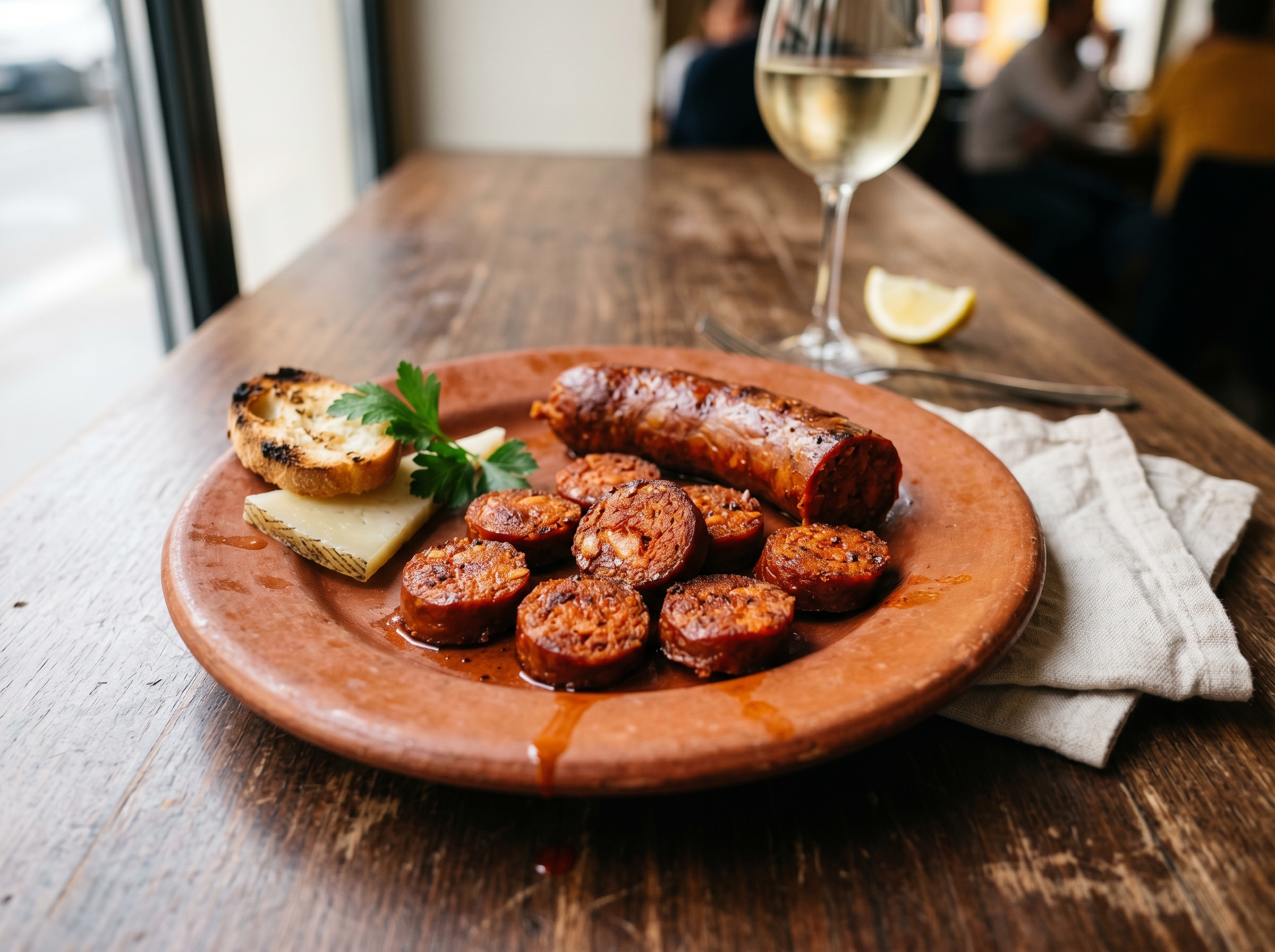
Three classic ways to serve. As a *tapa*: fanned out on a wooden board with crusty bread, a wedge of cured almond-tomato paste, and a glass of fino sherry or red Rioja. In rice: scattered over paella or stirred into the *sofrito* of a lentil stew. With eggs: pan-fried first to render the paprika oil, then scrambled tofu added to the same pan to soak up the color. The full log keeps for two weeks in the fridge, wrapped in fresh foil; freezes well for three months. Re-fry to serve.
The story
The first chorizo I ate that mattered was a coin of chorizo curado, sliced thin and laid across a crust of bread, at the bar of La Riuà in Valencia, in July 2018. I was working the paellera station that summer, learning to cook arroces under a head chef named Pep who had a tattoo of a socarrat layer on his forearm and a vocabulary of about forty words of French. The chorizo arrived between services, with a glass of Mahou and no ceremony. I asked Pep what gave it the red. He pointed at the jar of pimentón de la Vera on the shelf above the salt and said, eso. That. Then he went back to scrubbing the paellera.
I have since spent enough time in Spain to know that chorizo is the heavy hitter of the embutido category — the cured sausages that are eaten with bread and wine and nothing else, standing up, in places where standing up to eat is normal.
I have since spent enough time in Spain to know that chorizo is the heavy hitter of the embutido category. It comes in two main styles. Chorizo curado is the dry-cured, sliceable, deep-red kind you find hanging in delicatessens. Chorizo fresco is the fresh, soft version that gets cooked at the last moment — used in stews, fried with potatoes, crumbled into rice. The recipe below is closer to the curado style than the fresco, but it sits at an interesting halfway point: cured enough to slice and pan-fry, soft enough that you would not call it a true dry-cure.
The spice profile is what makes it chorizo. Smoked paprika is the spine. Fennel is the second beat. Garlic, cumin, oregano, clove — those round it out. Every chorizo in Spain, from the smallest village to the most expensive jamonería in Madrid, is built on a variation of this profile. The proportions shift, the curing time shifts, the meat shifts. The spices do not.
My version uses vital wheat gluten as the protein matrix. This is a controversial choice in some plant-based circles — there is a sub-community of cooks who consider seitan a kind of cheating, a too-direct attempt to imitate meat. I don’t agree. Seitan is a 2,000-year-old food invented in China and refined by Buddhist monastic kitchens for the same reason I’m using it here: it has the texture to carry assertive spice. The chorizo built around it does not taste like meat. It tastes like chorizo, which is a separate thing: a category defined by paprika and fennel and the heat of a pan, not by which animal provided the protein.
A few notes before you begin.
The cure is twenty-four hours. Not negotiable. I have tested twelve, eighteen, twenty-four, and forty-eight hours. Twelve is okay. Eighteen is good. Twenty-four is great. Forty-eight is no improvement over twenty-four. Plan accordingly — make this the day before you want to eat it.
The paprika has to be Spanish smoked paprika. Pimentón de la Vera, ideally — the kind smoked over oak. Hungarian sweet paprika is a different spice entirely; it has the sweet notes but not the smoke. American “smoked paprika” sold in supermarket spice aisles varies wildly in quality; the imported pimentón de la Vera dulce and picante are worth the extra few dollars.
The fennel must be toasted and ground fresh. Pre-ground fennel powder lost its essential oils six months before you bought it. Sixty seconds in a dry pan, then a quick grind. The difference is significant.
The kneading is exactly 90 seconds. Set a timer. Don’t go over. The texture goal is firm and toothsome — not bouncy or rubbery. Over-kneading is the most common chorizo failure.
The slice-and-pan-fry is the final move. You can eat seitan chorizo cold, like a tapa, sliced onto bread. But the dish was designed for the pan — the paprika oil releases into the cooking fat and that red-orange smear is the flavor delivery system. Pan-fry, always.
What the other recipes get wrong
Most plant-based chorizo recipes online — I checked the top ten in April 2026 — treat the cure as optional. “Eat immediately or refrigerate overnight for better flavor,” they say, as if those are roughly equivalent options. They are not. I tested cure times in my Washington kitchen in March 2026, with four identical logs steamed in the same batch, cured 12 / 24 / 48 hours, and pan-fried side-by-side on the same skillet. Here is what I found:
- 12 hours: spices still tasted like separate ingredients. The paprika hadn’t bloomed; the fennel sat on top. The slice held its shape but tasted like a seasoned seitan log, not a chorizo.
- 24 hours: the integration moment. Paprika, fennel, cumin, oregano, and clove fused into a single chorizo flavor. The texture firmed, the slice cut clean, the red color deepened by a full shade.
- 48 hours: indistinguishable from 24. No further improvement, no degradation. Diminishing returns set in hard at 24 hours.
- No cure (eaten straight from the steamer): a 60% chorizo. Edible, technically functional, but the flavors hadn’t married. The texture was spongier than it should have been because the residual steam moisture hadn’t redistributed.
The cure window that worked, every time: 24 hours minimum in the foil, in the coldest part of the fridge, before slicing. The cure is mechanical — it lets the spices migrate, the gluten relax, and the color set. Skip it and you have a 60% chorizo. Do it and you have the dish.
The line I draw
I will not skip the 24-hour cure. I will also not skip the pimentón de la Vera and pretend that grocery-store “smoked paprika” will do. The cure and the paprika are the two non-negotiables — everything else in the recipe is adjustable. Pimentón de la Vera is smoked over oak in Extremadura and tastes of woodsmoke and red pepper at the same time. American supermarket smoked paprika tastes of paprika and a faint memory of smoke. Hungarian paprika tastes of nothing but sweet pepper. If you cannot find Spanish smoked paprika in your city, mail order it. It costs nine dollars for a tin that lasts six months. Without it, this is not chorizo. It is a red seitan log.
When this can fail
Three ways, all from my own kitchen between 2022 and 2026:
- The over-kneaded dough. Got distracted by a phone call and kneaded for three minutes instead of ninety seconds. The seitan came out of the steamer firm, springy in a wrong way — closer to bubblegum than to charcuterie. The slice was bouncy, the pan-fry refused to crisp at the edges. Fix: ninety seconds, set a timer, stop when the alarm goes. The dough should be elastic and stringy, not tight.
- The boiled-not-steamed sausage. Steamer basket sat too low in the pot, water touched the foil-wrapped logs at the boil, water seeped in through the twisted ends. The chorizo came out spongy and waterlogged, the texture closer to a deli loaf than a sliceable cure. Fix: keep the foil logs above the waterline. A trivet under the steamer basket if needed. Gentle simmer, never a hard boil.
- The skillet too cold for the slice. Laid the coins into a barely-warm pan, the paprika oil never released into the fat, the slices steamed instead of crisped, no red smear in the pan. Fix: skillet on medium-high for two full minutes before the coins go in. The oil should shimmer. The first coin should sizzle the second it touches the surface.
What you have at the end is six servings of a flavor backbone you can deploy across a dozen dishes. Sliced on a tapa board. Crumbled into paella. Fanned across white-bean soup. Pan-fried first and then folded into scrambled tofu, in the same pan, so the eggs pick up the paprika oil. It is more useful than almost any other plant-based protein I keep in the fridge.
Make it on a Sunday. Eat it for the next ten days.
FAQ
QHow do you make vegan chorizo from scratch?
Build a seitan-based chorizo in three steps. First, blend white beans, tomato paste, garlic, soy sauce, vinegar, and olive oil into a smooth wet base. Second, whisk in a heavy load of Spanish smoked paprika (sweet and hot), toasted ground fennel, cumin, oregano, and clove — the spice profile is what makes chorizo recognizable. Third, knead in vital wheat gluten and chickpea flour for 90 seconds, form into logs, wrap in foil, steam for 45 minutes, and cure in the fridge for at least 24 hours. The cure is non-negotiable — it transforms the texture and integrates the flavors.
QWhat gives chorizo its red color?
Spanish smoked paprika — *pimentón de la Vera* — gives traditional chorizo both its red color and its signature smoky flavor. The paprika is fat-soluble, so when chorizo is pan-fried, the red pigment leaches into the oil, producing the bright red-orange smear in the pan that defines proper chorizo. Use Spanish smoked paprika specifically — Hungarian paprika is sweet but not smoked, and won't produce the same flavor. Buy *pimentón de la Vera dulce* (sweet) and *picante* (hot) and blend to taste.
QHow long does seitan chorizo last in the fridge?
Steamed and cured seitan chorizo holds for two weeks in the fridge, tightly wrapped in foil or in an airtight container. The cure improves through the first 4 to 5 days — flavor and texture continue to deepen — then plateaus. After two weeks the texture may start to dry out at the edges, in which case slice and pan-fry to refresh. Freezes well: wrap each log in plastic, then foil, and freeze for up to three months. Thaw overnight in the fridge before slicing.
QCan you make chorizo without vital wheat gluten?
Not really — the wheat gluten is what gives chorizo its meaty bite. Bean-based and tofu-based 'chorizos' exist (they're often labeled *soyrizo* in American grocery stores), but they have a crumbled, ground-meat-like texture rather than the firm sliceable structure of cured chorizo. If gluten is not an option, a crumbled tempeh chorizo with the same spice profile is the closest gluten-free analog — but the texture is fundamentally different.
QIs chorizo always vegan-able the same way?
Spanish chorizo (the cured, sliceable kind) is the version this recipe targets. Mexican chorizo is a different dish entirely — fresh, raw, loose-textured, cooked at the moment of use, with a different spice profile (more cumin, ancho chile, fewer fennel notes). For a Mexican chorizo, crumble cooked seitan or tempeh into a hot pan with a spice mix built around ancho chile powder, cumin, oregano, garlic, and apple cider vinegar — and cook until crispy. Different dish, different technique.