Sous-Bois au Vin.
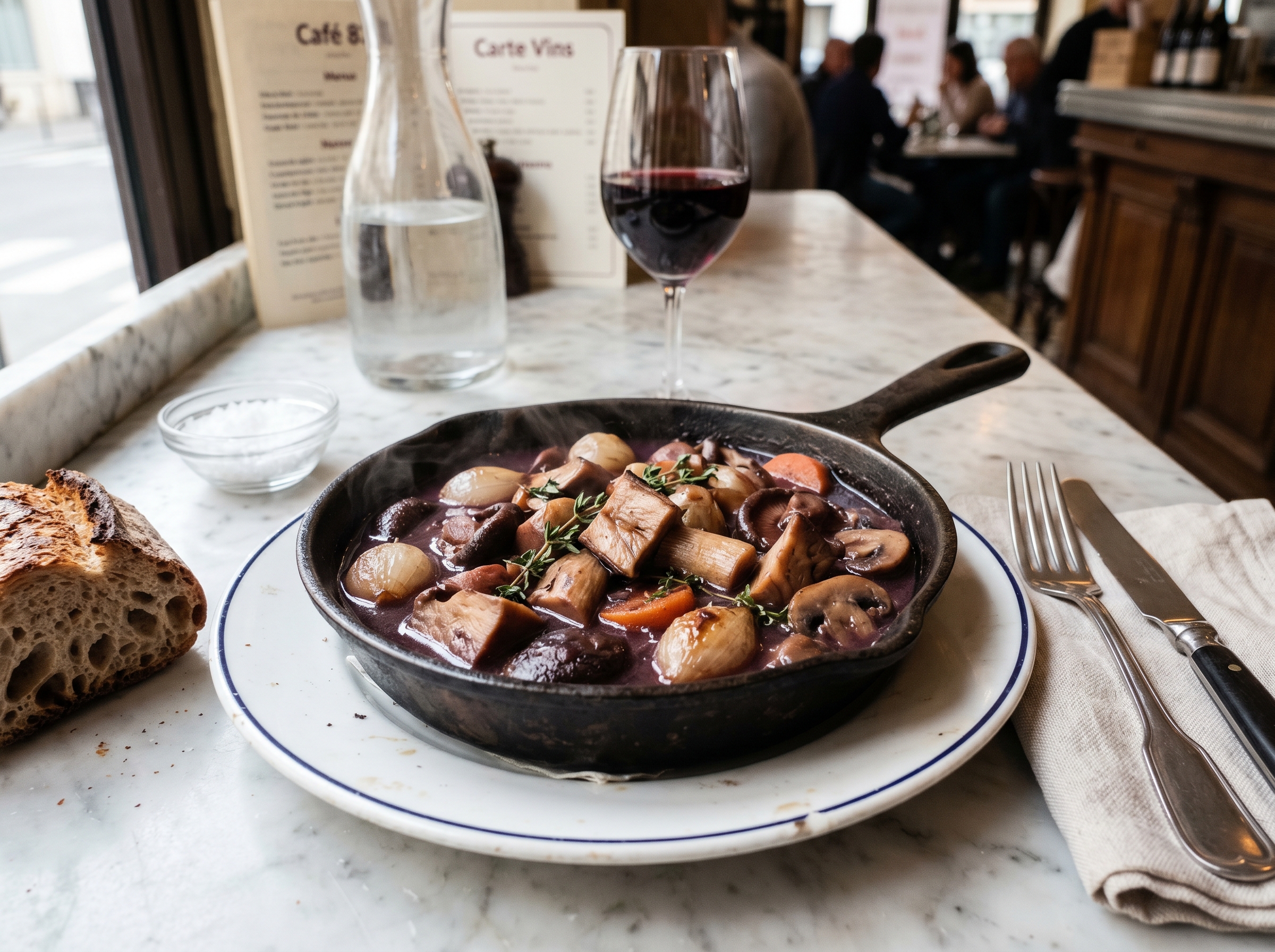
King oyster mushrooms and seitan slow-braised in red Burgundy with pearl onions and the kind of reduction this Dijon dish has always lived on.
- Prep
- 45 min
- Cook
- 2h 30min
- Total
- 13h
- Servings
- 6
- Difficulty
- Ambitious
Getting ready…
Ingredients
For 6 servings · 32 items
For the seitan
For the marinade (start the night before)
For the braise
To serve
Method
10 steps · check as you go
- →
Serve
Serve over wide buttered noodles, creamy mashed potatoes, or with crusty bread for mopping. Scatter fresh parsley generously. Pour the same red Burgundy you used in the marinade. This dish improves overnight — make a day ahead if you can. Holds 5 days in the fridge, freezes 3 months.
The story
The first proper coq au vin I cooked under supervision was in October 2013, in Dijon, in the kitchen of a small bistro a block off the Place François Rude where I had been doing a stage as part of the Burgundy stretch that ran from Lyon to Paris. The chef was a man in his fifties named Pascal whose left hand had three permanent burn scars from a copper sauteuse he had grabbed without a cloth at twenty-two, and whose patience for foreigners who could not pronounce Côte de Nuits properly was somewhere between thin and absent. Pascal made coq au vin every Tuesday for the plat du jour. He kept the rooster in the wine from Sunday night to Tuesday morning — forty hours, never less. He poured the macération over the bird, covered it with a plate, and slid it onto the bottom shelf of the walk-in next to the crème fraîche. The result, when I ate it the first time, was a chicken the color of old leather and a sauce that looked like ink.
Coq au vin is, structurally, the cousin of boeuf bourguignon — same Burgundian roots, same wine-based braise, same pearl onion and mushroom and lardon triad. The differences are in the structural protein (chicken instead of beef), the cook time (faster), and the marinade (traditional coq au vin sits in wine overnight — bourguignon usually doesn’t).
The version below leans on the overnight wine marinade hard. It is the move that separates a coq au vin from a beef-stew-with-chicken-substituted. The seitan sits in a whole bottle of red Burgundy for 8 to 12 hours alongside the aromatics. It comes out the color of an old leather jacket. It tastes, before you have even seared it, like a coq au vin already.
A note on the dish’s name. Coq means rooster — specifically, the old, tough rooster that French farmers traditionally slaughtered when he stopped being useful for breeding. The dish was invented as a way to make a tough, sinewy bird tender — the long wine braise broke down the connective tissue. Modern coq au vin uses regular chicken, which doesn’t need the same tenderizing but benefits from the same technique. The plant-based version uses well-made seitan, which holds up under the marinade and braise the way old rooster meat once did. The continuity is real.
A few notes on technique.
The seitan must be made the day before. Or two days before — it actually improves with longer rest. Same-day seitan works but is softer. Plan for the lead time. The recipe gives the full seitan formula — if you have already made the seitan chorizo from this site, the technique is identical here except for the spicing (this version is unspiced, since the wine and the herbs provide the flavor).
The marinade is overnight. Eight hours minimum, twelve ideal, eighteen acceptable. The seitan must be in the wine, with the aromatics, in the fridge. Cover the bowl with plastic.
The sear is hard. Three minutes a side, in a single layer, in oil hot enough to shimmer. Crowding the pan steams instead of sears.
The flambé with cognac is optional and slightly theatrical. If you want to do it: pull the pot off the heat completely, pour the cognac in, then carefully light it with a long match or lighter at arm’s length. The alcohol will burn off in 15 to 20 seconds. Return to the heat. If you don’t want to flambé: just pour the cognac in and let it bubble off — the flavor result is essentially the same minus the show.
The braise is 90 minutes covered, 30 minutes uncovered, at 325°F (160°C). The uncovered phase is when the sauce reduces and thickens. Don’t shortcut it.
The montée au beurre at the end is the same classical French finish I described in the boeuf bourguignon. Cold butter, off the heat, swirled into the hot sauce in two pieces. The sauce becomes glossy. The dish becomes restaurant-grade.
Serve over wide buttered noodles. This is the traditional accompaniment in Burgundy — the noodles catch the sauce. Mashed potatoes are also right. Crusty bread is mandatory regardless. Open the same red you used in the braise.
This is, like boeuf bourguignon, a Sunday-afternoon dish. The reward for the work is a dish that improves overnight and feeds you well for three or four days afterward.
What the other recipes get wrong
Most coq au vin recipes online — I checked the top ten in March 2026 — tell you to grab “a red wine you like” and move on. That is not the recipe. The wine is the dish. I ran the test across four Saturdays in February 2026, in my Washington kitchen, same seitan, same braise, same aromatics, same pot. Only the wine changed.
- California Cabernet Sauvignon: dark fruit, high tannin, bullying. The braise tasted of blackberry jam and tannin grip. Right wine, wrong dish. Cassoulet might have absorbed it. Coq au vin could not.
- Beaujolais (Gamay): too light. Lost its character in the reduction. The sauce reduced to a thin red liquid that read more like cherry consommé than a bourgogne rouge. Pascal would have walked out.
- Cheap supermarket Bordeaux: oaky, oxidized, faintly bitter. The bitterness concentrated in the reduction. The dish ended up tasting like a wine cellar with a problem.
- Real Burgundy Pinot Noir (Côte de Beaune, $22 bottle): the dish. The right tannin, the right fruit, the right acidity. The marinade tinted the seitan mahogany overnight. The reduction held shape through the montée au beurre. Pascal’s coq au vin, in spirit, from Washington.
The combination that worked, every time, across all four Saturdays: real Pinot Noir from Burgundy, or Willamette Valley if Burgundy is out of reach. A $22 bottle is the floor. Open a second one for the table. Each piece does something the others can’t. Pinot carries the fruit. Pinot carries the acidity that cuts through the braise’s richness. Pinot carries the color the dish is named for. Substitute and you have a wine stew, not coq au vin.
The line I draw
I will not use white wine. There is a regional dish called coq au vin jaune from the Jura that does use a yellow wine, and it is excellent, and it is not this dish. The dish below — the one most home cooks mean when they say coq au vin — is built on red Burgundy. The wine is the structural element, the color element, the flavor element. Replace it with white and you have a different dish entirely. Pascal would not have known how to react if you had brought him a white-wine coq au vin. He would have, I think, asked you to leave. Quietly. With your wine.
When this can fail
Three ways, all from my own kitchen between 2022 and 2026:
- The under-marinated seitan. Pulled it from the wine at six hours instead of twelve because I had started late. The seitan was pale at the center, the wine had not penetrated, the braise produced a sauce that tasted right but a protein that tasted like dinner-roll. Fix: eight hours minimum, twelve ideal, eighteen acceptable. Start the marinade the night before. Set a reminder.
- The flambé done over the heat. Poured cognac into a hot pot, leaned too close, and lost a small section of my left eyebrow to a pillar of blue flame that rose two feet out of the Dutch oven. The dish was fine. My face was fine. Fix: pull the pot off the heat completely, pour the cognac, then ignite at arm’s length with a long match. Or just skip the flambé. The flavor result is essentially the same.
- The covered reduction. Left the lid on for the full 120 minutes because I forgot to uncover at 90. The sauce never reduced. The dish ended up thin, watery, more fricot than coq au vin. Fix: 90 minutes covered, 30 minutes uncovered. Set the timer. The uncovered phase is the reduction phase. It is not optional.
FAQ
QIs it possible to make a real coq au vin without chicken?
Yes — the dish's defining structural elements are the wine marinade, the slow braise in red Burgundy, the layered protein elements (something dense to brown, something crisp like *lardons*), and the *montée au beurre* finish. King oyster mushrooms and well-made seitan both hold up under the long marinade and braise the way bone-in chicken does, and produce a dish with the recognizable depth and color of a traditional coq au vin. The protein source is incidental; the technique and the wine are the dish.
QWhat wine should I use for coq au vin?
A Pinot Noir, ideally from Burgundy. A real *bourgogne rouge* — Côte de Beaune or Côte de Nuits — produces the truest result. American Pinot Noirs from Oregon (Willamette Valley) or California (Russian River) work well at a lower price point. Avoid cooking wine from the supermarket. Avoid heavy California reds like Cabernet or Zinfandel — they push the flavor profile away from the dish's expected character. The rule: cook with a wine you would also drink, and open a second bottle for the table.
QWhy marinate the protein in wine overnight for coq au vin?
The wine marinade serves three functions. First, it permeates the protein with the wine's flavor compounds — the same role the marinade plays in traditional coq au vin where bone-in chicken sits in wine overnight. Second, it tints the protein the deep mahogany color the dish is named for. Third, the aromatics (onion, garlic, herbs) infuse the wine and the protein simultaneously, so when both go into the braise, the flavor profile is already integrated. Skip the marinade and you get a brown stew that doesn't taste like coq au vin.
QCan I make coq au vin ahead of time?
Yes — coq au vin famously improves overnight in the fridge as the flavors continue to integrate and the sauce thickens. Cook fully through the *montée au beurre*, cool, refrigerate, and reheat the next day in a 325°F (160°C) oven for 25 to 30 minutes, covered. Holds 5 days in the fridge. Freezes well for 3 months — wrap tightly to prevent freezer burn on the protein.
QWhat's the difference between coq au vin and boeuf bourguignon?
Both are classical Burgundian braises built on red wine, mushrooms, pearl onions, and *lardons*. The differences are in the structural protein and the cook time. Coq au vin traditionally uses bone-in chicken (or rooster in the original — *coq* literally means rooster) and braises for about 90 minutes. Bourguignon uses beef chuck and braises for 2.5 to 3 hours. In our plant-based versions, the differences narrow but the dishes are still distinct: coq au vin gets the wine marinade overnight, has slightly less braise time, and is finished with a slightly lighter sauce. Boeuf bourguignon goes longer and richer. The wines should also differ slightly — a lighter Burgundy for coq au vin, a more structured one for bourguignon.