The bread that balloons.
Chole Bhature.
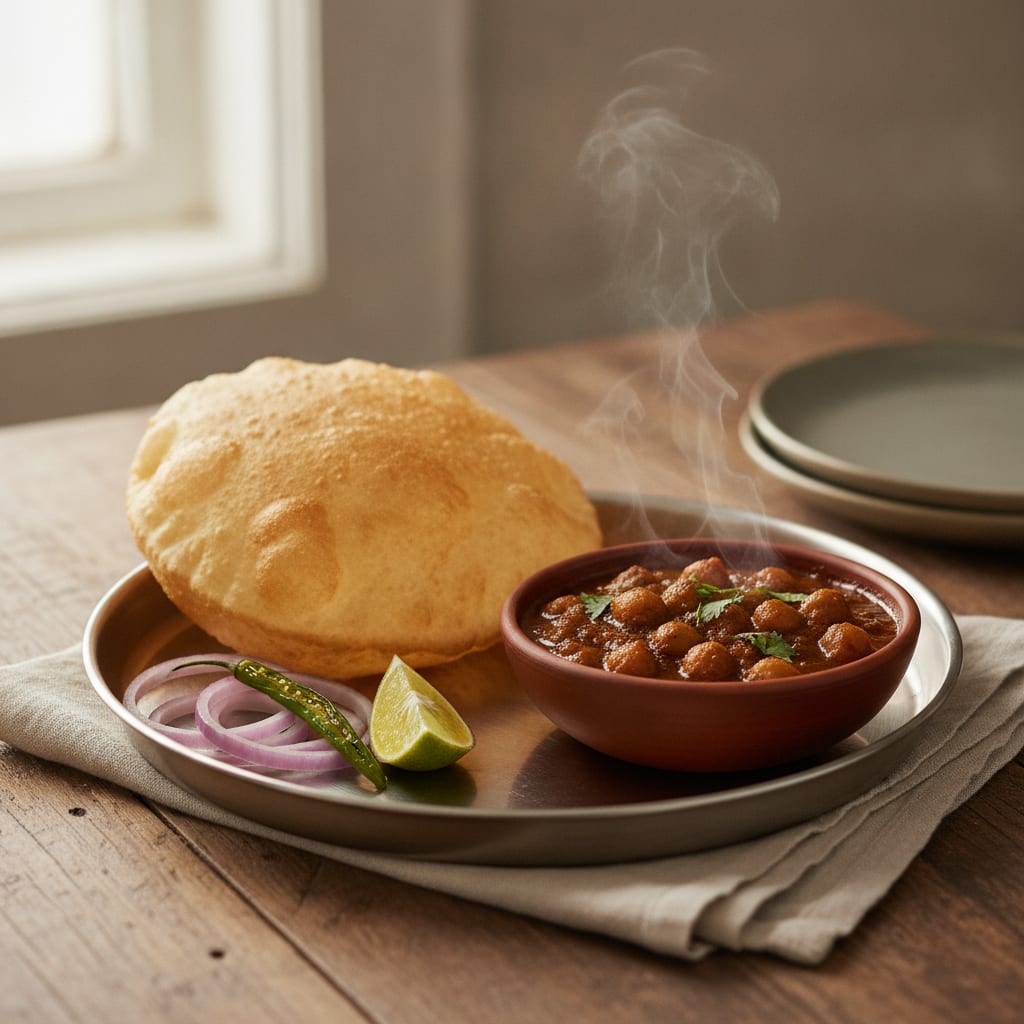
Punjabi tea-darkened chickpeas under a fried yogurt-leavened bhatura that balloons in the oil. The Delhi breakfast plate, two ways, no animal anywhere.
- Prep
- 30 min
- Cook
- 1h
- Total
- 1h 30min
- Servings
- 4
- Difficulty
- Medium
Getting ready…
Ingredients
For 4 servings · 21 items
For the chole
For the bhature
To serve
Method
6 steps · check as you go
- →
Serve
Serve the bhature hot and just-fried — they deflate as they cool — with the dark chole in a small bowl, raw onion rings, a slit green chilli, lime wedges, and a sharp mango or lime pickle. Tear the bread, scoop the chole. In Delhi this is breakfast; I eat it any hour I can get away with.
The story
Chole bhature is a Delhi breakfast that has no business being breakfast: a bowl of dark, glossy spiced chickpeas next to a fried bread the size of a hubcap, eaten before nine in the morning and defended like a birthright. The dish is Punjabi by root — most food writers trace the chole to pre-Partition Punjab and the pindi chole of Rawalpindi — and it crossed into Delhi with the refugees of 1947. One of the names that comes up again and again is Sita Ram, who set up what became Sita Ram Diwan Chand in Paharganj; the shop is still there, still serving the plate that helped define it.
I did not eat it in Delhi. I ate it in a strip-mall Punjabi place off a parking lot in Washington in 2025, on a grey January morning, from a cook behind the counter whose name I never got — she slid the thali across without a word, the bhatura still domed and shivering, and tapped the side of the chole bowl twice like eat it now, while the bread is alive. I did. The bread collapsed under my hand the way it is supposed to. That was the lesson: the bhatura is a clock.
This chole bhature has no dairy and no animal in it, and almost nothing had to move. The chole was already chickpeas and spice. The only dairy was the yogurt that leavens the bread — and a tangy soy or cashew yogurt reacts with the soda exactly the same way, throwing off the gas that makes the dome. It is not a “vegan chole bhature.” It is chole bhature, made with what is in my hands.
À la maison
The weeknight reading is the recipe above, and it asks two things of you in sequence: start the dough first so it has its long warm rest, and respect the tea. The tea is the trick most home recipes leave out — two bags simmered with the chickpeas stain them mahogany and add the bittersweet edge that reads as restaurant chole. Everything else is patience at two points: brown the onions past where you want to stop, and bhuno the masala until the oil beads out. Fry the bhature last, to order, and carry them to the table the moment they puff.
Au bistrot
The bistronomique reading keeps the same two elements and composes them, smaller and sharper, as a plated course.
Cook the chole down further, until it is almost a thick, glossy ragù you could quenelle, and brighten a spoonful of it at the last second with extra amchur and a little reserved tea liquid for sheen. Fry the bhature small — palm-sized rounds that puff into taut little pillows — and split one to show the steam pocket. Build the plate around contrast: a neat quenelle of the dark chole off-centre, the small puffed bhatura leaning against it, a fine julienne of raw red onion soaked in lime and a pinch of sugar so it goes pink and loses its rasp, a single slit green chilli, and a few jewels of pomegranate for the tartness amchur points at. Finish with a thread of coriander oil round the chole and a dusting of chaat masala over the bread. It is the same breakfast plate, read at a tasting-menu altitude — the bread still a clock, just a smaller one.
Le dressage — Overhead, tight. Dark slate or matte black plate, the chole quenelle catching one highlight, the small bhatura puffed and split to show steam, pink lime-onion in a loose nest, pomegranate scattered odd-numbered. A thread of green coriander oil. The plate should say a street breakfast, held still for one frame — heat and gloss against negative space.
What the other recipes get wrong
Most chole recipes online — I read the top ten in February 2026 — get the colour wrong, and they get it wrong by reaching for the wrong tool. Some leave the chickpeas pale and call it rustic; some lean on a spoon of dark gravy-browning or burnt sugar; a few use baking soda in the boil and overshoot into grey. I ran the test over a week in February 2026, four pots of chole, same masala, same beans, only the colour-and-body method changed:
- No colour treatment: pale, sweet, thin. Tasted of chickpeas in tomato gravy, not chole. No depth.
- Gravy browning / caramel: dark, yes, but with a flat scorched-sugar note that sat on top and never integrated.
- Baking soda in the boil: dark-ish and very soft, but the beans went mushy-skinned and the gravy turned faintly soapy and slick.
- Black tea in the boil + deeply browned onion + full bhuno: deep mahogany, glossy, with a faint bittersweet tannic tightness on the finish and real body from the onions. Not close. A different dish.
The reason is chemistry, not preference. Black tea is loaded with tannins (polyphenols) that bind to the chickpeas and stain them brown while adding a clean astringent edge — the same edge that keeps the dish from cloying. The deeply browned onions contribute melanoidins and dissolved body; the bhuno — frying the masala until the oil splits — drives off raw volatiles and concentrates the tomato. Gravy browning gives you colour with none of that structure; soda gives you colour by degrading the bean skins and shifting the pH alkaline, which is exactly why it goes soapy. Tea, onion, bhuno: every batch, the same deep, integrated dark.
The line I draw
I will not fry the bhature ahead of the meal to “get them out of the way.” The bhatura is a clock. It is at its best in the first two or three minutes, domed and shivering, the steam pocket still inflated; after ten minutes it has deflated into a chewy fried flatbread that is fine and is not the dish. The whole point of the bread is the moment it balloons and the moment you tear it while it is still alive. If I have to choose between a tidy kitchen and a bhatura that reaches the table puffed, the kitchen loses. Fry to order or don’t fry at all.
When this can fail
Three ways, all from my own kitchen between 2022 and 2026:
- The flat bhatura. Rushed the dough — barely an hour’s rest, in a cold kitchen — and the breads fried flat and dense, no dome at all. There was no gas built up to inflate. Fix: tangy live yogurt, a full two-hour-plus rest somewhere warm, and oil at a true 190°C; press gently under the oil to start the puff.
- The pale, thin chole. Skipped the tea and stopped the onions at translucent because I was hungry. The result tasted like chickpeas in tomato sauce, sweet and bodiless. Fix: simmer with black tea, brown the onions to deep gold, and bhuno the masala until the oil beads out.
- The soapy, grey chole. Tried baking soda in the boil to soften old chickpeas faster. They went mushy and the gravy turned slick and faintly soapy from the alkaline shift. Fix: soak the chickpeas properly overnight and simmer them long; let tea, not soda, do the colour.
FAQ
QCan you make chole bhature without dairy?
Yes, and nothing essential changes. The chole is naturally dairy-free — it is chickpeas, onion, tomato, and spice. The only dairy in a classic bhatura is the yogurt that leavens the dough, and unsweetened soy or cashew yogurt does the same job: its lactic acid reacts with the baking soda to produce the carbon dioxide that makes the bread puff. Use a live, genuinely tangy yogurt, give the dough a long warm rest, and the bhatura balloons exactly as it should.
QWhy are restaurant chole so dark?
Two reasons, and tea is the honest one. Many Delhi cooks simmer the chickpeas with black tea bags or a muslin of loose tea; the tannins stain the beans a deep mahogany and add a faint bittersweet tightness. Some also use dried amla or a long-browned onion base for colour. The darkness is not gravy browning agent — it is tea, deeply browned onions, and a proper bhuno of the masala until the oil separates.
QWhy won't my bhature puff up?
Almost always the dough or the oil. The dough needs a tangy yogurt-and-soda leavening and a long warm rest of at least two hours so gas builds inside a relaxed gluten net. The oil needs to be properly hot — around 190°C / 375°F — so the surface moisture flashes to steam and inflates the sealed pocket before it can leak. Roll evenly with no thin spots, and press the bread gently under the oil for the first few seconds to start the balloon.
QWhat is the difference between bhatura and puri?
Both are deep-fried Indian breads that puff, but a puri is small, made from whole-wheat atta, and unleavened — it puffs purely from steam. A bhatura is larger, made from maida (refined flour) with semolina for chew, and leavened with yogurt and baking soda (or yeast), which gives it a soft, slightly tangy, bread-like interior rather than the crisp shell of a puri.
QCan I make the chole ahead?
The chole is better the next day — the spices settle and the gravy deepens, and the tea colour holds. Make it up to three days ahead and reheat with a splash of water to loosen. The bhatura dough can rest in the fridge overnight; bring it back to room temperature before rolling. Fry the bhature only to order, though — they are at their best in the first few minutes and deflate as they cool.