No cream. It never had cream..
Carbonara.
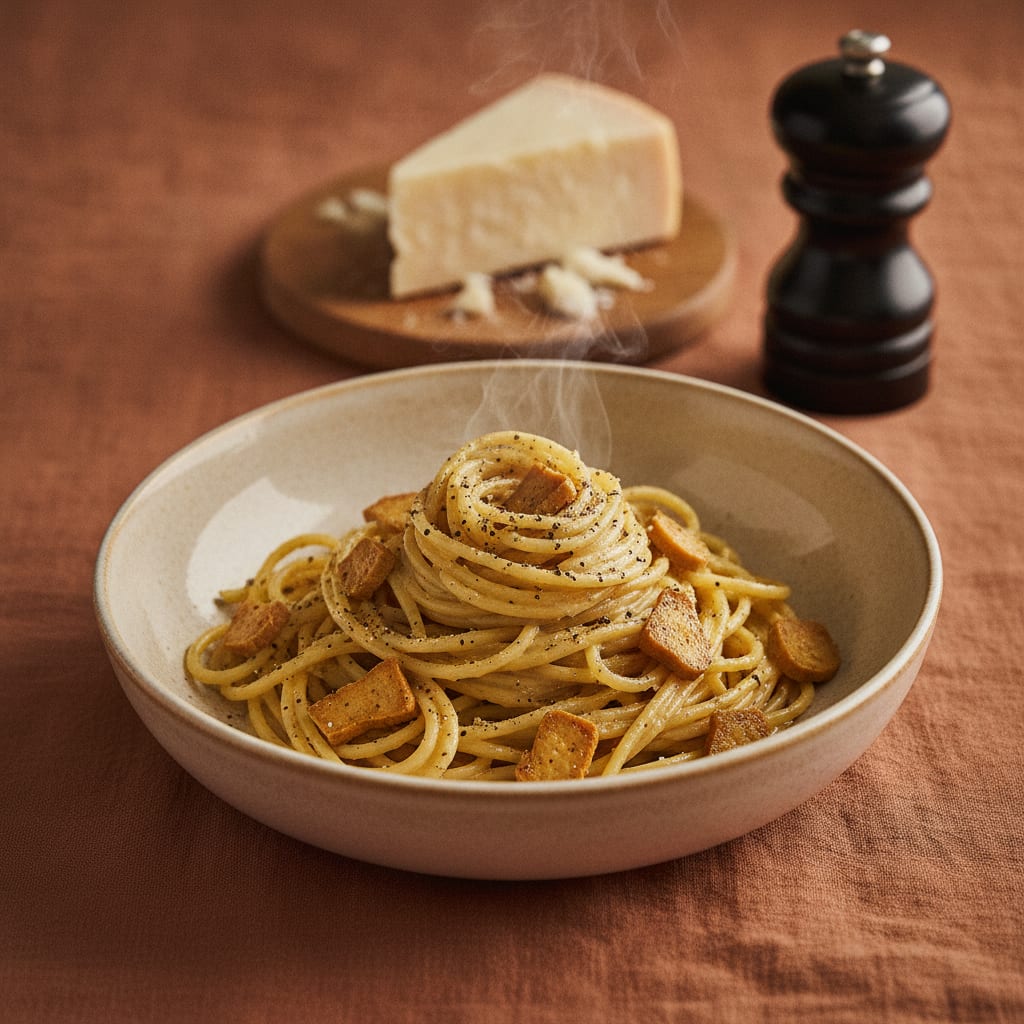
The Roman dish, two ways: a silken-tofu and chickpea-flour custard for the egg emulsion, smoked-tofu guanciale, pecorino-cashew. No cream, ever.
- Prep
- 15 min
- Cook
- 20 min
- Total
- 35 min
- Servings
- 4
- Difficulty
- Medium
Getting ready…
Ingredients
For 4 servings · 15 items
For the custard
For the guanciale
For the pasta
Method
6 steps · check as you go
- →
Serve
Serve in warm shallow bowls the instant it is glossy, each portion twirled into a nest so the sauce clings high rather than pooling. Finish with cracked black pepper and a snow of cashew pecorino at the table. A crisp Frascati or any sharp white cuts the richness the way it should.
The story
Carbonara is younger than almost anyone wants it to be. There is no trace of it in Italian cooking before the middle of the twentieth century — Ada Boni’s La Cucina Romana of 1930, the canonical record of Roman home cooking, has no carbonara in it at all. The most credible origin puts it in 1944, in the months after the Allies reached central Italy, when American rations brought bacon, cheese, and powdered egg into a hungry country and Italian cooks did what Italian cooks do. A Bolognese cook named Renato Gualandi later claimed he assembled the first one in Riccione that September, feeding British and American officers from what the army quartermaster had: good bacon, powdered egg yolk, some cheese. Whatever the precise truth, the dish is a postwar dish. It is barely older than the supermarket.
I learned to make it properly far from Rome, in Naples, in the spring of 2015, in the back kitchen of a trattoria called Da Concettina where I spent two years with my hands in other people’s pasta. The cook who ran the line there — a Roman who had married a Neapolitan and never let anyone forget the first part — made it for staff meal one slow afternoon and stood over my shoulder swearing when I reached to crack the egg into a pan that was still on the flame. “Spegni il fuoco,” she said. Kill the fire. She took the pan off the heat with her bare hand on the cold part of the handle and showed me how the sauce comes together in the residual warmth, never the direct heat. I have cooked it that way ever since.
This carbonara has no egg and no cream — and it never needed the cream anyway, because carbonara never had any. It has a custard blended from silken tofu and toasted chickpea flour, smoked tofu crisped into guanciale, cashew pecorino, and a half-teaspoon of black salt that does the egg-yolk smell better than you would believe. The method is exactly the Roman method: undercook the pasta, build the emulsion off the heat, toss with starchy water until it gleams. It is not a “vegan version” of carbonara. It is carbonara, made off the heat, the only way it was ever any good.
À la maison
The weeknight reading is the recipe above, and the single thing it asks of you is to respect the heat. Blend the custard cold and smooth so it pours like loose cream. Crisp the smoked tofu hard. Then — this is the whole game — take the pan off the flame before the sauce ever touches it, and finish the toss over the barest warmth with splashes of starchy pasta water until it turns glossy. If your sauce is grainy, it was too hot. If it is pasty, you needed more pasta water. Warm bowls, cracked pepper, eat it the second it gleams.
Au bistrot
The bistronomique reading is the same dish composed instead of tossed, with the custard treated as the sauce it actually is.
Push the emulsion first: blend the silken-tofu and chickpea-flour custard a little looser, pass it through a fine sieve so it is flawless, and warm it in a bain-marie held under 70°C — whisking — until it thickens to a pourable sabayon that just coats a spoon. Hold it there; do not let it climb. Take the smoked-tofu guanciale further too: cut it into clean batons, lacquer them with the soy-and-maple glaze, and crisp them so they shatter. Cook the pasta — here use a bronze-die tonnarelli or a single fat rigatoni — and roll it, sauced, into a tight nest with a carving fork and a ladle, the way you would plate a timballo portion. Stand the nest in a warm shallow bowl. Spoon the warm sabayon around and over it so it pools like a sauce nappe, lay three crisp guanciale batons across the top, and finish with a fine microplane of cashew pecorino and a deliberate grind of black pepper from height so it falls evenly. A single fried sage leaf or a streak of pepper oil if you want the plate to speak.
Il piatto — Three-quarter, close, shallow depth of field. Warm ivory bowl, the pasta nest centred and high, the pale-gold sabayon pooled around its base catching the light. Crisp batons in odd numbers, pepper falling. Negative space and steam. The plate should say silk and salt, restraint at a white tablecloth — not a heaped weeknight bowl.
What the other recipes get wrong
Most plant carbonara recipes online — I read the top ten in February 2026 — reach for cashew cream or coconut cream and a squirt of mustard, and call the result carbonara. It is not. It is pasta in a creamy sauce, and it tastes of cashew or coconut, never of egg. I ran the test over a week in February 2026, four sauces, same guanciale, same pasta, same off-heat finish, only the emulsion base changed:
- Cashew cream only: rich but flat and sweet, with a cashew flavour that sat on top of everything and read as alfredo, not carbonara. No yolk depth, no set.
- Coconut cream: worse — the coconut perfume fought the smoke and pepper, and it never lost a faint dessert sweetness.
- Silken tofu only: clean and neutral but loose; it slid off the pasta and pooled in the bottom of the bowl. No body.
- Silken tofu + toasted chickpea flour + kala namak: it set, it clung, it smelled like egg. Not close. A different category of sauce.
The reason is protein chemistry, not preference. Egg yolk thickens a custard because its proteins denature and build a water-trapping network — and they do it in a window, coagulating around 65–70°C and curdling above roughly 88°C. Chickpea flour gels by the same logic: its globulin proteins denature and set on heating, which is why a toasted-chickpea custard thickens and holds where plain cashew cream just stays creamy. The kala namak supplies the missing piece the cream versions can never fake — its sulphur compounds are the same family that gives a real yolk its smell, which is why it has to go in off the heat, before the aroma cooks away. Silken tofu carries the fat-like richness; the chickpea flour does the yolk’s structural job; the black salt does the yolk’s smell. Drop any one and you are back to creamy pasta.
The line I draw
I will not put cream in a carbonara, and I will not build the sauce on a hot pan. These are the same rule twice. Cream is what people add when their emulsion has already broken — it is a confession dressed up as an ingredient. And the emulsion breaks because the pan was on the flame when the sauce went in. Carbonara is silk built from heat control: an emulsion that comes together in residual warmth, off the fire, tossed with starchy water until it coats. The moment you cook it hard, the proteins seize and weep and you reach for cream to hide the grain. Take the pan off the heat. Trust the residual warmth. The Roman cook at Da Concettina took it off with her bare hand on the cold handle, and she was right.
When this can fail
Three ways, all from my own kitchen between 2022 and 2026:
- The scrambled sauce. Left the pan on the flame to “help it thicken,” and the custard seized into pale curds clinging to the spaghetti. There is no whisking it smooth again. Fix: pan off the heat before the sauce goes in, finish over the barest warmth, and keep it moving.
- The pasty, claggy bowl. Drained the pasta dry, forgot to save the water, and the sauce gripped into a stiff paste within a minute. Fix: pull the pasta a minute short, reserve a full mug of its starchy water, and loosen the sauce with splashes of it as you toss.
- The eggless smell. Stirred the kala namak in early, over heat, and by serving the egg aroma had cooked clean away — it tasted savoury but anonymous. Fix: whisk the black salt in off the heat, at the very end, so its sulphur note survives to the plate.
FAQ
QCan you make carbonara without eggs?
Yes — and the result is genuinely carbonara, because carbonara's identity is the silken emulsion and the salty-fatty guanciale, not the egg itself. Blend silken tofu with toasted chickpea flour, nutritional yeast, and grated cashew pecorino into a smooth custard. The chickpea flour's globulin proteins set the sauce the way egg yolk proteins do, while silken tofu carries the richness. A half-teaspoon of kala namak (black salt), added off the heat, supplies the sulphurous egg-yolk aroma. Finished off the heat with starchy pasta water, it turns glossy and clings to every strand.
QDoes real carbonara have cream?
No. Real carbonara has never had cream — the silk comes from an emulsion of egg, rendered guanciale fat, pecorino, and starchy pasta water, beaten together off the heat. Cream is a shortcut that papers over a broken technique. This version holds the same line: no cream. The body comes from silken tofu and chickpea-flour custard emulsified with the pasta water, which is exactly how the original earns its gloss.
QHow do you stop carbonara sauce from splitting?
Take the pan off the heat before the sauce goes in, and finish over the lowest possible heat. Egg yolks curdle around 65–70°C and a custard mixture splits above about 88°C; the plant version behaves the same way, since chickpea-flour proteins seize if overheated. Off the heat, with a splash of starchy pasta water and constant tossing, the proteins thicken into a smooth emulsion instead of scrambling. Motion plus gentle warmth is the whole secret.
QWhat can I use instead of guanciale in carbonara?
Smoked tofu pressed firm and cut into short lardons, fried in olive oil until crisp at the edges, with a little diced king oyster mushroom alongside for chew. A teaspoon of soy and a half-teaspoon of maple at the end stand in for the cure's salt and faint sweetness. Guanciale brings crunch, salt, smoke, and rendered fat; this brings all four, and the rendered oil in the pan goes on to flavour the sauce exactly as guanciale fat would.
QWhy is my carbonara grainy or pasty?
Two usual causes. Grainy means the sauce got too hot and the proteins curdled — work off the heat next time. Pasty means not enough starchy pasta water, or the pasta was fully cooked before it hit the sauce. Pull the pasta a minute short of al dente, reserve a full mug of its water, and loosen the sauce with splashes of it while you toss, until it coats the strands and pools nowhere.