The thing that is stirred.
Brandade.
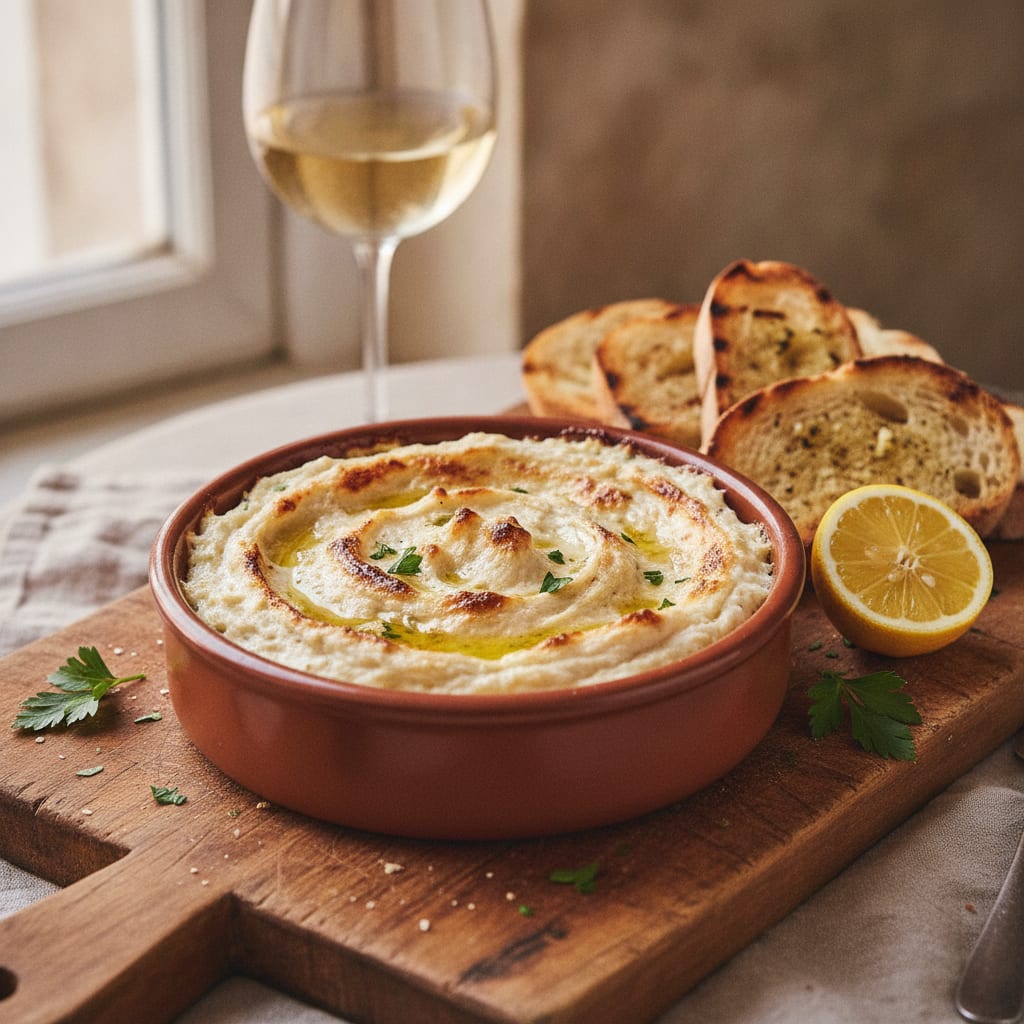
Nîmes' stirred emulsion, two ways: white beans and hearts of palm whipped with warm olive oil, kombu and nori for the sea, on grilled toast.
- Prep
- 25 min
- Cook
- 20 min
- Total
- 45 min
- Servings
- 6
- Difficulty
- Medium
Getting ready…
Ingredients
For 6 servings · 15 items
For the sea infusion
For the brandade
To serve
Method
6 steps · check as you go
- →
Serve
Serve hot from the gratin dish with grilled garlic-rubbed toast, lemon wedges, and a glass of cold white — a Picpoul de Pinet from the Languedoc is the regional pour. Scoop the warm, fluffy brandade onto the toast at the table. Leftovers can be spread cold or re-grilled; it also makes the filling for brandade-stuffed peppers or croquettes.
The story
Brandade is an argument about potato that most of the world has already lost. The dish is from Nîmes, in the Languedoc — by tradition codified at the end of the 18th century, with the recipe published in 1830 by the cook Charles Durand, called the Carême of Provençal cooking — and the real Nîmoise version contains no potato at all. It is an emulsion: salt cod and warm olive oil and a little garlic or milk, beaten and beaten until it mounts into a pale, fluffy cloud. The name says exactly that. Brandade comes from the Provençal brandar, to stir — brandado, “the thing that is stirred.” The potato version, the one you mostly meet, is a thriftier 19th-century descendant. Nîmes considers it a different dish.
I learned how wrong the potato can be the slow way, by making it badly. This was the winter of 2025, in Washington, the grey kind of January afternoon that wants something rich on toast, and my first attempts at a bean brandade were heavy, dense, and gluey — paste, not a cloud. A friend named Marc, who grew up near Montpellier, tasted one and said, kindly, “C’est pas fouetté.” It isn’t whipped. The fix was not more ingredients; it was warm oil, streamed slow, beaten until the whole thing lightened and grew. The emulsion was the dish. I had been making a dip.
This brandade has no cod. The body is white beans and hearts of palm — the beans whip creamy, the palm shreds into soft fibres that flake exactly like cod — with a steeped kombu-and-nori infusion for the sea. The method is the original: warm everything, whip the warm olive oil in slowly until it mounts pale and fluffy, fold the flakes back through, gratiné the top, eat it on garlic-rubbed toast. And no potato. It is not a “vegetable brandade.” It is brandade de Nîmes, stirred the way Nîmes stirs it, with the cod swapped and the rule kept.
À la maison
The weeknight reading is the recipe above, and the whole game is the emulsion. Warm your beans, warm your oil, warm the splash of soy milk, and stream the oil in slowly with the machine running until the mixture turns pale and fluffy and mounts — that lightness is the difference between brandade and bean dip. Steep the kombu and nori for the sea note instead of reaching for anything fishy. Keep some of the hearts-of-palm flakes back to fold in by hand so it has texture, not just smoothness. And do not add potato — the no-potato Nîmoise version is lighter and truer. Grill the top, rub the toast with garlic, and serve it hot.
Au bistrot
The bistronomique reading keeps the emulsion and frames it as a plated starter. Pipe the brandade, looser and silkier, into a quenelle or a neat low swoosh rather than a rustic gratin dish, and torch just the surface so it carries a thin gilded skin over a warm, fluffy centre. Underneath, lay a fine line of confit garlic and a brushstroke of a bright sauce vierge — diced tomato, olive, caper, basil, and good oil warmed together — for the Mediterranean lift the lemon hints at. Crisp a few hearts-of-palm flakes in olive oil until golden and shatter-light, and scatter them over for the texture of fried cod skin. Add a single croûton of grilled garlic toast cut to a precise soldier, a few fried capers, a dusting of nori powder for the sea, and a thread of basil oil. Finish with grated lemon zest. Same emulsion, same flavours, read as a composed course.
Le dressage — Three-quarter, slightly above. Pale matte plate, a single torched quenelle off-centre, sauce vierge dotted, a soldier of toast leaning, crisped palm flakes and nori dust scattered. Negative space, warm low light, a glass of Picpoul soft behind. The plate should say Languedoc, refined — an emulsion, not a dip.
What the other recipes get wrong
Most vegan brandade recipes online — I read the top ten in January 2026 — start with mashed potato, which makes them a smooth, heavy purée that misses the whole point: brandade is whipped, light, and flaky, and the Nîmoise original has no potato at all. So I made the body and the technique the variable. I ran the test over a week in January 2026, four batches, identical sea infusion and seasoning, only the base and the method changed:
- Mashed potato base, oil stirred in cold: dense, gluey, and flat — a thick parmentier that sat on the toast like wallpaper paste. No flake, no lightness, no lift.
- White beans only, blitzed smooth: creamier, but a homogeneous purée with no texture; it read as a bean dip, not a brandade. The flake was missing.
- White beans + hearts of palm, oil stirred in cold and fast: right ingredients, broken emulsion — the oil pooled out greasy and the texture was loose and split.
- White beans + hearts of palm, warm oil streamed in slowly, flakes folded in by hand: pale, fluffy, mounting, with soft cod-like flakes running through it. This was unmistakably brandade.
The reason is two things at once: texture and emulsion. Hearts of palm are built of long, soft fibres that pull apart into flakes nearly identical to flaked salt cod, so folding them through gives the dish its defining flake — something neither potato nor blitzed beans can do. And the lightness is an oil-in-water emulsion: when warm oil is streamed slowly into a warm bean-and-garlic base, the fat breaks into fine droplets suspended through the purée, and the whole mass lightens and mounts, exactly as it does when oil is beaten into warm cod. Pour the oil cold or fast and the emulsion never forms — the fat coalesces and weeps out greasy. Across all four batches, only the warm-oil, hand-flaked version was both light and flaky, which is the entire identity of brandade and the reason Nîmes leaves the potato out.
The line I draw
I will not put potato in a brandade, and I will not stop whipping before it mounts. The dish is named for the stirring — brandado, the thing that is stirred — and its soul is a pale, fluffy emulsion, not a smooth heavy purée. The moment you bulk it out with mashed potato you have made a parmentier and borrowed a famous name; it goes dense and gluey and loses the lightness that makes Nîmes proud of it. And if you stir cold oil in fast to save a minute, the emulsion breaks and you get a greasy, separated paste. Warm oil, streamed slow, beaten until it lightens, no potato. That is the whole of it, and Nîmes would not bend on any part.
When this can fail
Three ways, all from my own kitchen between 2022 and 2026:
- The broken emulsion. Streamed cold oil into the base too fast to hurry it; the fat pooled out and the brandade went greasy and split. Fix: warm the oil, the base, and the soy milk, and stream the oil in slowly with the machine running until it mounts pale and fluffy.
- The gluey paste. Reached for mashed potato to thicken it once, and it set into dense wallpaper glue. Fix: skip the potato entirely — use white beans for the body and hearts of palm for the flake, the true Nîmoise way.
- The over-salted batch. Salted to taste before remembering the kombu and nori had already brought plenty of saline; it came out punishingly salty. Fix: season last, taste first, and let the seaweed do most of the salting — add fine salt only at the very end if it needs it.
FAQ
QDoes real brandade de Nîmes have potato in it?
No — and this is the purist distinction. True brandade de Nîmes is an emulsion of salt cod, olive oil, and a little warm milk or garlic, whipped pale and fluffy, with no potato at all. The potato version is a later, more economical adaptation that spread in the 19th century and is common in Paris as a kind of gratin parmentier. The Nîmoise original is all about the emulsion. This version keeps that no-potato rule: the body comes from white beans and hearts of palm, whipped with warm olive oil.
QWhat does brandade mean?
Brandade comes from the Provençal verb brandar, 'to stir' or 'to shake' — brandado means 'the thing that is stirred.' The name describes the technique: warm olive oil is beaten into the warm base until it emulsifies into a pale, fluffy, mounting purée. That stirring, that emulsion, is what makes a brandade a brandade rather than a paste — which is why streaming the warm oil in slowly matters so much here.
QHow do you make brandade without salt cod?
Build the body from white beans, which whip into a creamy emulsion, and hearts of palm, which shred into soft fibres that read exactly like flaked cod. A little artichoke adds another tender flake. For the sea, steep kombu and toasted nori in warm water and blend that infusion in — kombu gives clean glutamate and nori the iodine, sea-salt note that salt cod carries. Whip warm olive oil and a splash of soy milk into the warm base, fold the flakes back in, and grill the top. It reads as brandade because it's built and stirred like one.
QWhy must the oil be warm when you make brandade?
Because brandade is an emulsion, and emulsions are easier to build and more stable when everything is at the same warm temperature. Warm components — base, oil, and the splash of milk — accept each other and mount into a light, fluffy texture, exactly as warm flaked cod does in the original. Cold oil streamed into a warm base, or oil poured in too fast, breaks the emulsion into a greasy, separated mess. Warm everything, and stream the oil slowly.
QCan I make brandade ahead?
Yes. The emulsion holds 3 days in the fridge; it firms when cold, so let it come to room temperature and beat in a little warm olive oil or soy milk to loosen it back to a fluffy spoonable texture before grilling. Assemble it in the gratin dish ahead and grill the top fresh just before serving so the ridges are hot and golden. Cold leftovers also spread well on toast or roll into croquettes.