Wellington Forestière.
A Wellington built on a king oyster mushroom log, a deeply savory duxelles, and buttery puff pastry that shatters when cut. Forestière, the Escoffier way.
- Prep
- 1h 30min
- Cook
- 45 min
- Total
- 3h 15min
- Servings
- 6
- Difficulty
- Ambitious
Getting ready…
Ingredients
For 6 servings · 28 items
For the king oyster center
For the duxelles
For the spinach-mustard layer
For the pastry
Crucial
Method
8 steps · check as you go
- →
Serve
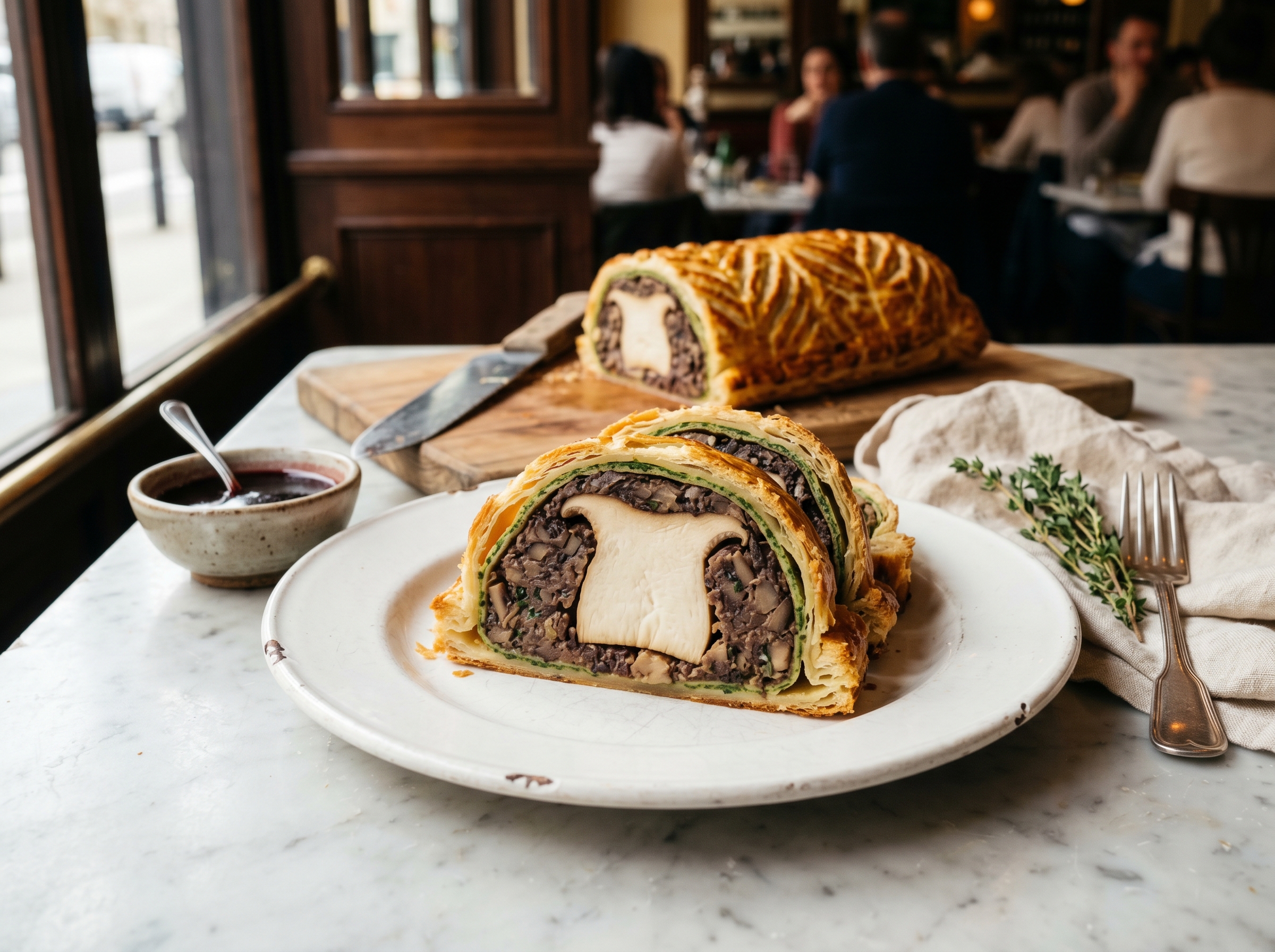
Slice into 2 cm thick rounds with a serrated knife — saw gently, don't press. Each slice should show the distinct layers: golden pastry, the green spinach-mustard, the dark mushroom duxelles, and the pale amber center. Serve with creamy mashed potatoes, a red wine reduction sauce, and roasted Brussels sprouts or glazed root vegetables. A glass of red Burgundy or a structured Cabernet pairs beautifully. This is a holiday-table centerpiece — Thanksgiving, Christmas, an anniversary dinner. Make it once and you'll know when to make it again.
The story
Beef Wellington is the show-off dish. The one a host makes when they want to be seen putting in the work — a thing you bring to the table whole, on a wooden board, and slice in front of the guests, who then watch the cross-section of the cut reveal the four layers of construction. Golden pastry. Green spinach-mustard. Dark mushroom duxelles. Amber centerpiece. Each slice is its own small portrait of restraint.
The dish is named after Arthur Wellesley, the first Duke of Wellington, who famously defeated Napoleon at Waterloo in 1815. The dish’s actual origin is murky — there’s no evidence the Duke ever ate this specific preparation in his lifetime, and the recipe doesn’t show up in print until the early 20th century. What is clear is that the wellington belongs to a category of late-Victorian British cooking that imitated French en croûte technique, of which filet de bœuf en croûte is the direct French ancestor. The British took the French technique, gave it an English name, and let it sit on Sunday roast menus for the next hundred years.
I cooked a season at a Mayfair restaurant in 2023 — autumn into winter — where Wellington was the Sunday lunch headliner and the head chef, a Yorkshireman who’d worked under Marco Pierre White in the nineties, ran a service kitchen the way a sergeant runs a barracks. I worked the garde-manger, prepping spinach and duxelles for forty Wellingtons every Saturday night, the smell of mushroom water boiling off in the pass for six straight hours. He showed me three things that no recipe online had ever told me: the spinach gets squeezed twice, the duxelles is dry, and the plastic-wrap roll is the single technique that separates a home Wellington from a restaurant one. The rest is just oven temperature.
The Wellington below is the version I make at home in Washington in 2025, built on what that Mayfair kitchen taught me, with a king oyster mushroom log in the center instead of fillet. The structure is identical. The duxelles is the same duxelles. The spinach gets the same double-squeeze. The pastry gets the same hot-and-brief bake. The protein at the center is the variable that least matters — what matters is whether the architecture holds.
What the other recipes get wrong
Most plant-based Wellington recipes online — I checked the top ten in April 2026 — solve the pastry question with whatever sheet of puff pastry is closest to the cart. I tested six different store-bought puff pastries in a single Saturday in March 2026, in my Washington kitchen, baking six identical Wellingtons back-to-back. Here is what I found:
- Pepperidge Farm Puff (US): accidentally vegan, shattered cleanly, deep amber lacquer with the maple-milk wash. The winner.
- Trader Joe’s all-butter puff: not vegan, slightly less puff, slightly heavier crumb.
- Jus-Rol standard (UK, imported): vegan, reliable, slightly less dramatic puff than Pepperidge Farm.
- Wewalka block puff: thick, dense, never quite shattered — the layers fused.
- Whole Foods 365 puff sheets: vegan, but blistered unevenly and the top split.
- Homemade rough puff with vegan butter: extraordinary when it worked, inconsistent across batches, 90 minutes of extra work for a marginal gain on a good day.
The combination that worked, every time, across all six Wellingtons: Pepperidge Farm puff, brushed with plant-milk-and-maple wash, chilled 30 minutes after assembly, baked at 425°F for 35 minutes. The maple in the wash gives the amber lacquer the chef in Mayfair brushed on with an egg yolk and a thumb of cream. The chill is the difference between a puff and a slump.
The line I draw
I will not use store-bought duxelles. Not from a deli case, not from a tin, not from a frozen mushroom mince marketed as “Wellington filling.” Duxelles is the dish — twenty-five to thirty minutes of slow water loss, the mushrooms going from pale and wet to dark and almost-jammy, the smell shifting from raw mushroom to something closer to dried porcini. That transformation is the whole flavor architecture of the Wellington. Skip it and you have a baked log with a soggy interior and a sad pastry. If you do not have thirty minutes to make duxelles, you do not have time to make Wellington. Make something else.
When this can fail
Three ways, all from my own kitchen between 2023 and 2026:
- The wet duxelles. Pulled off the heat at twenty minutes because I had a guest at the door. The mushroom mince still had visible liquid pooling at the spoon edge. The Wellington came out of the oven puffed and gold, but the slice showed a grey ring of soaked pastry below the duxelles layer. Fix: when you think it is done, give it five more minutes. The mince should hold a furrow when you drag a spoon across the pan.
- The under-squeezed spinach. First squeeze in a colander, no towel. Looked dry enough by eye. The Wellington came out with a green stain seeping through the bottom of the pastry. Fix: squeeze in a clean kitchen towel after the colander — twist it like you mean to wring it dry. The towel comes back wet and green. That water was about to ruin the pastry.
- The warm assembly. Forgot the final 30-minute chill, rushed to the oven for a dinner guest. The pastry slumped in the heat, lost half its puff, and the seam on the bottom split. Fix: the cold chill is mechanical, not optional. The cold pastry rises higher and seals tighter. Set a timer for 30 minutes and use the time to make the wine reduction.
A few more notes before you begin
This is a project. Plan for 3+ hours of active work spread across two days, including overnight marination. It is not a weeknight dish. It is the dish you make on a Saturday afternoon for a Sunday-night dinner, or on Sunday morning for that night’s centerpiece. Set expectations accordingly.
The duxelles is the part most home cooks rush. Twenty-five to thirty minutes of constant cooking, releasing water and concentrating flavor, until you have a dense, almost-jammy mince that holds its shape when you drag a spoon through it. If yours is wet, cook longer. Wet duxelles produces a wellington that collapses.
The spinach must be squeezed twice. Once in the colander, once in a towel. The drier the better. Water in the spinach migrates through the mustard and into the pastry during baking, which is exactly what produces the soggy-bottom horror story.
The plastic-wrap roll is the trick. Spread the duxelles, spinach, and mushroom log in a rectangle on plastic. Roll tight. Chill for 30 minutes. This compresses the structure into a uniform cylinder that you can then wrap in pastry. Skip the plastic and you’ll fight the wellington for forty-five minutes trying to get it to hold together.
Puff pastry: store-bought is acceptable and probably better than what most home cooks can produce. In the US, Pepperidge Farm is accidentally vegan. In the UK, Jus-Rol standard puff is reliable. If you have the time, homemade rough puff with vegan butter is exceptional — about 90 minutes including chilling — but skip-able.
The maple-syrup-in-plant-milk wash is the trick that replaces the egg wash. The maple gives the pastry a slightly amber lacquer that signals professional finish. Brush twice — once after wrapping, once after decorating.
The final chill (30 minutes after assembly, before baking) is non-negotiable. Cold pastry puffs higher and crisps more dramatically than room-temperature pastry.
The bake is hot — 425°F (220°C) — and brief — 35 to 40 minutes. Tent with foil if the top browns too fast.
The 15-minute rest after the oven is essential for clean slices. Cutting too early gives you a delicious mess; cutting at 15 minutes gives you the cross-section that justifies all the work.
Serve with mashed potatoes, a red wine reduction (a small saucepan of red wine, shallot, thyme, and a knob of vegan butter, reduced to a glaze), and roasted Brussels sprouts. Pour a structured red — Burgundy or Cabernet. Take a photograph if you want to. This is the dish you can be proud of having made.
The Duke of Wellington probably never ate this. But if he had, and if a French chef in his kitchen had made it with king oysters instead of fillet because the duck confit shipment hadn’t arrived, he likely would not have noticed. The dish does its own work. The protein is incidental. The technique is everything.
FAQ
QCan you make a real beef Wellington without beef?
Yes — the architecture of beef Wellington is what makes it Wellington, not the beef itself. The architecture is: a centerpiece protein with a deeply savory exterior, wrapped in a moisture barrier (the spinach-mustard layer), encased in a duxelles of finely-chopped sautéed mushrooms, and enclosed in puff pastry that puffs and shatters in the oven. Substitute the beef with a marinated, seared king oyster mushroom log and the structural integrity holds. The wellington reads as wellington because it follows wellington's rules, not because of the protein.
QWhat is the duxelles in a Wellington and why does it matter?
Duxelles is a deeply reduced mince of mushrooms, shallots, garlic, and herbs cooked for 25 to 30 minutes until all moisture has evaporated. In a Wellington, the duxelles serves three functions. It provides the umami-rich, almost-jammy flavor layer that contrasts with the structural protein. It acts as a moisture barrier between the protein and the pastry — preventing the dreaded soggy bottom. And it provides the visual contrast in the finished slice, separating the dark mushroom layer from the lighter elements. A wet duxelles is the most common Wellington failure; cook it longer than you think you should.
QIs store-bought puff pastry vegan?
Often, accidentally. In the US, Pepperidge Farm Puff Pastry is vegan (uses vegetable shortening instead of butter). In the UK, Jus-Rol All Butter is not vegan but Jus-Rol Puff Pastry (the standard version) is. Read the label — look for any milk or butter in the ingredients. If neither is available, you can make rough puff pastry from scratch with vegan butter (chilled, grated, folded into seasoned flour) — about 90 minutes including chilling time, with results that exceed any store-bought.
QWhy use plastic wrap to roll the Wellington?
The plastic wrap acts as a temporary mold. Spreading the duxelles, spinach, and mushroom log on a flat surface and then rolling them with plastic compresses everything into a tight, uniform cylinder. When chilled for 30 minutes, the cylinder holds its shape and can be unwrapped and rewrapped in pastry without collapsing. Without the plastic-wrap technique, home-made wellingtons tend to be lumpy and uneven. This method was popularized by Gordon Ramsay and is now the standard for both restaurant and home wellingtons.
QCan I make Wellington ahead of time?
Yes — assemble the wellington completely (through the pastry-wrap step) and refrigerate for up to 24 hours before baking. This actually improves the result: cold pastry rises higher and crisps more dramatically than room-temperature pastry. Apply the egg-wash substitute just before baking, not in advance. You can also freeze an assembled but unbaked wellington for up to 1 month — wrap tightly in plastic and foil. Bake from frozen, adding 15 to 20 minutes to the cook time, with foil tented over the top for the first 30 minutes.